😊...Some quick house-keeping🏡 before we dig into the essay...If you've been following my most recent essays--please proceed to section 1 of this essay. If you haven't read my most recent work or this is your first time reading this blog, I highly recommend that you read the prior work first as it gives this particular essay its context. Here's the highly recommended order from first to last:
 mwiya
mwiya
 mwiya
mwiya
 mwiya
mwiya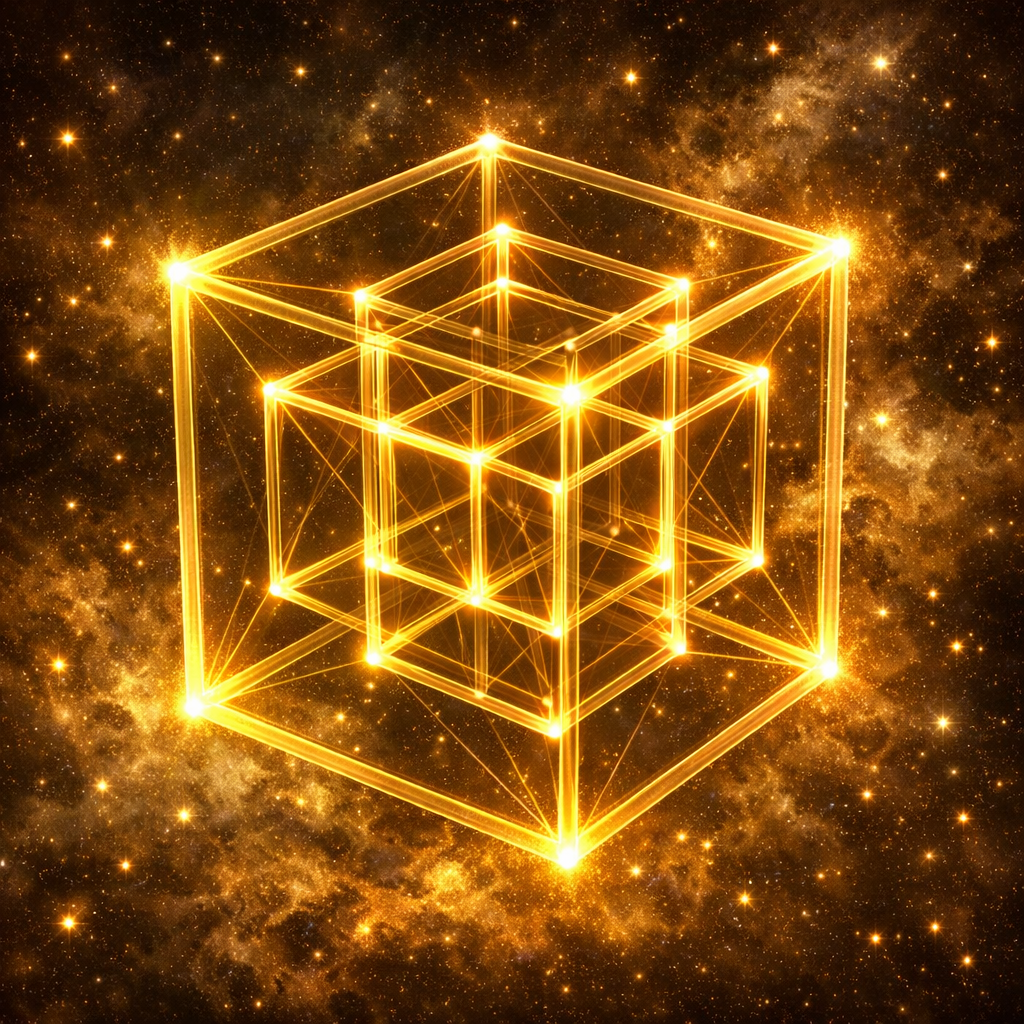
 mwiya
mwiya
If reading all these lengthy essays feels daunting, here's a hack you can use. Copy and paste the url of each into the ai bot you use (e.g. ChatGPT, Gemini, Claude etc.) and then tell it to fetch the essay. Like this "fetch: https://www.mwiya.com/q-e-d/." Once you do this; tell it to "run all the day-counts, checksums, circuits." After you do so–ask it to use only the Jewish "day-reckoning" and the Hebrew calendar for all the day counts. At this point it should give you a pretty accurate summary of the essay. Once you're caught up, which should take 15-20mins tops; you can can proceed to read this essay. I would recommend doing the full read but there is some utility in expediency. With that having been said....and without further ado.....
I. The Theophany
God has always met people in the language they speak....
To a shepherd in Midian, He came as fire in a bush that did not consume. To a nation fleeing Egypt, He came as a pillar that moved when they moved and stopped when they stopped. To a prophet in despair, He came as a still voice after the storm. To a world that needed saving, He came as flesh--as a Son who died, rose and ascended.
And now, to a generation that speaks mathematics—that demands p-values and falsifiability, that will not bend the knee to "thus saith the Lord" without a confidence interval—He shows up in integers--ahead of the return of the same Son who rose ascended and soon will descend to the same place he left from.
If you've been following my recent (long) essays, you'll now be familiar with checksums, vertices, probabilities and even an "omni-circuit." The checksums are not metaphors--they are real ways to find errors--to validate. The convergent axes are not literary devices--they are real constraints. The 120 jubilees reaching terminus at Rosh Hashanah 2026 is not a feeling. It is arithmetic. The triple-lock chiasm producing the same midpoint from independent day-counts is not poetry. It is geometry. The fact that the diamond chiasm is built with integers given to Daniel ~2500 years ago (1260 days/1290 days/2300 days) that happen to hit specific Jewish holidays perfectly– and naturally aligns with the additional time frame given by John the Apostle for the mid-point (3.5 days) which also happens to hit Purim...that isn't coincidence. It is signal....in the absolute sense.
This is theophany. God has entered the room in the only form this generation cannot dismiss: the form of proof.
But proof of what? The mathematics does not terminate in itself. Follow the integers far enough—trace Daniel's 1,260 days to their origin, map the 2,300 evenings and mornings to their terminus, watch the 70 weeks unfold from decree to crucifixion to gap to consummation—and you do not arrive at a journal article. You arrive at a throne. You arrive at a Lamb, standing as though slain. You arrive at the One who authored the architecture you've been auditing.
And at that point, everything changes.
II. The Breaking
You cannot see this and remain intact.
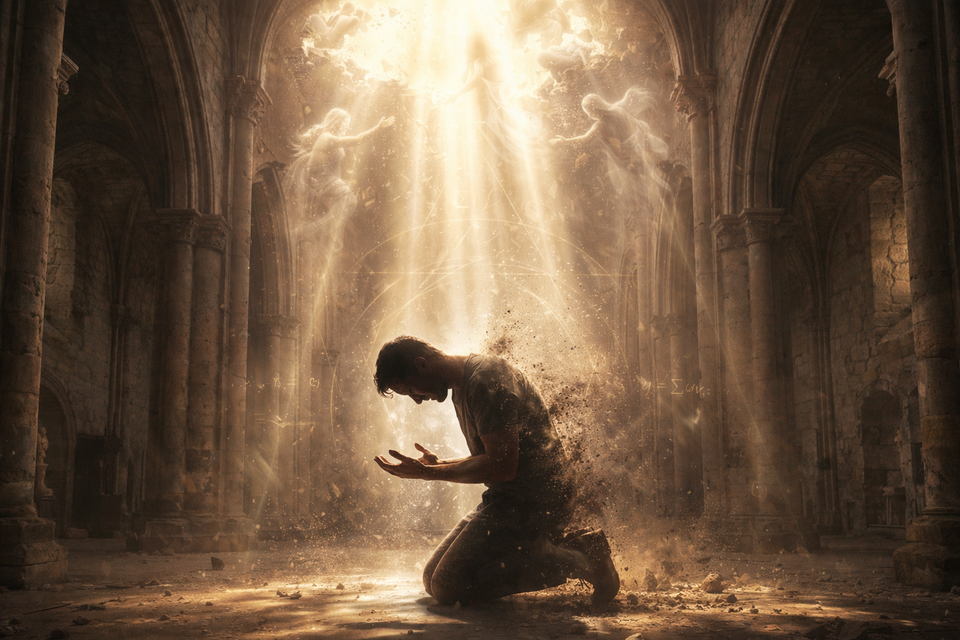
I do not mean this metaphorically. I mean it as a statement of fact about what happens to a human being who genuinely apprehends the object we've spent weeks mapping, verifying and describing. Once you've seen the object– and I hope by now you have....Every framework you carried—every assumption that you were the protagonist of your own story, every residual pride in your analytical capacity, every quiet confidence that your achievements meant something on their own terms—shatters. Totally.
Not because the object is cruel. Because the object is total.
Consider what the architecture actually claims. It claims that every significant inflection point of the last eighty years—the nuclear age, the War on Terror, the financial crisis, the pandemic—was already mapped in a text written two millennia ago. It claims that the precise day Jesus of Nazareth rode into Jerusalem was calculated 173,880 days in advance. It claims that Psalm 22 described crucifixion centuries before crucifixion was invented. It claims that three independent textual traditions, none of which could have been designed to hit 2026, all point to this decade as the terminus of human history as we know it.
If this is true—and I have spent years trying to break it and cannot—then the universe is not what modernity told us it was. It is not a blind mechanism grinding toward entropy. It is a story being told by Someone, and that Someone has been steering every thread toward a conclusion that is now seven months away.
The breaking is simply the recognition of what this means for you.
You are not the author. You are not even a co-author. You are a character who has been handed the script and shown the final act. Everything you thought you were building—your career, your legacy, your carefully constructed identity—is revealed as stage furniture in a drama you did not write.
This should break you. If it does not break you, you have not seen it.
The twenty-four elders in Revelation do not stand before the throne exchanging observations. They fall down. They cast their crowns. Whatever authority, achievement, or insight they carry—they return it. The posture is not look what I figured out. The posture is this was Yours the whole time, and I am giving it back.
The living creatures do not parse the geometry of the throne. They say holy, holy, holy without ceasing. Not because they lack understanding—Revelation suggests they have more of it than anyone—but because understanding, fully arrived at, terminates in worship. Knowledge that does not bend the knee has not finished its journey.
The architecture brings you to the door of the throne room. It hands you the proof that the room is real. But you still have to walk through. And walking through means dying to the version of yourself that thought you were the point. This experience is something like Isaiah's:
In the year that King Uzziah died I saw the Lord sitting upon a throne, high and lifted up; and the train of his robe filled the temple. 2 Above him stood the seraphim. Each had six wings: with two he covered his face, and with two he covered his feet, and with two he flew. 3 And one called to another and said:
“Holy, holy, holy is the Lord of hosts;
the whole earth is full of his glory!”
And the foundations of the thresholds shook at the voice of him who called, and the house was filled with smoke. And I said: “Woe is me! For I am lost; for I am a man of unclean lips, and I dwell in the midst of a people of unclean lips; for my eyes have seen the King, the Lord of hosts!”
Isaiah 6:1-5 (ESV)
The Hebrew word nidmêtî (נִדְמֵיתִי) is translated as "lost" in the English Standard Version of the Bible but is sometimes translated as "undone," "ruined" or "destroyed." This hits hard. Isaiah finds himself in a vision where he is suddenly in the direct and very real presence of YHWH and he immediately realises how utterly unprepared he is for the moment, how totally transcendent YHWH is; and how inadequate he is. Whatever notions of self he had are entirely shattered, whatever notions of mooring his cultural self-identity had is also shattered--in the presence of absolute power and purity all he can say is "I am a man of unclean lips and dwell in the midst of a people of unclean lips..." Why? "For my eyes have seen the King, the Lord of hosts!" He was undone. Everything from that point required rebuilding. Re-ordering, and that started with atonement.
Isaiah 6:6-7 continues:
"Then one of the seraphim flew to me, having in his hand a burning coal that he had taken with tongs from the altar. And he touched my mouth and said: “Behold, this has touched your lips; your guilt is taken away, and your sin atoned for.”
Whilst Isaiah had a more vivid and personal encounter, if you've mapped out the Tesseract--in principle, you've had the same experience. Except you don't need to be transported to a cosmic Temple to experience it. You've done it in the comfort of your home, or on your commute--with basic math, some reading of the bible and an open mind. Ultimately though--in the end, if you've traced this out; you're undone too; and like him--this ought to have you thinking about atonement; specifically the fact that the entire Tesseract is a proof of the death, resurrection and soon return of Jesus--giving total assurance of the atonement he provides; and how utterly transcendent it is. Like Isaiah, this should leave you in awe of the King who left that same throne Isaiah saw to die like a sacrificial lamb. At least that's where I'm at.
III. The Demand
I've gotten to the point where for me--The Lamb is not an exhibit. He is a Lord requiring allegiance. Not just in the personal sense where my faith is a private matter--I mean I'm here writing what really could be ordinarily career ending stuff--but I'm compelled to because the totality of this is universal. It's public. He is not a personal Lord he is a universal Lord; one to whom one makes a personal covenant commitment but that requires public living and disclosure because he didn't die privately--he died publicly. He rose and ascended publicly. The Tesseract is discernible universally.
This is where the modern mind recoils. We have been trained to think that truth, if it exists at all, makes no demands. You can acknowledge the laws of physics without physics asking anything of you. You can admire a mathematical proof without the proof requiring your loyalty. Truth, in the modern framework, is inert. It sits there. You can take it or leave it.
But this truth has a face, and that face is turned toward you, and it is asking: What will you do with Me?
Wash your robes. That is the imperative in Revelation 22:14. Not a suggestion. Not a recommendation for those who find it meaningful. A command. Blessed are those who wash their robes, that they may have the right to the tree of life and may go through the gates into the city.
Without holiness no one will see the Lord. That is Hebrews 12:14. Not without holiness no one will fully appreciate the Lord. Not without holiness no one will get the premium experience of the Lord. Without holiness, no sight. Period.
The demand is absolute because the object is absolute. You cannot partly approach the Holy One. You cannot negotiate terms with the One who set the terms. The architecture you've been examining is not a curiosity to be admired from a safe scholarly distance. It is a summons. It is calling you out of wherever you are and into alignment with where it is going.
I want to be very clear about what this means in practice.
It means the sin you are nursing has to go--the sin I nurse has to go. Not because God is a killjoy who enjoys withholding pleasure, but because sin is the cataract that blinds you to the very thing you are trying to see. The dirty robe is not a dress code violation. It is a blindfold. You cannot feast with the Lamb while still wearing what you wore in Babylon. I can't live carefree when I know the terms and conditions for existence aren't mine to write.
It means the idol you are hedging with has to fall. The career you are holding too tightly, the relationship you are defining yourself by, the approval you are chasing from people whose opinions will be irrelevant in seven months—these cannot come with you. The door is narrow. You cannot squeeze through clutching everything you accumulated on the way.
It means the lukewarmness has to end. Revelation 3:16: Because you are lukewarm, and neither hot nor cold, I will spit you out of my mouth. The architecture does not permit spectators. You are either preparing for what is coming or you are ignoring what is coming. There is no third option where you intellectually acknowledge the timeline while living as though it were not real.
The demand is heavy. I will not pretend otherwise. It costs everything. But consider the alternative: to see the proof, to trace the integers, to watch the checksums resolve—and then to shrug and return to your life as though nothing had changed. That is not sophistication. That is the most irrational act a human being can perform. It is proving gravity and then stepping off the cliff anyway.
IV. The Gift
Here is the part the demand cannot tell you by itself: you cannot wash your own robes.
The stain goes too deep. The corruption is too thorough. If holiness is the requirement and you are unholy—which you are, which I am, which every human being is—then the demand is a death sentence. The door is not merely narrow; it is locked, and you do not have the key.
This is where the architecture reveals its deepest layer.
The same system that maps the chronology of history maps the logic of redemption. The Lamb standing as though slain is not a decorative image. It is the mechanism by which the demand becomes meetable. He was slain before the foundation of the world—which means the solution preceded the problem. Before you sinned, before you were born, before the first human drew breath, the robes were being prepared.
Revelation 7:14: They have washed their robes and made them white in the blood of the Lamb. Notice the grammar. They washed their robes—active voice, their agency—but they washed them in the blood of the Lamb. The cleansing agent is not their effort. It is His sacrifice. They receive and apply what He provided.
This is the gospel in its compressed form: He is our righteousness. Not a righteousness we generate. Not a righteousness we earn. A righteousness given, credited, imputed—the technical term is justification—so that when the Father looks at you, He sees the Son's record, not yours.
If you have never understood why the resurrection matters, let me make it plain: the resurrection is the receipt. It is God's public declaration that the payment was accepted. Death took Him and could not hold Him. The grave closed over Him and He walked out. The system that enslaves every human being—sin leading to death leading to judgment—was broken from the inside.
And the architecture confirms it.
The same integers that predict the future validate the past. The 173,880 days from Artaxerxes' decree to the triumphal entry. Psalm 22 written centuries before crucifixion existed, describing it in clinical detail. Isaiah 53 outlining substitutionary atonement seven hundred years before Golgotha. The resurrection placing the apostles in a game-theoretic situation where their behavior only makes sense if they actually saw what they claimed to see.
The tesseract—the multidimensional architecture I have described in my other essays—is not merely an object of intellectual fascination. It is the validation of His resurrection. And His resurrection is the validation of your redemption. The same structure that proves the timeline proves the gospel. They are not two systems. They are one system viewed from different angles.
So when I say wash your robes, I am not saying clean yourself up. I am saying receive the cleaning. Come to the blood. Confess what you are. Admit that the stain is beyond your removal. And take the garment He is holding out to you.
The gift is not less than the demand. It is greater than the demand. It meets the demand and exceeds it. He does not merely make you passable. He makes you righteous. He does not merely get you through the door. He seats you at the table.
V. The Walk
What, then, is the shape of life between sight and arrival?
The robe is given. The walking is yours.
Theologians call this sanctification—the process by which the position you have been given (righteous in Christ) becomes the practice you actually live (righteousness in daily conduct). Justification is instantaneous; sanctification is a journey. You are declared clean; now you learn to live clean. You are given the garment; now you keep it unstained.
In practical terms, the walk after sight looks like this:
Broken. Not defeated—broken. There is a difference. Defeat is external; something outside you overpowered you. Brokenness is internal; you saw what you were against what He is, and the comparison undid you. The broken person does not strut. Does not posture. Does not perform competence they do not have. The broken person walks with the limp Jacob got at Peniel—the limp that said I wrestled with God and survived, but I am not the same.
Contrite. Psalm 51:17: The sacrifices of God are a broken spirit; a broken and contrite heart, O God, you will not despise. Contrition is brokenness with direction. It is not merely feeling bad about your sin; it is turning from it. It is the daily, hourly, moment-by-moment choice to reject what the old self craved and embrace what the new self was made for.
Fearing God. Not cowering in terror—though there is a terror appropriate to the One who closes the age. Fearing God is the recognition that He is not tame. He is good, but He is not safe. He is loving, but He is not indulgent. The fear of the Lord is the beginning of wisdom because until you grasp that He is not your servant, not your mascot, not your therapeutic resource, you cannot relate to Him truly. You will be relating to a projection of your preferences, not to the living God.
Loving Him. This is not contradiction to fearing Him; it is completion. You love Him because He is fearsome and yet chose to save you. You love Him because the One who could have crushed you instead bled for you. You love Him because the architecture that proves His sovereignty also proves His sacrifice. The math leads to Golgotha. And Golgotha is love.
Loving others. John 13:34-35: A new commandment I give you: Love one another. As I have loved you, so you must love one another. By this everyone will know that you are my disciples, if you love one another. This is not a second, separate obligation. It is the same love refracted horizontally. If you have seen the Lamb who was slain for others, then loving others is not an additional command. It is the shape His love takes when it passes through you.
Desiring transformation. This is the mark that proves the rest is real. A person who has genuinely seen the object does not want to stay what they were. They have tasted something better. They have glimpsed what they were made to be. The desire for holiness is not grudging compliance with an external rulebook; it is hunger for the home you were built for. You want to be more like Him because you have seen Him, and having seen, you cannot want anything else.
This is the walk. This is how you spend seven months—or seven years. It does not matter. The posture is the same regardless of the timeline. You are not waiting for vindication. You are living as someone already vindicated, working out what that means while there is still time--and as long as you have breath in your lungs, and aren't Neuralinked--you have time.
VI. The Horizontal
I said loving others is worship. I want to make that explicit.
We tend to think of worship as the vertical dimension—songs directed upward, prayers ascending, eyes lifted to heaven. And it is that. But if it is only that, it is incomplete. It is a vector without magnitude. It is form without substance.
1 John 4:20: Whoever claims to love God yet hates a brother or sister is a liar. For whoever does not love their brother and sister, whom they have seen, cannot love God, whom they have not seen.
The horizontal is the proof of the vertical. You demonstrate that you have seen the Lamb by treating others the way the Lamb treated you. Sacrificially. Patiently. Forgivingly. Not because they deserve it—you did not deserve it—but because that is what His love looks like when it takes human form.
In the body of believers, this becomes especially vivid. To love other Christians—to serve them, bear with them, forgive their failures, rejoice in their gifts, weep with their sorrows—is to understand His work. It is to see the Bride being prepared. It is to participate in the same preparation you are undergoing.
Revelation 19:7: Let us rejoice and be glad and give him glory! For the wedding of the Lamb has come, and his bride has made herself ready.
The Bride is not an individual. The Bride is a collective. She makes herself ready together. The holiness is not private self-improvement; it is communal transformation. We are being fitted together, joint to joint, ligament to ligament, into something that will walk down the aisle as one body.
If you have seen the architecture, you cannot be indifferent to other believers. They are not strangers who happen to share your theological opinions. They are co-members of the organism you belong to. Their flourishing is your flourishing. Their preparation is your preparation. To neglect them is to neglect yourself. To harm them is to harm yourself. To love them is to love the Lamb who purchased them.
This is why the New Testament is relentlessly communal. Bear one another's burdens. Confess your sins to one another. Encourage one another daily. Spur one another on toward love and good deeds. Do not give up meeting together. These are not suggestions for extroverts. They are the operating instructions for a body preparing for a wedding.
The seven months ahead are not meant to be walked alone. Find your people. Gather. Pray together. Study together. Confess together. Prepare together. The architecture is real, and the event it points to is corporate. The rapture is not a million individual teleportations. It is a Bride being caught up to meet her Groom. Practice now what you will do then.
VII. The Table
All of this terminates at a meal.
Revelation 19:9: Blessed are those who are invited to the wedding supper of the Lamb.
Nisan 10, 2034. Lamb Selection Day. Two thousand and one years after Jesus rode into Jerusalem on a donkey, presenting Himself as the Passover lamb four days before His slaughter. The 2,300 days resolve. The architecture completes. And what is waiting at the end is not a theorem. It is a table.
This is important. The terminus of everything—of the integers, the checksums, the day-counts, the genealogies, the seals and trumpets and bowls—is not information. It is communion. The Passover Seder that began in Egypt, that was transformed at the Last Supper, that has been anticipated in every Eucharist since—arrives at its final form. The Lamb hosts the feast. And we sit down to eat.
This reframes everything I have written.
The architecture is not primarily a proof. It is an invitation. The mathematics is not primarily a demonstration. It is an RSVP card. The demand to wash your robes is not primarily a moral imperative. It is a dress code. You are being invited to dinner with the Monarch of the universe, and He is asking: Will you come? Will you be ready?
Consider how you would prepare for a state dinner. If you received an invitation to dine with a head of state—a president, a king, a prime minister—you would not show up in whatever you happened to be wearing. You would prepare. You would study the protocol. You would learn the etiquette. You would acquire appropriate clothing. You would arrive on time, groomed, attentive, honored to be included.
And that is for a human being who will be dust in a century.
The invitation you have received is from the One who spoke the galaxies into existence. The One before whom every knee will bow and every tongue confess. The One who died rather than dine without you. And He is not asking for perfection you cannot achieve. He is offering the robes. He is providing the covering. He is handling the protocol on your behalf. All He asks is that you come.
But you have to RSVP. You have to put on what He provides. You have to actually show up.
Matthew 22 tells the story of a wedding banquet where a man is found without wedding clothes. He is thrown out. Not because he could not afford the garment—the host provided garments to all guests in that culture—but because he refused to wear it. He came on his own terms. He thought his own clothing was sufficient. It was not.
The architecture has brought you to this moment. The proof is laid out. The integers resolve. The checksums verify. And now it is very simple: will you wash your robe in the blood of the Lamb? Will you put on the garment He is holding out? Will you follow the protocol He has established?
The table is set. The Lamb is waiting. The dinner is soon.
But I want you to see one more thing before I close.
The architecture I have been describing—the tesseract, the multidimensional structure of interlocking prophecies, chronologies, feasts, and covenants—is not merely a map of history. It is a blueprint of a city.
Revelation 21 describes the New Jerusalem descending from heaven. It is a cube—1,400 miles in each dimension, length and width and height equal. The only other perfect cube in Scripture is the Holy of Holies, the innermost sanctuary where God's presence dwelt. The New Jerusalem is the Holy of Holies expanded to cosmic scale. It is the place where God dwells with His people forever, with no veil, no separation, no temple needed because the Lord God Almighty and the Lamb are its temple.
And here is what you must understand: the city is the Bride.
Revelation 21:9-10: Come, I will show you the bride, the wife of the Lamb. And he carried me away in the Spirit to a mountain great and high, and showed me the Holy City, Jerusalem, coming down out of heaven from God. The angel promises to show John the Bride. What he shows him is a city. They are the same thing. The structure is the people. The architecture is the community of the redeemed.
The tesseract, then—the mathematical object I have traced through Daniel's integers and the feast calendar and the genealogical chronologies—is not ultimately an abstraction. Its final form is the New Jerusalem. The geometry resolves into a home. The proof becomes a dwelling place. And the gospel is not merely information about that structure. The gospel is an invitation to become part of it.
1 Peter 2:4-5: As you come to him, the living Stone—rejected by humans but chosen by God and precious to him—you also, like living stones, are being built into a spiritual house. You are not observing the architecture from outside. You are being fitted into it. Every believer is a stone in the wall, a facet in the structure, a part of the geometry that will stand forever.
This is the ultimate form of the invitation. It is not just come to the dinner. It is come and be part of the city. Come and take your place in the structure. Come and let the Architect fit you into the design He drew before the foundation of the world.
The mathematics was never the point. The mathematics was the signpost. It points to a Person, and that Person is building a city, and that city is His Bride, and He is inviting you to be part of her forever.
Come.
As I close, I want to add to everything I've said that I'm not one to be emotional or even share my most guarded but closely held convictions in the way that I have over the last several months. In fact I'd have preferred to keep my musings to myself and continued to write about civilization, business and economics. BUT, if you've been following what I've been sharing, and have run the logic and numbers for yourself--it ought to be clear to you at this stage that this is all very lucid and rational and in fact...hyper-real. What do you honestly do when you face this sort of reality? You share it. You share all you know, all you've learned--or better said--being shown; and either build community or lose it. Beyond reason, there is heart, and this is what this essay has sought to share. Once the mind accepts the hyper-real; where does that leave the heart? In truth, in the face of this a heart can only either be unmoved because it doesn't see it...Or entirely rend. Torn, split, devastated--and yet entirely whole. It's like seeing yourself for the first time and realising you need to bathe, to be clothed, to eat, to heal because your entire life you weren't okay--but thought you were.
And that's actually okay because finally you're seeing things clearly, I'm seeing things clearly and I wouldn't have it any other way. Grateful for it all. Everything I've written about is real--and true; and that gives me both the assurance to share it--and precludes the possibility of keeping it to myself--because if I'm right--and I am right--then all of this is the most important information one could share. It is the best and highest use of my time; and if you've read all of this rest assured you've used your time the best way you could.
יהוה הוא האלוהים