Contents & figures
An essay on the biblical pattern of redemption
The King and the Gathering
Sacrifice, shelter, and the inheritance of the nations

Preamble: What has failed, and what remains to be tested
27 September 2026
Rosh Hashanah has come and gone. Yom Kippur, and the potential Jubilee opening proposed for 2026, have also passed without the event anticipated. Those predictions have been falsified. This is where we are, and I want to begin here because an argument about the truth cannot ask to be excused from telling it. Where does that leave the Kingdom Birth framework? Should the entire construction be treated as falsified? There is a serious argument that it should. That possibility deserves to remain before us while we examine what survives.
The next declared falsification point is the gate of 7–8 October 2026. The claim requires both a geopolitical covenant firmed up at that gate and the emergence in Jerusalem of two individuals wearing sackcloth and prophesying as the proposed witnesses. If that required conjunction does not occur, the model, as presently specified, must be treated as falsified and void. The period from today, 27 September, to 7–8 October is therefore a defined interval of testing. Sukkot is already under way, having begun at sunset on 25 September, and its relation to the framework will occupy much of what follows. The feast places the present proposal within a near horizon against which it can fail; it must not become an invitation to move the horizon whenever the expected event fails to appear.
A chronology is most easily deceived when it has only one clock. A calculation may be admired because one wishes to admire it; a date may be reached by arithmetic and afterward clothed with significance. The weakness need not lie in the arithmetic. It may lie in its solitude. Nothing outside the calculation has been allowed to resist it, and the interpreter finds at the end of the road only what he placed there at the beginning.
A stronger chronology permits different systems to constrain one another. Genealogy must agree with covenant chronology; covenant chronology with Exodus; Exodus with conquest and Jubilee; Jubilee with sanctuary and restoration; sanctuary with feast; feast with prophetic sequence; prophetic sequence with fixed day counts. All of them, if they claim to describe history, must eventually submit themselves to history. Independence also has to be examined rather than announced: two calculations which inherit the same assumption are not two independent witnesses to its truth. A date recovered from a proposed endpoint is a valid conditional result, but it cannot then be counted as an unrelated reason for believing that endpoint.
In this qualified sense the Kingdom Birth framework has become more structurally interesting as its earliest predictions have lost their claim upon us. Connections and dependencies which were initially obscure have become visible. That warrants examination; it does not reverse the failures. Greater coherence can improve a hypothesis, but it cannot turn a missed prediction into a fulfilled one.
The Rosh Hashanah 2026 resurrection prediction failed. Yom Kippur 2026, subsequently considered as another possible opening, also passed without the proposed event. Those facts must remain permanently in the record. A model which can turn every failure into success possesses no meaningful chronology. The failed dates perform the necessary office of preventing theology from becoming an exercise in moving the conditions of its own vindication.
Yet the failure of an assignment does not establish that every underlying observation was false. It may reveal that a real scriptural relationship was given a mistaken place upon the calendar. The question is therefore no longer whether the original resurrection date can be saved. It cannot. The question is whether the remaining biblical relationships possess enough coherence, and sufficiently definite conditions of failure, to deserve further examination. That is the question this essay undertakes. The history of the argument stands at its entrance, where the reader can see it, and the possibility of its failure accompanies it to the end.
The end of a journey tells us what the journey was for. A people may be brought out of bondage and yet remain homeless; an enemy may be overthrown and yet leave behind him a country in which no one knows how to live. Deliverance, considered by itself, is therefore an unfinished good. It opens the prison door, but it does not furnish the house. Scripture carries its account of redemption beyond the broken fetter to the restored inheritance, beyond the battlefield to the feast, beyond the departure from Egypt to the presence of God among a people who have learned to call his dwelling their home.
This is the governing movement of the argument that follows. The Messiah who accomplishes redemption as priest establishes its public consequences as king. Those consequences include the vindication of his people, the judgment of their oppressors, the recovery of inheritance, the gathering of the nations into worship, and the restoration of embodied life beneath the presence of God. Passover, Jubilee, and Tabernacles belong together because sacrifice, liberty, and communion belong together. The blood upon the threshold and the branches above the dwelling are separated by a journey, but they belong to one story.
To follow that story requires a particular kind of reading. A prophecy need not repeat the whole biblical account in order to contribute something definite to it. One passage may identify the ruler, another describe his inheritance, another place the resurrection before a season of indignation, and another supply a measured interval. Their conjunction can yield an argument which none presents alone. Yet each passage must retain its own voice. A stated sequence, an unmistakable quotation, a festival correspondence, and a proposed modern date do different work. The strength of their union depends upon preserving those differences. A bridge becomes trustworthy through the soundness of its joins.
The reading developed here is a Christian, future-restoration interpretation of those joins. It includes the Kingdom Birth chronology as a proposed historical placement of the larger theological pattern. Its dates will be considered after the pattern itself has become clear. All extended Scripture quotations are from the King James Version, with the selected passages quoted in full.
Trace the Thread
Choose a theme. Follow its connections. Open a passage.
Connections of meaning, not a timeline. Select a passage to examine the argument.
Explore the six themes through their passages in the essay.
Living Water
The life Jesus offers at Sukkot is read beside the Lamb’s provision for the assembled multitude.
- Isaiah 49:8–10 — The promised springs
- John 7:37–39 — The invitation at Sukkot
- Revelation 7:9–17 — The gathered recipients
- John 6:35 — Neither hunger nor thirst
- Zechariah 14:8–9 — Water and the King
Shelter
The fragile booth, Zion’s canopy, prepared dwelling, and the multitude’s shelter gather around God’s protecting presence.
- Psalm 27:4–6 — Hidden in his pavilion
- Isaiah 4:5–6 — Canopy over Zion
- Revelation 7:9–17 — Sheltered before the throne
- Leviticus 23:39–43 — Booths and branches
- John 14:1–3 — Prepared dwelling
Birth
The mother-city and her children provide the essay’s argument for a corporate reading of Revelation’s child.
- Isaiah 54:1–5 — The enlarged tent
- Galatians 4:22–28 — Jerusalem above
- Revelation 12:1–6 — Birth and reception
- Isaiah 66:7–13 — Zion brings forth
- Hebrews 12:22–24 — The heavenly assembly
Kingship
The Messiah’s completed offering, enthronement, shared dominion, and public victory are read as distinguishable stages.
- Psalm 110:1–7 — The royal priest
- Hebrews 10:11–14 — Offering and enthronement
- Revelation 11:15–18 — The kingdom proclaimed
- Psalm 2:6–9 — The Son’s inheritance
- Daniel 7:13–14 — Dominion bestowed
Inheritance
Release and return meet the claims of divine kingship and the gathering of nations into worship.
- Leviticus 25:8–13 — Liberty and return
- Psalm 82:8 — Inherit the nations
- Zechariah 2:10–12 — A people and a portion
- Psalm 2:6–9 — The royal grant
- Zechariah 14:16–19 — Nations at Sukkot
Trumpets
A shared festival sound has distinct uses: sacrificial worship, a trumpet observance, royal praise, and Jubilee liberty.
- Numbers 10:10 — Festival sacrifices
- Leviticus 23:24 — The trumpet observance
- Leviticus 25:8–13 — The Jubilee summons
- Psalm 47:1–9 — Royal acclamation
- Numbers 29:12–16 — Sukkot’s offerings
I. The road through the feasts
Israel's calendar remembers both an act of deliverance and the life which that deliverance makes possible. Its agricultural seasons and its covenant history are interwoven: the God who brings a people out of Egypt is also the God who gives them fields to sow, fruit to gather, and a place in which to rejoice. The pilgrimage command states the progression:
Three times thou shalt keep a feast unto me in the year.
Thou shalt keep the feast of unleavened bread: (thou shalt eat unleavened bread seven days, as I commanded thee, in the time appointed of the month Abib; for in it thou camest out from Egypt: and none shall appear before me empty:)
And the feast of harvest, the firstfruits of thy labours, which thou hast sown in the field: and the feast of ingathering, which is in the end of the year, when thou hast gathered in thy labours out of the field.
Three times in the year all thy males shall appear before the Lord GOD .
The three pilgrimages are Unleavened Bread, the Feast of Harvest or Weeks, and the Feast of Ingathering or Tabernacles. Rosh Hashanah and Yom Kippur belong to the appointed observances of the seventh month, but they are not additional members of this threefold pilgrimage sequence. That distinction is consequential. The calendar contains more than one ordered movement. The pilgrim travels from deliverance through firstfruits to ingathering; the autumn worshipper passes through the trumpet observance, the Day of Atonement, and Tabernacles. These movements share a destination while approaching it through different aspects of covenant life.
Two movements. One meeting at Sukkot.
- Unleavened BreadDeliverancePassover foundation
- WeeksFirstfruits of harvestPentecost
- SukkotIngatheringThe gathered people
- Trumpet observanceRoyal proclamationRosh Hashanah
- Day of AtonementAtonement · Jubilee releaseYom Kippur
- SukkotRejoicing and dwellingThe kingdom feast
Christian interpretation begins with unusually explicit foundations. Paul identifies Christ with Passover:
Purge out therefore the old leaven, that ye may be a new lump, as ye are unleavened. For even Christ our passover is sacrificed for us:
Therefore let us keep the feast, not with old leaven, neither with the leaven of malice and wickedness; but with the unleavened bread of sincerity and truth.
He also identifies the risen Christ with firstfruits:
But now is Christ risen from the dead, and become the firstfruits of them that slept.
For since by man came death, by man came also the resurrection of the dead.
For as in Adam all die, even so in Christ shall all be made alive.
But every man in his own order: Christ the firstfruits; afterward they that are Christ’s at his coming.
The order is present within the text: Christ first, then those who belong to him at his coming. Firstfruits is an assurance that the field has begun to yield; its significance extends toward the harvest which follows. Acts places the outpouring of the Spirit at Pentecost:
And when the day of Pentecost was fully come, they were all with one accord in one place.
And suddenly there came a sound from heaven as of a rushing mighty wind, and it filled all the house where they were sitting.
And there appeared unto them cloven tongues like as of fire, and it sat upon each of them.
And they were all filled with the Holy Ghost, and began to speak with other tongues, as the Spirit gave them utterance.
Thus the Christian reading of the spring feasts rests upon the death and resurrection of Jesus and the gift of the Spirit. To say that he fulfils them is to identify their decisive Christological realization; it need not mean that every implication of redemption, resurrection, and the Spirit's work has already been exhausted. The firstfruits themselves forbid that conclusion. They testify to an accomplished beginning which contains a promise of more.
Sukkot is the next pilgrimage feast after Weeks. The sequence therefore invites a question larger than the order of days in one autumn: what becomes of the people redeemed by the Lamb and given the Spirit? The answer suggested by Ingathering is corporate, embodied, and joyful. They are gathered before God. The purpose of deliverance reaches beyond the announcement that the captives are free to the life they will share when they have returned.
Torah describes the feast in terms which hold wilderness memory and harvest abundance together:
Also in the fifteenth day of the seventh month, when ye have gathered in the fruit of the land, ye shall keep a feast unto the LORD seven days: on the first day shall be a sabbath, and on the eighth day shall be a sabbath.
And ye shall take you on the first day the boughs of goodly trees, branches of palm trees, and the boughs of thick trees, and willows of the brook; and ye shall rejoice before the LORD your God seven days.
And ye shall keep it a feast unto the LORD seven days in the year. It shall be a statute for ever in your generations: ye shall celebrate it in the seventh month.
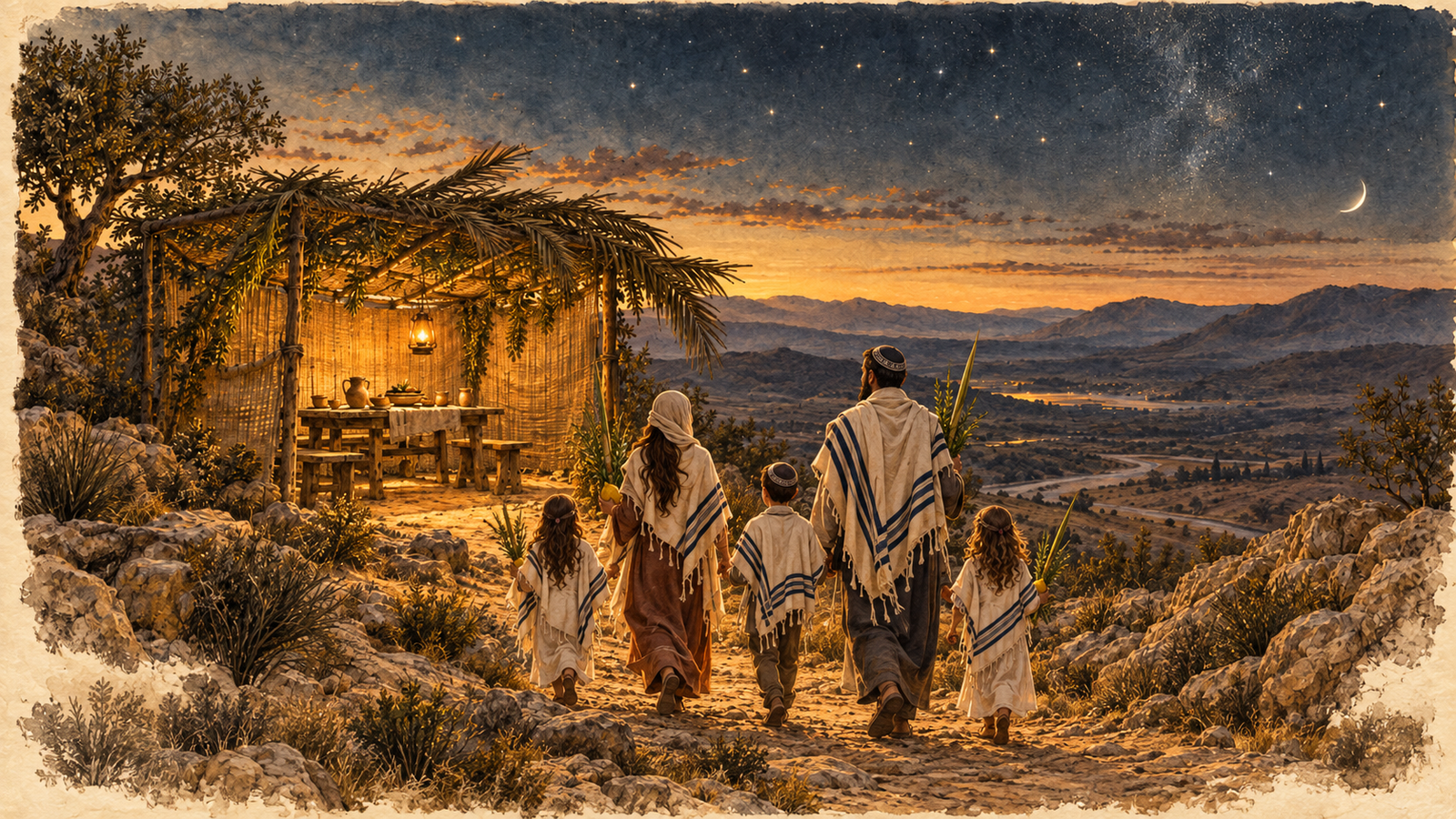
Ye shall dwell in booths seven days; all that are Israelites born shall dwell in booths:
That your generations may know that I made the children of Israel to dwell in booths, when I brought them out of the land of Egypt: I am the LORD your God.
There is a deliberate strangeness in celebrating a completed harvest under a fragile roof. The Israelite has gathered the fruit of the land, yet inhabits a dwelling which recalls the wilderness. Possession must not become forgetfulness. The roof of branches teaches that even settled life remains dependent upon the God who sustained the journey. Its frailty is not the feast's final truth. Beneath it the worshipper learns the difference between a shelter which he can build and a protection which he must receive.
The sanctuary's festal joy also has a sound. Numbers 10 prescribes two silver trumpets and entrusts their sounding to the priests; their use includes the offerings of the appointed feasts:
Also in the day of your gladness, and in your solemn days, and in the beginnings of your months, ye shall blow with the trumpets over your burnt offerings, and over the sacrifices of your peace offerings; that they may be to you for a memorial before your God: I am the LORD your God.
Sukkot belongs within this command. It is an appointed feast with prescribed burnt offerings, as Numbers 29 makes explicit, and therefore shares the sacrificial trumpet observance. The feast of booths and ingathering is not a silent interval after the autumn trumpet has ceased; its worship also sounds before God. This is a genuine Torah basis for a Sukkot trumpet connection, alongside the palms, shelter, water, and assembled rejoicing already traced. Numbers 10:1–8, Numbers 29:12–16
The distinction is one of specificity. These silver trumpets accompany the sacrifices of the festivals generally. Rosh Hashanah has the more distinctive observance of a memorial of trumpet-blowing, while the Jubilee trumpet on Yom Kippur has the particular legal purpose of proclaiming liberty and return. Sukkot therefore possesses a real trumpet association without possessing that association exclusively. Within the larger pattern, the sound can belong to the rejoicing of the gathered as well as to the announcement of their release. Leviticus 23:24, Leviticus 25:9–10
This is why the pilgrimage progression can be described as another clock, provided the expression is used carefully. It measures the movement of redemptive purpose: deliverance, the beginning of harvest, the gathering of its fullness. It does not, merely by existing, measure an additional number of modern years. Its contribution is order and destination. The numerical intervals must come from passages which actually give them.
II. The King who appoints his disclosure
John places Jesus at Sukkot within a dispute about manifestation. The feast is named; the proposal to show himself to the world is explicit; and Jesus' answer concerns the appointment of his time:
Now the Jews’ feast of tabernacles was at hand.
His brethren therefore said unto him, Depart hence, and go into Judæa, that thy disciples also may see the works that thou doest.
For there is no man that doeth any thing in secret, and he himself seeketh to be known openly. If thou do these things, shew thyself to the world.
For neither did his brethren believe in him.
Then Jesus said unto them, My time is not yet come: but your time is alway ready.
The world cannot hate you; but me it hateth, because I testify of it, that the works thereof are evil.
Go ye up unto this feast: I go not up yet unto this feast; for my time is not yet full come.
When he had said these words unto them, he abode still in Galilee.
But when his brethren were gone up, then went he also up unto the feast, not openly, but as it were in secret.
The brothers understand publicity more readily than revelation. They imagine that a man who possesses extraordinary power ought to bring it where the greatest number can see it. Jesus answers from another relation to time. His works bear witness to the Father, and his witness exposes the world's evil; his appearance cannot be governed by the world's appetite for spectacle. The contrast is therefore not simply between appearing and refusing to appear. It concerns who determines the hour, what the appearance discloses, and what kind of kingship the observer is prepared to recognize.
Jesus does go to the feast. John then records:
Now about the midst of the feast Jesus went up into the temple, and taught.
And the Jews marvelled, saying, How knoweth this man letters, having never learned?
Jesus answered them, and said, My doctrine is not mine, but his that sent me.
If any man will do his will, he shall know of the doctrine, whether it be of God, or whether I speak of myself.
He that speaketh of himself seeketh his own glory: but he that seeketh his glory that sent him, the same is true, and no unrighteousness is in him.
The concealed arrival is followed by public teaching. Sukkot becomes a setting in which presence precedes full recognition, and disclosure occurs in stages. The King is already among the worshippers, yet the meaning of his presence is still contested. Nothing in this scene permits us to treat divine concealment as divine absence.
This pattern has appeared before. At Cana the answer concerning his hour stands beside the manifestation of his glory:
Jesus saith unto her, Woman, what have I to do with thee? mine hour is not yet come.
This beginning of miracles did Jesus in Cana of Galilee, and manifested forth his glory; and his disciples believed on him.
The hour has not arrived, yet glory has truly been manifested. An anticipatory sign is not made unreal by the greater disclosure still to come. The Passover narratives develop the same distinction. At the first narrated Passover, Jesus identifies the temple of his body with its coming destruction and resurrection; near another Passover, after feeding the multitude, he withdraws from the attempt to make him king by force. In both cases the observers encounter something real and then misunderstand the form its fulfilment must take. John 2:13–22; 6:4–15
At the final Passover the language changes:
And Jesus answered them, saying, The hour is come, that the Son of man should be glorified.
Verily, verily, I say unto you, Except a corn of wheat fall into the ground and die, it abideth alone: but if it die, it bringeth forth much fruit.
Now is the judgment of this world: now shall the prince of this world be cast out.
And I, if I be lifted up from the earth, will draw all men unto me.
This he said, signifying what death he should die.
The appointed hour joins glorification, death, fruitful multiplication, the judgment of the world, and the displacement of its ruler. The glory is disclosed through the surrender by which the people are gathered. Christ's public kingship cannot be understood apart from the death which establishes its redemptive character.
John's Sukkot scene consequently has a genuine place in the larger expectation of disclosure. The brothers' words place manifestation to the world upon the narrative stage; Jesus corrects their timing and manner, while actually revealing himself at the feast. Read alongside Zechariah's promised national worship at Sukkot, this can serve as an anticipation of the King's wider recognition. The distinction between anticipation and explicit prediction matters here: the brothers propose the display, and Jesus does not announce a date for a future worldwide Sukkot appearance. The future application arises from reading John's enacted pattern together with the prophets. It is a canonical argument, rather than a sentence placed into Jesus' mouth.
The feast culminates in an invitation whose meaning John himself explains:
In the last day, that great day of the feast, Jesus stood and cried, saying, If any man thirst, let him come unto me, and drink.
He that believeth on me, as the scripture hath said, out of his belly shall flow rivers of living water.
(But this spake he of the Spirit, which they that believe on him should receive: for the Holy Ghost was not yet given ; because that Jesus was not yet glorified.)
The water is identified with the Spirit, received in relation to Jesus' glorification. The promise therefore begins to be fulfilled through the glorified Christ's gift of the Spirit; its first fulfilment belongs to the apostolic age. Yet the life thus given carries the believer toward a fullness still to be enjoyed. Revelation 7 portrays that fullness in a gathered company: palms in their hands, God's shelter over them, hunger and thirst ended, and the Lamb leading them to living fountains. The invitation spoken at Sukkot and the multitude before the throne can therefore be read as promise and enjoyed provision within one redemptive movement. The one who calls the thirsty to himself becomes the shepherd who brings his redeemed to the springs.
The Gospel's account supplies a further, explicit promise concerning hunger as well as thirst:
And Jesus said unto them, I am the bread of life: he that cometh to me shall never hunger; and he that believeth on me shall never thirst.
These words belong to the bread-of-life discourse in the Passover setting of John 6; the invitation to drink belongs to the Sukkot setting of John 7. Their distinction strengthens the pilgrimage argument. The Christ who gives himself as bread and calls the thirsty to drink is the source of the life in which the gathered will hunger and thirst no more. What Passover establishes through the Lamb's self-giving, Sukkot presents through the joy and provision of the ingathering. The two discourses concern the same giver and the same dependent recipients.
John has already described the enduring quality of this gift:
Jesus answered and said unto her, Whosoever drinketh of this water shall thirst again:
But whosoever drinketh of the water that I shall give him shall never thirst; but the water that I shall give him shall be in him a well of water springing up into everlasting life.
In John 4 the gift becomes a spring unto everlasting life; in John 7 the living water is explained through the Spirit; in Revelation 7 the Lamb leads the gathered people to living fountains. These images are related without being interchangeable in every detail. Their continuity lies in the giver, the life given, and the overcoming of thirst. The future assembly manifests corporately the life whose source has already been revealed in Jesus. Its festal shelter and palm branches will bring the invitation's Sukkot setting into still sharper focus.
Whether John's last great day is the seventh day of the feast or the concluding eighth day is debated. That question should remain open where the text leaves it open. Nor should the later celebration of Simchat Torah, with its annual Torah-reading completion, be projected without qualification into the Gospel scene. The biblical eighth-day assembly is already sufficient for the argument; its significance does not depend upon assigning later customs to Jesus' hearers. John 7:37, textual notes
III. A shelter stronger than its branches
The promise of water leads naturally to the question of the life which receives it. Paul writes of the body through the language of a temporary dwelling, but his hope is emphatically more than escape from embodiment:
For we know that if our earthly house of this tabernacle were dissolved, we have a building of God, an house not made with hands, eternal in the heavens.
For in this we groan, earnestly desiring to be clothed upon with our house which is from heaven:
If so be that being clothed we shall not be found naked.
For we that are in this tabernacle do groan, being burdened: not for that we would be unclothed, but clothed upon, that mortality might be swallowed up of life.
Now he that hath wrought us for the selfsame thing is God, who also hath given unto us the earnest of the Spirit.
The desire is to be clothed, and the promised victory is that mortality should be swallowed by life. The Spirit is the earnest of that destiny. John supplies the relation between Jesus' glorification and the Spirit's gift; Paul supplies the relation between the gift and embodied life beyond mortality. Neither passage needs to name Sukkot in order to contribute to the dwelling theme, though neither should be quoted as if it explicitly did so.
The same discipline applies to the Synoptic Gospels and Acts. They do not directly identify an observance as Sukkot. The booths of the Transfiguration, the glory upon the mountain, and the restriction upon disclosure until after the resurrection offer a possible thematic comparison, while Acts supplies the historical Pentecost outpouring. Their contribution is real without requiring an unrecorded festival date. Matthew 17:1–9
In the Psalms, shelter and worship repeatedly belong to the same desire:
One thing have I desired of the LORD , that will I seek after; that I may dwell in the house of the LORD all the days of my life, to behold the beauty of the LORD , and to enquire in his temple.
For in the time of trouble he shall hide me in his pavilion: in the secret of his tabernacle shall he hide me; he shall set me up upon a rock.
And now shall mine head be lifted up above mine enemies round about me: therefore will I offer in his tabernacle sacrifices of joy; I will sing, yea, I will sing praises unto the LORD .
The worshipper seeks God's house because there he beholds God's beauty, and he trusts God's shelter because there he is kept in trouble. Protection is personal before it is architectural. His security consists in being received by the one whose dwelling he desires. The Songs of Ascents carry the same assurance along the pilgrim road:
The LORD is thy keeper: the LORD is thy shade upon thy right hand.
The sun shall not smite thee by day, nor the moon by night.
The LORD shall preserve thee from all evil: he shall preserve thy soul.
The LORD shall preserve thy going out and thy coming in from this time forth, and even for evermore.
These passages should be situated honestly within their liturgical histories. The Hallel, Psalms 113–118, has an established Sukkot use; Psalm 118 is associated with the waving of the branches and the cry for salvation. The fifteen Songs of Ascents are associated in the Mishnah with the Temple steps during the feast's celebrations. Psalm 27's seasonal recitation belongs to later Jewish practice. These are different kinds of association, and the beauty of their agreement does not require them all to be equally ancient or exclusive to Sukkot. Mishnah Sukkah 3:9, 4:5, 5:4, Psalm 27 in seasonal practice
Isaiah carries the shelter into a vision of purified Zion:
And the LORD will create upon every dwelling place of mount Zion, and upon her assemblies, a cloud and smoke by day, and the shining of a flaming fire by night: for upon all the glory shall be a defence.
And there shall be a tabernacle for a shadow in the daytime from the heat, and for a place of refuge, and for a covert from storm and from rain.
Cloud and fire recall the wilderness presence; the covering rests upon Zion and her assemblies; the tabernacle protects against heat and storm. The divine presence which led the journey becomes the protection of the gathered people. Isaiah 49 brings release, restored inheritance, and living water into an even closer conjunction:
Thus saith the LORD , In an acceptable time have I heard thee, and in a day of salvation have I helped thee: and I will preserve thee, and give thee for a covenant of the people, to establish the earth, to cause to inherit the desolate heritages;
That thou mayest say to the prisoners, Go forth; to them that are in darkness, Shew yourselves. They shall feed in the ways, and their pastures shall be in all high places.
They shall not hunger nor thirst; neither shall the heat nor sun smite them: for he that hath mercy on them shall lead them, even by the springs of water shall he guide them.
Here prisoners come out, desolate inheritances are restored, and the returning people are protected from hunger, thirst, heat, and sun. Their guide leads them to springs. This is a distinctive constellation of promises, and Revelation will take it up with remarkable precision. The resemblance is stronger than a general impression that both passages are comforting. They describe the same kinds of deprivation being overcome through the same kind of merciful guidance.
Haggai contributes another explicit calendrical foothold: his oracle concerning the renewed house is dated to the twenty-first day of the seventh month, within Sukkot. He joins the continuing presence of God's Spirit to the shaking of nations and the promised glory and peace of the house. Amos's restoration of David's fallen booth supplies a further restoration image, which Acts 15 applies to the inclusion of the Gentiles, although Amos does not thereby name the festival. Even the invitation to Wisdom's table in Proverbs belongs, more distantly, to Scripture's association of received life with a prepared house and a meal. These are concentric relationships, with direct festival references at the centre and broader affinities farther out. Haggai 2:1–9, Amos 9:11–15 and Acts 15:13–18, Proverbs 9:1–6
IV. The mother, the child, and the canopy
The dwelling imagery becomes more intimate when Zion is presented as a mother. A house can shelter those who arrive at its door; a mother gives birth to those who belong to her. Isaiah brings these images together in the promise that a woman bereaved of children will enlarge her tent because a multitude is coming:
Sing, O barren, thou that didst not bear; break forth into singing, and cry aloud, thou that didst not travail with child: for more are the children of the desolate than the children of the married wife, saith the LORD .
Enlarge the place of thy tent, and let them stretch forth the curtains of thine habitations: spare not, lengthen thy cords, and strengthen thy stakes;
For thou shalt break forth on the right hand and on the left; and thy seed shall inherit the Gentiles, and make the desolate cities to be inhabited.
Fear not; for thou shalt not be ashamed: neither be thou confounded; for thou shalt not be put to shame: for thou shalt forget the shame of thy youth, and shalt not remember the reproach of thy widowhood any more.
For thy Maker is thine husband; the LORD of hosts is his name; and thy Redeemer the Holy One of Israel; The God of the whole earth shall he be called.
The sequence within the promise is striking. The barren woman is summoned to sing; the tent must be enlarged; her seed will inherit the Gentiles and inhabit desolate cities; her maker is named as her husband and redeemer. Birth, dwelling, inheritance, and covenant union already occupy one passage. The tent is enlarged because the family grows, and the family grows through the faithfulness of the husband who is also the maker of the world. The city which seemed abandoned becomes a place with room for children.
Paul explicitly takes this passage into his account of Jerusalem above:
For it is written, that Abraham had two sons, the one by a bondmaid, the other by a freewoman.
But he who was of the bondwoman was born after the flesh; but he of the freewoman was by promise.
Which things are an allegory: for these are the two covenants; the one from the mount Sinai, which gendereth to bondage, which is Agar.
For this Agar is mount Sinai in Arabia, and answereth to Jerusalem which now is, and is in bondage with her children.
But Jerusalem which is above is free, which is the mother of us all.
For it is written, Rejoice, thou barren that bearest not; break forth and cry, thou that travailest not: for the desolate hath many more children than she which hath an husband.
Now we, brethren, as Isaac was, are the children of promise.
The identification of the heavenly Jerusalem as mother therefore rests upon an apostolic statement, and its connection to Isaiah 54 rests upon an apostolic quotation. Paul is arguing about the two covenants and the freedom of the children of promise. He is not interpreting Revelation 12 directly. Nevertheless, he supplies a definite identity and relationship which can be brought to its interpretation: Jerusalem above is mother, and believers are her children. The corporate birth is already more than an image of private conversion considered in isolation. It concerns the constitution of a people whose belonging is determined by promise.
Isaiah 66 gives that people a birth scene:
Before she travailed, she brought forth; before her pain came, she was delivered of a man child.
Who hath heard such a thing? who hath seen such things? Shall the earth be made to bring forth in one day? or shall a nation be born at once? for as soon as Zion travailed, she brought forth her children.
Shall I bring to the birth, and not cause to bring forth? saith the LORD : shall I cause to bring forth, and shut the womb ? saith thy God.
Rejoice ye with Jerusalem, and be glad with her, all ye that love her: rejoice for joy with her, all ye that mourn for her:
That ye may suck, and be satisfied with the breasts of her consolations; that ye may milk out, and be delighted with the abundance of her glory.
For thus saith the LORD , Behold, I will extend peace to her like a river, and the glory of the Gentiles like a flowing stream: then shall ye suck, ye shall be borne upon her sides, and be dandled upon her knees.
As one whom his mother comforteth, so will I comfort you; and ye shall be comforted in Jerusalem.
The movement from a man child to a nation and then to Zion's children provides a scriptural basis for a collective reading of birth imagery. The singular picture can carry a corporate reality. Jerusalem is the mother in whose consolations the children are nourished; peace comes like a river, and the glory of the nations like a stream. The motherhood belongs within the same restoration which gathers peoples and makes a dwelling for them.
Isaiah's language also requires attention to the order it actually states. Verse seven speaks of birth before travail, while verse eight speaks of Zion bringing forth her children as soon as she travails. The oracle celebrates a divinely accomplished birth whose suddenness overcomes ordinary expectation. Revelation will portray its woman already in travail. Their relationship is consequently an interpretive correspondence, not permission to erase the difference between their descriptions. Isaiah contributes the mother-city and the corporate child; the exact synchronization with resurrection and indignation must be argued alongside Isaiah 26 and the other passages.
Hebrews locates the Christian assembly within this same heavenly reality:
But ye are come unto mount Sion, and unto the city of the living God, the heavenly Jerusalem, and to an innumerable company of angels,
To the general assembly and church of the firstborn, which are written in heaven, and to God the Judge of all, and to the spirits of just men made perfect,
And to Jesus the mediator of the new covenant, and to the blood of sprinkling, that speaketh better things than that of Abel.
Mount Zion, the city of the living God, heavenly Jerusalem, the general assembly, the church of the firstborn, and Jesus the mediator are named together. The readers are told that they have come to this company. Their covenantal access is already real, even while the full bodily consummation remains ahead. This prevents the future application from making heavenly belonging a benefit wholly absent from the present. It also gives the future gathering a defined home: the people are brought into the manifest enjoyment of the citizenship and access which are already theirs in Christ.
Revelation's woman and child can now be approached with this larger account in view:
And there appeared a great wonder in heaven; a woman clothed with the sun, and the moon under her feet, and upon her head a crown of twelve stars:
And she being with child cried, travailing in birth, and pained to be delivered.
And there appeared another wonder in heaven; and behold a great red dragon, having seven heads and ten horns, and seven crowns upon his heads.
And his tail drew the third part of the stars of heaven, and did cast them to the earth: and the dragon stood before the woman which was ready to be delivered, for to devour her child as soon as it was born.
And she brought forth a man child, who was to rule all nations with a rod of iron: and her child was caught up unto God, and to his throne.
And the woman fled into the wilderness, where she hath a place prepared of God, that they should feed her there a thousand two hundred and threescore days.
The interpretation adopted in this essay identifies the woman with heavenly Jerusalem understood as the covenant mother of God's people, and reads the child corporately as the body belonging to Christ, brought forth into resurrection life and caught up to God. This is a more developed claim than a bare comparison between birth and ascent. Isaiah 54 supplies the fruitful mother and the enlarged tent; Galatians names the mother as Jerusalem above and believers as her children; Isaiah 66 supplies Zion's sudden corporate birth; Hebrews places the assembly of the firstborn in the heavenly city. Those relationships provide the identity argument which a corporate interpretation requires.
The Messianic character of the child remains essential. The rule with a rod of iron recalls Psalm 2 and points first to the authority of the royal Son. But Revelation itself extends participation in precisely that rule to Christ's faithful people:
And he that overcometh, and keepeth my works unto the end, to him will I give power over the nations:
And he shall rule them with a rod of iron; as the vessels of a potter shall they be broken to shivers: even as I received of my Father.
The royal attribute therefore does not exclude corporate participation. The saints receive authority from the one who has received it from his Father. Paul likewise speaks of Christ and his people through a bodily unity:
For as the body is one, and hath many members, and all the members of that one body, being many, are one body: so also is Christ.
For by one Spirit are we all baptized into one body, whether we be Jews or Gentiles, whether we be bond or free; and have been all made to drink into one Spirit.
Read together, these passages permit the child to signify Christ's people in their union with their head: his life becoming manifest in them, his reception securing theirs, his dominion shared with those who overcome. The interpretation does not require the church to replace Christ as the source of kingship. Its force depends upon their belonging to him. What is personal and original in the Son becomes corporate and derivative in his body.
The future framing of Revelation gives this reading another reason to be considered. At the opening of the heavenly vision John is told:
After this I looked, and, behold, a door was opened in heaven: and the first voice which I heard was as it were of a trumpet talking with me; which said, Come up hither, and I will shew thee things which must be hereafter.
This expressly announces things which must occur hereafter. Within the futurist construction, it directs attention toward a future enactment of the birth-and-reception pattern, rather than confining Revelation 12 to a rehearsal of Bethlehem and the ascension. Yet the statement does not expressly say that every image shown from that point must refer exclusively to a future event. Chapter five already presents the Lamb through his accomplished death and redemption; a future-directed vision can disclose what is coming by recalling the act upon which it depends. Revelation 4:1 therefore supports the model's prospective orientation, but cannot by itself compel the conclusion that the child is corporate. That conclusion rests upon the mother-city, corporate-birth, shared-rule, and body-of-Christ connections considered together. Revelation 5:6–10
The distinction between the woman's heavenly identity and her wilderness refuge must also remain intelligible. The reading understands the woman as a covenant community whose origin and citizenship are heavenly, while her earthly historical expression undergoes persecution and preservation. The child caught to the throne, the woman nourished in the wilderness, and the remaining offspring against whom the dragon makes war are distinguishable aspects of the vision. A city identified only as a literal location in heaven would not explain the wilderness flight. The corporate identification must retain both the heavenly belonging and the earthly history, and it must account for the differentiated offspring rather than merging every figure into the same assembled group. Revelation 12:13–17
This is also why birth is here connected with bodily redemption. The children of promise already exist; the Spirit already joins believers to Christ. The future event proposed by the model is their emergence into manifested, embodied sonship, for which Paul uses the language of travail and adoption:
For the earnest expectation of the creature waiteth for the manifestation of the sons of God.
For the creature was made subject to vanity, not willingly, but by reason of him who hath subjected the same in hope,
Because the creature itself also shall be delivered from the bondage of corruption into the glorious liberty of the children of God.
For we know that the whole creation groaneth and travaileth in pain together until now.
And not only they , but ourselves also, which have the firstfruits of the Spirit, even we ourselves groan within ourselves, waiting for the adoption, to wit , the redemption of our body.
Creation waits for the manifestation of God's sons, and those who possess the Spirit's firstfruits wait for the redemption of the body. The corporate birth proposed for Revelation 12 can consequently be read as the unveiling of life already grounded in Christ. Within the network, Isaiah 26 describes the dead living, Revelation 12 the birth and reception, and Revelation 7 the company received before the throne. These are proposed portrayals of a common event-complex from different directions, rather than three successive events inferred from chapter numbers alone.
The relation to Sukkot now deepens. Isaiah 54's tent expands for the mother's children; Hebrews 12 brings the assembly to heavenly Zion; Revelation 7 places the gathered beneath God's tabernacling protection. Isaiah 4, quoted earlier, supplies a particularly close join between protective and nuptial imagery. The word rendered defence in verse five is chuppah, a canopy; the word rendered tabernacle in verse six is sukkah, a booth or shelter. These are different Hebrew words, placed in adjacent verses within one vision of glory covering Zion and her assemblies. The connection is textual, rather than an inference from similar sounds. The same word chuppah appears in bridal contexts in Psalm 19 and Joel 2. Isaiah 4:5–6, Hebrew and translation, Chuppah: biblical occurrences and lexicon
We should therefore speak of a convergence of meanings rather than an identity of objects. A sukkah is not simply another name for a wedding canopy, and Isaiah does not describe the details of a later marriage ceremony. His canopy covers divine glory; his shelter preserves the gathered from heat and storm. The bridal resonance becomes substantial when these verses are read with Isaiah 54's husband and mother-city and Revelation's presentation of the holy city as the Lamb's wife:
And there came unto me one of the seven angels which had the seven vials full of the seven last plagues, and talked with me, saying, Come hither, I will shew thee the bride, the Lamb’s wife.
And he carried me away in the spirit to a great and high mountain, and shewed me that great city, the holy Jerusalem, descending out of heaven from God,
Mother, bride, city, and body express different relationships within the redeemed community. Their conjunction need not be forced into a literal family tree. Motherhood describes the children's covenant belonging; bridal imagery describes the union of God and his people; the body describes their participation in Christ; the city describes their common habitation and ordered life. The canopy and the booth place that life beneath a presence which both receives and protects it.
The Sukkot association consequently gathers force through a complete movement: a people are brought forth, received, assembled, and sheltered; their dwelling is enlarged; their communion has a nuptial character; and their belonging carries an inheritance. Shemini Atzeret will add the concluding assembly to this account of ingathering. No single image carries the whole argument, but together they explain why birth into manifest life, reception before the throne, and life under God's covering can belong to the same proposed opening of the kingdom.
The mother-city and the corporate child
Chuppah · canopyIsaiah 4:6
Sukkah · shelter
V. The chambers and the opening heavens
The shelter promises acquire temporal force in Isaiah 26. Within the wider complex of chapters 24–27, often called the Isaiah Apocalypse, judgment and restoration concern heaven and earth together. Earthly rulers and heavenly powers are judged; the Lord reigns in Zion; the peoples receive a feast; death is swallowed up; the dead live; the scattered are gathered by a great trumpet. This complex supplies more than a store of images. At a crucial point it gives an ordered relation between the people's life, their concealment, and the indignation which overtakes the earth:
Thy dead men shall live, together with my dead body shall they arise. Awake and sing, ye that dwell in dust: for thy dew is as the dew of herbs, and the earth shall cast out the dead.
Come, my people, enter thou into thy chambers, and shut thy doors about thee: hide thyself as it were for a little moment, until the indignation be overpast.
For, behold, the LORD cometh out of his place to punish the inhabitants of the earth for their iniquity: the earth also shall disclose her blood, and shall no more cover her slain.
On the bodily-resurrection reading adopted here, verse nineteen announces the living of the dead. Verse twenty calls God's people into chambers and commands them to remain hidden until indignation has passed. Verse twenty-one explains the danger: the Lord comes to punish the inhabitants of the earth and uncover its bloodshed. The announcement, summons, and explanation form a meaningful sequence. Resurrection is followed by protected reception; concealment is appointed for the period of punitive visitation. Calling the surrounding chapters poetically arranged does not remove the temporal relation expressed by the command to remain hidden until the danger is past.
The scope of that conclusion should be stated with equal care. Isaiah does not locate these chambers in heaven or narrate every stage of a transportation there. The heavenly-reception reading is formed when his promise is brought alongside Jesus' words:
Let not your heart be troubled: ye believe in God, believe also in me.
In my Father’s house are many mansions: if it were not so , I would have told you. I go to prepare a place for you.
And if I go and prepare a place for you, I will come again, and receive you unto myself; that where I am, there ye may be also.
The connection concerns reception into prepared dwelling with the Lord. It does not depend upon pretending that the Hebrew word for chambers and the Greek word rendered mansions are identical. A coherent relation between two promises can exist without a manufactured verbal identity.
The heavenly-Jerusalem reading developed above supplies a further relation: the people received into the Father's dwelling are children of the mother-city and members of the royal Son. Revelation 12's corporate birth and catching up can therefore be joined to Isaiah's resurrection and protected reception. The child's ascent and the woman's wilderness preservation remain distinguishable within that account. Their common source is God's keeping of his people; their differing locations and roles must continue to be explained by the model's participant assignments.
The closer chronological comparison lies in Revelation 6–8. The sixth seal brings a disclosure of divine judgment through the unmaking of the visible order:
And I beheld when he had opened the sixth seal, and, lo, there was a great earthquake; and the sun became black as sackcloth of hair, and the moon became as blood;
And the stars of heaven fell unto the earth, even as a fig tree casteth her untimely figs, when she is shaken of a mighty wind.
And the heaven departed as a scroll when it is rolled together; and every mountain and island were moved out of their places.
And the kings of the earth, and the great men, and the rich men, and the chief captains, and the mighty men, and every bondman, and every free man, hid themselves in the dens and in the rocks of the mountains;
And said to the mountains and rocks, Fall on us, and hide us from the face of him that sitteth on the throne, and from the wrath of the Lamb:
For the great day of his wrath is come; and who shall be able to stand?
The rolled heaven and falling stars draw especially closely upon Isaiah 34:
And all the host of heaven shall be dissolved, and the heavens shall be rolled together as a scroll: and all their host shall fall down, as the leaf falleth off from the vine, and as a falling fig from the fig tree.
Isaiah 34 stands outside chapters 24–27, but belongs to the same wider prophetic world of judgment upon the nations. Its language provides a firmer explanation of the scroll image than an appeal to the later rolling of a Torah scroll at Simchat Torah. The image concerns the collapse of the order beneath which earthly power imagined itself secure. The kings who commanded others to appear before them now seek a place where they themselves cannot be seen.
The final question of the sixth seal is who can stand. The following vision shows servants marked out for protection and then a multitude standing before the throne. Before the multitude appears, an explicit restraint is imposed upon harm:
And after these things I saw four angels standing on the four corners of the earth, holding the four winds of the earth, that the wind should not blow on the earth, nor on the sea, nor on any tree.
And I saw another angel ascending from the east, having the seal of the living God: and he cried with a loud voice to the four angels, to whom it was given to hurt the earth and the sea,
Saying, Hurt not the earth, neither the sea, nor the trees, till we have sealed the servants of our God in their foreheads.
Protection precedes the specified injury. That relation is stated within Revelation itself, rather than inferred solely from the sequence of visions. The numbered servants of Israel and the innumerable multitude which follows are distinct scenes; their identification with one another is not assumed in this essay. The second scene is given at length:
After this I beheld, and, lo, a great multitude, which no man could number, of all nations, and kindreds, and people, and tongues, stood before the throne, and before the Lamb, clothed with white robes, and palms in their hands;
And cried with a loud voice, saying, Salvation to our God which sitteth upon the throne, and unto the Lamb.
And all the angels stood round about the throne, and about the elders and the four beasts, and fell before the throne on their faces, and worshipped God,
Saying, Amen: Blessing, and glory, and wisdom, and thanksgiving, and honour, and power, and might, be unto our God for ever and ever. Amen.
And one of the elders answered, saying unto me, What are these which are arrayed in white robes? and whence came they?
And I said unto him, Sir, thou knowest. And he said to me, These are they which came out of great tribulation, and have washed their robes, and made them white in the blood of the Lamb.
Therefore are they before the throne of God, and serve him day and night in his temple: and he that sitteth on the throne shall dwell among them.
They shall hunger no more, neither thirst any more; neither shall the sun light on them, nor any heat.
For the Lamb which is in the midst of the throne shall feed them, and shall lead them unto living fountains of waters: and God shall wipe away all tears from their eyes.
The contrast with the sixth seal is exact enough to carry theological weight. Those on earth seek concealment from the face of God; these stand before him and are sheltered by him. The question of standing is answered by a people whose robes have been washed in the Lamb's blood. They carry palms, worship together, receive the tabernacling presence, and are spared hunger, thirst, and scorching heat. The Lamb leads them to living springs. Isaiah 49's returning people are heard again, and the tears promised away in Isaiah 25 are wiped from their eyes.
The Greek expression behind the promise of divine dwelling in Revelation 7:15 carries the force of spreading a tent over them, combining presence with protection. The shelter is therefore central to the scene's meaning. The multitude has not merely reached a safer district of the universe; it has been received into the keeping of God. Revelation 7:15, translation note
At this point the vision must be brought directly beside Jesus' appearance at Sukkot. John 7 places the invitation to the thirsty within the Feast of Tabernacles; Revelation 7 places the provision of living water within an assembled people bearing palms and receiving divine shelter. Leviticus 23 supplies the festival's explicit combination of palm branches, rejoicing before God, and dwelling in booths. The Gospel names the feast and interprets its life-giving promise through Jesus; Revelation gathers its recognizable features around the Lamb. The argument is cumulative: water, palms, shelter, and assembled worship reinforce one another.
The palms in Revelation 7:9 consequently have a role beyond ornament. They belong to the festal vocabulary of a people rejoicing before their deliverer, and their conjunction with the divine tent makes the Sukkot association especially apt. Palm branches can signify victory more broadly, but here victory is enjoyed as ingathering into God's presence. John 7 does not itself describe people carrying palms or Jesus sitting beneath a booth; those details enter the connection through the feast's Torah prescription and Revelation's own description. The biblical links are sufficient without adding an unrecorded action to the Gospel scene.
The shelter makes the provision personal. In the feast, the people inhabit booths while remembering the God who kept them in the wilderness; in the vision, God himself spreads his protection over the people. Their relief from the sun and heat belongs to that keeping. The promise that they will hunger and thirst no more also recalls Jesus' bread-of-life declaration, while the living fountains recall his Sukkot invitation. Isaiah 49:10 supplies Revelation's especially close verbal background for hunger, thirst, heat, and springs. John identifies the giver of the promised life. The prophetic source and the Gospel connection thus perform complementary work: Isaiah describes the restored people's provision, and Jesus calls those who seek that life to himself.
The Lamb's shepherding joins the elements which might otherwise appear separate. Their robes are washed in his blood; their hunger and thirst are answered in the life he gives; their journey reaches the fountains to which he leads them. Sacrifice, nourishment, water, and shelter belong to the same company because they belong to the same redemption. The Spirit identified in John 7 is the present gift of that life, while Revelation portrays the gathered people enjoying the protection and provision toward which the gift carries them. This is a theological correspondence between the scenes, rather than a claim that Revelation is simply quoting the Gospel or that every occurrence of water has exactly the same symbolic referent.
The invitation at Sukkot thus returns in Revelation as a vision of people received and sustained. The voice which called the thirsty is recognized in the Lamb who guides them; the feast's branches are in their hands; its shelter has become the keeping of God; and the wilderness deprivations of hunger, thirst, and scorching heat have lost their power over them. John presents the Messiah within the feast, offering its promised life. Revelation presents the redeemed before the Messiah, enjoying that life together. This is the connection between appointed disclosure and ingathering: the one revealed as the source of life is also the one into whose care the harvest is gathered.
The invitation at the feast; the life before the throne
This is where Isaiah's sequence strengthens the proposed reading of Revelation. The resurrection and reception of Isaiah 26 are associated with the sixth-seal transition and the appearance of the sheltered multitude; the seventh seal and the ensuing trumpet judgments then unfold after that protected-assembly scene. Revelation 6 does not expressly narrate a resurrection. Its placement there is supplied by the cross-text argument. But neither is the argument merely a collection of similar pictures. It joins Isaiah's resurrection-before-protected-endurance structure to Revelation's protection-before-harm command and its movement from terrified exposure to sheltered standing.
Two features keep this chronological claim precise. First, Revelation 6 already announces that the great day of wrath has come. The sequence therefore concerns the arrival and disclosure of judgment followed by its further execution; it cannot honestly be described as a world in which wrath is entirely absent until chapter eight. Second, the multitude has come out of great tribulation. The proposed reading distinguishes that preceding tribulation from the punitive judgments which subsequently unfold. Whether these distinctions provide the best account of Revelation remains an exegetical question, but they are definite claims with textual objects, rather than an absence of chronology.
The opening of the seventh seal confirms the transition into further judgment:
And when he had opened the seventh seal, there was silence in heaven about the space of half an hour.
And I saw the seven angels which stood before God; and to them were given seven trumpets.
And another angel came and stood at the altar, having a golden censer; and there was given unto him much incense, that he should offer it with the prayers of all saints upon the golden altar which was before the throne.
And the smoke of the incense, which came with the prayers of the saints, ascended up before God out of the angel’s hand.
And the angel took the censer, and filled it with fire of the altar, and cast it into the earth: and there were voices, and thunderings, and lightnings, and an earthquake.
And the seven angels which had the seven trumpets prepared themselves to sound.
The prayers of the saints rise before God, and fire from the altar is cast upon the earth. This recalls the martyrs beneath the fifth seal, whose appeal concerns the judgment of those who shed their blood. Isaiah had promised that the earth would no longer cover its slain. The disclosure of hidden murder, the reception of the redeemed, and the coming judgments now belong to a single moral argument: what was done to God's servants has been seen, and it will be answered. Revelation 6:9–11
Life, protected reception, and judgment
- The dead liveResurrection announcedVerse 19
- Enter the chambersGod’s people received into shelterVerse 20
- Until wrath passesProtection during punitive visitationVerses 20–21
- Sixth sealDivine presence exposed; wrath announcedRevelation 6:12–17
- Protected companyServants sealed; multitude before GodRevelation 7
- Further judgmentsSeventh seal and trumpet sequenceRevelation 8
VI. The assembly after the ingathering
The crowd before the throne raises the question of an assembly, as well as a shelter. Torah places a concluding sacred convocation beside the seven days of Sukkot:
And the LORD spake unto Moses, saying,
Speak unto the children of Israel, saying, The fifteenth day of this seventh month shall be the feast of tabernacles for seven days unto the LORD .
On the first day shall be an holy convocation: ye shall do no servile work therein .
Seven days ye shall offer an offering made by fire unto the LORD : on the eighth day shall be an holy convocation unto you; and ye shall offer an offering made by fire unto the LORD : it is a solemn assembly; and ye shall do no servile work therein .
Shemini Atzeret, the eighth-day assembly, gives the proposed festival reading a further coherence. Sukkot supplies the palms, the ingathering, the rejoicing, and the dwelling; the concluding assembly supplies a form for the corporate appearance of the gathered people before God. One can therefore understand why the multitude of Revelation 7 should evoke more than individuals finding refuge. They have become a worshipping company. The protection has a communal form, and its activity is praise.
This claim should be grounded in the biblical convocation itself. The later joining of Simchat Torah to the festival's conclusion enriches subsequent Jewish observance, but it is not required to explain John's scene. Nor does Revelation specify an eighth day or the twenty-second of Tishrei. The assembly association contributes meaning; it does not silently move the proposed opening event to a new date. The seven-day Sukkot window and the eighth-day convocation remain distinguishable even when their theological relationships are considered together. History of Shemini Atzeret and Simchat Torah
Isaiah's larger vision shows why the assembly belongs within an account of life overcoming death:
And in this mountain shall the LORD of hosts make unto all people a feast of fat things, a feast of wines on the lees, of fat things full of marrow, of wines on the lees well refined.
And he will destroy in this mountain the face of the covering cast over all people, and the vail that is spread over all nations.
He will swallow up death in victory; and the Lord GOD will wipe away tears from off all faces; and the rebuke of his people shall he take away from off all the earth: for the LORD hath spoken it .
And it shall be said in that day, Lo, this is our God; we have waited for him, and he will save us: this is the LORD ; we have waited for him, we will be glad and rejoice in his salvation.
The feast is for all peoples, the covering lies over all nations, and the Lord removes both death and tears. The universality is not an incidental enlargement of a private consolation. It expresses the scope of the victory. Death has made every nation a country of mourners; the promised banquet answers a wound which no national border can contain.
Paul explicitly draws upon this promise when describing resurrection transformation:
So when this corruptible shall have put on incorruption, and this mortal shall have put on immortality, then shall be brought to pass the saying that is written, Death is swallowed up in victory.
The association between Isaiah's banquet and resurrection is thus made within the New Testament itself. Revelation's sheltered assembly shares Isaiah's promise of tears removed; Paul's account of bodily transformation shares Isaiah's promise of death swallowed up. Together they place shelter, feast, and embodied victory within one prophetic horizon. They need not make every part of that horizon simultaneous. The same sunrise can disclose the near hills before the distant mountains; a promise can begin to be possessed before all its enemies have disappeared.
An opening reception also has to be read alongside Jesus' explicit account of a gathering after tribulation:
Immediately after the tribulation of those days shall the sun be darkened, and the moon shall not give her light, and the stars shall fall from heaven, and the powers of the heavens shall be shaken:
And then shall appear the sign of the Son of man in heaven: and then shall all the tribes of the earth mourn, and they shall see the Son of man coming in the clouds of heaven with power and great glory.
And he shall send his angels with a great sound of a trumpet, and they shall gather together his elect from the four winds, from one end of heaven to the other.
The cosmic disturbances resemble those of the sixth seal, and the gathering follows the tribulation named by Jesus. This is an important constraint upon the synthesis. The Kingdom Birth reading distinguishes the opening reception, the later resurrection of the witnesses, and a terminal gathering which includes those who die faithfully during the intervening crisis. That is its proposed reconciliation of an opening shelter with subsequent righteous deaths and later gathering. Paul supplies the order of Christ and those who belong to him, but does not enumerate these proposed subdivisions. The model must therefore argue that the related gathering passages describe distinguishable stages; their shared imagery does not establish the distinction for it. Conversely, the explicit resurrection of the witnesses shows that resurrection language need not refer on every occasion to one undifferentiated scene.
Isaiah 27 adds the defeat of Leviathan, the guarding and watering of God's vineyard, and a trumpet which gathers the scattered to worship at Jerusalem. The vineyard is made fruitful because its keeper watches it; the outcasts worship because they have been gathered. These images bring us from the safety of the redeemed to the question of the world in which redemption is publicly established. Isaiah 27
VII. The inheritance and the royal priest
If the earth already belongs to God, what can it mean for God to inherit the nations? Scripture itself creates the question. Psalm 24 declares:
The earth is the LORD’s , and the fulness thereof; the world, and they that dwell therein.
Psalm 82 nevertheless ends with a summons:
Arise, O God, judge the earth: for thou shalt inherit all nations.
Possession and acknowledged government can therefore be distinguished. The inheritance language concerns the manifestation of rightful rule within a world which has resisted it. Whatever position one takes on the disputed identity of the gods addressed earlier in Psalm 82, its concluding appeal expressly joins divine judgment to the nations becoming God's inheritance. Psalm 2 gives the royal Son a corresponding grant:
Yet have I set my king upon my holy hill of Zion.
I will declare the decree: the LORD hath said unto me, Thou art my Son; this day have I begotten thee.
Ask of me, and I shall give thee the heathen for thine inheritance, and the uttermost parts of the earth for thy possession.
Thou shalt break them with a rod of iron; thou shalt dash them in pieces like a potter’s vessel.
The nations are the Son's inheritance because their rule is given to him. Daniel's vision develops the same relation between divine grant and universal dominion:
I saw in the night visions, and, behold, one like the Son of man came with the clouds of heaven, and came to the Ancient of days, and they brought him near before him.
And there was given him dominion, and glory, and a kingdom, that all people, nations, and languages, should serve him: his dominion is an everlasting dominion, which shall not pass away, and his kingdom that which shall not be destroyed.
Later in the chapter the saints receive the kingdom. Their participation belongs within the dominion bestowed upon the one like a son of man; it does not make them competing sources of sovereignty. Here the corporate hope and the personal kingship of the Messiah meet. Daniel 7:18, 27
Psalm 47 gathers the royal themes into a single act of praise:
O clap your hands, all ye people; shout unto God with the voice of triumph.
For the LORD most high is terrible; he is a great King over all the earth.
He shall subdue the people under us, and the nations under our feet.
He shall choose our inheritance for us, the excellency of Jacob whom he loved. Selah.
God is gone up with a shout, the LORD with the sound of a trumpet.
Sing praises to God, sing praises: sing praises unto our King, sing praises.
For God is the King of all the earth: sing ye praises with understanding.
God reigneth over the heathen: God sitteth upon the throne of his holiness.
The princes of the people are gathered together, even the people of the God of Abraham: for the shields of the earth belong unto God: he is greatly exalted.
The trumpet, the subduing of peoples, the chosen inheritance, the reign over the nations, and the gathering of their princes all belong to the psalm's movement. Its established use before the shofar on Rosh Hashanah is consequently intelligible. Yet the psalm does not name Rosh Hashanah or assign its royal hope exclusively to that date. A proposed Yom Kippur culmination can therefore be read as realizing the kingship celebrated at Rosh Hashanah while also realizing Yom Kippur's Jubilee release. The calendar days remain distinct; their meanings can converge in one royal verdict. Psalm 47 in Rosh Hashanah practice
Psalm 110 explains why that verdict belongs to the same Messiah whose offering establishes redemption:
The LORD said unto my Lord, Sit thou at my right hand, until I make thine enemies thy footstool.
The LORD shall send the rod of thy strength out of Zion: rule thou in the midst of thine enemies.
Thy people shall be willing in the day of thy power, in the beauties of holiness from the womb of the morning: thou hast the dew of thy youth.
The LORD hath sworn, and will not repent, Thou art a priest for ever after the order of Melchizedek.
The Lord at thy right hand shall strike through kings in the day of his wrath.
He shall judge among the heathen, he shall fill the places with the dead bodies; he shall wound the heads over many countries.
He shall drink of the brook in the way: therefore shall he lift up the head.
The psalm joins an enthronement, an interval of rule among enemies, a perpetual priesthood, and the judgment of kings. Its first verse already prevents a flattening of all fulfilment into one instant: the enthroned lord is seated until his enemies become his footstool. The second verse describes rule exercised amid opposition. The fourth identifies an enduring priesthood. Royal authority and priestly mediation belong to one figure, but their consequences unfold through distinguishable stages.
Hebrews makes this combination explicit:
And every priest standeth daily ministering and offering oftentimes the same sacrifices, which can never take away sins:
But this man, after he had offered one sacrifice for sins for ever, sat down on the right hand of God;
From henceforth expecting till his enemies be made his footstool.
For by one offering he hath perfected for ever them that are sanctified.
The offering is accomplished; the enthronement follows; enemy subjection is awaited. Christian expectation is therefore neither the hope of a redemption still needing to be purchased nor the pretence that every enemy has already ceased to operate. The priest has completed his sacrifice, and the king will establish the public victory appropriate to it. A future defeat of hostile kings can fulfil Psalm 110's royal judgment without exhausting the whole horizon of a reign which continues until death itself is destroyed.
The continuity of person matters more than the multiplication of symbols. The Lamb who receives the multitude is the ruler to whom the nations belong. The priest who has offered himself is the king who judges. His government is answerable to the character revealed in his sacrifice; the redeemed are not handed over, at the end of their deliverance, to a sovereign unrelated to their redeemer.
One Messiah; the unfolding effects of redemption
- Offering accomplishedThe redemptive foundationHebrews 10:11–14
- Inheritance restoredJudgment, release, rightful rulePsalms 2; 47; 82 · Leviticus 25
- Nations gatheredWorship and dwelling with the KingZechariah 2; 14
VIII. The trumpet of return
Torah gives release and restored inheritance a legal form. Jubilee is more particular than a general feeling that a new age has arrived:
And thou shalt number seven sabbaths of years unto thee, seven times seven years; and the space of the seven sabbaths of years shall be unto thee forty and nine years.
Then shalt thou cause the trumpet of the jubile to sound on the tenth day of the seventh month, in the day of atonement shall ye make the trumpet sound throughout all your land.
And ye shall hallow the fiftieth year, and proclaim liberty throughout all the land unto all the inhabitants thereof: it shall be a jubile unto you; and ye shall return every man unto his possession, and ye shall return every man unto his family.
A jubile shall that fiftieth year be unto you: ye shall not sow, neither reap that which groweth of itself in it, nor gather the grapes in it of thy vine undressed.
For it is the jubile; it shall be holy unto you: ye shall eat the increase thereof out of the field.
In the year of this jubile ye shall return every man unto his possession.
The trumpet sounds on the tenth day of the seventh month, the Day of Atonement. It proclaims liberty, and its enacted consequence is return: to one's family and to one's possession. The law addresses actual land and actual households. Its force as a larger theological pattern depends upon retaining that concreteness. Restoration means that alienation is answered, that bondage loses its hold, and that those who had been separated from their inheritance are received into it again.
Applied to the Kingdom Birth proposal, Jubilee supplies a fitting legal image for the public consequences of redemption. The application from Israel's land law to the Messiah's universal inheritance is typological, but it is reasoned: release, restored possession, and rightful rule already belong to the texts being joined. The terminal year and the terminal feast perform different work. The chronology proposes the year; the Jubilee law explains why a Day of Atonement would be theologically appropriate to the verdict assigned to it.
The Song of Moses binds vengeance, vindication, and the restoration of land and people together:
See now that I, even I, am he, and there is no god with me: I kill, and I make alive; I wound, and I heal: neither is there any that can deliver out of my hand.
For I lift up my hand to heaven, and say, I live for ever.
If I whet my glittering sword, and mine hand take hold on judgment; I will render vengeance to mine enemies, and will reward them that hate me.
I will make mine arrows drunk with blood, and my sword shall devour flesh; and that with the blood of the slain and of the captives, from the beginning of revenges upon the enemy.
Rejoice, O ye nations, with his people: for he will avenge the blood of his servants, and will render vengeance to his adversaries, and will be merciful unto his land, and to his people.
The nations are summoned to rejoice with God's people because the blood of his servants is avenged and mercy reaches his land and people. The final Hebrew atonement language helps explain the Day of Atonement association, although the song does not itself prescribe a calendar date for this intervention. Its fundamental claim is moral: judgment of the adversary and deliverance of the servant are two consequences of the same divine action. Deuteronomy 32:43, comparison translation Isaiah gives that unity a terse expression:
For the day of vengeance is in mine heart, and the year of my redeemed is come.
The warrior imagery of Isaiah 63 and Revelation 19 adds the overthrow of hostile power to this account of redemption. Yet vengeance cannot be allowed to become an independent appetite which swallows the promised restoration. The year of the redeemed tells us what the defeat of the oppressor is for. Isaiah 63:1–6 and Revelation 19:11–16
Zechariah shows the public world produced by this verdict:
Sing and rejoice, O daughter of Zion: for, lo, I come, and I will dwell in the midst of thee, saith the LORD .
And many nations shall be joined to the LORD in that day, and shall be my people: and I will dwell in the midst of thee, and thou shalt know that the LORD of hosts hath sent me unto thee.
And the LORD shall inherit Judah his portion in the holy land, and shall choose Jerusalem again.
Many nations join the Lord and become his people, while Judah remains his portion and Jerusalem his chosen city. The two directions of inheritance meet: God claims a people, and a people receive their place under his rule. Universal inclusion and Judah's restoration stand together within the prophecy.
Zechariah 14 then joins living water to universal kingship:
And it shall be in that day, that living waters shall go out from Jerusalem; half of them toward the former sea, and half of them toward the hinder sea: in summer and in winter shall it be.
And the LORD shall be king over all the earth: in that day shall there be one LORD , and his name one.
The formerly hostile nations are brought into an annual pilgrimage:
And it shall come to pass, that every one that is left of all the nations which came against Jerusalem shall even go up from year to year to worship the King, the LORD of hosts, and to keep the feast of tabernacles.
And it shall be, that whoso will not come up of all the families of the earth unto Jerusalem to worship the King, the LORD of hosts, even upon them shall be no rain.
And if the family of Egypt go not up, and come not, that have no rain; there shall be the plague, wherewith the LORD will smite the heathen that come not up to keep the feast of tabernacles.
This shall be the punishment of Egypt, and the punishment of all nations that come not up to keep the feast of tabernacles.
Here Sukkot is explicitly named. The movement from conflict over Jerusalem to worship of its King belongs within the prophecy itself. The nations do not merely learn that a battle has been lost; they learn where to bring their homage and from whom the rain comes. Their agricultural life becomes subject to the truth celebrated by the feast. Ingathering can no longer be imagined as the achievement of a world sufficient to itself.
This completes an important part of the argument. Psalm 82 calls for God to judge and inherit the nations; Psalm 2 grants the nations to the Son; Psalm 47 celebrates royal dominion and gathered rulers; Psalm 110 joins the king's victory to his perpetual priesthood; Jubilee supplies release and restored possession; Zechariah shows the nations worshipping at Sukkot. John contributes the Messiah's appointed disclosure and his invitation to the life represented by water. The promises have converged upon a world in which the identity of the King, the source of life, and the proper destination of worship are publicly known.
IX. The measured interval
The theological argument now permits the chronological proposal to be stated without requiring arithmetic to create its meaning. Daniel supplies a precedent for measured prophecy concerning Jerusalem, Messiah, and sanctuary:
Seventy weeks are determined upon thy people and upon thy holy city, to finish the transgression, and to make an end of sins, and to make reconciliation for iniquity, and to bring in everlasting righteousness, and to seal up the vision and prophecy, and to anoint the most Holy.
Know therefore and understand, that from the going forth of the commandment to restore and to build Jerusalem unto the Messiah the Prince shall be seven weeks, and threescore and two weeks: the street shall be built again, and the wall, even in troublous times.
And after threescore and two weeks shall Messiah be cut off, but not for himself: and the people of the prince that shall come shall destroy the city and the sanctuary; and the end thereof shall be with a flood, and unto the end of the war desolations are determined.
And he shall confirm the covenant with many for one week: and in the midst of the week he shall cause the sacrifice and the oblation to cease, and for the overspreading of abominations he shall make it desolate, even until the consummation, and that determined shall be poured upon the desolate.
The futurist reading adopted by the model treats the final week as an eschatological period distinguishable from the earlier weeks. Other readings construe the referents and sequence differently; the separation is an interpretive premise, not a mathematical consequence of subtracting sixty-nine from seventy. Within that premise, however, Daniel supplies the seven-year framework. The seven days of Sukkot can then offer a typological comparison; they do not generate the years. Likewise, the familiar calculation of sixty-nine weeks as 173,880 days depends upon seven-year weeks, 360-day years, and a chosen decree date. Daniel's measured form is clear even where the conversion into an exact modern chronology remains disputed.
The Kingdom Birth terminal year arises from a longer reconstruction. Its selected Masoretic genealogical and covenant harmonization, combined with an early Exodus anchor at 1446 BCE, yields an unadjusted creation epoch of 3959 BCE. A further nine-year allowance for unrecorded fractions of patriarchal ages shifts that epoch to 3968 BCE; on a six-millennia interpretation, and with no year zero, the proposed boundary falls in 2033 CE. The nine-year allowance is consequential: without it, the corresponding boundary would be 2042. It is an inferential calibration rather than a number explicitly supplied by the genealogies. The year 2033 therefore has a derivation within the construct, together with a premise on which that derivation materially depends.
The restoration and generation branches provide additional framing. The model combines Ezekiel's 390 and 40 with an assumed subtraction of seventy, a sevenfold multiplication, and 360-day years, yielding 907,200 days; its proposed modern restoration application depends upon the ancient starting point selected. A generation reckoned as eighty 360-day years from 14 May 1948 reaches 21 March 2027, whereas eighty solar years reach 14 May 2028. These are different constructions, not interchangeable descriptions of one interval. In the model they frame an opening threshold, rather than independently establishing every date which follows. The modern use of Jubilee also does not rest upon a demonstrated uninterrupted count from antiquity. The historical spine and the legal meaning of Jubilee should not be confused with proof of such a continuous counter.
The shorter network uses Daniel's stated interval:
And from the time that the daily sacrifice shall be taken away, and the abomination that maketh desolate set up, there shall be a thousand two hundred and ninety days.
Blessed is he that waiteth, and cometh to the thousand three hundred and five and thirty days.
Daniel gives 1,290 days from the removal of the daily sacrifice and the setting up of the abomination, followed by a blessing associated with 1,335. The Kingdom Birth model applies the 1,290 number in two connected arms. That duplication and the identification of the arms' events are the model's harmonizing construction; Daniel does not expressly command two consecutive 1,290-day counts. Nor should the stated sacrifice-and-abomination trigger disappear merely because a festival calculation is attractive. These are the precise interpretive joints upon which the numerical proposal turns. The additional forty-five days to 1,335 should likewise retain their textual existence even where the present synthesis has not established their event assignment.
Under the adopted Hebrew calendar conventions, the paired arms do close. The first runs from 1 Tishrei 5787, beginning at sunset on 11 September 2026, to 19 Adar II 5790, the Hebrew date containing the morning of 24 March 2030. The second runs from that shared date to 10 Tishrei 5794, beginning at sunset on 2 October 2033 and continuing through the daylight of 3 October. Each arm contains 1,290 Hebrew dates counted inclusively, and therefore 1,289 transitions between dates. Because the midpoint belongs to both counts, their union contains 2,579 distinct dates.
Two conventions are at work and must be stated separately. The Hebrew date begins at sunset; inclusive counting includes the first and last dates. A sunset boundary does not itself require every biblical duration to be counted inclusively. Once both conventions are adopted here, adding 1,290 complete twenty-four-hour periods to the morning of 24 March is a different operation from the one the model specifies. That elapsed-time calculation reaches 4 October; it does not refute an inclusive Hebrew-date count ending on Yom Kippur. The earlier mismatch arose from asking a different arithmetic question.
The two inclusive 1,290-date arms
11 September 2026
24 March 2030
2 October 2033
Final testimony date: daylight 20 March 2030
Death at closing sunset + 3½ schematic days
Final counted date: daylight 30 March 2034
Endpoint assigned through the restoration reading
The witness branch reaches the shared midpoint through another proposed relation. Revelation gives their ministry as follows:
And I will give power unto my two witnesses, and they shall prophesy a thousand two hundred and threescore days, clothed in sackcloth.
It later describes their vindication:
And after three days and an half the Spirit of life from God entered into them, and they stood upon their feet; and great fear fell upon them which saw them.
And they heard a great voice from heaven saying unto them, Come up hither. And they ascended up to heaven in a cloud; and their enemies beheld them.
With the adopted testimony start at sunset on 7 October 2026, the 1,260th inclusive testimony date is 15 Adar II, whose daylight falls on 20 March 2030. The model places their death at that date's closing sunset boundary. Three and a half schematic days then reach the morning of 24 March, within 19 Adar II, the midpoint shared by the two 1,290-date arms. This is a schematic sunset-to-morning relation, not an astronomical calculation of an observed death instant followed by exactly eighty-four measured hours. Its agreement is real at the resolution claimed.
The significance of this branch is that its beginning can also be recovered from the retained endpoint and event joins. If the terminal Yom Kippur assignment and the inclusive intervals are held fixed, the backward calculation returns the midpoint, the Rosh Hashanah counting anchor, and the proposed witness start. Those starts are therefore not simply unexplained dates attached to the scheme. Their recovery is a valid conditional derivation. It is also important to count the evidence correctly: an endpoint used to derive a start cannot gain an independent confirmation merely because the same equation is subsequently run forward.
Revelation's seventh trumpet adds royal proclamation:
And the seventh angel sounded; and there were great voices in heaven, saying, The kingdoms of this world are become the kingdoms of our Lord, and of his Christ; and he shall reign for ever and ever.
And the four and twenty elders, which sat before God on their seats, fell upon their faces, and worshipped God,
Saying, We give thee thanks, O Lord God Almighty, which art, and wast, and art to come; because thou hast taken to thee thy great power, and hast reigned.
And the nations were angry, and thy wrath is come, and the time of the dead, that they should be judged, and that thou shouldest give reward unto thy servants the prophets, and to the saints, and them that fear thy name, small and great; and shouldest destroy them which destroy the earth.
The narrative places this proclamation after the witnesses' vindication and the intervening account of earthquake and woe. The proposed extension from the witness midpoint to the Yom Kippur terminus therefore requires a distinction between the announcement or inauguration of dominion and its assigned climactic execution. Psalm 110's enthronement before complete enemy subjection and John's staged disclosure make such distinctions intelligible. They do not by themselves settle precisely how Revelation's seventh trumpet should be synchronized. The duration has been supplied by the wider model; the remaining question concerns the event to which each end is attached.
The sanctuary branch makes another conditional approach to the restoration. Daniel states:
Then I heard one saint speaking, and another saint said unto that certain saint which spake, How long shall be the vision concerning the daily sacrifice , and the transgression of desolation, to give both the sanctuary and the host to be trodden under foot?
And he said unto me, Unto two thousand and three hundred days; then shall the sanctuary be cleansed.
The model reads the evening-morning expression as 2,300 days; the alternative interpretation in terms of paired daily offerings would produce a different count. On the adopted reading, a start at sunset on 12 December 2027 reaches 10 Nisan 5794, whose daylight falls on 30 March 2034, as the 2,300th inclusively counted date. Ten Nisan has Passover significance through the selection of the lamb in Exodus 12. Ezekiel's sanctuary calendar supplies a Nisan restoration setting, while the equation of Daniel's endpoint with precisely the tenth remains the further proposed join. Exodus 12:3–6
The distinction has a measurable consequence. Fixing 10 Nisan recovers the December start; allowing only a broader early-Nisan restoration season produces a range of possible starts. Likewise, the movement from Tishrei through Nisan comprises seven named months inclusively, but only six full month advances. Ezekiel's seven-month burial and cleansing period cannot be equated with that span without defending the inclusive-month interpretation; seven complete elapsed months would carry the date into Iyyar. The approximately seven-year Sukkot-to-Sukkot envelope also must not be renamed an exact 2,520-day interval. Its feast-to-feast span is about 2,569 days. Ezekiel 39:12–16
Placed together, the proposal assigns an opening reception to Sukkot 2026, witness testimony to the ensuing October gate, witness vindication to the March 2030 midpoint, royal judgment and Jubilee release to Yom Kippur 2033, national worship to the Sukkot beginning at sunset on 7 October that year, and the sanctuary restoration season to Nisan 2034. Shemini Atzeret contributes to the interpretation of the assembled multitude without silently extending the opening window. The calendar supplies a placement for the theological stages; the stages supply reasons for the selection of events.
The conditions stated in the preamble govern this entire construction. Recovering Rosh Hashanah as a counting anchor cannot reverse the failed resurrection prediction attached to it. Nor can the richer birth-and-shelter interpretation remove the 7–8 October 2026 covenant-and-witness test. If the required conjunction fails, the specified chronology is void; the new connections must not become a means of rescuing it after the event. The scriptural relationships can still be examined on their own merits, but the model must answer to the historical claims it has actually made.
The chronology thus possesses internal reasons, conditional derivations, and genuine agreements under its stated conventions. Its historical truth remains to be tested. That distinction allows the argument to be examined at its full strength: neither dismissed because no single verse repeats the entire system nor declared certain because the equations can be made to close.
X. The land in which the feast is kept
A kingdom requires more than a defeated enemy. The fields must sustain life, the land must be cleansed, and worship must take an ordered form. Ezekiel's restored sanctuary belongs here. Under the future-restoration reading adopted by this essay, his prescriptions describe the practical life of a restored people:
And it shall be the prince’s part to give burnt offerings, and meat offerings, and drink offerings, in the feasts, and in the new moons, and in the sabbaths, in all solemnities of the house of Israel: he shall prepare the sin offering, and the meat offering, and the burnt offering, and the peace offerings, to make reconciliation for the house of Israel.
Thus saith the Lord GOD ; In the first month , in the first day of the month, thou shalt take a young bullock without blemish, and cleanse the sanctuary:
And the priest shall take of the blood of the sin offering, and put it upon the posts of the house, and upon the four corners of the settle of the altar, and upon the posts of the gate of the inner court.
And so thou shalt do the seventh day of the month for every one that erreth, and for him that is simple: so shall ye reconcile the house.
In the first month , in the fourteenth day of the month, ye shall have the passover, a feast of seven days; unleavened bread shall be eaten.
And upon that day shall the prince prepare for himself and for all the people of the land a bullock for a sin offering.
And seven days of the feast he shall prepare a burnt offering to the LORD , seven bullocks and seven rams without blemish daily the seven days; and a kid of the goats daily for a sin offering.
And he shall prepare a meat offering of an ephah for a bullock, and an ephah for a ram, and an hin of oil for an ephah.
In the seventh month , in the fifteenth day of the month, shall he do the like in the feast of the seven days, according to the sin offering, according to the burnt offering, and according to the meat offering, and according to the oil.
The sequence includes cleansing in the first month, Passover, and the seven-day observance beginning on the fifteenth day of the seventh month. The festivals belong within a regulated life of land, sanctuary, prince, and people. This gives the sanctuary branch of the chronology a substantive object. Cleansing is followed by service; restored possession is followed by the obligations and joys of inhabiting it.
The sacrifices raise a real theological question, but the question should not be framed as though the resurrection had made the continued existence of Temple offerings historically impossible. Acts describes Jewish believers zealous for the law and Paul entering a purification arrangement which anticipated offerings. His arrest interrupts the narrative, so the passage should not be used to claim that he completed every proposed sacrifice. It does establish that post-resurrection participation in Temple practice belonged to the life being narrated. Acts 21:20–27
Ezekiel, on the adopted reading, supplies the future prescription. The synthesis does not need to seek an unrelated text to establish that the vision itself contains these rites. It needs to explain their relation to the definitive sacrifice described by Hebrews. A useful distinction is already present there:
For if the blood of bulls and of goats, and the ashes of an heifer sprinkling the unclean, sanctifieth to the purifying of the flesh:
How much more shall the blood of Christ, who through the eternal Spirit offered himself without spot to God, purge your conscience from dead works to serve the living God?
Hebrews recognizes a ritual purification of the flesh while distinguishing the cleansing of conscience through Christ. Its argument does not grant animal blood an alternative power to accomplish Christ's work. This allows the proposed restored rites to be understood as functional regulations of sacred space and communal life, bearing a Christological reference, without becoming a second purchase of eternal redemption. Calling them merely memorial can be too thin, since Ezekiel's own language assigns them purificatory and atoning functions within the sanctuary order. Their relation to Christ must account for those functions rather than erase them.
This remains a theological synthesis which different Christian traditions assess differently. Its internal principle is nevertheless clear. Redemption accomplished, redemption publicly vindicated, and life administered within restored territory are distinguishable aspects of one divine purpose. Sacrifice at the restored sanctuary, in this reading, witnesses to and regulates life under the redemption already accomplished by the royal priest. It does not reopen the question which his offering has settled.
Revelation itself depicts faithful sufferers brought to life and sharing in a reign:
And I saw thrones, and they sat upon them, and judgment was given unto them: and I saw the souls of them that were beheaded for the witness of Jesus, and for the word of God, and which had not worshipped the beast, neither his image, neither had received his mark upon their foreheads, or in their hands; and they lived and reigned with Christ a thousand years.
But the rest of the dead lived not again until the thousand years were finished. This is the first resurrection.
Blessed and holy is he that hath part in the first resurrection: on such the second death hath no power, but they shall be priests of God and of Christ, and shall reign with him a thousand years.
On the future earthly-reign reading used here, this vision supports a distinction between the vindication of the saints, their exercise of royal and priestly service, and the final end of death. Its designation of the first resurrection must be reconciled with any proposed earlier resurrection of other saints. The multiple-stage account treats these as participation in the resurrection of the righteous, distinguished from the later fate of the remaining dead; Revelation does not explicitly give that harmonizing explanation. Retaining this interpretive burden is part of allowing the whole network, including its difficult passages, to speak.
Nor does the restored order exhaust the final horizon. Paul carries Psalm 110's reign to the destruction of the last enemy:
Then cometh the end, when he shall have delivered up the kingdom to God, even the Father; when he shall have put down all rule and all authority and power.
For he must reign, till he hath put all enemies under his feet.
The last enemy that shall be destroyed is death.
For he hath put all things under his feet. But when he saith all things are put under him, it is manifest that he is excepted, which did put all things under him.
And when all things shall be subdued unto him, then shall the Son also himself be subject unto him that put all things under him, that God may be all in all.
Death is the last enemy, and the kingdom reaches a consummation in which God is all in all. A proposed 2033 victory over hostile rulers must therefore be distinguished from the exhaustive completion of every promise if the model also envisages subsequent kingdom history. The inauguration of a restored order and the abolition of death cannot be compressed merely to make one date bear all the glory.
The distinction makes the hope greater. Redemption extends from those already gathered into shelter to the world in which God's government is acknowledged, and onward to the end of death's dominion. Isaiah's feast, John's water, Paul's incorruption, and Revelation's dwelling converge finally in a creation whose life is no longer interrupted by the ancient enemy:
And I saw a new heaven and a new earth: for the first heaven and the first earth were passed away; and there was no more sea.
And I John saw the holy city, new Jerusalem, coming down from God out of heaven, prepared as a bride adorned for her husband.
And I heard a great voice out of heaven saying, Behold, the tabernacle of God is with men, and he will dwell with them, and they shall be his people, and God himself shall be with them, and be their God.
And God shall wipe away all tears from their eyes; and there shall be no more death, neither sorrow, nor crying, neither shall there be any more pain: for the former things are passed away.
Coda: The house at the end of the road

There is a door at the beginning of this story and a dwelling at its end. Upon the first door is the blood of the lamb. Behind it a household waits through a night in which judgment passes over the land. Before morning they will take the road, carrying a freedom whose meaning they have scarcely begun to understand. The door has preserved their lives; the journey will teach them whose lives they are.
Much lies between that threshold and the final dwelling. There are deserts in which water must come as a gift, fields in which seed disappears before fruit can be seen, cities which mistake possession for permanence, and graves whose silence seems older than any promise. There are kings who imagine that history belongs to those who can compel others to obey. There are servants whose blood sinks into the earth, and mourners who are left to remember what the powerful have chosen to forget. Scripture grants none of these things the last word. Its patience with the world's sorrow is the patience of a promise which intends to answer it.
The answer takes the form of the Lamb becoming the shepherd of those he has redeemed. The one whose blood has washed their robes leads them to water. His invitation at the feast has become their life before the throne: palms in their hands, shelter above them, and neither hunger nor thirst to trouble their rejoicing. The one who was rejected receives the nations as his inheritance. The priest who has finished his offering sits as king until the enemies of life have lost their dominion. His victory restores something more intimate than an empire: the possibility that creatures may live together in the presence of their maker without fear, dispossession, or death.
The feasts now disclose their unity. Passover gives the redeemed their departure. Firstfruits promises that the field will yield more than one risen life. The Spirit places the life of the coming harvest within those who still travel beneath a mortal roof. Jubilee sends the alienated home to their inheritance. Sukkot gathers them before the giver of the land, where abundance can be enjoyed without the old illusion of self-sufficiency. The sacred assembly gives their gathering a voice. What began as the guarded hope of households becomes the praise of a multitude no one can number.
The mother-city has room for them. Isaiah's command to lengthen the cords and strengthen the stakes has answered the sorrow of the empty dwelling: children stand where desolation once seemed final. The assembly of the firstborn has come to Zion, and those who shared the Son's life are received into the joy of his household. Over the glory is a canopy; beneath it is a people who belong. The shelter bears the tenderness of covenant union, for the one who keeps them has pledged himself to them. Their ingathering is also a homecoming to a love which knew them before they reached its door.
Isaiah's chambers belong to this same hospitality. The doors are shut while indignation passes because the people within belong to the one who judges outside. When the earth discloses its blood, the murdered are remembered; when the kings seek concealment, the redeemed are shown standing; when the heavens roll away, God's shelter does not fail. The frail booth has always borne witness to a protection greater than timber. Its lesson is fulfilled when the presence which sustained the wilderness becomes the joy of the gathered.
And the nations come. Their arrival is the public answer to the psalmist's prayer that God should inherit the earth. They bring their worship to the King from whom the water flows and under whose rule the land is made fruitful. The trumpet which announced liberty has done its work: families return, inheritance is restored, and a country once measured by the power of its oppressors learns to order its years around thanksgiving. The feast is kept because life has been given back.
From the offering to the dwelling
One redemptive story, read across several clocks.
01The offering
02The gathering
03The testimony
04The inheritance
05The dwelling
06The homecoming
The measured branches
Hebrew dates begin at sunset. Inclusive counting is a separate convention. These tracks are schematic, not proportional.
Sunset 11 Sept. 20261,290 dates
1,289 transitions19 Adar II 5790Shared midpoint
Morning 24 Mar. 20301,290 dates
1,289 transitions10 Tishrei 5794Yom Kippur terminus
Sunset 2 Oct. 2033
1,290 + 1,290 − 1 shared date = 2,579 distinct dates. Rosh Hashanah remains a counting anchor; its failed resurrection assignment remains failed.
Death at the closing sunset + 3½ schematic days → morning 24 March 2030.
Daylight 30 Mar. 2034
Daniel 8 supplies the evening-morning count; 10 Nisan is the model’s selected endpoint.
The chronological foundations and the remaining joins
Genealogy and covenant reconstruction + 1446 BCE Exodus → 3959 BCE creation epoch. A nine-year allowance → 3968 BCE. Six millennia, without a year zero → 2033. The nine-year adjustment is an inferential calibration.
(390 + 40 − 70) × 7 × 360 = 907,200 days. An eighty-year frame from 14 May 1948 reaches 21 March 2027 using 360-day years, or 14 May 2028 using solar years. Ancient anchors and unit choices remain assumptions.
The futurist reading of Daniel 9 supplies the seven-year framework. The Sukkot-to-Sukkot envelope is about 2,569 days, not 2,520. Two consecutive 1,290 counts, their event assignments, inclusive counting, and the precise sanctuary endpoint belong to the model. Daniel’s sacrifice-and-abomination trigger and the 1,335-day blessing retain their interpretive demands.
The Rosh Hashanah and Yom Kippur 2026 resurrection predictions failed. The stated 7–8 October 2026 test requires both the covenant and two sackcloth witnesses. Without that conjunction, the specified chronology is void.
Living water: Isaiah 49 → John 7 → Revelation 7 → Zechariah 14; John 6 adds the promise of hunger and thirst overcome.
Shelter and birth: Psalms 27; 121 and Isaiah 4; 26; 54; 66 → Galatians 4; Hebrews 12 → the corporate reading of Revelation 7; 12.
Embodied life: Isaiah 25–27 → Romans 8; 2 Corinthians 5; 1 Corinthians 15 → Revelation’s gathered people, tears removed, and death overcome.
Trumpets: festival offerings (Numbers 10, including Sukkot) · first-day observance (Leviticus 23) · Jubilee liberty (Leviticus 25).
The royal priest: offering accomplished → enemies subdued → inheritance restored → nations worship → death destroyed.
Any proposed chronology must answer to the history it claims to describe. The greater promise answers to the faithfulness of the one who made it. That is why careful counting and steadfast hope need not be enemies, and why a mistaken date need not be defended at the expense of truth. The household's confidence rests finally in its host. The worth of the road is known by the home to which he brings it.
At that home the ancient promises are neither discarded nor left as inscriptions upon the gate. They have become the conditions of ordinary life. Water is near. The table is set. The people are gathered, and their names are known. The earth keeps no secret grave from which God cannot call his own. The sun no longer strikes them with the cruelty of the wilderness, and the tears which attended their journey are remembered by the hand that wipes them away.
The last sound is therefore not the crash of the kingdoms as they fall. It is the voice of the gathered answering the voice that called them: the harvest brought in, the inheritance restored, the dwelling filled with praise. The King is among his people, and they are home.