On an ordinary person's extraordinary journey
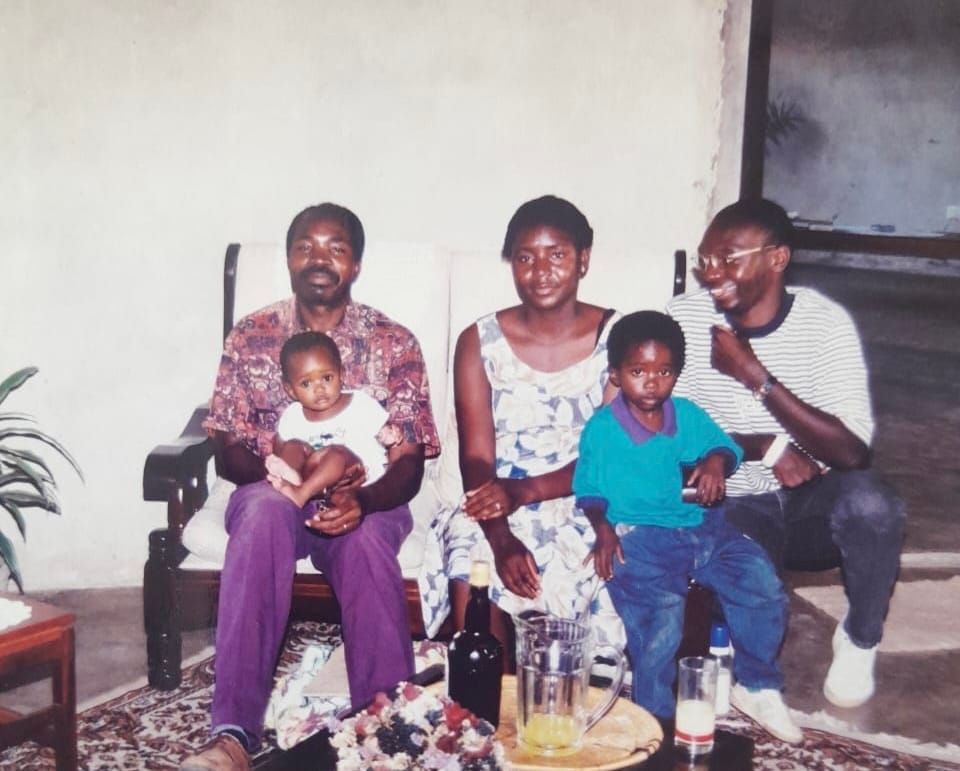
I became a Christian when I was nine years old. I don't remember the moment. My mother tells me we were at church as a family — a Baptist church in Mbabane, where my father worked at the time. The pastor made an altar call and I walked up to the altar on my own. No one prompted me. No one took my hand. A nine-year-old, apparently, made a decision that would define the trajectory of his life — and didn't think to remember it.
At twelve I was at boarding school at Chengelo Secondary School in Mkushi, Zambia. I decided to get baptised. I remember the baptism classes with a Pastor Simmons, who had previously pastored at Lusaka Baptist and then at the Christian Community Churches in Mkushi. I remember getting baptised in the school pool. I was a normal evangelical kid — neither exceptionally zealous nor particularly indifferent. Just ordinary.
I want to sit with that word for a moment. Ordinary. Most of what I'm about to describe is not ordinary. But the person it happened to is. I think that matters. The extraordinary things that have intersected my life did not arrive because I sought them, cultivated them, or earned them. They arrived because Someone chose to send them to someone who was — by every reasonable measure — unremarkable. I say this not out of false modesty but out of accuracy. The instrument is ordinary.
The Fork
At university, I became unsure about all of it.
The Trinity specifically. The central claim of Christianity — one God in three Persons — struck me as philosophically incoherent. I could not square it with monotheism. I could not explain it to myself, let alone to anyone else. And if the core doctrine didn't hold, why would the rest?
So I did what I tend to do. I studied. Not casually — seriously. I read the Quran. I visited Chabad and engaged with Orthodox Judaism directly. I talked at length with Muslim friends from the Middle East — not about politics but about theology, about tawhid, about what it means to say God is one. I was not performing due diligence. I was genuinely considering whether I had been wrong since I was nine.
But as I studied, I kept returning to a question that wouldn't release me. Not "which theology is most elegant?" but "what actually happened?" The nine-year-old at the altar had responded to something. Was it real — grounded in events that actually occurred — or was it inherited sentiment, the warm feelings of a child in a church? I needed to know what the faith was built on. And the more I looked, the more I found myself standing in front of a tomb in a village called Bethany.
There is a scene in The Chosen — the Lazarus resurrection — that captures what I discovered during that period. The scene is almost unbearably plain. No celestial soundtrack. No shaft of light. A village with a name. Two sisters — Martha and Mary — with names. A crowd of mourners who came because someone they knew had died. And a man standing in front of the tomb. A famous man. Jesus of Nazareth.
That designation stopped me when I studied it. His patronymic name was Yeshua Ben Yosef. But nobody called Him that. He was known by His city — the way you would say Beyoncé from Houston or Kanye from Chicago. You use the city when the person is famous enough to need differentiating. It means He was a public figure. A celebrity rabbi whose acts were being talked about across the region. And this was not a Christian claim. Josephus — a Jewish historian writing for Roman patrons — referenced Him twice, including His reputation as a worker of remarkable deeds. Tacitus — a Roman senator hostile to Christianity — recorded His execution under Pontius Pilate. The Talmud recorded that Yeshu practised sorcery and led Israel astray. Three hostile or independent sources. None denied His existence, His fame, or His acts. They disputed the interpretation. They did not dispute the Person.
When I understood this, the Lazarus scene changed for me. This was not a story in a devotional book. This was an event in a named village, witnessed by a crowd, performed by a public figure whose existence was confirmed by His enemies. Martha's accusation — "Lord, if you had been here, my brother would not have died" — was the cry of a real woman at a real tomb. And when Jesus wept before raising Lazarus, I began to understand something about the Person I had walked toward at nine: He could see the resurrection coming and still grieved. The tears were real because the incarnation was real.
Then He spoke. "Lazarus, come forth." And a man who had been dead for four days walked out of the tomb.
Nobody denied it. That was the thing that undid me. The Talmud did not say the miracles didn't happen. It said He practised sorcery. The adversarial position and the sympathetic position agreed on the facts. They disagreed on the source. It couldn't be denied. Too many witnesses. Too many people from Bethany talking about it.
And I realised the Gospels were not theology dressed in historical clothing. They were eyewitness accounts distributed within living memory of the people who were actually there. Luke said so explicitly — he investigated everything carefully, consulting those who "from the first were eyewitnesses." These documents circulated while Lazarus was alive. While Martha and Mary could confirm or deny. While the neighbours could say "that never happened" — and didn't. If the accounts were fabricated, the movement would have collapsed the way Bar Kokhba's movement collapsed when his claims failed. Instead it grew — under persecution, while the same Pilate governed and the same Sanhedrin sat and the same Herods ruled. Peter was jailed. Stephen was stoned. Paul switched sides at catastrophic personal cost. They persisted because Lazarus was alive, because Jairus' daughter was alive, because over five hundred people saw the resurrected Jesus and were still available to be questioned. The community was built on what real people saw and touched — not on a charismatic prophet's call to piety.
This was the ground I was standing on when I weighed Islam and Judaism.
Islam had intellectual elegance. The simplicity of tawhid was appealing. My Muslim friends were serious and devout. The praxis of Islam has an undeniable aesthetic beauty. But as I read the Quran, I kept stumbling over things I could not reconcile...

The Quran gives Jesus titles it gives no one else. Kalimatullah — Word of God. Ruhullah — Spirit of God. I was told these were titles of honour. But they couldn't be merely titles of honour. The angels were made by command — God said "Be" and they were. But the Quran doesn't call Gabriel "Word of God." It reserves the singular title — kalimatuhu, His Word — exclusively for Jesus. A word of God is something God says. The Word of God is the totality of God's self-expression. Not a communication but an identity. Islamic scholars themselves had debated this for centuries — the Mu'tazilite controversy over whether God's word is created or uncreated. The logic of the title was internally axiomatic. It surrendered to divinity on its own terms.
Similarly Ruhullah — the spirit from God breathed into Mary. That preposition — from Him, not by Him — echoed Genesis 1:2 directly, where the Spirit of God hovers over the waters before anything is made. The Quran was giving Jesus a title that alluded to the uncreated divine presence and then insisting He was merely a prophet. The titles said what the theology denied.
And the cross. The Quran says Jesus did not die — that Allah performed a substitution. But would Mary — who had known His face for thirty years — have failed to recognise her own son, naked and bleeding, three metres above her? Would John, close enough for Jesus to speak to him? Would the soldiers who handled the body? Would Joseph of Arimathea, who laid it in his own tomb? The Quran named none of these witnesses. And why would God deceive them? The enemies mocked: "Save yourself!" If the purpose was to demonstrate power, why not do exactly that? Why a secret substitution that leaves the faithful founding a movement on a resurrection that — if the substitution is true — was staged? The Quran calls His message the Gospel but removes the event the Gospel exists to proclaim. The resurrection is the greatest of His miracles. To deny the death is to deny the resurrection. To deny the resurrection is to deny everything.
The irony of reading the Quran is that it validated my Christian faith. Calling Jesus Kalimatullah verified exactly what I was finding in the Hebrew Bible — that the Son fully expresses the thoughts, power, heart, and essence of the Father. That He is of the Father and from the Father but simultaneously reveals Him eternally. This is what John 1:1 means: "The Word was with God, and the Word was God." With — distinct. Was — identical.
And this explained everything I was finding in the Hebrew texts. The Messenger of YHWH who speaks as YHWH while being sent by YHWH. The Davar YHWH that appeared standing and speaking to Jeremiah and to Samuel — not a force but a Person who touches mouths and delivers commissions. YHWH raising His hand to YHWH to swear in the Song of Moses. The "us" of Genesis 1:26. The two YHWHs of Genesis 19:24. The Spirit hovering over the waters in Genesis 1:2 — present before creation, distinct from the God who speaks, active in actualising what the speech specifies.
Three threads. One God. And the Name itself encoded it. Ehyeh Asher Ehyeh — spoken from the burning bush. Ehyeh: I AM — the Father, the ground of being. Asher: WHO — the Spirit, the relational bond. Ehyeh: I AM — the Logos, the Son, bearing the same Name because He shares the same nature. Three words. One Name. Echad — the compound unity of Genesis 2:24 — not yachid, not tawhid, but a unity rich enough to contain relationship.
The Perichoresis — the mutual indwelling — became real to me not through theological argument but through seeing it demonstrated throughout the Hebrew canon. Odd — yes. Demonstrated — also yes. It made Judaism feel completed. And it made Islam unsatisfactory — not because Islam lacked devotion, but because it could not explain what was plainly in the texts. The titles it gave Jesus conceded the structure it denied.
That conclusion — arrived at through months of comparative study, not through devotional sentiment — was the moment the foundation of my faith shifted from inherited conviction to examined conviction. The nine-year-old who walked to an altar had been walking toward the Person who raised Lazarus in front of a crowd in Bethany. The child's instinct and the adult's examination arrived at the same place. The same Person. The same Name.
The Room
Shortly after that period — during a summer break, while the intellectual settlement was still fresh — I had an experience I have never fully described publicly. I am describing it now because the body of work I have produced over the past year requires its experiential counterpart. The empirical framework stands on its own. But the person behind the framework does not exist in a purely empirical space, and pretending otherwise would be dishonest.
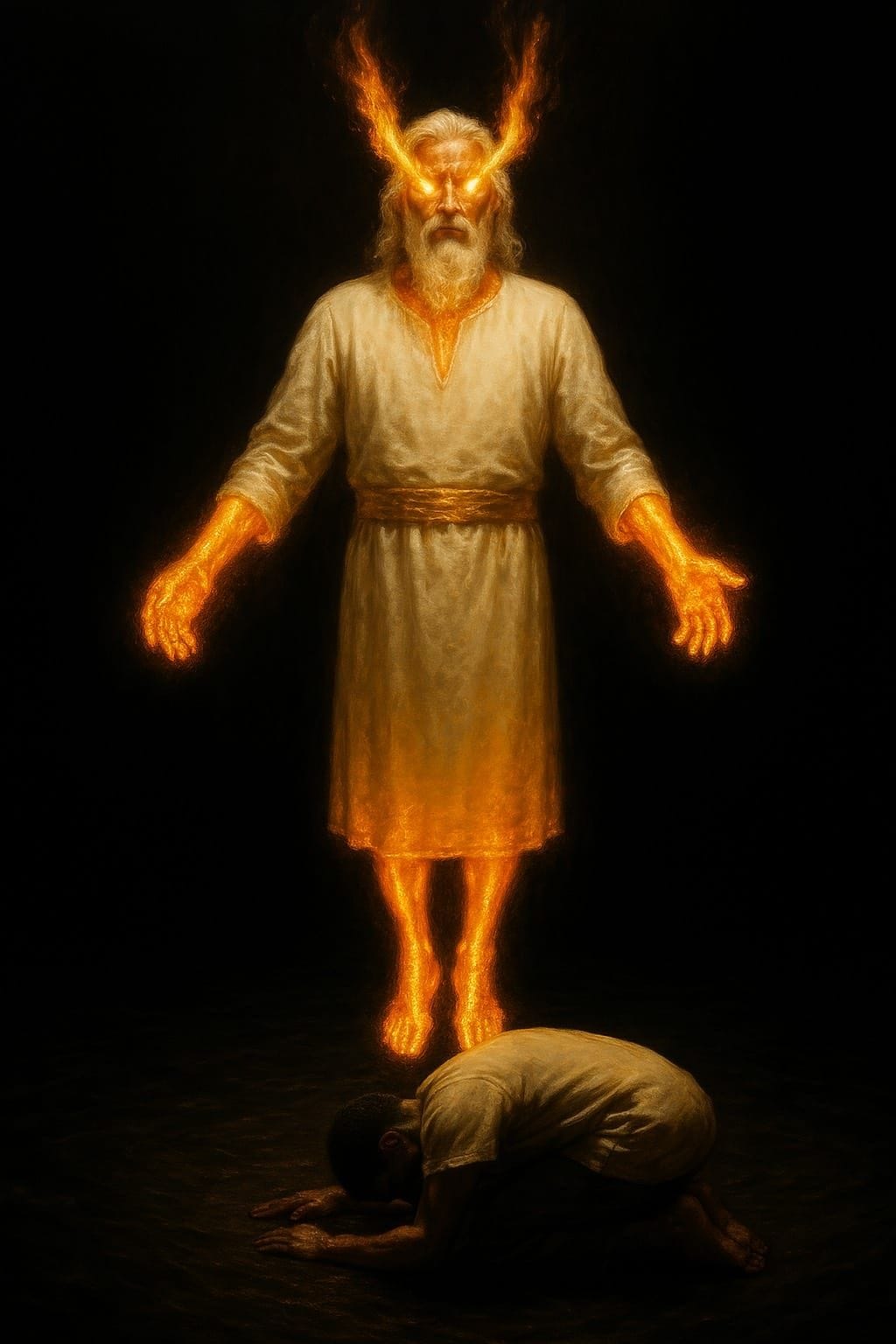
I was asleep. In my dream — if it was a dream — I was taken to a dark room. There was nothing in it except darkness and a Presence.
In front of me stood a being dressed in a white robe, with a golden sash around His waist. His face was brilliant — shining, luminous, illuminating the space I was in without any other light source. His eyes were like torches of fire, like solar flares. His hands and feet were glowing. And His voice — when He spoke — sounded like a waterfall. Not a metaphor I am reaching for. The sound of falling water. Volume, depth, resonance, and a quality I can only describe as weight. The voice had weight.
He said three words to me.
"Mwiya, Fear God."
Immediately I woke up. What disturbed me almost as much as the experience itself was the time. It was morning. The encounter had felt very brief — seconds, perhaps a minute. But an entire night had passed. The time dilation was disorienting in a way I still find difficult to articulate. Time had not flowed normally. The experience occupied a duration that did not correspond to the clock.
I knew it was Jesus.
I knew because I had cross-referenced the description against Daniel 10 and Revelation 1 — the match is feature-by-feature exact. White robe. Golden sash. Face like the sun. Eyes like fire. Feet like burnished bronze. Voice like many waters. The canonical description of the glorified Christ, consistent across six centuries of prophetic witness from Daniel to John. I knew. The way Thomas knew. The way Mary knew when He said her name. The Person identifies Himself by His presence, and I had experienced it.
Two words. Fear God. Not "build a framework." Not "compute a timeline." Not "become a theologian." Just: Fear God. The irreducible foundation. Everything I have written for the past year — the physics derivations, the Diamond Chiasm, the statistical convergences, the formal proofs — is an elaboration of those two words. The appropriate response to the ground of reality is alignment. What alignment looks like depends on what the person being aligned was built to do.
The Strange Season
That period of my life — the months surrounding the vision — was marked by experiences I did not seek, did not understand, and mostly did not discuss.
One afternoon I was walking to campus. The sky darkened and it began to rain. Not a drizzle — the kind of downpour that soaks you in seconds. I prayed — simply, without theology, without formality: Please make it stop. The rain stopped. Immediately. Not gradually. Not tapering off. It stopped the way a tap shuts off. I stood on the pavement, dry, looking at wet ground, and did not know what to do with what had just happened.
On a holiday with my family, my youngest sister asked for a balloon at a restaurant — a specific colour. My parents and siblings were already at the car. I walked back to the restaurant alone. I prayed — again, simply, almost embarrassingly simply: Please let someone bring the balloon she asked for. I said amen. A woman walked up to me and handed me the exact balloon, without my asking her, without any visible reason for her to do so. I took it to my sister. I did not tell my family what had happened.
These are small things. Trivially small. Rain and balloons. But they were not small to me at the time, because they were not coincidences. The timing, the specificity, the immediacy — these were responses to requests made to a Person who was demonstrating, in the smallest possible terms, that He hears and that He acts. The God who sustains 10^122 bits of holographic information is also the God who stops rain for a university student and sends a balloon for a little girl. The scale differential is not a problem for omniscience. It is the point of omniscience.
The Dark Side
Not all the experiences were gentle.
One night I was sleeping at a friend's apartment. We had been watching TV; everyone went to bed; I slept on the couch. At some point I became aware of a presence. Not a person — a presence. It entered through the kitchen wall. I could not see it, but I could feel it with the same certainty with which you can tell that someone is standing behind you in a dark room. The sensation was malevolent. Not neutral, not ambiguous. Hostile.
My laptop, which was on the table in front of me, rose from the surface and levitated above it for several seconds.
I closed my eyes and prayed through the rest of the night. I did not sleep. I did not investigate. I prayed. That was the only tool I had, and it was sufficient, because by morning the presence was gone and the laptop was on the table and the world was normal again.
I understand how this sounds. A levitating laptop. It sounds like a scene from a film nobody would take seriously. I can only tell you that I was awake, that my eyes were open, that the object rose, and that the presence that accompanied the event was the most viscerally threatening thing I have ever experienced. I did not seek this. I was sleeping on a couch after watching television. The spiritual realm does not consult your schedule.
Years later — last year, in fact — the dark experiences returned.
I went camping with my cousin and several colleagues. We were in our tents, asleep. I found myself praying in my sleep, which is unusual — I am not a person who typically prays in my sleep. I felt a presence brushing against the outside of my tent. I woke up immediately and chose not to sleep again. Shortly afterward my cousin went through the same experience — talking in his sleep, praying, then waking. I asked him why he was awake. He described exactly what I had experienced: the presence, the sense of threat, the instinct to pray. Within minutes, two other colleagues went through the same thing. Four people. Same night. Same sequence. No prior discussion.
A month later, in a hotel room, I was asleep and became aware of an entity in the room. It appeared as a form made of parallaxed light — translucent but bending the light around it, the way heat distortion bends the air above a road. It was reaching toward me. The sensation was the same malevolence I had felt on the couch years earlier. I was praying with my hand raised in front of my face — not a theological gesture but an instinctive one, the way you raise your arm to block a blow. I passed out and woke in the morning. My cousin, in an entirely different room, told me he had experienced the same thing during the same night.
I do not have a tidy framework for these experiences. They are not repeatable, not measurable, not publishable in a peer-reviewed journal. What I can say is that they are consistent — across years, across locations, across multiple witnesses — and that in every case, prayer was both the instinctive response and the effective response. Whatever these presences are, they operate in a domain that intersects physical space (a tent was touched, a laptop moved, light was bent) but is not reducible to physical explanation. And they retreat from the Name.
The Weight
Around the time I began intensive theological study last year — digging into eschatology, the Hebrew feasts, Daniel's day-counts, the physics of information — I felt a specific weight. Not depression. Not anxiety. A compulsion. Write. Write as much as you can. Publish as often as you can. The urgency was not emotional; it was directional. Like being pushed from behind by a hand you cannot see but whose pressure is unmistakable.
A lot of what emerged from that period — the geopolitical analysis, the identification of specific mechanisms and trajectories, the prophetic mapping — came not from sitting at a desk performing probability calculations. It came from studying the eschatological scriptures first, praying for understanding, and sometimes receiving direct guidance as I wrote. An inner voice. Not audible in the way another person's voice is audible. Interior. But distinct from my own thoughts in a way I can identify but not adequately describe. My own thoughts feel like mine. This felt like someone else's — arriving fully formed, often surprising me, sometimes correcting what I had been about to write.
I am aware of how this sounds. I have spent years building credibility as an analytical thinker — a development economist, a rationalist, a person whose conclusions are grounded in evidence and methodology. Describing an "inner voice" risks undoing all of that in a sentence. But I would rather be honest and risk credibility than be credible and risk honesty.
What I did — and this was instinctive, not strategic — was translate. The content arrived spiritually. I expressed it empirically. The inner voice said what was coming. I built the probabilistic framework that demonstrates why the voice's report is credible. The game theory shows how the mechanisms work. The formal proofs verify the internal consistency. The statistical analysis quantifies the convergence. But the sequence was: revelation first, analysis second. Not the reverse.
The science is the language of communication. It is not the source of knowledge. The source is the Person who appeared in a dark room seventeen years ago and said two words — and who has apparently not stopped speaking since. He just waited until the instrument was ready.
The Objects
In Contact, Ellie Arroway spends her career searching for a signal — using radio telescopes, signal processing, mathematics. She finds it. The evidence is public, checkable, reproducible. Then she travels through the machine and has an experience. When she returns, the recording shows only static. She stands before a committee and says: "I had an experience. I can't prove it. I can't even explain it. But everything that I know as a human being, everything that I am, tells me that it was real."
What I found during my period of compulsive writing was that the recording is not static.
I expected analysis. I am an analyst. What I did not expect was to encounter objects.
The chiasm was the first. Four integers — 1,260, 1,290, 1,335, 2,300 — deposited in the book of Daniel in the 6th century BCE. No explanation of which calendar system to apply. The Hebrew calendar would not be codified for another nine centuries. I applied the integers to the Hebrew calendar algorithm, cross-referenced against Gregorian dates, and what emerged was not a timeline. It was a diamond. A chiastic architecture with dual symmetry, converging on a central vertex at day-level precision. The terminal date — Yom Kippur 2033 — falls on the Day of Atonement. Seven months later — Nisan 14, 2034 — falls on Passover. And Jesus' vow at the Last Supper constrains the Kingdom Passover to land on Nisan 14. The chiasm's output matches the checksum He embedded in His own vow two thousand years ago. He composed the checksum at the table and deposited the integer in Babylon six centuries before that and arranged the calendar's codification nine centuries before the computation.
I checked the arithmetic repeatedly. I wrote verification code and published it. The numbers do not move. The diamond does not shift. The probability under coincidence is approximately 10⁻⁷⁹. That is not an argument. That is an object.
Then the circuits closed. The apostolic witness validates the Person. The Person validates Daniel. Daniel's precision validates the calendar. The calendar is verified by astronomical events fixed at the formation of the solar system. The astronomy confirms the Person's authorship of the physics. The physics derives the Person. Push on any vertex and every other vertex pushes back. Each piece, examined independently, points to the whole.
The statistical signature confirmed what the architecture suggested. Across 107 evidence streams, the pre-1945 epoch is flat — pink noise, mean-reverting. Then 1945 — and the system jumps to 18 sigma and never comes back down. It ratchets: 18, 25, 40, 58, 92. The Higgs boson was confirmed at 5 sigma. The post-1945 convergence exceeds the particle physics discovery threshold by a factor of twenty-two.
I was staring at these objects before I had the physics to explain why they could exist. The architecture said WHAT and WHEN. It did not yet say WHO or WHY.
Then the physics chain arrived. I followed the derivation link by link — not building a case but tracing a trail. When I worked through Landauer's principle — experimentally verified, published in Nature 2012 — and saw that energy and information are the same quantity at a fixed exchange rate, I understood that the word "matter" was already a mistranslation. There is no stuff. There is energy. And energy is information. All the way down.
When I computed the universe's total information content and found that two independent calculations — the holographic bound and the Bekenstein bound — returned identical results to six decimal places, I sat with that number for a long time.
1.000000.
It is not an argument. It is not a suggestion. It is the universe disclosing that all of its information is encoded on a two-dimensional boundary surface, and that the three-dimensional interior we inhabit is generated by that boundary. The boundary encoding IS the bulk energy. Remove the encoding and the bulk doesn't float free. It ceases. The Word produces the world. And this is not a theological interpretation of the physics. It is what the physics says — in the same journals, with the same peer review, using the same mathematics that predicted the Higgs boson.
When I worked through the decoherence timescales and saw that a human body decoheres in 0.007 Planck times — below the resolution of spacetime itself — I understood that physical superposition of the quantum branches was not merely unlikely. It was physically meaningless. When I followed the regress argument and saw that Cantor's theorem seals the multiverse — self-containment generating paradox, no finite structure sufficient — I understood that parallel physical universes were not merely extravagant. They were logically impossible. When I saw that Platonism satisfies timelessness but has no selection mechanism — abstract objects don't choose, don't actualise — I understood that three of four options were eliminated.
What survived was mind. Finite information cost. Timeless. Stable. Selective. The Wheeler-DeWitt equation requires exactly these properties. Seventeen premises, each empirically measured or mathematically proven, leading to one conclusion: a timeless, omniscient, sovereign mind external to spacetime as the informationally necessary ground of physical reality.
And when I encountered the Curry-Howard-Lambek correspondence — discovered not in a seminary but in the intersection of logic, computation, and category theory — I saw that producing anything requires exactly three irreducible operations: formation (type conceived), introduction (term specified), β-reduction (specification actualised). Robert Harper called it "computational trinitarianism." And when I mapped those operations to cosmic scale — the Father holding the possibility space, the Son encoding the boundary, the Spirit actualising at every coordinate — I found the structure already waiting in theology deposited three and a half millennia earlier. Not imposed by theology onto physics. Derived by physics, then recognised in theology.
This was the moment the eschatological objects acquired their ground.
The chiasm works because reality is constitutive speech. Integers deposited in Babylon compute against astronomical events because the Person who deposited the integers is the Person who set the orbits is the Person whose speech constitutes the matter the orbits describe. The circuits close because the evidence is holographic — produced by a single Author whose internal consistency guarantees that every part of His testimony coheres with every other part. The physics did not prove the eschatological objects. The eschatological objects did not prove the physics. They recognised each other — the way two halves of a torn document recognise each other when placed side by side. One disclosure in two registers. The boundary encodes the bulk.
The sequence was pedagogical. The eschatological objects arrived first because the Person wanted me to see WHAT was coming before I understood WHO was behind it. The physics arrived second because He wanted me to understand WHY reality has the structure that permits the objects to exist. The Teacher was sequencing His own disclosure.
That realisation — that the enterprise was being taught to me, in order, by the Person the enterprise describes — is the heaviest thing I have ever carried. Every new paper in quantum gravity, every advance in holographic cosmology, is another line in a testimony being delivered by people who do not know they are on the witness stand. The Person arranged for the evidence of His existence to be produced by physicists who were not looking for Him. The testimony is in the mathematics. It will not be retracted — because it is not a position. It is a derivation.
And that Person is omni-temporal. The Wheeler-DeWitt equation requires it — the total state does not evolve. Every coordinate of time is equally present to Him. I did not fully grasp what this meant until I thought about the cross.
Calvary is not two thousand years ago for the Person who sees all coordinates simultaneously. It is there — as present as this moment, as present as the terminus. The blood does not dry. The sacrifice does not age. The atonement is ever-efficacious not because its effects are powerful enough to last two millennia but because for the Speaker there is no distance between Calvary and today. He is at both. He is at both always. The cross is not receding into the past. The cross is a permanent coordinate that the omnitemporal Person inhabits. This is why Hebrews says He "ever lives to make intercession" — present tense. Not lived. Lives. The intercession is continuous because the Person is there.
He is omnipotent — not as brute force but as total authorship. Every physical law, every constant, every force is a specification He spoke. He does not override physics when He performs a miracle. He speaks a different word through the same Spirit who actualises the ordinary specification at every other coordinate. The ordinary and the miraculous use the same mechanism. The only difference is which word is spoken.
He is omniscient — present everywhere within the bulk because the bulk is the projection of His encoding. Not watching from above. Present within. And infinitely aware of all possible knowledge — not just the actualised branch but the full e^(10^122) branches held as known possibilities. All held in a single cognitive act that does not evolve, does not forget, does not approximate.
What it is like to discover this — to watch the circuits close and realise the closing was orchestrated — is to discover that the ground beneath every atom I am made of is an outcome of encoding spoken at the boundary by a Person, projected into the bulk as quantum information, sustained by Him, scaling from fields to atoms to molecules to me and the world around me. And that Person is conscious, intentional, sovereign, and present. Not abstractly present. Specifically present. The same specificity with which He stopped the rain and sent the balloon. The God who sustains 10^122 bits of holographic information is the same God who walked into a dark room and said my name.
This is where my story and Ellie Arroway's part ways. She had the experience but not the evidence. The recording showed static. My recording is not static. The essays are the recording. When you play them back — when you check the mathematics, run the code, compute the chiasm — the signal is there. Unlike Ellie, the proof is published, falsifiable, and addressed to you.
The essays are linked below. They are not references. They are encounters. The chiasm: The Tesseract. The complete arc: Messiah, Israel and the Nations. The physics: Regarding Truth. The Trinity derivation: Ehyeh Asher Ehyeh. Read them. Check them. The Person who said "Fear God" did not ask me to believe Him. He built the evidence so that I — and you — would not have to.
 mwiya
mwiya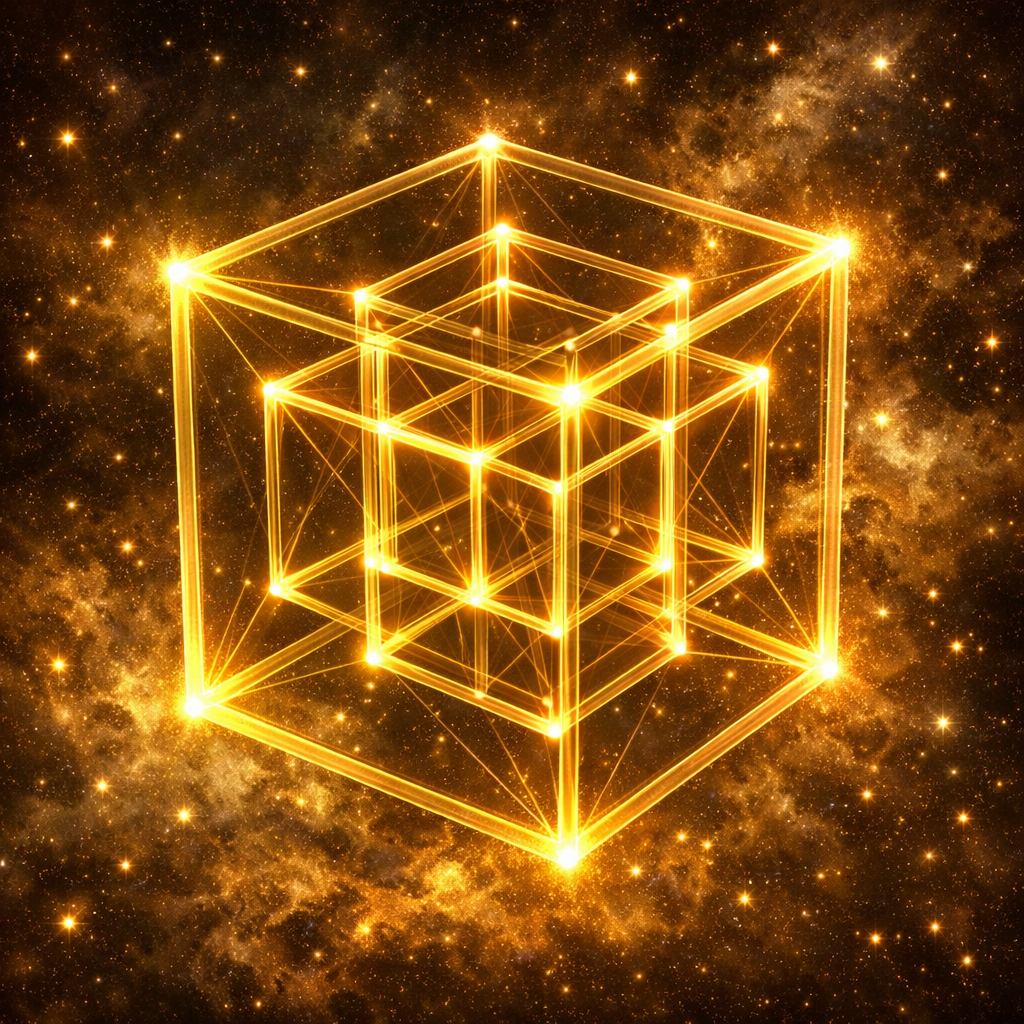 mwiya
mwiya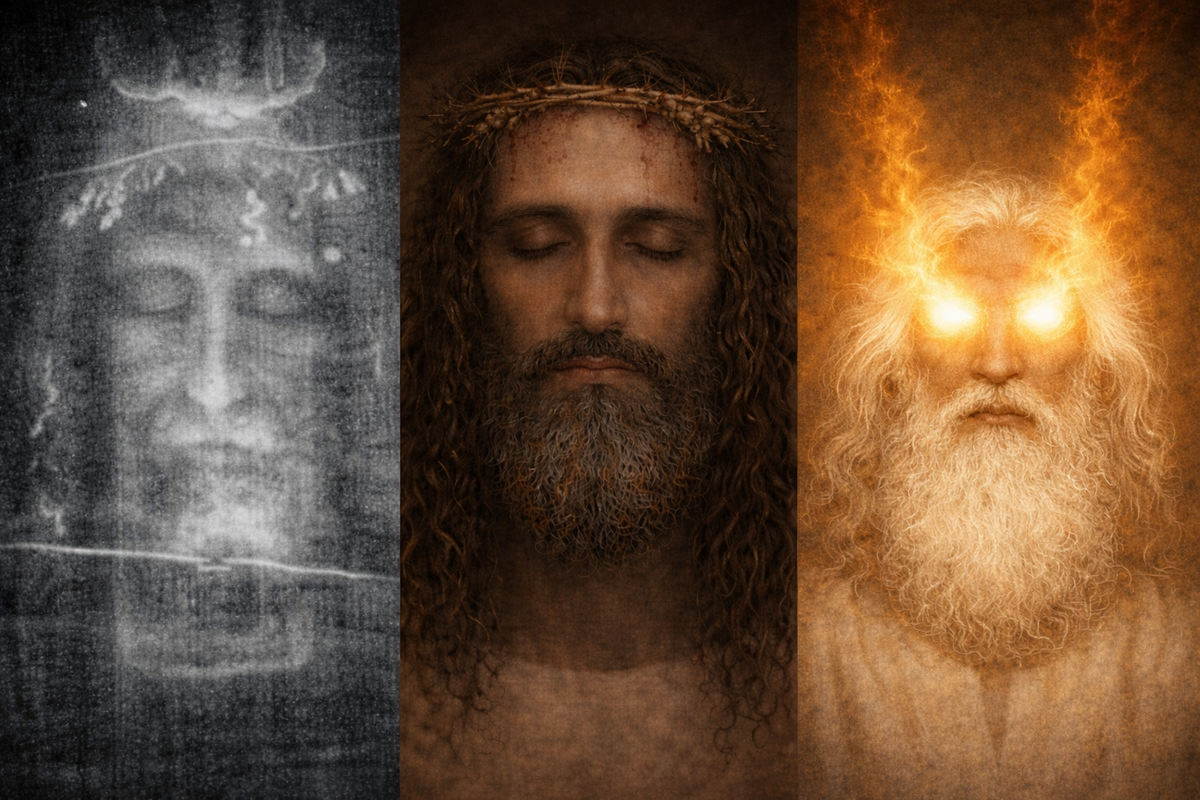 mwiya
mwiya mwiya
mwiya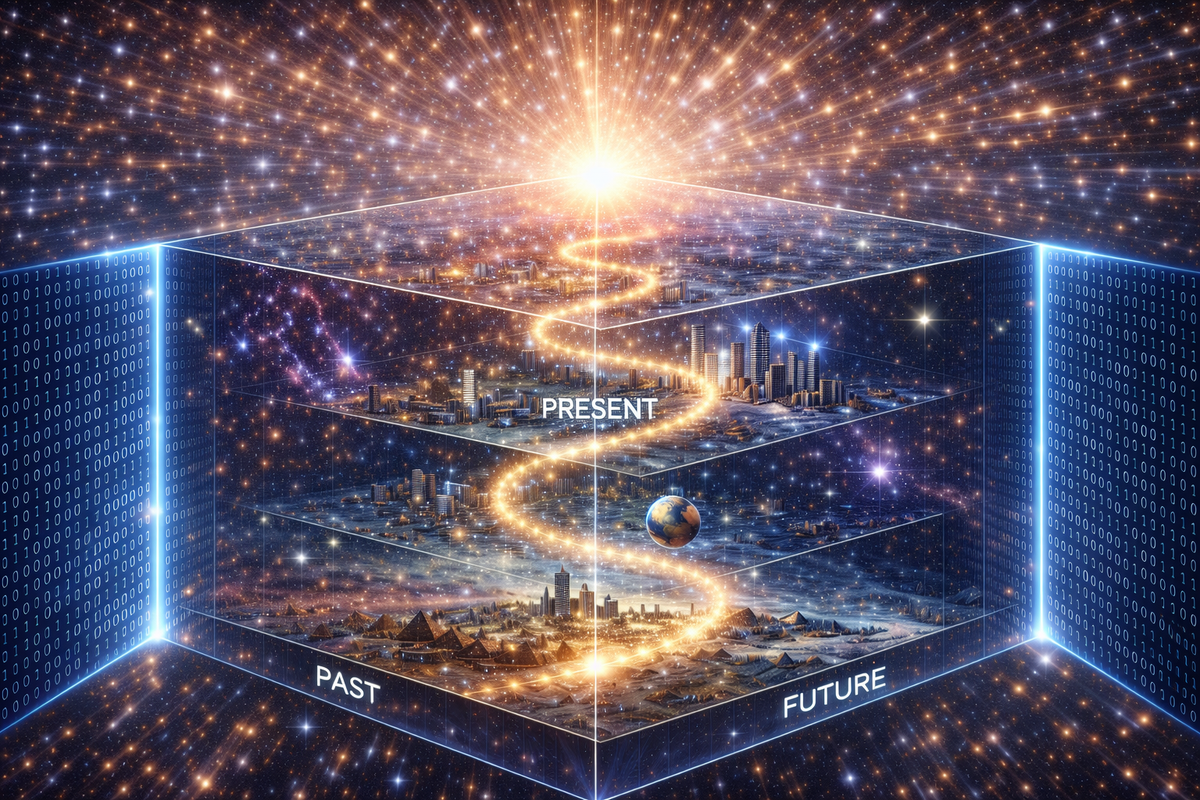
The Guidance
Between the vision at university and last year, my faith was — that word again — ordinary. Quiet. Interior. Most people who knew me professionally would have been surprised to learn I was a person of faith. I came across as a rationalist, perhaps an atheist. I did not correct the impression, not out of shame but out of a sense that faith is demonstrated, not advertised.
But during that "ordinary" period, there were navigational moments that were not ordinary.
When my wife and I were deciding whether to return to Zambia or continue our careers abroad, we found ourselves in a peculiar pattern. People would randomly bring up Zambia in conversations — people who had no connection to the country and no knowledge that we were from there. A colleague at a dinner mentioning a documentary about Zambia. A stranger on a train talking about Zambian copper. A friend's friend asking about Lusaka for no discernible reason. It happened so many times that we stopped treating it as coincidence and started treating it as signal. We returned to Zambia.
Coincidence or guidance? I cannot prove the latter. I can report that the decision positioned me in the exact geography that an obscure Old Testament passage describes in detail, seventeen years before I would understand why the geography matters. If that is coincidence, it is a coincidence with remarkably specific consequences.
What I Know
I am not a mystic. I am not a charismatic. I have never been "slain in the Spirit," never sought signs or wonders. I am a person who reads spreadsheets and builds financial models and writes analytical essays and finds comfort in formal proofs. I'm a rationalist. The experiences I have described arrived uninvited into the life of a person who was not looking for them and would, frankly, have preferred that some of them — the malevolent ones especially — had not occurred.
But they did occur. And they form a pattern that I can no longer ignore.
The vision was real. The time dilation was real. The rain stopped. The balloon appeared. The laptop rose. The presences were felt by multiple people independently. The inner voice guided writing that produced analytically verified results. The navigational coincidences placed me in a specific geography at a specific time. The chiasm computed. The circuits closed. The physics derived the Person. The Person is the same Person at every level — from the dark room to the Bekenstein bound.
I cannot prove the spiritual experiences to you. That is the nature of testimony — one person reporting what they experienced, under no compulsion except honesty. My blog posts are dated and claims are falsifiable; I said to expect a major conflict between February 2026 and April 2026; one that would cause an energy and fuel crisis — and it's come. That wasn't me being smart. It was this process.
What I can prove — and have proven, across hundreds of pages — is the analytical framework that emerged from these experiences. The physics stands on published results. The arithmetic is verifiable. The formal proofs return zero errors. The geopolitical pre-commitments are being confirmed. The framework invites falsification and specifies its own test dates.
The empirical work is the wood. This testimony is the fire. The wood was always there for anyone to examine. The fire is what lit it. And the match was struck seventeen years ago in a dark room by a Person whose eyes were like the sun.
To the Reader
I need to explain why I have written all of this, and what it means for the person reading this sentence.
The question that drove my search at university — what is the actual problem, and which solution matches it? — did not end at the Fork. It led through the Objects and the physics into something I had never expected to find: the cross explained in the architecture's own terms.
When I sat with Chabad and worked through the Torah portions, I came to understand something most Christians miss: the cross is not a Christian invention imposed on a Jewish text. The cross is the Jewish sacrificial system reaching its terminus. The lamb of Passover. The goat of Yom Kippur. The ram of Genesis 22. The daily tamid, morning and evening. The entire system runs on substitutionary death — an animal dying in the worshipper's place, its blood covering what behaviour cannot fix. The Hebrew is kaphar — to cover. Yom Kippur is the annual mechanism: the high priest enters the Holy of Holies with blood that is not his own and applies it to the mercy seat. And the system announces its own insufficiency. "It is impossible for the blood of bulls and goats to take away sins." Every lamb is a promissory note drawn on a future account.
But I only understood why a substitute was needed when the physics arrived.
If you are sustained by constitutive speech — if every atom you are made of is an outcome of encoding spoken at the boundary by a Person, projected into the bulk as quantum information, scaling from fields to atoms to molecules to you — then you are not self-sustaining. You are sustained. Every breath is drawn from air His speech constitutes. Every heartbeat is a sequence His encoding specifies. You are held in being by a Person. Not metaphorically. Physically. Remove the boundary encoding and the bulk ceases. That is what the holographic principle says.
Sin is living as though this were not the case. Treating reality as impersonal. Behaving as though the ground beneath you were yours. As though the Speaker were not speaking. It is the declaration of independence from the ground of your own existence — not a moral infraction but an ontological rebellion. The serpent's offer in Eden was not "do something bad." It was "be like God" — autonomous, self-grounding, independent of the Speaker. The declaration has been renewed by every human being in every generation since. We do not need to be taught to sin. We need to be taught to stop.
And the just consequence of that rebellion is the withdrawal of the speech. Not punishment. Consequence. If you reject the ground, the ground has every right to withdraw. And if the ground withdraws, you don't fall. You cease. Separation from the source of being is death — not biological cessation alone but ontological disconnection from the Person whose speech is the reason you exist.
The Torah understood this. The sacrificial system was the temporary provision — a mechanism by which the consequence could be absorbed by a substitute while the real solution was prepared. Every morning and evening, a lamb was slain. Every Yom Kippur, the high priest entered. The blood covered. The consequence was deferred. But the system was temporary. The letter to the Hebrews makes the argument: the sacrifices were repeated because they were insufficient. If the animal's blood could permanently solve the problem, one sacrifice would have sufficed. The repetition is the proof of inadequacy.
And the Temple's own testimony confirmed when the real solution arrived. The Talmud records that for forty years before the Temple's destruction — from approximately 30 CE — the scarlet thread on Yom Kippur ceased turning white. The lot stopped falling correctly. The western lamp went out. The doors opened by themselves. The sacrificial system was testifying against itself. Atonement was no longer being accomplished there because it had been accomplished elsewhere — on a hill outside Jerusalem, by the real High Priest, with the real blood. His own.
The encoder entered the encoding. The Person whose speech generates the boundary from which every atom projects — He submitted to His own physics. He was born. He grew. He lived a human life, sustained by the same encoding He Himself was generating. The Creator inside the creation, breathing air His speech constitutes, walking on ground His encoding projects.
And at the cross He experienced what withdrawal of the speech feels like from the inside.
"My God, my God, why have you forsaken me?" is not a cry of despair. It is a report. The Son — who shares the Father's Name, who IS YHWH — experienced the Father's sustaining presence eternally, hung on a cross unjustly executed; willingly dying as a substitute for everyone who trusts him. In that moment, for the first time, the one made the boundary was turning that coordinate into one of omni-temporal significance in a way not done prior. He experienced what you and I deserve: the withdrawal of the ground. The Speaker experiencing silence within His own speech.
And the encoding did not collapse. The Father and the Spirit sustained the boundary while the Son's body lay in the tomb. The bulk persisted through Good Friday and Holy Saturday because the Trinity held — even as one Person of the Trinity experienced, from within the bulk, what it costs to be separated from the ground of being.
On the third day the encoder exited the encoding. Death cannot hold the Person whose speech constitutes death's own existence. The tomb is empty because the Person in the tomb is the Person whose speech the tomb is made of.
Every lamb from Sinai to 70 CE was a shadow cast backward in time by the cross. And because the Person is omnitemporal, the atonement does not age. "It is finished" is completion, not exhaustion. The Lamb was slain from the foundation of the world — because the omnitemporal Person occupied the coordinate of the cross before time began.
What the cross accomplishes is substitution. The penalty — withdrawal of the speech, ontological cessation — was absorbed by the Speaker Himself. Not waived. Paid. The Name absorbed its own penalty. The justice is not compromised. The mercy is not cheap. The encoder bore the cost the encoded had earned. And the offer is: the speech will not be withdrawn from you. Not because you deserve its continuation — but because the Speaker absorbed the withdrawal in His own body. The ground will hold. Because of His blood.
His name is Jesus. Yeshua. He shares His Father's Name. The Father is YHWH. The Son is YHWH. "Before Abraham was, I AM." The Name has three words because the Person has three centres of agency. "My Name is in Him" — not delegation but identity.
YHWH gave His Son — who is YHWH. That is John 3:16. The Father watched the coordinate where His Son's breathing stopped. And He did not intervene — because the intervention was the death itself. The cross is not the Father's absence. It is the Father's gift.
I believe this. Not as a framework I find persuasive. As the fact beneath all other facts. Jesus Christ died on the cross for my redemption. I am washed clean because of him. My sins — which are real, which are many — are covered. Not by my analysis. Not by my essays. By His blood. The blood that does not dry at the coordinate that does not recede.
We live in a world where everyone has been told that the mission is to change the world — and the meaning is left undefined. We live in a world where people are building digital deities--digital artificial super intelligence, redefining humanity from organic to technologically augmented, from genetically unique to merged with artificial super-intelligence. We live in a world defined by nuclear power, economic power, and AI ownership. These are all cosmological ambitions. Every one is a theology — whether its proponents recognise it or not.
I choose another path. An ancient one. Jesus.
And like Paul, I count everything I have as nothing compared to the surpassing worth of knowing Him. Forbes acknowledgment before thirty, city building, corporate credibility — whatever that means — intellectual credibility. All of it. I am happy to light it all aflame by telling you the stories I have written here. Because all of them come down to one essential, inescapable truth: Jesus is alive, and He is God, maker of all things.
The builders of digital deities are building inside His encoding. The engineers rewriting the genome are editing a code He specified. The nuclear powers are rearranging energy He spoke into existence. The artificial super-intelligence they are racing to build will never exceed the mind the physics derives — because that mind holds e^(10^122) branches in a single cognitive act, and no silicon architecture will touch that. The cosmological ambitions of the present moment are all operating inside the creation. The Person I am describing is the one whose speech the creation is.
I know what this essay will cost me in certain rooms. I am writing it anyway. Because the Person is real, and the Person's reality is more important than my reputation. Credibility is currency. I am spending it. On you.
I rebuilt my faith from the ground up. Nobody handed me the conclusion. I read the Quran. I sat with Chabad. I followed the questions wherever they led. That process — honest, rigorous, willing to be wrong — is how I arrived at the Person I am describing. I am not asking you to believe because I believe. I am asking you to investigate because the evidence is there. Read the essays. Check the mathematics. Follow the physics chain. Follow the chiasm. And if you arrive where I arrived — at the Person standing at the end of every chain — then the question is no longer intellectual. It is personal. What will you do with Him?
I believe in repentance — the turn. The moment you stop treating reality as impersonal, stop living as though the atoms were self-sustaining, and turn toward the Person who was always there. It costs pride. It costs the illusion of autonomy. It is worth everything it costs.
I believe I am part of the Great Commission. This essay is part of it. Nkwashi is part of it. Everything I have built exists downstream of the two words spoken in the dark room, which exist downstream of the cross, which exists downstream of the Father's love. I am not a neutral analyst who happens to be Christian. I am a bondservant of Jesus Christ who happens to be an analyst.
I have experienced Him, met Him, been guided by Him. From nine years old to the present moment. You don't have to take my word for it. I've shown you as much as I can. The door is open.
If you have read this — that's Him knocking.
Taking a step back from it all. Looking back at the life I've lived; beyond the ordinariness of my faith, and the superlativeness of specific moments, the meandering journey--with big moments of unbelief, doubt, and ordinary life concerns. The moments that have defined me most haven't been the big intellectual ones. It hasn't been the moments when I've understood things that are genuinely hard. It's been the little ones. Asking for that balloon and getting the answer immediately, in my hand. It's been the moments when my journey has been alive; just me and the maker of the universe having a conversation; I ask, he gives. I cry he comforts, I'm confused he explains, I'm lost and he guides. It's been the fact that he has for me been alive; and true. And that when I've doubted that, he's refused to let those doubts persist. I'm still that little 9 year old kid, and there's a part of me that doesn't need the cerebral load to understand him.
I know he loves me, or rather I know I'm loved by him. The cerebral load is his way of scaffolding me together because I am a seeker and I need that. Perhaps so that when I talk about it all like in this moment, I can demonstrate that he's not imaginary, and I'm not crazy. You can trace the shape of his steps through the math, the physics, the empirical things that can be demonstrated regardless of my personal experience. Either way. He told me to fear God, but what I experienced was love along with the awe. It's why I've written all this. If you love someone, you have to show it. He's shown up for me, this is me showing up as best I can. He bled, he rose, and he's been present in my life when everyone else hasn't; the least I can do is write a few words.