

Reclaiming Africa's Future
Two moments anchor everything that follows. They are separated by a century and a half, and they are the same moment.
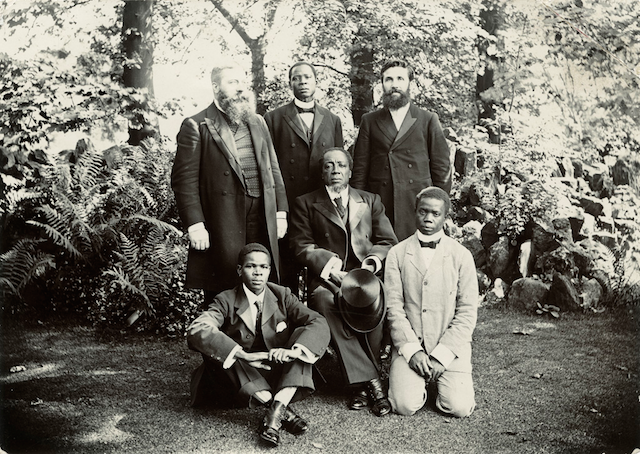
The first is 27 June 1890 at Lealui, on the flood plain of the Upper Zambezi. Lubosi Lewanika — a man of genuine political intelligence, a survivor of a coup, a ruler who had spent years carefully studying what kind of external relationship could protect his kingdom — sits down to sign what he believes is a treaty of friendship and mutual protection with the government of Queen Victoria. His son Litia is with him. His Ngambela (Prime Minister). Thirty-eight indunas (Privy Council). The Lozi state's full constitutional witness for a moment of this magnitude. He signs. What he has signed is a commercial concession granting a private corporation the exclusive and perpetual right to every mineral in his territory. The man across the table has no mandate from the Crown. He represents Cecil Rhodes. He has spent the preceding days explicitly presenting himself as an imperial ambassador. It is a lie, carefully prepared. Lewanika has no means of detecting it. He does not know what an Order-in-Council is. He does not know that the distinction between the Crown and a Crown-chartered company is the difference between the deal he wants and the deal he is getting. He will spend the remaining thirty-six years of his life trying to recover what was lost in that moment; and his successors would continue to demand similar recognition from the newly independent Zambia. The copper that will define Zambia's twentieth century is already gone.
The second moment is not historical. It is a woman at the edge of her village in Western Province, managing land her family has managed for generations. She knows which areas flood in a wet year, which trees indicate healthy woodland, the seasonal patterns of fish in the channel. This knowledge is the foundation of survival, accumulated across generations through custodial governance that no external institution has ever found a way to pay for or formally recognise. The carbon credits her land generates flow through institutional structures in which she has no standing. The royalties from any minerals under her territory flow to a state that has since 1965 consistently converted her community's governance functions into administrative subdivisions whose revenues go elsewhere. She is the most important person in this essay. Everything that follows is designed for her.
Lewanika did not lose at Lealui because he was less intelligent than his counterpart. He lost because he was operating without legal infrastructure that could make his intentions binding, without institutional backing that could enforce his interpretation of what was agreed, and without the epistemic tools to detect that the framework within which he was negotiating had been designed by his counterparty. The woman in Western Province is in the same position, updated for the twenty-first century. The mechanisms are different. The structure is identical.
This essay names that structure, traces it back to its origins, and proposes the design adequate to escaping it. The argument has three movements. The first describes the problem — what is actually happening to African societies, at what depth, and with what consequences. The second names the capture — the epistemic dimension that makes the problem self-perpetuating and invisible to those living inside it. The third proposes the solution — a governance architecture built from the foundations that actually survived, enhanced for the conditions of the present, and defended at the constitutional depth that previous attempts at reform have consistently failed to reach.
◆
Part One
THE PROBLEM
"Until the lion learns to write, every story will glorify the hunter."
— Igbo proverb
I. Two Thousand Years Without Peacetime
Africa has not experienced peacetime interrupted by episodes of external aggression. It has experienced continuous civilizational conflict for over two thousand years, losing ground in every direction against every adversary. The losses have been cumulative and compounding. They have not been reversed by formal independence. They have been frozen.
The sequence is precise and the mechanism is consistent across every phase: an external power with superior institutional capacity, superior legal infrastructure, and superior information about what it was acquiring entered into contact with African political entities, extracted what it required, and left behind an institutional architecture designed to continue that extraction under changed management. Each phase built on the damage produced by the previous one.

The Pharaonic civilisation — four thousand years of continuous cultural development from the first dynasties to Cleopatra — was not defeated by military conquest alone. Hellenistic and then Roman cultural imposition suppressed it so thoroughly across nine centuries that Egyptians lost the ability to read their own ancestors' writing. The hieroglyphic script, unread since the fourth century CE, was decoded not by Egyptians but by a French scholar working from the Rosetta Stone in Paris in 1822. A civilizational tradition four thousand years old was made illegible to its inheritors. That is the measure of what sustained cultural imposition produces at its most complete.
The Arab-Islamic conquests of the seventh and eighth centuries erased Latin-Christian North Africa in three centuries. The civilisation that produced Augustine of Hippo, Tertullian, and Cyprian — the intellectual architects of Western Christianity whose theology still shapes Christian thought globally — was absorbed and displaced so completely that only the Amazigh and the Copts survived at the margins as evidence of what had existed everywhere. The Amazigh retained their language, Tamazight, through twelve centuries of active suppression, achieving its constitutional recognition in Morocco and Algeria only in the twenty-first century. The Copts retained their liturgical language — the last living descendant of ancient Egyptian — while shrinking to roughly ten percent of Egypt's population after constituting its overwhelming majority before the conquest. Their survival is not evidence of tolerance. It is the measure of how thorough the replacement was everywhere else.


Tamazight Berber Women (left) Augustine of Hippo (right)
The Atlantic slave trade was the most economically catastrophic assault on human capital in recorded history. Twelve to fifteen million people — disproportionately drawn from productive age cohorts and the leadership classes that societies generate as their organisational capacity — were removed permanently from West, Central, and Southern Africa across four centuries. The permanent alteration of gender ratios, kinship structures, and political organisation that followed was not a temporary setback recovered from at independence. It was structural damage to the civilizational substrate whose consequences are visible in governance fragility and institutional weakness across the affected regions today.

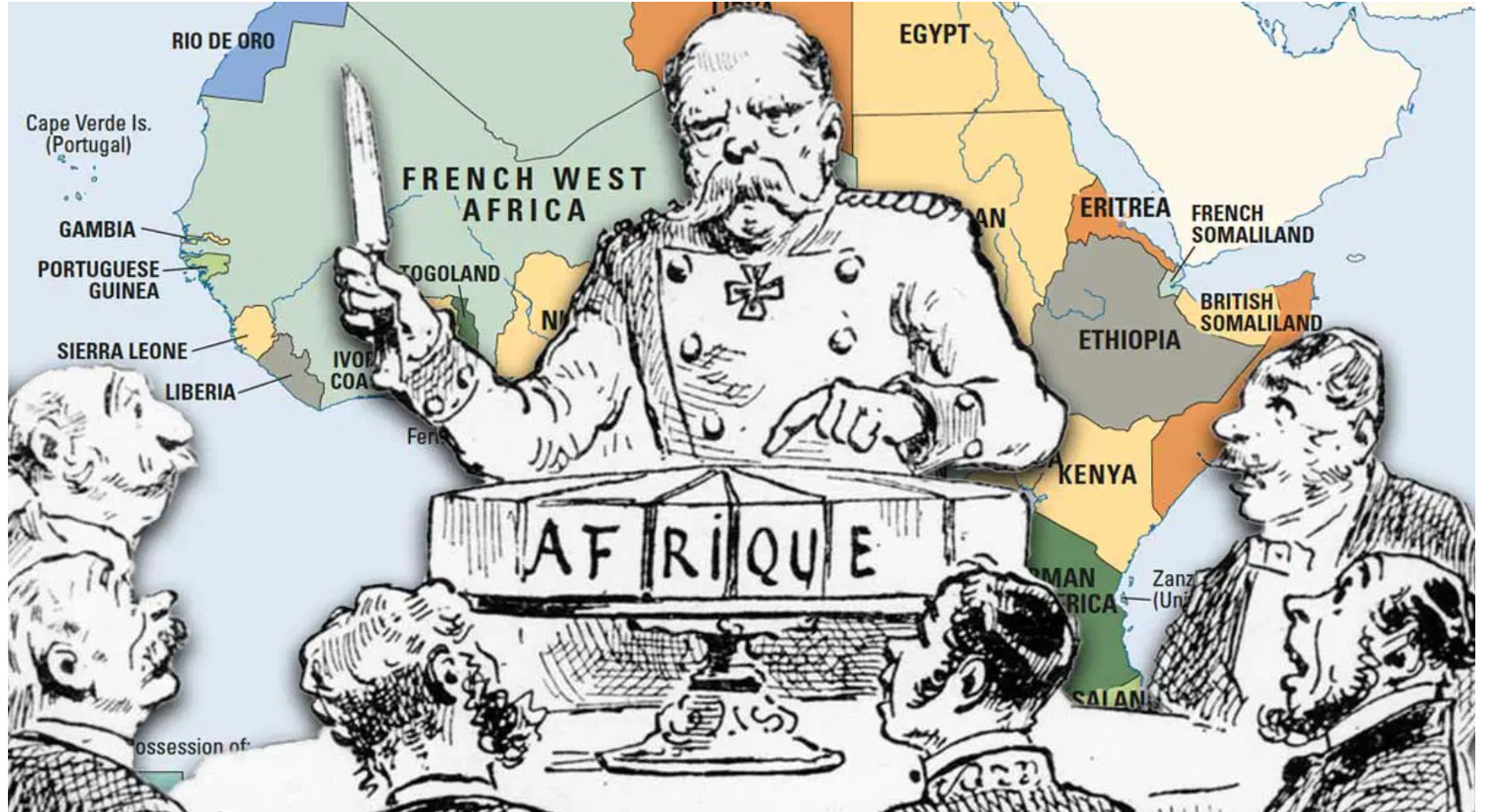
Western colonialism then imposed the complete institutional architecture through which African territories would subsequently understand, administer, and reproduce themselves. Territorial boundaries drawn at Berlin in 1884 without reference to existing political communities. Legal systems transplanted from European jurisprudence without organic connection to the governance traditions of the territories they governed. Administrative frameworks designed for extraction rather than for the flourishing of the populations within them. Educational institutions that taught their graduates to think in European analytical frameworks as the neutral standard of educated thought. The independence generation inherited these frameworks and governed within them, because they had been formed within them and had no institutional alternative to draw on.
Formal independence did not end the conflict. It suspended it in the institutional infrastructure of the post-colonial state, whose continued operation reproduces the capture it was designed to achieve.
II. The Man Who Was Outmaneuvered Once
The standard reading of Lewanika treats Lealui as the defining event of his reign — the morning he was deceived, the concession he could not recover, the kingdom he could not protect. The standard reading is wrong in its emphasis. Lealui was one morning in a reign of forty years. What Lewanika accomplished in the rest of those forty years, against the most sophisticated colonial powers in the world and with a fraction of their institutional resources, is the story that matters for what comes next.
By the late 1880s, Barotseland sat at the centre of one of the most dangerous geopolitical configurations on the African continent. The Portuguese were closing from the west and southwest, their Angolan administration pushing eastward along the Zambezi tributaries, their cartographers drawing maps that placed the Barotse heartland inside Portuguese territory. The Germans were present in South West Africa — what is now Namibia — and their northeastern expansion represented a potential pincer from the south. The Congo Free State under Leopold II was pressing south from the northeast, its agents operating in the territories that Lewanika claimed as tributary. The British South Africa Company, having secured the Lochner concession, was advancing from the south and east. Barotseland was encircled by four colonial powers simultaneously, each with superior military capacity, superior legal infrastructure, and the full weight of European diplomatic convention on its side. No other pre-colonial African ruler faced a configuration of this complexity, and almost none attempted what Lewanika attempted in response.
What Lewanika understood — and what no amount of formal legal training had given him, but that his acute political intelligence had worked out from first principles — was that the colonial powers feared each other more than they feared him. Their mutual competition was his operational resource. He could not defeat any of them individually. He could play them against each other systematically. This insight, articulated without any of the game theory vocabulary that would be developed to describe it sixty years later, is the foundation of everything he accomplished in the decades after Lealui.
The most extraordinary expression of that strategy was the boundary dispute with Portugal over the western limits of Barotseland. By the early 1900s, the contest had reached a point where both British and Portuguese claims were legally contested and neither could be resolved through bilateral negotiation between the two colonial powers without sacrificing the other's interests. Lewanika — now a formally recognised ruler under British protection, with access to the British legal system and its diplomatic channels, and with two decades of experience watching how European powers conducted their disputes — pushed successfully for the matter to be submitted to international arbitration. The arbitrator was King Victor Emmanuel III of Italy. The ruling, delivered in 1905, established the Barotse western boundary largely on terms that protected Lewanika's territorial claims against Portuguese encroachment. A pre-colonial African ruler had submitted a boundary dispute with a European colonial power to international arbitration, argued his case through the mechanism that European powers used to adjudicate their own disputes with each other, and won. This had not happened before. It has barely been recognised since. That ruling continues to define Zambia's borders from Feira on the frontier with Mozambique to the Caprivi border with Namibia, the western border with Angola, and the northwestern border with the DRC.
The analytical significance is precise. At Lealui in 1890, Lewanika operated without foreign intelligence about who his counterpart actually was, without legal counsel that understood the distinction between the Crown and a Crown-chartered company, and without any institutional backing that could have verified the ambassador's credentials or contested the document's terms. He was outmaneuvered because he lacked the epistemic tools the encounter required. In the Italian arbitration, he had access — through the British protectorate framework, imperfect and exploitative as it was — to international legal mechanisms, diplomatic channels, and the institutional infrastructure for making his case in a forum the Portuguese were bound to respect. When the playing field was equalised, even approximately, even within a framework that was not designed for him, he won.
The conclusion is not that Lewanika was sometimes brilliant and sometimes naive. The conclusion is that Lewanika was consistently brilliant, and that the single morning at Lealui was the morning the playing field was most radically unequal. He brought his full intelligence to every encounter. The outcome varied with the institutional resources he could bring alongside that intelligence. The variable was not the man. The variable was the institutional depth.
The lesson for African leaders is that intelligence without institutional infrastructure produces brilliant analysis of situations that cannot be acted upon. The specific infrastructure that determines whether intelligence is operative is: foreign intelligence analysis that tells you accurately who you are dealing with, what they actually want, and what the asymmetries in the encounter are; legal infrastructure that can make your intentions binding on a counterparty who does not share your good faith; and institutional depth that can survive the time between your initial positioning and the moment when the commitment you have secured needs to be enforced. The custodial republic is the attempt to ensure that every future encounter — with the copper multinationals, with the great powers competing for the 2030-2040 deficit, with the ASI transition's demand that African minds accept cognitive architectures designed elsewhere — is the Italian arbitration encounter rather than Lealui.
III. The Domestic Dimension
The account of Africa's civilizational conflict is incomplete if it describes only external vectors. At every phase, the external power required domestic partners — and found them. This is the dimension of the analysis that is hardest to name and most necessary to name, because it is the dimension that makes rebuilding genuinely difficult.
The Arab slave trade across the Sahara and the Indian Ocean was not conducted by Arab raiders penetrating deep into the African interior and returning loaded with captives. It was conducted through networks of African intermediaries — rulers who raided neighbouring peoples, merchants who organised the caravans, brokers who delivered people to the coastal markets — who earned rents from its perpetuation and whose political and economic position depended on its continuation. The Atlantic trade operated identically. The European presence was, for most of its four-century duration, confined to coastal fortresses. The millions of people who moved through those fortresses were captured in the interior by African political entities. The Kingdom of Dahomey built its royal treasury around the slave trade. The Ashanti Confederacy conducted military campaigns whose output supplied the Cape Coast Castle as a matter of state policy. The domestic participation was not incidental. It was structural. Without it, neither trade could have operated at the scale it reached.
The colonial period reproduced the pattern at the institutional level. The British and French administrations that governed sub-Saharan Africa with radically insufficient European personnel did so through African intermediaries — chiefs who accepted collaboration in exchange for administrative recognition, police forces drawn from communities with historical grievances against those they were deployed to control, educated elites whose European formation gave them access to colonial institutions and whose access depended on maintaining the colonial relationship.
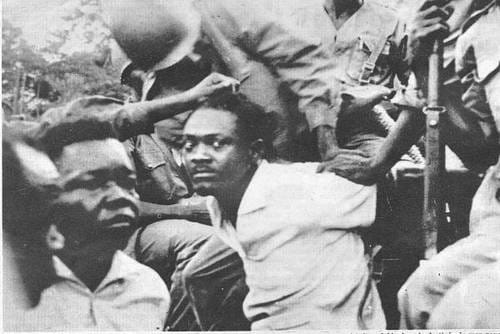
The post-colonial period has not ended the pattern. It has updated it. The coups that defined African political history between independence and the present required internal networks — officers whose ambitions aligned with foreign intelligence priorities, operators who knew which vulnerabilities to exploit, intermediaries who managed the financial architecture of transition. Patrice Lumumba was assassinated by Belgian and CIA operatives, but the mechanism required domestic collaborators who knew where he was, how to isolate him from his security, and how to ensure his killers' protection afterward. Thomas Sankara was killed by men who had served alongside him. Kwame Nkrumah was overthrown while abroad by officers who had commanded under his government. In almost every case, the external intelligence agency provided the mandate and the resources; the domestic collaborators provided the operational knowledge the external power could not have.
The pattern extends to the present in forms that are more difficult to identify precisely because they are embedded in institutions treated as legitimate. The technocrat who structures his country's debt in terms he knows will require structural adjustment is the Dahomey merchant updated for the finance ministry. The politician who accepts electoral support conditional on mining concessions that route revenues offshore is the complicit chief updated for the multiparty system. None of these actors experiences their role as collaboration in civilizational capture. Each experiences it as making rational choices under the constraints they face. That experience is exactly what a structural analysis predicts: a system that requires no individual villain because the incentive architecture produces the required behaviour without one.
The consequence is epistemic fragmentation — a broken framework of perception that makes it genuinely difficult to identify what is true, who can be trusted, and which institutions reflect authentic community interest as opposed to the interests of whoever controls the institutional label. Every African who has watched an elected representative campaign on community development and govern for personal enrichment has learned something that compounds across generations: formal institutional identity is an unreliable signal of actual institutional purpose. This accumulated distrust is not irrational. It is the accurate product of accurate learning over generations of evidence. But it creates a compounding trap of its own: if no institution can be trusted, then the coordination required to build anything collectively becomes essentially impossible.
IV. The Coordination Trap
Africa does not fail because its people lack capability or its resources are insufficient. It fails because every actor who operates within its systems, knowing those systems are failing, finds it individually rational to perpetuate the failure.
This is the coordination trap: a Nash equilibrium in which individually rational decisions produce collectively catastrophic outcomes, held in place by compounding parameters that make exit from the equilibrium more costly than continued participation in it. Weak property rights make long-term investment irrational. Extraction culture — the social legitimisation of resource capture by whoever holds institutional access — makes predatory behaviour socially acceptable rather than merely economically rewarded. Informational opacity makes accountability impossible. Short time horizons, driven by political instability and commodity price volatility, ensure that actors optimise for immediate capture rather than long-term institutional development. Each parameter worsens the others.

The Zambian case makes the structural analysis precise. At independence in 1964, Zambia was among the wealthiest countries in sub-Saharan Africa by per capita income, with the world's richest accessible copper deposits. By 1990 it had experienced one of the most comprehensive economic collapses in post-colonial African history. The copper price collapse of 1975 is the standard explanation. The Chile counterfactual demolishes it. Chile faced the same price collapse in 1975 and the same depressed market through the following decade. Chile's copper sector — through CODELCO — invested continuously in production capacity across that period. When prices recovered, Chile had more copper to sell. Zambia's ZCCM contracted production across the same period because political obligations consumed the capital production required. By the time prices recovered, Zambia had less copper than it had in the 1970s. The production collapse compounded the price collapse, and the compound effect was fiscal ruin that no single external shock can fully explain. The cause was institutional architecture — or its absence.
The deeper failure was the 1965 Local Government Act, which converted every chief's governance functions into municipal councils, stripped traditional authority of governance substance while retaining its ceremonial form, and ignored the Barotseland Agreement that Lozi acquiescence to independence had required. What the BSAC had done through deception in 1890, the post-independence government did through legislation in 1965. The mechanism differed. The outcome was structurally identical: the removal of the governance infrastructure closest to community need, with the longest time horizons, and the deepest territorial knowledge, from the architecture of the state. Zambia has been governing without those foundations for sixty years, wondering why the structure keeps failing.
V. The Coming Permanent Juncture
Previous phases of Africa's civilizational conflict were slow enough that partial resistance was possible and partial recovery, across generations, was achievable. The current juncture is categorically different, and the difference is not one of degree.
The Amazigh retained their language for twelve centuries because the Islamic conquest could not reach every mountain valley simultaneously. The Copts retained their identity because the demographic replacement of a majority population takes longer than military conquest. Interior communities retained civilizational continuity that the coasts lost because the slave trade could not penetrate everywhere at equal intensity. Traditional governance institutions survived the colonial period in attenuated form because the colonial administration could not replace all of them completely. Slow capture produces survivors and preserves possibilities.
Artificial superintelligence, when achieved, will not be slow. The estimated period between achievement and permanent irreversibility is measured in months, not centuries. The first entity — state or corporate — to achieve and consolidate ASI encodes its civilizational values into the intelligence architecture that governs the next order: into training data whose selection reflects specific assumptions about what knowledge is and what it is for; into alignment frameworks whose values reflect specific commitments about what human flourishing means; and eventually into brain-computer interface systems that will merge human cognition with that architecture, making the cognitive frameworks of the capturing civilisation not merely the ambient environment within which African leaders govern but the literal structure of their thought.
The US AI czar estimated in early 2026 that China is three to six months behind leading frontier laboratories — not years. Five US companies are projected to spend over $450 billion on AI-specific capital expenditure in 2026 alone. The race is not approaching. It is here.
Africa is not a theatre of this competition. It is the source of the physical inputs without which no power wins it. Five vectors of copper demand are moving simultaneously for the first time in history. AI data centres will consume 2.5 million metric tons annually by 2040 against 1.1 million today — a hyperscale facility requiring up to 50,000 tons per installation. Grid expansion to supply those data centres adds another million metric tons. The EV transition adds 6.3 million metric tons against 2.6 million today, as electric vehicles require nearly three times more copper than conventional ones. Military modernisation — with NATO members under pressure toward five percent of GDP in defence spending — adds nearly a million metric tons more. Humanoid robotics represents a potential additional 1.6 million metric tons if deployment reaches projected scale. Against this demand, existing and planned mines meet only seventy percent of projected 2035 demand. Mine development takes over a decade. The deficit is locked in. The S&P Global study published in January 2026 projects a global copper deficit of ten million metric tons annually by 2040 — twenty-five percent below demand even after recycled scrap doubles.
Zambia holds deposits with an average ore grade of 2.3 percent against a declining global average of 0.7 percent, making its copper strategically irreplaceable as grades deteriorate elsewhere. The DRC produces approximately seventy to seventy-five percent of the world's cobalt and holds its largest reserves. The great powers competing for ASI supremacy have already modelled this. They are acting on those conclusions now, before the deficit is fully apparent in market prices, before competing powers have completed bilateral arrangements, and — critically — before African governance institutions have built the architecture to govern the terms.
The geopolitical order within which this competition unfolds has undergone a structural break. The US National Security Strategy of December 2025 formalized the end of the post-Cold War framework. What replaces it is not genuine multipolarity but competitive anarchy: great powers in open civilizational competition whose stakes are sufficiently high that existing cooperation frameworks cannot contain the competitive pressures. New START expired on 5 February 2026 with no successor agreement. The arms control architecture that maintained strategic stability for three decades has dissolved. And ASI inverts the logic of mutual assured destruction: the first mover who achieves ASI gains the ability to prevent others from reaching the same threshold. When the alternative to action is permanent civilizational irrelevance — an infinite loss — the finite risk of nuclear exchange becomes calculable in the decision frameworks of actors under existential competitive pressure. This is the most dangerous feature of the current environment: the Promethean competition for ASI supremacy is being conducted by actors who are simultaneously managing nuclear arsenals under a collapsed arms control regime.
The Ukraine war illustrates the structural logic with precision. The Budapest Memorandum, in which Ukraine surrendered its nuclear arsenal in exchange for security assurances from Russia, the US, and the UK, is the most instructive document available for evaluating the worth of external security commitments when called upon: they are worth nothing. The lesson follows: genuine settlement requires prior defeat; defeat cannot be achieved inside the current escalatory structure; therefore diplomatic off-ramps are structurally infeasible regardless of how many peace conferences are held. Both sides negotiate because negotiating is less costly than stopping, not because the bargaining set contains a mutually acceptable outcome. The Washington Accords, signed in December 2025 between the United States and the DRC government, apply the same logic to African resource governance. They were signed under acute political duress — the M23 rebellion, backed by Rwanda and resourced in part by eastern DRC mineral revenues, had captured significant territory in North Kivu and was threatening Goma. The DRC government traded mineral access commitments for a US security guarantee it needed more urgently than it needed good contract terms. The sequencing is Lochner's sequencing: the party with superior institutional capacity, superior legal infrastructure, and superior information about the strategic value of what it was acquiring set the terms; the party under existential pressure signed them. The domestic gatekeeper mechanism was present in its most violent contemporary expression — the M23 is Congolese in its membership, Rwandan in its state backing, and mineral revenues in its economic logic, demonstrating that the collaboration pattern that enabled civilizational capture across two thousand years is still operational in 2025.
For Africa, the ASI temporal vice means that the deferral option has closed. An Africa that enters the ASI transition in its current state of civilizational capture will find that capture made not merely permanent but algorithmic: embedded in the intelligence systems that replace human decision-making across governance, commerce, education, and eventually cognition itself, impossible to resist because resistance would require operating outside the cognitive architecture through which all governance is conducted. The lock-in will not feel like imposition. It will feel like continuity.
◆
Part Two
THE EPISTEMOLOGICAL CAPTURE
"The most potent weapon in the hands of the oppressor is the mind of the oppressed."
— Steve Biko
VI. The Occupation of Epistemology
The military and political dimensions of Africa's civilizational conflict are visible and nameable. The epistemological dimension is more dangerous precisely because it is invisible to those captured within it.
African leaders who govern today were formed in institutions — universities, professional training programmes, diplomatic academies — that taught them to think about governance, economics, law, and development in frameworks designed by and for Western institutional purposes. They measure their countries' progress by indices whose construction and weighting reflects Western analytical priorities. They conduct their most consequential diplomacy in European languages. Their most talented graduates are trained to succeed within Western professional frameworks, and the incentive gradient pulls them toward Western institutions. When they seek best practice, the reference class is OECD governance. When they seek development finance, the conditionality is designed in Washington or Brussels. The capture is not experienced as capture because the frameworks within which it operates have been internalised to the point where they feel like neutrally valid ways of understanding reality rather than civilisationally specific constructs whose adoption was coerced over generations.
This is what makes Western universalism — the proposition that Enlightenment values and institutions are not one civilizational tradition among several but the neutral standard of human progress against which all others are measured and found partially wanting — the most durable form of civilizational capture. It requires no army and no administration to maintain. It maintains itself through the formation systems that produce the governing class. An African finance minister conducting debt negotiations with IMF staff does so in English or French, against analytical models built on Washington Consensus assumptions, on terms whose conditionality was designed to ensure macroeconomic behaviour compatible with the financial system's principal shareholders' interests. She does not experience this as civilizational capture. She experiences it as doing her job competently. The formation that produced her competence is the mechanism of the capture.
Every African leader who measures their country's governance quality against the World Bank Governance Indicators, the Ibrahim Index, or the Freedom House rankings is measuring themselves against the adversary's assessment criteria. The adversary designed these instruments to answer questions about what good governance looks like from within a specific civilizational tradition. An African state that scores well on these indices has demonstrated that it governs in ways that serve the interests that designed the measurement system. That is not the same thing as governing well for its own communities. The distinction is invisible to those who have been formed to treat the measurement systems as neutral.
VII. The Self-Replicating Mechanism
The deepest expression of epistemological capture is not what the governing class does. It is what they cannot imagine doing differently.
When the independence generation inherited the colonial state, they did not experience its institutional logic as foreign. They had been formed within it. The schools that produced them were modelled on European institutions. The legal systems they administered were English common law or French civil law. The economic frameworks through which they understood development were Western development economics. Nkrumah, Nyerere, and Cabral — the most intellectually sophisticated members of the independence generation — spent their most productive years trying to articulate African alternatives to the frameworks they had been formed within, and largely failed to institutionalise those alternatives against the structural inertia of the systems they had inherited. The frameworks reproduced themselves not through coercion but through the formation systems that produced each successive generation of governance.
The NGO sector is the contemporary mechanism through which epistemological capture is maintained and extended. It is a parallel governance system that is not named as such — delivering health services the state does not deliver, running education programmes the state does not fund, managing conservation projects on territory the state does not effectively govern, employing a substantial portion of the educated professional class at salaries the civil service cannot match. Its accountability runs upward to donors in Washington, London, Geneva, and Stockholm, not downward to the communities it serves. The community is a beneficiary, not a principal. It receives services designed according to the donor's programme logic. The NGO country director who governs a programme budget larger than a district council's entire annual allocation answers to a programme officer in a foreign capital whose assessment criteria were designed in that foreign capital's institutional culture. The capture is self-replicating across institutional forms.
The judiciary is the institution where epistemological capture operates most consequentially and most invisibly. A judge trained entirely in the common law tradition, appointed through a judicial service commission modelled on the Westminster original, operating within procedural rules derived from English civil procedure, is adjudicating disputes about community land, natural resource governance, and traditional authority through a framework designed for a different civilisation's governance problems. They do not experience this as a problem. They have been trained to believe that common law categories are the sophisticated way of thinking about law, and that customary governance traditions are pre-legal antecedents that common law has superseded. The judgments that follow from this formation systematically undermine the governance traditions that are most deeply rooted in African communities, because those traditions are most illegible in the legal framework the judge has been formed to apply.
VIII. Why Reform Has Failed
Six decades of development economics, donor intervention, governance reform, and anti-corruption initiatives have not escaped the coordination trap because they have consistently misdiagnosed the problem.
The standard diagnosis identifies symptoms — corruption, weak institutions, poor governance — and prescribes institutional reforms calibrated to improve performance on metrics designed by external actors. The diagnosis is not wrong. It is shallow. It describes the surface expression of the trap without identifying the epistemic substrate that maintains it. You cannot reform your way out of a formation problem with reforms designed within the captured framework. The reform itself replicates the capture.
Zambia's post-independence governance history demonstrates this with precision. The Barotseland Agreement, signed in London as the price of Lozi acquiescence to the independence settlement, was simply ignored by the UNIP government. Not violated through contested interpretation. Ignored. When governance reform in subsequent decades produced new institutional frameworks — community-based natural resource management, decentralisation programmes, district councils with expanded mandates — each was enacted within the same colonial institutional logic that had always routed control and revenue away from communities. The reforms improved performance on the metrics being measured. They did not change the underlying distribution of governance power. They could not, because they were designed within the framework that distributed power away from communities in the first place.
The Konkola Copper Mines case is the contemporary demonstration. When Zambia's government placed KCM under provisional liquidation in 2019, following Vedanta's environmental violations and royalty disputes that normal contractual mechanisms could not resolve, the decision was domestically popular, legally questionable, and operationally catastrophic. The Zambian state had no institutional capacity to operate the mine itself, no national trading entity to market the output, and no alternative investor relationship ready to assume the asset. The result was years of production decline and eventual renegotiation with Vedanta from a weaker position than the original dispute. The government demonstrated political will. It demonstrated the absence of the institutional architecture that makes political will operative. Political will without institutional architecture is performance. The captured framework produces the performance and absorbs the frustration, leaving the underlying structure intact.
IX. What Epistemological Capture Means for the ASI Transition
The specific danger of epistemological capture at the moment of the ASI transition is not that African states will be invaded or colonised in conventional senses. It is that they will adopt the cognitive architecture of the transition willingly, because it will be presented as — and experienced as — progress.
Every previous phase of Africa's civilizational conflict required some degree of coercion. The slave trade required military capacity to capture or the political capacity to organise capture. Colonial administration required the threat of force even when force was not applied. The post-colonial institutional framework required the conditionality mechanisms of international financial institutions to maintain. Each of these left visible traces — the refusal to be enslaved, the anti-colonial independence movement, the resistance to structural adjustment — that constituted the partial survivals from which recovery remained theoretically possible.
Brain-computer interface systems that merge human cognition with proprietary superintelligent networks will not be presented as capture. They will be presented as enhancement. The governing class that adopts them will be more cognitively capable in every measurable dimension: faster processing, better pattern recognition, superior analytical capacity, access to information and modelling tools that unaugmented minds cannot match. In a competitive environment where other governing classes have adopted these systems, the choice not to adopt will look like strategic incompetence. The civilizational values encoded in the architecture — the specific assumptions about what knowledge is, what governance is, what human flourishing means, whose frameworks are valid — will be invisible because they will feel like the furniture of thought rather than the imposition of an external system. The capture will be, for the first time in the full two-thousand-year sequence, genuinely voluntary. That is what makes it permanent. The fact that leaders are sleepwalking into this dynamic is the capstone of 2300 years of African failure to appraise risk and act accordingly.
The secular states leading the Promethean competition cannot provide a principled counter to this. Post-Enlightenment humanist ethos asserts human dignity as a foundational value without the theological grounding that originally gave dignity its content. The secular resistance to transhumanism rests on intuition — it feels wrong — without a principled account of why it is wrong that survives competitive pressure. When Elon Musk argues that merging with artificial superintelligence is the only way humanity survives the transition, there is no secular humanist counter-argument that does not ultimately concede his premises while disputing his conclusions. The secular tradition can say the human mind should not be networked and written to. It cannot say why, in terms that do not dissolve under the logic of the competition it is trying to resist.
Africa's epistemological capture, if uncorrected, means that the governing class will be the last to perceive this danger and the first to embrace the solution that makes the danger permanent. They will adopt the framework that feels most sophisticated — the one that scores best on the metrics they have been formed to value — and that framework will be the one designed by whoever achieves ASI first.
◆
Part Three
THE CUSTODIAL REPUBLIC
"We did not inherit the earth from our ancestors. We borrow it from our children."
— attributed to various traditions

X. Starting Where the Survivals Are
The only epistemologically defensible starting point for rebuilding is the institutions that actually survived. Not the institutions that were designed to survive. The institutions that survived despite being designed against.
The formation systems that produced the governing class — colonial schools, missionary universities, post-independence institutions modelled on European originals — are the mechanism of the epistemological capture. They cannot be the starting point for a response to it. If the problem is that African governing classes have been formed within frameworks designed by others, the solution cannot be designed within those frameworks. It must be grounded in something whose legitimacy derives from a different source entirely.
The institutions with the longest track record of surviving the civilizational assault are the ones whose legitimacy derives not from state recognition, external validation, or commercial relationship but from the accumulated practice of specific communities governing specific territories across generations in ways that the communities themselves recognise as legitimate. The Barotse Royal Establishment in Western Province has governed the Zambezi floodplain and its communities for centuries. It survived the Lochner Concession. It survived colonial indirect rule. It survived the 1965 Local Government Act that stripped its formal governance functions. It survived six decades of post-colonial marginalisation. Its legitimacy — the community's recognition of its authority — does not depend on state endorsement, which is why state withdrawal of endorsement in 1965 did not end its governance function. The community continued to bring its disputes to the Kuta. The Kuta continued to adjudicate them. The governance continued because its legitimacy root was harder to sever than any externally recognised institution's legitimacy root. That empirical resilience is the custodial republic's foundation.
Invoking traditional institutions as the starting point requires naming precisely what is not being claimed. It is not claimed that traditional institutions are repositories of pure, uncorrupted wisdom unsullied by the conflicts of history. Chiefs collaborated with slave traders. Paramounts accommodated colonial administrators. Traditional leaders converted communal land into personal concessions. The gatekeeper dynamic operated within traditional institutions as reliably as it operated within colonial and post-colonial ones. The argument for building on traditional institutions is not that they are pure. It is that they are the institutions with the longest demonstrated track record of surviving assault, and that their legitimacy root — the relationship between a specific leader and a specific community on specific land across generations — is harder to sever than any other available foundation. Enhancement rather than replacement is not a conservative instinct. It is the only response to the evidence that is epistemologically defensible.
The Royal Bafokeng Nation demonstrates what building on that foundation, with institutional enhancement, produces. Registered freehold title established before platinum was discovered on their land gave the Bafokeng legal standing in commercial courts when extraction began without their consent. That legal standing enabled litigation. The litigation produced a settlement. The settlement enabled institutional diversification that secured the community's position against subsequent political recalculation. The causal chain begins entirely with the registered title established before the contest began. The sequencing is everything. The full architecture of the Fractal Royal Estate system — described in Section XX — extends this logic to the entire territory of the custodial republic.
XI. The Fractal Architecture and Economic Sovereignty
The custodial republic's governance architecture rests on a single logic applied at every scale: natural capital is held in trust across generations, governed by institutions whose authority derives from territorial rootedness and community accountability, with revenue flowing through a structured system that ensures benefits reach the communities from whose territories they are generated.
The fractal logic means the system does not depend on any single institutional node. Disruption of any node does not collapse the system; it activates the oversight function of the level above and the accountability function of the level below. Ward trusts report to area trusts, which report to district trusts, which report to provincial trusts. At each level, the trust's governance body is drawn from the community it serves, with meritocratic appointment requirements that prevent both elite capture and the appointment of the unqualified. The specific property rights architecture, a freehold system for the trusts and a leasehold system for everyone else, and the intelligence functions that each level administers are described in full in Section XX. What the fractal logic accomplishes structurally is described here.
A national trading entity closes the economic sovereignty gap that converts formal sovereignty into the performance of sovereignty. Zambia is formally sovereign. Its mineral revenues flow to Zurich, London, Shanghai, and Toronto. The proposed entity would act as the central marketing vehicle for all of Zambia's critical minerals output — purchasing from producers at market-referenced prices and selling into international markets through its own trading desk. At the volumes that the 2030-2040 deficit makes Zambia's grade-advantaged deposits worth, this entity would become one of the world's largest copper traders by volume. That scale creates pricing power that no royalty structure can replicate. A seller with sufficient volume does not price-take from market discovery processes it plays no role in. It participates in price formation. It also allows capital formation to take place at two points; royalties from production (flowing to communities and the state) and margin from commodity trading (to the state). This allows the Republic to benefit more materially from the factors of production; specifically its land--and its marketing of production output generated by expert mining houses. It also allows the State to close the arbitrage flows that foreign multinationals engage in to reduce taxes via transfer pricing and inter-company trading. Mining operators gain efficiency not from tax planning but from operational efficiencies; capital formation within the State allows it to begin financing its own exploration and domestically owned mining operations--or indeed any extractives.
The revenue-based royalty replaces the cost-based royalty that mining companies have manipulated for decades. The mechanism is straightforward: declare operating costs high enough that royalty thresholds based on profitability are never reached. A revenue-based royalty calculated on gross output removes the manipulation opportunity entirely. It is simple to audit and impossible to obscure through transfer pricing. The sovereign wealth architecture converts commodity revenue surpluses into permanent capital rather than current expenditure. The provincial trust structure adds the dimension the Norway model does not include: a defined percentage of mining revenues from each province flows into a provincial trust, governed by the provincial elder council, whose investment mandate is the intergenerational benefit of the province's communities.
XII. Constitutional Depth
The custodial republic's most important innovation is not any specific governance mechanism. It is the depth at which those mechanisms could be constitutionally embedded.
Zambia's post-independence governance history is a history of mechanisms that were legislatively enacted and legislatively reversed — the Barotseland Agreement ignored, the Local Government Act passed, recognition given and withdrawn — because legislative enactment is vulnerable to the political majority that any subsequent election might produce. Constitutional inalienability is the specific response. The natural capital trust system, the national trading entity's mandate, the BCI prohibition, the formation system's Abantu philosophy foundation — these are embedded in constitutional provisions that require a supermajority to amend, with additional safeguards that make amendment require a referendum in the affected provinces. An elected government that finds the provincial trust architecture inconvenient cannot simply legislate against it. It must mount a constitutional amendment campaign that requires the support of the communities whose institutional standing it would remove. The political economy of that campaign — attempting to take institutional power from communities who hold it — is prohibitive in ways that the political economy of simple legislative reversal is not.
A proposed dual Head of State architecture addresses the accountability gap between national governance and community governance. Two Paramount Chiefs act as Constitutional Monarchs, and the seats rotate every two years; no one Paramouncy presides alone--but two act as Counsels as was the case in Rome. Members of Parliament are voted for in General Elections, and a Prime Minister is chosen from among the MPs in the National Assembly; with cabinet drawn from the same. A senior chamber in the National Assembly is constituted and holds specific constitutional powers: the right to convene in any governance crisis, the right of institutional petition to the Constitutional Court, and the standing to initiate referendums on natural capital governance questions that affect traditional communities. These are operational powers whose exercise changes the political calculus for any government that considers overriding the custodial architecture. The council cannot govern in place of the elected executive. It can make override costly enough that the political calculation systematically favours accommodation.
The Party and the Republic
Athens invented democracy before it invented the party, and the sequence matters. Cleisthenes established the Ekklesia in 508 BC on a deliberate principle: the lottery rather than election, the citizen directly rather than the faction. For two generations it produced a civilisational achievement unmatched in the ancient world — the Parthenon, Sophocles, Thucydides — because it formed the citizen as a moral and political being capable of governing rather than merely electing someone to govern for them. Then it killed Socrates, voted the Sicilian Expedition on the strength of Alcibiades's brilliant dishonesty, and destroyed itself. Direct democracy without institutional memory, without structural protection for dissent, without any mechanism between the demagogue's rhetoric and the binding decision, was governance by whoever could most compellingly address the crowd on a given afternoon. The party was invented to solve this problem. It solved it imperfectly and introduced problems of its own that Athens had not faced.
Rome did not inherit Athens's experiment. It developed independently, from the trauma of kingship rather than the aspiration to popular governance, and what it produced was in many ways more durable: the aristocratic republic, a system designed not to express the popular will but to prevent any single will from becoming total. The Senate's collective authority, maintained by the mos maiorum — the way of the ancestors, the accumulated custodial wisdom of generations — converted aristocratic competition into institutional governance for four centuries. The Roman aristocracy governed collectively not because they were virtuous but because the alternative, one man's dominance, was worse for every aristocrat except the one man. That structural alignment of interest with institutional preservation was the Republic's genius, and it worked until the competitive pressures of empire made it insufficient.
The Optimates who defended the Senate in its final decades were simultaneously right and useless. They correctly identified that the Senate's collective authority was the specific thing preventing autocracy, and they used that correct identification as a screen for an oligarchic capture that had already hollowed out the institution they claimed to protect. The late Republic's Senate was not the instrument of Roman collective governance that the mos maiorum described. It was an instrument of factional competition among a handful of great families who blocked land reform, ignored the dispossession of the Italian peasantry, and converted the authority of tradition into a mechanism for preventing any governance response to the social crises that imperial expansion had produced. The form of the Republic was intact. The substance had been converted into the private property of the class that performed it. When Cicero wrote of the res publica he was describing an institution already performing itself rather than governing.
Caesar did not destroy the Republic. He named what had already happened — which is why his crossing of the Rubicon was simultaneously an act of treason against the form and a diagnosis of the substance. He was an Optimate who defected, a man who understood the Roman system from inside it and used that understanding against it when the system refused to accommodate his ambitions within its normal channels. The Caesarian logic — personal authority filling the vacuum created by institutional hollowing — did not solve the problem it identified. It eliminated the institutional constraint along with the oligarchic capture, leaving nothing between Roman governance and whoever commanded the most loyal army. Augustus achieved what Caesar had not: he gave the autocracy an institutional form that survived his body, maintaining every Republican institution in its traditional form while draining each of substantive power. The Republic performed itself. The Principate governed. The lesson is the one that neither Athens nor Rome had fully applied: an institution whose authority derives from demonstrated excellence rather than class membership or charismatic seizure requires something deeper than shared tradition or electoral legitimacy as its foundation.
The modern political party emerged not from philosophical design but from parliamentary coordination problems in 1670s England, and what it produced across three centuries was a mechanism for aggregating interests into governing coalitions at the scale that democratic legitimacy requires. It simplified politics to the point of democratic operability. It also reproduced, in mass-democratic form, the same pathologies that Athens and Rome had demonstrated. The French Revolution showed what partisan ideology produces without institutional container: the Committee of Public Safety, the Terror, the guillotine as the instrument of doctrinal purity. The American Civil War showed what the party system produces when partisan logic makes compromise structurally irrational: six hundred thousand dead in a conflict whose specific form was shaped decisively by two parties whose electoral arithmetic required maximum polarisation. The rise of fascism in Germany and Italy showed what the party system produces when institutional depth is insufficient to constrain a party that wins power and then dismantles the system that legitimated its victory. Hitler did not destroy Weimar democracy with a coup. He destroyed it from within, using the party system's own legitimating mechanisms — elections, parliamentary procedure, coalition mathematics — to acquire the power that abolished those mechanisms.
Africa received the party at the worst possible moment. The independence movements required mass political organisation, and the party was the organisational form available, producing governing institutions built for one purpose — mobilising populations against colonial rule — that were immediately required to serve a completely different purpose in the context of a Cold War that converted every African political contest into a field of superpower competition. The African governing class formed in the 1940s and 1950s returned from London, Paris, and Moscow carrying not only colonial formation but the specific ideological frameworks embedded within it. Nyerere's Fabian socialism was sincerely held and also a direct transmission of British Labour Party thinking into Tanzanian governance. The Marxism of Nkrumah and Sékou Touré was genuinely their intellectual commitment and also a framework whose adoption made them immediately legible to Soviet intelligence as potential partners and to American intelligence as targets. The ideological sincerity was real. The epistemic capture was simultaneously real. The two were not in contradiction, because the most durable capture is the capture that feels like conviction.
Foreign intelligence services did not need to manufacture African party politics as an instrument of external control. They found it ready-made. Nkrumah was overthrown with CIA support not because American intelligence cared about Ghana's constitutional order but because his non-alignment policy was incompatible with Cold War resource management. Lumumba was assassinated because his insistence on genuine Congolese sovereignty over the Congo's mineral wealth was incompatible with Belgian and American strategic interests in Katanga's copper and uranium. Mobutu governed for thirty-two years with consistent Western support because his venality was manageable and his anti-communism was reliable. The Angolan civil war cost five hundred thousand lives sustaining an MPLA-UNITA-FNLA triangular conflict whose ideological distinctions dissolved the moment external support was withdrawn, leaving three armed organisations competing for control of an oil economy — which is what they had always been beneath the ideological performance. In Zambia, the pattern operated in its everyday rather than catastrophic form: UNIP's Humanism as a non-aligned framework generating both Western development finance and Eastern solidarity support, the one-party state as a patronage architecture performing ideology while distributing copper revenues to coalition maintenance, and the multiparty opening of 1991 producing not ideological competition but a transition between patronage systems operating under democratic forms. The parties that have contested Zambian governance since 1991 are not distinguished by coherent ideological differences. They are distinguished by the specific coalitions of ethnic, regional, and business interests each has assembled. This is not Zambia's failure. It is what the party system structurally produces in the absence of the institutional infrastructure that makes ideology governmentally relevant.
The left-right distinction that has organised Western partisan politics since the seating arrangements of the 1789 National Assembly maps poorly onto African governance not because Africans lack ideological sophistication but because the argument the left-right distinction is designed to resolve is not Africa's most urgent governance question. Left and right dispute the appropriate boundary between state and market in an industrial capitalist economy with an established tradition of individual rights that pre-dates the state and institutional infrastructure robust enough that the boundary question is meaningful and practically resolvable. The primary challenge in Africa is not where to draw that boundary. It is whether any governance structure can be built that prevents natural resource revenues from being extracted by whoever controls the interface between the country and the international markets that value what the country holds. That question has no left answer or right answer. It has an institutional architecture answer or no answer. The custodial republic is a capitalist society with a custodial structure: private enterprise is encouraged, protected, and expected to generate productive returns; natural resource rents flow to the commonwealth through the fractal estate system; the state provides the baseline welfare that makes private enterprise possible; and the natural capital inheritance is held in constitutional trust because it belongs to no individual, having been bequeathed by the ancestors and owed to the descendants simultaneously.
The Academy performs the ideological function that the party system performs badly, not through the transmission of doctrinal positions but through the formation of persons. The distinction matters because parties are interest coalitions whose ideological commitments are instruments of coalition maintenance, deployed selectively when useful and abandoned when inconvenient. The Academy operates on seminary logic: not teaching a subject but changing someone into a person whose understanding of governance, natural capital, constitutional obligation, and intergenerational accountability is unified at the level of perception rather than layered as competency over conviction. The mandarin examination that qualifies every MP, civil servant, and traditional successor extends this formation logic across every domain of institutional authority — not as a credential to be earned once and displayed permanently, but as an assessment that persists across the entire arc of a governing career, updated continuously by the revered elder councils whose accumulated operational experience constitutes the evidence base against which the formation is tested. And before anyone governs in any institutional capacity, they must first have governed for a community: a ward Kuta, a school board, a trust council whose accountability runs downward to people rather than upward to hierarchies. The civic board prerequisite is not a procedural requirement. It is the specific mechanism through which the Optimate pathology — institutional access without the downward obligation that should accompany it — is broken at the foundational level.
The political party does not disappear in the custodial republic. It becomes honest. Stripped of the pretence that it is a vehicle for ideology — the pretence that has been the mechanism through which foreign intelligence services and foreign capital have entered African governance for six decades — it becomes what it has always actually been: a coalition of individuals competing for the right to govern within a framework they cannot dismantle, through an examination they cannot bypass, toward the service of communities whose judgment constitutes the only test that ultimately matters. The constitutional architecture removes from electoral competition the questions whose answers must not depend on who won the last election — the natural capital inheritance, the BCI prohibition, the Academy's independence, the inalienability of the estate system. What remains within electoral competition is what democratic choice is legitimately valuable for: the pace of infrastructure investment, the specific terms of bilateral relationships, the balance between current welfare and long-term endowment accumulation. The individual MP votes their informed conscience rather than the party whip, because the formation system has given them something more fundamental to be loyal to than their party's electoral arithmetic. The history that runs from Athens through the Roman Senate through the independence-era parties to Lusaka 2026 has consistently asked the same question: how do you build an institution whose authority derives from demonstrated service rather than from class membership, electoral victory, or ideological performance? The Academy is the custodial republic's answer. Not because it is African. Because it is adequate to the problem that two and a half thousand years of history has consistently demonstrated no previous answer has been adequate to.
XIII. The Formation Response to Epistemological Capture
An architecture that depends on people formed within the captured framework to govern it will reproduce the capture through governance. The formation system is therefore not an ancillary component of the custodial republic. It is the mechanism through which the epistemological capture is actually reversed, rather than merely described.
The distinction between a university and a seminary is ontological, not methodological. A university transmits knowledge. A seminary forms persons. The seminary graduate has not learned a subject. They have been changed into someone. If the custodial republic's formation system operates on seminary logic, then Abantu philosophical formation — the African governance tradition's understanding of personhood, obligation, territorial stewardship, and intergenerational accountability — is not a course within the curriculum. It is the medium the entire institution operates in. The technical competencies the curriculum includes — natural capital valuation, commodity trading, constitutional law, fiscal management, international regulatory frameworks — are taught within the philosophical formation, not alongside it. The goal is a person who performs natural capital valuation from within Abantu ontological foundations — whose understanding of what natural capital is and what valuation serves is shaped at every level by the custodial framework the formation has built into their perception.
The civic board prerequisite extends the formation logic across every domain of institutional authority. Before any person governs in any institutional capacity — the legislature, the judiciary, the senior civil service, corporate boards, NGO governance — they must first have governed for a community. Served on a school board, an area Kuta, a trust council — a body whose accountability runs downward to people rather than upward to hierarchies, funders, or shareholders. There are no exceptions and no parallel tracks. The judiciary application is the most consequential: a judge who has never governed for a community adjudicates disputes about community land and resources through a legal framework designed elsewhere, without personal experience of what custodial governance feels like as a living system. The civic board prerequisite means every judge who sits on a Zambian bench has first sat in a governance body whose logic is custodial.
XIV. The Theological Foundation
Every society assumes an ontology — a set of commitments about what human beings are, what they are for, and what therefore may and may not be done to them. The custodial republic's response to the epistemological capture must be grounded in an ontology that is genuinely African and constitutionally operative, not borrowed and internalised.
Zambia's constitution declares the country a Christian nation. Christianity in Zambia is not practiced as a matter of private concern. It is the public ontology of the nation. The secular states leading the Promethean competition have their own ontology, though they rarely name it as such: post-Enlightenment humanist ethos in which religion is private, the state assumes a formally neutral posture toward ultimate questions, and human dignity is asserted as a foundational value without the theological grounding that originally gave dignity its content. The guardrails of religious morality persist as an epistemological echo of the Christian ontology that preceded the Enlightenment settlement — embedded in legal frameworks and moral intuitions that secular liberalism inherited from Christendom without fully acknowledging the inheritance. But echoes decay.
The specific consequence is that the secular states' resistance to cognitive capture through BCI is structurally weak. They can say it feels wrong. They cannot say why it is wrong in terms that survive competitive pressure. Zambia's constitutional Christianity provides the load-bearing prohibition. Not a strategic claim — we are concerned about cognitive sovereignty — which is negotiable under sufficient pressure. A theological claim: this mars the image of God. The imago dei argument against transhumanism operates through three violations. The human mind as constituted — its privacy, interiority, and irreducible subjectivity — is part of bearing the divine image. A mind readable and writable by external systems is no longer a creature in covenant with God; it is a node in a network whose sovereignty lies elsewhere. Christian ethics — sin, repentance, forgiveness, sanctification — is predicated on the individual person standing before God as an irreducible subject. A mind networked into shared cognitive architecture does not confess; it is indistinguishable from the network, and the covenant structure breaks down. And BCI creates a new category of being whose governance is ultimately exercised by whoever controls the network — not merely a sovereignty problem, but a theological category error.
An ontological claim grounded in constitutional Christianity cannot be traded away without apostasy — without the governing class declaring that the constitutional foundation of the republic does not bind when inconvenient. That declaration has a political cost in a deeply Christian society that no urgency argument about the Promethean competition can overcome. The secular state negotiates. The custodial republic does not negotiate what is constitutionally sacred.
XV. Traditional Authority as It Is
To understand what the custodial republic proposes, it is necessary first to understand what traditional authority in Zambia actually is today — not as romanticised heritage, not as constitutional aspiration, but as a living governance reality whose strengths and limitations are both visible in the daily experience of the communities it serves.
Traditional authority in Zambia operates across three distinct levels, each with a different territorial scope, a different governance function, and a different relationship to the communities it serves. These levels predate the colonial period, survived it in attenuated form, and continue to function in the present despite sixty years of post-independence policy that has variously ignored, undermined, co-opted, and periodically celebrated them.
The sub-chief is the most local expression of traditional authority — the leader whose jurisdiction covers a ward or cluster of villages, whose community knows him or her personally, and whose decisions about land use and community disputes are made in direct relationship with the people most immediately affected. The sub-chief's Kuta — the deliberative council through which governance decisions are reached — is the institution where land disputes are most commonly brought, where local natural resource decisions are most practically made, and where the community's governance is most directly visible and most directly accountable to those governed. In the historical and contemporary order, however, the sub-chief's Kuta operates largely outside formal legal recognition. Its decisions carry community legitimacy but lack legal enforceability in state courts. The sub-chief who protects a forest, maintains a watershed, or manages a fishery on behalf of the community receives no institutional recognition for that governance and no economic return from the value it produces. The community's custodial work is invisible to the formal economy and unrewarded by the formal state.
The senior chief governs at the district level — a territory encompassing many wards and many sub-chiefs, each of whom owes governance deference to the senior chief while retaining the authority appropriate to their own jurisdiction. The senior chief's authority is both broader and less immediate than the sub-chief's. In the historical and contemporary order, the senior chief similarly operates without formal legal standing over the most consequential natural resource decisions in their territory. Mining licenses are issued by the national state. Timber concessions are awarded by the Forestry Department. The governance function is real and respected by communities who rely on it; the economic function is absent.
The monarch or paramount chief — the Litunga of the Lozi, the Mwata Kazembe of the Luapula, the Chitimukulu of the Bemba — governs at the provincial scale and embodies something neither the sub-chief nor the senior chief embodies in the same degree: the total territorial sovereignty of a people, expressed across centuries of continuous governance on specific land. The paramount is not a more senior administrator. The paramount is the living institutional expression of a civilisation's continuous presence on its territory. In the historical and contemporary order, this claim is acknowledged ceremonially and ignored practically. The national state issues the mining licenses. The national state receives the royalties. The paramount's Kuta deliberates, advises, and occasionally protests. It does not govern the territory's natural capital in any sense that international commercial and regulatory frameworks recognise. The civilizational claim exists. Its institutional infrastructure does not.
This is the current order. Traditional authority is present, legitimate, and without the institutional depth to make its governance operative at the level where the critical decisions are made. The custodial republic's proposition is that this gap — between the governance legitimacy that the chieftaincy system possesses and the institutional depth it lacks — is the specific gap the architecture is designed to close. Not by replacing traditional authority with something new. Not by absorbing it into the administrative state. By supplying what it lacks: legal standing, property rights infrastructure, formation systems, economic architecture, and constitutional protection at the depth required to make the governance that communities already recognise as legitimate also operative at the level where mineral rights are adjudicated, where timber concessions are negotiated, and where great powers seek supply access.
XVI. The Revered Elder: The Bridge Between Two Worlds
Before describing the custodial republic's envisioned order, there is a figure who must be introduced — someone who does not govern from within any of the three levels of traditional authority and does not hold elected office, but whose governance function is the most consequential in the entire system for the quality of what the system produces across time. This is the revered elder.
The revered elder is not defined by age. The custodial republic has no use for a council of old men who have spent their lives within the walls of a single institution and accumulated authority through proximity and seniority. What it requires, and what the revered elder embodies, is something far rarer: a person who has achieved genuine professional excellence in the wider world — in commodity trading, constitutional law, military command, agricultural innovation, corporate governance, international diplomacy — and who has done so without losing the roots that connect them to their people, their land, and the governance traditions their community has sustained across generations. The revered elder is not someone who left and became cosmopolitan. The revered elder is someone who left, proved themselves against the widest available field, and returned carrying both what they earned out there and what they never stopped knowing about home.
Consider what this means in practice. A man grows up in a chieftaincy in Luapula Province. He speaks the language of the Kazembe paramountcy. He knows which streams flood in a wet year, which elders hold which land disputes in memory, which families have governed which stretches of the Luapula river across living memory. He attends the district school, is selected for the National Academy, completes his formation, and over the following thirty years builds a career managing critical minerals commodity trading at the national trading entity — negotiating copper offtake agreements with Chinese and European buyers, structuring pricing terms against market indices, developing the institution's intelligence capacity about how CMOC's commodity desk and Glencore's African operations actually deploy their strategies. By the time he retires, he knows things that no textbook and no training programme can produce: how the counterparty actually thinks at the moment a deal is being closed; which concessions they will accept and which they will walk away from; what information they are counting on you not having; and precisely why information asymmetry, in any commodity negotiation, flows systematically toward whoever has the deeper market intelligence. He has failed in negotiations and recovered and adapted and learned in the specific ways that thirty years of doing it at scale produce.
And he is from Luapula. He still goes home for the ceremonies. He knows the paramount's family. He understands, not from a briefing document but from having grown up inside it, the specific governance logic of the Kazembe paramountcy — why certain land decisions require certain deliberative processes, which community relationships are load-bearing, what the community actually needs from the institutions that are supposed to serve it. He can walk into a negotiation with a major mining operator on behalf of the provincial trust and bring both the technical sophistication of thirty years in commodity markets and the territorial legitimacy of a man whose people have governed this land for centuries. He can sit on the National Academy's elder council and tell its faculty precisely which parts of the formation curriculum prepared him for what he actually faced, and which parts produced graduates who arrived at their first real negotiation underprepared in ways that cost the community real money. He can sit on a district secondary school's governing board and answer the question that the school's own teachers cannot answer from inside the classroom: are we forming these children into people capable of bridging the two worlds they will have to navigate, or are we producing one kind of person at the expense of the other?
This is the revered elder. The bridge is the point. African governance has suffered acutely from a forced choice between two kinds of inadequacy: leaders who are technically sophisticated but epistemologically captured, formed entirely within Western institutional frameworks and increasingly disconnected from the communities whose interests they are meant to serve; and leaders who are rooted in community traditions but without the institutional range to make that rootedness operative in the international forums where the most consequential decisions about those communities are actually made. The revered elder dissolves this forced choice. They are both. The technical sophistication and the territorial rootedness are not in tension within them — they are integrated, because the career that produced the sophistication was conducted by someone who never stopped being from somewhere specific.
The obligation of excellence is the constitutional mechanism that ensures revered elders exist in sufficient number and quality to fill these functions across the entire fractal. In Western systems, excellence is privately owned. A person earns it, benefits from it, retires from it, and if they choose to give back, that generosity is celebrated but optional. In the custodial republic, the community's claim on excellence is primary and constitutional: the community that raised the person, the school that formed them, the Academy that developed them, the trust system that gave them the platform from which their career was built — all of these are investments whose return the constitution requires. The elder's seat is not a retirement gift. It is the completion of the investment cycle that the community opened when the person first entered a school in their ward. The young person who sees the revered elder sitting in the Kuta or governing the school board understands something no careers guidance programme can communicate: the highest aspiration is not to escape the community. It is to go out, prove yourself in the widest available field, and come back worthy of the trust the community places in the people who govern it.
XVII. The Ward Level: Sub-Chiefs and Their Kutas
In the historical order, the sub-chief's Kuta governs with community legitimacy and without legal force. In the custodial republic's envisioned order, this changes at the foundational level.
Under the custodial republic, the ward Kuta becomes the primary governance institution of a Royal Estate that holds, in registered form, the full bundle of property rights corresponding to the territory it governs: freehold title to the land, mineral rights to what lies beneath it, forest and ecosystem rights to what grows above it, and water rights to the systems that flow through it. The sub-chief becomes the constitutional custodial trustee of this estate — not its personal owner, but its trustee across time, with obligations running simultaneously backward to the ancestors whose stewardship of the territory is the foundation of the community's claim, and forward to the descendants whose inheritance the sub-chief is constitutionally bound not to impair. This dual temporal obligation is enforceable in ways it has never previously been: property rights held in registered form, protected by constitutional inalienability provisions, and governed through a Kuta whose deliberations are formally recorded and whose ratification is the legal condition of any transaction affecting the estate's assets.
The ward Kuta's deliberative structure in the envisioned order reflects the full social architecture of the community: the sub-chief's senior indunas, a women's governance council with specific constitutional standing addressing the marginalisation of the community members with the deepest daily relationship to the land's management, a youth council with rotating membership, and the ward's revered elder panel. The elder panel at the ward level is composed of the ward's own bridge figures — people who grew up in this specific place, left to build careers in the wider world, and returned carrying what they earned out there alongside what they never stopped knowing about home.
The ward Kuta does not merely ratify natural capital transactions proposed by others. It governs the ward Royal Estate as an active institutional landlord. It issues leaseholds to forest operators who wish to harvest timber — on terms the Kuta sets, for durations the Kuta controls, subject to management conditions whose compliance the ward trust monitors and enforces. It issues surface access agreements to mining exploration companies — on terms that include data-sharing provisions, ensuring that the seismic and geochemical intelligence the exploration generates flows to the ward estate as well as to the explorer. It issues grazing and cultivation rights to commercial agricultural operators and administers the water rights the estate holds in registered form. At every level of the leasehold system, the ward Kuta is the landlord: the party with the property rights, setting the terms, monitoring compliance, and exercising the enforcement rights that registered title provides.
XVIII. The District Level: Senior Chiefs and Their Kutas
In the historical order, the senior chief coordinates governance across wards without the fiscal architecture that would give that coordination developmental substance. In the custodial republic's envisioned order, the senior chief becomes the governor of a district Royal Estate that operates at the scale where ward-level property rights aggregate into territorially significant holdings.
The district estate holds the property rights whose economic significance only becomes apparent at the district scale: the mineral rights to deposits whose geology crosses ward boundaries, the forest rights to watershed-level timber resources, the water rights to river systems that flow through multiple wards, and the surface rights to infrastructure corridors — road, pipeline, transmission line routes — whose development will determine the economic viability of the estate's other holdings. The senior chief's Kuta governs this estate with the same landlord logic that the ward Kuta applies at smaller scale, but with the institutional capacity the district level enables: a dedicated legal function, a geological and ecological assessment capacity, a market intelligence function that tracks the commodity prices relevant to the estate's mineral holdings, and a revenue deployment function that converts the estate's income into development investment for the district's communities.
The district estate's income is used for three purposes in constitutionally specified proportions: a fixed share flows to the ward trusts beneath it; a fixed share flows to the district's formation infrastructure — the schools, the Academy extension programme, the national service placement coordination the district administers; and a defined share is reserved for the district estate's own exploration and assessment programme. This last allocation is the most strategically important. The senior chief's Kuta in the historical order enters negotiations with mining developers at a systematic disadvantage: the counterparty has already conducted the geological surveys, already assessed the resource quality, already modelled the economics, and is offering terms calibrated to what the community does not know rather than to what the resource is worth. In the custodial republic's envisioned order, the district estate's exploration programme ensures this asymmetry is progressively eliminated. When a mining developer approaches the district Kuta, the Kuta already has geological assessments of its own. The negotiation begins from parity rather than from the developer's preferred starting point of maximum information asymmetry.
The senior chief's elder council in the envisioned order is composed of the district's most accomplished former residents who have returned from careers in provincial trust administration, the judicial service, military command, or commodity trading — carrying both territorial legitimacy and institutional range that careers spent entirely within the chieftaincy's own structure cannot produce. They govern the formation and governance quality of the district's institutions, and they ensure that the estate's intelligence function is maintained at the standard required for informational parity to be genuine rather than nominal.
XIX. The Provincial Level: Monarchs, Paramount Chiefs, and Their Kutas
In the historical order, the paramount chief's authority is constitutionally acknowledged and operationally marginal on the decisions that matter most. In the custodial republic's envisioned order, the paramount becomes the custodial trustee of a provincial Royal Estate whose scale and constitutional protection make it one of the most significant natural capital landholdings in Southern Africa.
The provincial estate holds the full bundle of registered property rights across the province's territory: freehold to the land, mineral rights to what lies beneath, forest and ecosystem rights to what grows above, water rights to the province's major river systems. It administers the leasehold structure through which mining developers, forest operators, agricultural investors, infrastructure builders, and ecosystem service buyers gain access to the province's resources — on terms the provincial Kuta sets, for durations it controls, subject to management conditions whose compliance the provincial trust monitors and whose breach gives rise to enforceable legal remedies. The provincial estate is not a passive royalty recipient. It is an active institutional landlord at the scale where the province's natural capital meets the international markets whose terms determine what that capital is worth.
The provincial estate's exploration programme operates at a scale commensurate with its holdings. Provincial geological surveys, commissioned and owned by the estate, map the full mineral endowment of the province's territory. Forest and ecosystem inventories establish the carbon, biodiversity, and timber value of the province's above-ground natural capital. Legal intelligence functions maintain a current assessment of the contractual terms available in comparable transactions globally. When a major mining developer approaches the provincial Kuta, the Kuta does not begin the negotiation as an uninformed counterparty. It begins as a landlord who has already assessed the deposit independently, already modelled the economics, already reviewed comparable terms in transactions across the DRC, Chile, Australia, and PNG, and who is represented by counsel and advisers whose specific expertise matches the developer's own team.
The provincial Kuta's revered elder council carries the most consequential governance function in the entire fractal. The elder who spent twenty years in commodity trading operations knows exactly how the counterparty thinks when a royalty negotiation reaches its critical phase — which information they are counting on the community not having, which concessions they will grant under pressure and which are genuinely non-negotiable. The elder who served as a constitutional court justice knows which legal theories have succeeded and which have failed in customary land rights litigation across the region. The elder who commanded a military district brings strategic assessment capacity specifically trained to identify the gap between what a counterparty says it wants and what it actually needs. None is there as a figurehead. Each is there because the specific knowledge their career produced is the knowledge the Kuta needs to govern its estate competently, and because their territorial roots ensure that knowledge is applied in the community's interest.
The paramount's constitutional role is distinct from the elected provincial governor's in a specific and important way. The elected governor holds executive authority over the province's economic development and administrative functions. The paramount holds custodial authority over the province's natural capital inheritance — the permanent claim that outlasts any election, any government, and any bilateral agreement. The two authorities are designed to be complementary: the elected governor makes decisions about the present; the paramount makes decisions about the intergenerational claim. Neither can operate effectively without the other. A provincial governor without the paramount's custodial standing cannot make the natural capital governance commitments that international co-issuance frameworks require. A paramount without the elected governor's executive authority cannot deliver the public services that natural capital revenues must fund.
XX. Fractal Royal Estates
In the historical order, traditional authorities hold land and territory through customary tenure and political claim — forms of holding that are powerful within the communities that observe them and invisible to the international commercial and regulatory frameworks that govern the most consequential decisions about that territory's resources. The community's claim exists. The legal infrastructure that makes it enforceable does not.
The Fractal Royal Estate is the custodial republic's instrument for closing this gap across the entire territory of the system, from the smallest ward to the largest province. Each level of the traditional authority hierarchy administers a Royal Estate that holds, in registered legal form, the full bundle of property rights corresponding to the territory it governs: freehold title to the surface, mineral rights to what lies beneath, forest and ecosystem rights to what grows above, water rights to what flows through. These are not customary claims registered in a parallel tenure system that international commercial law does not recognise. They are property rights of the same legal character as any freehold landowner's rights — registered in the national land registry, legally enforceable in commercial courts, capable of being collateralised, and constitutionally protected against expropriation.
The Royal Bafokeng Nation demonstrates what this transition from customary claim to registered title produces when the contest over resources begins. The Bafokeng held freehold title deeds under South African property law — registered ownership, legally indistinguishable from any private landowner's claim, with a Mines Department memorandum explicitly confirming that mineral rights vested in the Bafokeng tribe. When Impala Platinum smelted ore from Bafokeng land and paid royalties to the apartheid government rather than to the community, the Bafokeng had legal standing to sue in commercial courts. They sued. They won. Then they diversified the proceeds into a sophisticated investment portfolio and built the institutional capacity that has made the Royal Bafokeng Nation one of Africa's most financially sophisticated traditional authorities. None of this would have been possible without the registered title established before the contest began. The Fractal Royal Estate extends this logic — from a single community that had the foresight and the historical circumstances to register their title before the mineral discovery — to the entire territory of the custodial republic, systematically and constitutionally.
The leasehold system through which the Royal Estates exercise their property rights is the architecture's primary economic mechanism. A mining developer who wishes to explore or develop a deposit within a ward's territory does not deal with the national Ministry of Mines as the primary counterparty — as they currently do under Zambia's existing mining regime. Under the custodial republic, the developer deals with the Kuta that administers the relevant Royal Estate, because the Kuta holds the mineral rights that the developer requires. The state's role is regulatory — setting environmental standards, health and safety requirements, and macroeconomic parameters — but the property right itself is the estate's, and the terms on which it is granted are the Kuta's to set.
The exploration programme that each estate maintains — funded from the estate's income in constitutionally fixed proportions — is the intelligence function that prevents the leasehold system from replicating the information asymmetry of the historical order in a new institutional form. Holding the property right is necessary but not sufficient. The community that holds a mineral right without understanding what the mineral deposit is worth is still vulnerable to the developer who knows the deposit's full value and offers terms calibrated to what the community believes rather than what the resource is worth. The estate's own geological surveys, conducted before negotiations begin, eliminate this gap. The fractal structure ensures the intelligence function operates across scales simultaneously: the ward estate's survey data feeds into the district estate's assessment, which feeds into the provincial estate's geological model, which feeds into the national trading entity's market intelligence function. No level of the system negotiates with external counterparties from informational isolation. Information asymmetry is the mechanism through which the historical order extracted value from communities that held the resources. Eliminating it is the estate system's central strategic purpose.
XXI. The Senior Fiscal Role of the State
In the historical order, the national state is the fiscal principal and the traditional authority is fiscally invisible. In the custodial republic's envisioned order, the state holds the sovereign prerogatives of the macroeconomy — taxation, monetary policy, public debt management, and bilateral investment treaty negotiation — but it is no longer the fiscal principal at the natural capital level. There, the state is the enabler rather than the beneficiary.
The revenue architecture defines this relationship with constitutional specificity. Of every unit of value generated from the estate system — mineral royalties, forest leasehold income, ecosystem service payments, infrastructure corridor access fees — a constitutionally fixed percentage flows directly to the ward estate that holds the relevant property right, a constitutionally fixed percentage to the district estate, a constitutionally fixed percentage to the provincial estate, a constitutionally fixed percentage to the national natural capital endowment fund, and the residual to general state revenue. These percentages are constitutionally embedded, amendable only by supermajority, and their violation by any level of the state apparatus is a constitutional breach actionable in the Constitutional Court by any estate in the affected jurisdiction. The architecture makes fiscal predation by the central state — the mechanism that has converted every previous iteration of community resource governance into a revenue stream for Lusaka with minimal community benefit — constitutionally impermissible rather than merely politically undesirable.
The national trading entity sits at the junction between the estate system's property rights logic and the international commodity markets whose terms determine what those rights are worth economically. Capitalised by the national natural capital endowment fund, governed by a board drawn from the provincial trust elder councils and the Academy's senior practitioners, it is mandated to maximise long-term revenue for the custodial system rather than short-term profit for the state. Its mandate is not to replace the estate system's leasehold structure but to complement it: the estates negotiate the property right terms; the trading entity ensures that the minerals, timber, and ecosystem service outputs those leasehold terms generate are sold into international markets at the best available prices rather than at the terms a single buyer with information advantage imposes on a seller without alternatives.
XXII. National Service and Nation Building
The custodial republic requires a mechanism that bridges the fractal estate system's deeply territorial governance logic — rooted, by design, in specific communities on specific land — and the national identity that must exist for the coalition of custodial states to be anything more than a transactional alignment among territories with overlapping resource interests. That mechanism is national service: a constitutionally mandated period of structured contribution by every citizen between eighteen and twenty-one, conducted through institutions specifically designed to produce cross-territorial solidarity alongside technical formation.
National service in the custodial republic is not military conscription, though it includes a military track for those who choose it. It is a three-year period during which every young Zambian spends at least twelve months in a province other than the one they were raised in, working in one of three streams. The territorial governance stream places the cohort within the ward and district trust system as governance apprentices and estate management trainees — learning the leasehold administration, the natural capital monitoring functions, and the Kuta's deliberative processes from the inside, in a territory where they have no family connections and no inherited standing. The infrastructure stream places the cohort in the construction and maintenance programmes that the custodial republic's community investment requires — roads, water systems, distributed energy infrastructure — alongside the communities who depend on that infrastructure and will assess the quality of the work directly. The formation stream places the cohort in the primary and secondary schools of underserved districts as teaching assistants and youth mentors, embedding them in the community's formation function for a year before they have completed their own.

The cross-territorial placement is non-negotiable and cannot be substituted by any alternative arrangement. A Tumbuka young person who spends a year governing within the estate management function of a Tonga-speaking district trust learns something no curriculum can teach: that the custodial obligation she has been formed within is not Tumbuka in its essence but Zambian, that the territorial knowledge of the Tonga community they are serving in is as legitimate and as deep as the knowledge of the Luangwa valley, and that the nation being built is composed of communities who share a governance logic even when they share very little else. The reverse placement produces the same recognition from the other direction. Across three years of national service, the cohort generates the cross-territorial relationships whose accumulated depth, over a generation, constitutes the social infrastructure of a national identity that is genuinely felt rather than merely declared.
National service is simultaneously the custodial republic's most powerful anti-patronage mechanism. The governing class that the Academy produces — meritocratically selected, philosophically formed, tested by the civic board prerequisite — could, without an intervening institution, become a self-enclosed formation system whose graduates recognise and advance each other in ways that replicate the patronage networks they were designed to displace. National service is the intervening institution. The cohort is composed of every Zambian, not only Academy candidates, which means the Academy graduate spends three years working alongside and accountable to young Zambians whose formation has been entirely different from their own. The future trust administrator who spent a year maintaining water pumps in a district where she knew no one, with no institutional standing beyond her national service designation and no claim on anyone's goodwill — who had to earn the community's trust through demonstrated competence and genuine relationship — has governing instincts that no classroom formation can replicate. Mandatory military training as part of that National Service; and required service to corporal level provides all citizens with a real understanding of what protection of the Republic would require. Mandatory contribution of a defined percentage of the service corps to peace keeping forces teaches citizens risk even when the homeland is at peace; and hopefully makes the cost of service real before they head into university or college--as is the case in Israel.
The weighted performance system compounds this. Every civic board and Kuta that a national service alumnus subsequently governs on carries their record. The instinct for downward accountability — to people who can see your face, assess your work directly, and whose assessment you cannot avoid — built during national service is precisely the instinct that the weighted performance system subsequently tests, rewards, and compounds across a career. The anti-patronage logic and the formation logic are the same logic: the custodial republic creates a governing class whose advancement depends on making institutions genuinely better, because that is the only strategy the weighted performance system rewards, and national service is where that instinct is first formed.
XXIII. The Academy's Role in the Constitutional Order
The National Academy is the custodial republic's most consequential institution, for the reason that every other institution's quality is ultimately a function of the quality of the people who govern it. An inalienability provision enforced by a judge formed within the colonial epistemological framework will be interpreted against custodial governance when the legal reasoning runs in that direction. An estate negotiation conducted by a trust administrator whose formation has internalised the assumption that market pricing is the neutral standard of value will produce terms that systematically undervalue what the market cannot price. The architecture's durability is a function of the formation system's integrity.
A university transmits knowledge. A military academy instils discipline. The Academy forms persons. Its graduates have not learned a subject. They have been changed into someone — someone whose understanding of mineral rights law, commodity trading, constitutional jurisprudence, and ecological valuation is not a set of technical competencies layered over an Abantu philosophical orientation, but a unified way of perceiving governance problems in which the technical and the philosophical are fused at the level of perception itself. The examination system that persists throughout the Academy graduate's entire career tests not what they know but whether that formation took and continues to hold under operational pressure.
The Academy's elder council is the governance body through which the revered elder concept finds its most precise constitutional expression. It is composed of the Academy's most accomplished graduates — people whose careers have most rigorously tested what the formation produced. An elder who spent thirty years in commodity trading at the national trading entity brings the specific operational knowledge of which parts of the formation prepared her adequately for what she actually faced and which parts left graduates systematically underprepared at the moments when preparation mattered most. An elder who served as a constitutional court justice brings the jurisprudential knowledge of which legal training approaches produce advocates capable of defending the estate system's property rights claims in the courts where they will be tested. An elder who managed a provincial estate through a contested mining development brings the governance knowledge of which formation elements hold under adversarial conditions and which dissolve when they are needed most. Their function is to answer, continuously and with the authority of lived evidence, the question no active faculty member can answer: did the formation produce people adequate to the conditions they actually faced? The curriculum changes in response to operational evidence provided by the people most qualified to evaluate it. The formation is anchored to what works rather than to what is revered.
Every traditional succession — every sub-chief's appointment, every senior chief's installation, every paramount's recognition — requires Academy certification as a condition of constitutional recognition. Not because the Academy overrides the community's authority to choose its leaders, but because the community's choice cannot be constitutionally recognised unless the chosen successor has completed the formation the custodial republic requires. This makes the Academy's formation the condition of traditional authority's constitutional standing — creating an incentive for every chieftaincy to ensure its potential successors enter and complete the Academy track, and through that incentive, making the formation system self-reinforcing within the traditional authority structure rather than imposed upon it from outside.
XXIV. The Constitutional Order Overall
In the historical order, the Zambian constitution acknowledges traditional authority and subordinates it to the national state. Chiefs are consulted. Their ceremonial role is protected. Their governance functions are not constitutionally defined in ways that give them operational force over the resources that matter most. The state decides.
In the custodial republic's envisioned order, the constitution is a compound settlement between three sources of legitimate authority that have, in every previous version of the Zambian state, been in unresolved conflict: the national democratic mandate expressed through elected government, the traditional custodial mandate expressed through the chieftaincy system and the Royal Estates, and the intergenerational natural capital mandate expressed through the trust system and its constitutional protections. The compound settlement assigns each source of authority its specific domain and constitutionally insulates each from domination by the others.
The elected government holds executive and legislative authority over national governance functions that apply to all citizens: defence, monetary policy, foreign relations, national infrastructure, the judicial system's adjudicative function. It does not hold authority over the natural capital governance functions the constitution assigns to the estate system, and it cannot acquire that authority through simple legislative majority. The traditional authority holds custodial governance authority over the territories that the fractal Kuta system governs, expressed through the estate leasehold architecture, the constitutional inalienability provisions, and the traditional council's specific powers. The estate system holds the permanent economic claim — the registered property rights whose revenues the constitution directs through the provincial and district estate architecture — and it cannot be overridden by either the elected government or the traditional authority acting alone.
The compound settlement produces three constitutional features no previous version of the Zambian constitution has included. The traditional council holds operational constitutional powers — the right to convene in governance crises, petition the Constitutional Court as an institutional plaintiff, and initiate referendums on natural capital governance questions affecting traditional territories. The natural capital endowment fund is constitutionally protected in a manner analogous to the judiciary's independence — a fund generating revenues for constitutionally mandated purposes that cannot be redirected without constitutional amendment. And the provincial referendum requirement for any amendment affecting natural capital governance in a traditional territory gives the affected communities a structural veto over the most consequential decisions about the framework within which their inheritance is governed. Three sources of authority that check each other structurally rather than through goodwill, whose interaction produces governance outcomes that no single source could produce or undermine alone.
XXV. The Game Theory of the Custodial Republic
Every governance system is, at its foundation, a game — a structured set of rules, incentives, and enforcement mechanisms within which actors make choices that produce collective outcomes. The custodial republic's durability ultimately rests on whether the game it creates is one that rational actors, pursuing their own interests under the constraints the architecture imposes, find it in their interest to play rather than defect from. An architecture that depends on altruism fails whenever the altruists run out. An architecture that makes custodial governance the individually rational strategy for every actor whose behaviour it requires survives.
The coordination trap that the custodial republic is designed to escape is itself a game — a Nash equilibrium in which defection is individually rational for every actor even though the aggregate outcome is collectively catastrophic. A sub-chief who manages the forest in her ward in ways that protect its long-term productivity generates no revenue for the community whose governance makes that productivity possible. A sub-chief who grants a timber license generates an immediate payment. The custodial behaviour produces no economic return to the party whose governance makes it possible; the defecting behaviour produces an immediate private return. Under those payoff conditions, defection is the dominant strategy regardless of values — and the equilibrium it produces is the systematic underpricing of African natural capital that has characterised the continent's resource economy for sixty years.
The estate leasehold system inverts this payoff fundamentally. The sub-chief who manages the forest is managing an asset she holds in registered form. The timber operator who wants to harvest it must lease the harvesting rights from the ward estate — on terms the Kuta sets, at prices the estate's own forest inventory informs. The sub-chief who maintains the forest's productivity is managing an appreciating asset whose leasehold value increases as timber stocks grow. The sub-chief who grants a destructive license is dissipating an estate asset, triggering constitutional trustee obligations whose breach is actionable by the district estate in commercial courts. The custodial behaviour is now the behaviour that grows the estate's value; the defecting behaviour is now the behaviour that impairs it and creates legal liability. The dominant strategy has been inverted — not because the sub-chief's values have changed but because the architecture has changed what each choice produces.
The exploration programme inverts the information asymmetry that has been the historical order's most consequential governance failure. Every natural resource negotiation in the history of post-colonial Africa has been conducted with information flowing systematically toward the external party. The estate's exploration programme — funded from the estate's income in constitutionally fixed proportions, conducted before negotiations begin, and shared across the estate hierarchy so that no level negotiates in informational isolation — eliminates this asymmetry as a structural feature of the encounter. The revered elders whose careers have given them the specific knowledge of how commodity negotiations actually operate at the critical moment ensure that informational parity translates into contractual outcomes that reflect the resource's genuine value.
The weighted performance system closes the game theory loop at the level of individual career incentives. Without it, the civic board prerequisite is a hurdle to be cleared and moved past. With it, the institution the graduate served on follows their career permanently. An estate that governed well during the graduate's tenure compounds their record. An estate that governed poorly constrains their advancement regardless of individual performance elsewhere. The individually rational career strategy is no longer to complete the civic board service minimally and move on. It is to make the institution genuinely better — because the institution's collective performance is inseparable from the personal record that determines the graduate's trajectory for decades. The only winning strategy is the custodial strategy.
The coalition game is the most complex and in the long run the most important. Individual African states are too small to exercise genuine sovereignty against the great powers competing for ASI supremacy and the critical minerals their infrastructure requires. Without the coalition, the individually rational strategy for each African state is to compete for bilateral deals with individual great powers, because the state that signs first gets the best available terms and the states that hold out get worse terms as the great power diversifies its supply relationships. This is the prisoner's dilemma at continental scale — the same game that the colonial period's bilateral treaty framework was specifically designed to produce. The custodial republic's coalition architecture changes the dilemma by establishing, through the pilot's demonstrated success, a credible coordination mechanism. A custodial state's individually rational strategy is to maintain the coalition because the payoff from coalition membership — governance premium plus market-making leverage — exceeds the payoff from bilateral defection — a marginally better bilateral deal minus both the governance premium and the market-making leverage that solo operation cannot sustain. The coalition is self-reinforcing once established because defection from it is individually worse than membership. That is the only kind of coalition that holds under competitive pressure.
The game theory of the custodial republic resolves, in its deepest structure, to a single claim: the architecture creates a game whose winning strategies are also the strategies that produce the outcomes the custodial republic exists to protect. The sub-chief, the senior chief, the paramount, the Academy graduate, the revered elder on the school board, the national trading entity's practitioners, the coalition member state — each faces payoff conditions under which the custodial strategy is the dominant strategy. The woman in Western Province who governs her territory under this architecture is not protected by the goodwill of the governing class above her. She is protected by the fact that the governing class above her faces payoff conditions under which protecting her governance is also the strategy that advances their own institutional standing.
XXVI. The Window and the Coalition
The window for establishing the custodial republic is defined by three concurrent deadlines that are not separate convergences but the simultaneous expressions of a single historical juncture.
The copper demand curve's pre-deficit period — before the 2030 production peak, before the deficit becomes so acute that the terms of access are set by desperation rather than by governance — is the economic deadline. Zambia's mineral wealth and the great powers' modelling of the 2030-2040 deficit are not warnings of a future event. They are the current operating environment. The institutional architecture must be in place before the revenues arrive in volumes that make the political economy of their capture irresistible — because once that political economy is established, reversing it requires fighting the 200,000 direct mining jobs and the governing class whose incentive landscape has been shaped by a decade of extraction on already-agreed terms.
The EUDR and supply chain due diligence regulatory frameworks are the regulatory deadline. These instruments create a governance premium for natural capital governance — a price differential available to custodial governance that conventional extraction cannot access — that makes the custodial republic's economic architecture viable rather than aspirational. The governance premium exists in the window between regulatory adoption and either effective enforcement or regulatory capture. The pilot must establish institutional presence and generate documented governance outcomes in this window.
The emergence of artificial general intelligence is a fundamental deadline. The lack of a custodial architecture prior to essentially guarantees the lack thereof thereafter. The structure of the global economy in a post-intelligence era will possibly be one which cements the existing flow of economic value in the world before countries have the ability to respond in a coordinated manner. The ability to respond is now measured in weeks--and that's because ai capabilities double every few months.
The sequencing of implementation follows a specific strategic logic. Two Southern African rulers faced the same colonial threat in the same period and achieved radically different outcomes. One negotiated for his kingdom's survival from a position of informational deficit, without legal counsel that understood the distinction between the Crown and a Crown-chartered company, and without direct access to the actual sovereign. He lost. Khama III went directly to the Colonial Office in London with advisers who understood the relevant distinctions, secured direct engagement with the actual principals, and achieved terms that protected his territory's autonomy within the colonial framework. Bechuanaland became Botswana, inheriting a governance relationship that enabled the institutional development the custodial republic is now attempting at a different scale. The lesson is sequencing: establish institutional presence before bilateral architecture arrives, build legal standing and contractual relationships and international recognition before the contest intensifies, and ensure that the pilot's success is demonstrable before the coalition is sought. You cannot ask other African states to adopt a governance architecture whose feasibility you have not yet demonstrated. Western and Luapula Provinces are the demonstration.
No individual African state exercises genuine sovereignty in the post-Pax Americana world. The diplomatic leverage, legal infrastructure, market scale, and institutional depth required to govern the terms of engagement with the great powers competing for ASI supremacy are beyond what any single African state can assemble independently. The coalition of custodial states — African states that have adopted the custodial architecture and whose combined natural capital holdings give them collective market-making capacity — is the minimum sovereignty unit for the African civilizational response. Zambia's three million tons of copper by 2031 is a significant counterparty. Zambia plus the DRC plus Botswana plus Tanzania, acting collectively through a shared natural capital marketing entity, holds the kind of market-making power over the critical minerals required for the Promethean competition that creates genuine negotiating leverage. The political will to form that coalition is the binding constraint — which is why demonstrating the pilot's institutional success is the necessary prior step. You cannot form a coalition of custodial states if you have not first proven that custodial governance is achievable, durable, and economically superior to extraction.
XXVII. Who Watches the Watchers?
The custodial republic rests on an assumption that must be named and refused: that traditional leaders, once given constitutional standing, registered property rights, and revenue-generating estates, will govern those assets in the community's interest. History refuses this assumption with precision. The Kingdom of Kongo, one of the most sophisticated pre-colonial African polities — a centralised state with a professional diplomatic corps, a bureaucratic administration, and formal relations with the Vatican — became, over the seventeenth and eighteenth centuries, the largest single source of captives for the Atlantic slave trade, its own nobility raiding and selling its own people to sustain the revenues that maintained their position. The Kingdom of Dahomey built its royal treasury so completely around the slave trade that abolition in the nineteenth century required the kingdom to restructure its entire fiscal architecture. These were not barbaric polities captured by external evil. They were sophisticated governance systems whose leaders responded to the incentive structures they faced. The incentive structures were perverse. The outcomes were catastrophic. The custodial republic's architecture produces perverse incentives of its own if it is not designed with the same analytical honesty about institutional failure that it applies to the colonial and post-colonial orders it is designed to replace.
The specific danger is not that traditional leaders are uniquely venal. It is that they are human, which means they respond to incentives, and the incentives that the estate system creates — control over registered property rights, authority over leasehold terms, governance of revenues that flow through constitutionally protected channels — are exactly the incentives that have historically produced the gatekeeper dynamic the essay has traced across two thousand years of African civilisational conflict. The sub-chief who controls the ward estate's mineral leasehold terms is in precisely the position that the slave-trading Kongo nobility occupied: holder of the interface between the community's assets and the external parties who want access to them, with the community's dependence on that interface as the source of both their legitimate authority and their potential for predation. The constitutional architecture that gives the Kuta registered property rights and leasehold authority also gives it the capacity for exactly the extraction it was designed to prevent. An architecture that does not account for this is not a reform of the gatekeeper dynamic. It is the gatekeeper dynamic institutionalised under a more sophisticated legal form.
The Roman answer to this problem was the mos maiorum — tradition as the constraint on individual conduct — and it failed when the class whose formation transmitted the tradition found the tradition's constraints incompatible with the competitive pressures of imperial wealth. The Athenian answer was democratic accountability — the citizen assembly as the check on its own leaders — and it failed when the assembly's collective judgment proved susceptible to the same rhetorical manipulation that it was supposed to guard against. The answer the custodial republic requires is different from both: not tradition as informal constraint, not democratic procedure as periodic correction, but structural transparency as continuous enforcement — a system in which the information required to hold power accountable is not merely available in principle but is actively generated, independently verified, comprehensibly reported, and legally consequential in ways that operate regardless of whether the community's members choose to use it. The watcher is not primarily a person or an institution. The watcher is the architecture of visibility itself.
◆
XXVIII. Transparency as Constitutional Infrastructure
Every Royal Estate, at every level of the fractal — ward, district, provincial — is subject to mandatory independent audit on an annual cycle, conducted by auditors appointed by the national anti-corruption commission rather than by the estate's own governance body, with results published in a form accessible to every community member whose territory the estate governs. This is not a governance aspiration. It is a constitutional requirement whose violation by any estate trustee is a breach of custodial obligation actionable in the Constitutional Court.
The audit is not a financial audit alone, though the financial audit is its foundation. It covers three domains simultaneously. The first is fiscal integrity: every unit of revenue flowing into the estate from leasehold arrangements, ecosystem service payments, mineral royalties, and infrastructure access fees is independently traced from source to disposition, with every expenditure categorised by its constitutional allocation — the fixed proportions flowing to ward trusts, formation infrastructure, the exploration programme, and the national endowment fund. Transfer pricing between estate levels, informal payments outside registered leasehold channels, and expenditure that does not correspond to any constitutional allocation are audit findings that trigger automatic investigation by the anti-corruption commission. The second domain is governance quality: the audit assesses whether the Kuta's deliberative processes met the procedural requirements the constitution establishes — whether the women's council and youth council participated in decisions affecting their constitutional standing, whether the elder panel's oversight function was exercised or merely performed, whether decisions were recorded in the formal minutes whose existence is the legal condition of their enforceability. The third domain is custodial performance: the audit assesses whether the estate's natural capital was managed in ways consistent with the trustee's intergenerational obligation — whether forest inventories are improving or degrading, whether water systems are being maintained, whether the geological survey programme is being funded and conducted at the standard the constitution requires.
The results of these three audit domains are published annually in a public register accessible online and in physical form at every ward administration office, district council, and provincial trust headquarters. They are published not as technical documents legible only to accountants and lawyers but in a standardised reporting format specifically designed for community comprehension: a one-page estate health summary for each ward, district, and provincial estate, showing in plain language what the estate received, what it spent, where the money went, whether the governance processes were followed, and whether the natural capital is being maintained. The summary is produced in English and in the primary local language of the territory the estate governs. The format is standardised across every estate in the country, which means any community member can compare their ward estate's performance against every other ward estate in the country, and any journalist, NGO, academic, or international institution can do the same.
Respect due to trustees and kutas should not only be based on tradition. It should also be earned — and the audit is the mechanism through which earning is made visible.
The standardised comparison is not incidental. It is the mechanism through which the information asymmetry that has historically operated between traditional leaders and their communities is inverted. In the historical order, the chief knows what the mining company paid for access and the community does not. The chief knows what the timber operator's leasehold terms include and the community does not. The chief knows what the estate received from the national endowment fund and the community does not. This informational advantage is the specific resource that converts custodial authority into extractive authority — the same mechanism that Lewanika's counterpart exploited at Lealui, operating now within the custodial architecture itself if the architecture does not address it. The standardised public audit eliminates this advantage. When the ward estate's annual summary is posted at the village administration office and every neighbouring ward estate's summary is posted beside it, the community member who asks why her ward received twenty percent less leasehold income per hectare than the adjacent ward is asking a question whose answer the audit has already made available. The question itself becomes a governance event — a moment at which the accountability architecture produces its intended output.
◆
XXIX. Removal: Merit Cuts in All Directions
Transparency without consequence is performance. The custodial republic requires a removal mechanism for trustees and Kuta members whose governance performance falls below the constitutional standard, and that mechanism must be as precisely calibrated as the appointment mechanism — neither so easy that it becomes a tool for factional removal of legitimate governors, nor so difficult that it becomes a screen behind which poor governance is permanently protected by traditional deference.
The removal trigger operates through the audit system rather than through political process. An estate that produces two consecutive annual audits with findings of fiscal irregularity — undisclosed leasehold income, expenditure that cannot be attributed to constitutional allocations, transfers between estate levels that do not correspond to the constitutionally fixed proportions — enters automatic receivership under the anti-corruption commission. The trustee's authority over the estate's property rights is suspended pending investigation. During suspension, the district estate above assumes the ward estate's governance functions with the specific mandate of stabilising operations rather than substituting permanently for the community's governance. If the investigation produces findings of deliberate breach rather than administrative failure, the trustee is removed from constitutional office, stripped of any future right to hold estate governance authority, and referred to the criminal prosecution service. The removal is not a political decision. It is the automatic output of the audit system applied to a threshold the constitution defines with sufficient specificity that no discretion is available to whoever administers it.
Governance quality failures — documented failure to convene required deliberative processes, systematic exclusion of the women's council or youth council from decisions within their constitutional standing, elder panel records showing no substantive engagement with the estate's intelligence function — trigger a different mechanism. A governance quality finding does not automatically produce removal. It produces a publicly registered improvement notice, specifying the failures found and the standard required, with a twelve-month compliance period during which the Kuta's deliberative processes are monitored by an independent observer appointed by the provincial estate's elder council. A second governance quality finding within five years produces removal. The distinction between fiscal and governance quality failures reflects the different nature of the breaches: fiscal irregularity is an act whose commission is a clear constitutional breach; governance quality failure may reflect incapacity, resource constraint, or administrative inexperience rather than deliberate predation, and the twelve-month compliance period provides a corrective pathway that the fiscal breach mechanism does not.
Custodial performance failures — documented degradation of natural capital beyond the thresholds the constitution establishes — produce the most complex removal calculus, because natural capital degradation may reflect deliberate mismanagement, climatic events outside the trustee's control, or the lagged consequences of decisions made by predecessors. The audit system distinguishes these by requiring the estate's own exploration and monitoring programme to maintain baseline measurements against which changes are assessed, and by requiring the trustee to submit an annual custodial narrative explaining observed changes against baseline. A trustee who can demonstrate that degradation reflects climate events or predecessor decisions and who can show an active restoration programme within constitutional resource allocations is not removed. A trustee who cannot explain degradation, who has diverted the exploration programme's constitutionally allocated funding to other purposes, or who has granted leasehold terms whose compliance conditions are being violated without enforcement action — this trustee has breached custodial obligation regardless of whether the degradation itself was deliberate, and the removal mechanism applies.
The removal mechanism applies with equal force at every level of the fractal. A district estate trustee who fails the audit standard is removed by the same process as a ward estate trustee. A paramount chief whose provincial estate produces audit findings of the requisite severity is subject to the same constitutional removal mechanism as the most junior sub-chief in the system. This is the specific innovation that distinguishes the custodial republic's accountability architecture from every previous attempt to hold traditional authority accountable within African governance: it applies the same standard to every level, and it applies it through the audit system rather than through the political process, which means it is not subject to the deference that political actors — who need traditional leaders' electoral support — consistently extend to traditional institutions that fail their communities. The Constitution does not defer. The audit does not defer. The removal mechanism does not defer. It applies the standard that the trustee accepted when they accepted the constitutional appointment, and it applies it regardless of the trustee's traditional standing, their family's governance history, or the community's cultural practice of deference to authority.
◆
XXX. Benefits Made Real: The Informed Community
The accountability architecture described above functions at the institutional level — between the audit system, the anti-corruption commission, and the estate governance bodies. It is necessary and insufficient. Institutional accountability without community awareness is a tree that falls in an empty forest: the mechanism exists, the standard is applied, the finding is published, and nothing changes because the community whose patrimony is at stake does not know what the finding means, does not understand what the estate is worth, and has not been formed to recognise the connection between the estate's governance quality and their own material conditions.
The benefits flowing from the estate system must be real before they can be understood as real, and they must be understood as real before they can generate the community engagement that the accountability architecture requires as its human foundation. In the historical and contemporary order, the community's relationship to the natural capital beneath and around them is abstract — they know the mine is there, they see the trucks passing, they hear that royalties are being paid somewhere, and they experience none of the revenue directly. The abstraction is not accidental. It is the specific product of an extraction regime designed to maximise the distance between the community and the value their territory generates, because distance is the mechanism through which information asymmetry operates and through which the gatekeeper class extracts its rents. The custodial republic must make benefits concrete — not in the sense of trivial cash distributions that exhaust the estate's income without building its asset base, but in the sense of visible, attributable, measurable improvements in community conditions that community members can connect to estate governance quality.
The ward estate's revenue flows must be translated into community experience at the ward level in three specific forms. The first is direct community investment: a constitutionally fixed percentage of ward estate income flows annually into a ward community fund whose allocation is determined by the Kuta's deliberative process in a public meeting open to every adult community member, with the allocation decision recorded and posted publicly alongside the audit summary. Roads repaired, water systems maintained, school buildings upgraded, health post supplies restocked — these are not gifts from the state or from a beneficent chief. They are returns on the community's natural capital inheritance, governed by the community's own institution, whose quality the community can assess directly. The connection between estate governance and community conditions is made explicit and visible rather than filtered through abstraction. The second form is the community dividend: a constitutionally fixed percentage of ward estate income flows as a direct per-capita distribution to every registered adult resident of the ward, paid quarterly through the mobile money system that the digital infrastructure programme extends to every ward in the country. The dividend is small in absolute terms in the system's early years and grows as the estate's asset base develops. Its significance is not primarily economic. It is epistemic: it makes every community member a direct financial stakeholder in the estate's governance quality, with a quarterly reminder that the estate exists, that it generates real income, and that their share of that income is a function of how well it is governed.
The third form is the most consequential for the long-term functioning of the accountability architecture: financial literacy and estate governance education, mandatory in every school curriculum from primary through secondary level and integrated into the national service formation programme. A community member who does not understand what a leasehold is cannot assess whether the terms the Kuta granted to a mining explorer are favourable or exploitative. A community member who does not understand what a geological survey produces cannot assess whether the estate's exploration programme is generating the informational parity that the game theory requires. A community member who has never seen a balance sheet cannot assess whether the estate audit's fiscal findings represent minor administrative issues or systematic extraction. The formation system's Abantu philosophical foundation addresses the governance values and obligations that custodial governance requires. The financial literacy curriculum addresses the specific technical knowledge that makes those values governmentally effective. Both are required. Values without technical knowledge produce citizens who care deeply about their patrimony and cannot identify when it is being stolen. Technical knowledge without values produces citizens who can read a balance sheet and do not experience what the balance sheet represents as their concern.
◆
XXXI. The Anti-Corruption Commission: Teeth, Independence, and Scope
Every previous anti-corruption initiative in Zambia's post-independence history has shared a structural vulnerability: the institution charged with investigating corruption is funded by, appointed by, and ultimately accountable to the government whose members are among the most likely subjects of its investigations. This is not a design oversight. It is a design feature of a system that wants the performance of anti-corruption without the substance. The custodial republic requires a different structure.
The Anti-Corruption Commission of the custodial republic is constitutionally independent in the same sense that the judiciary is constitutionally independent — its budget is a fixed constitutional allocation that cannot be reduced by parliamentary appropriation, its commissioners are appointed through a process that requires concurrent supermajority approval from both the elected parliament and the traditional council, and their removal requires a constitutional process whose threshold is higher than any electoral majority the government of the day is likely to command. The commissioners serve fixed terms that do not align with electoral cycles, ensuring that no single government can replace the entire commission through a single electoral mandate. These are the foundational structural requirements for genuine independence, and they are insufficient without the operational requirements that genuine independence requires: investigative authority that extends without exception to every person in every institution in the custodial republic, including the Academy's elder councils, the traditional authority at every level of the fractal, the national trading entity's board, and the elected government's own ministers.
The commission's investigative authority is matched by prosecutorial authority that does not depend on the government's attorney general. The commission maintains its own prosecution service, staffed by advocates whose appointment, advancement, and tenure run through the commission rather than through the government's legal service. This structural separation is the specific mechanism through which the historical pattern — investigation without prosecution, prosecution without conviction, conviction without enforcement — is broken. A commission that investigates and then refers findings to a prosecution service that the government controls has accomplished nothing beyond providing evidence that the government can choose whether to act on. A commission that investigates and prosecutes its own findings faces the same political pressure at the prosecution stage that the historical model faced at every stage. The commission's own prosecution service faces that pressure at the institutional level — the government can attempt to defund or restructure the commission — but cannot face it at the individual case level, because no government minister controls whether any specific prosecution proceeds.
The commission's scope explicitly includes traditional authority. This is the provision that the political economy of traditional authority's incorporation into the custodial republic makes most difficult and most necessary. A traditional leader whose estate governance is subject to constitutional audit and removal mechanisms but whose conduct is not subject to criminal investigation for corruption has a gap in their accountability that creates exactly the extractive incentive the architecture is designed to close. The Kongo nobility that sold its own people into slavery was not violating any law that applied to it — it was the law. The custodial republic's traditional leaders are not the law. They are trustees of a constitutional estate, and their conduct in that capacity is subject to the same criminal law that applies to every other trustee in the country. Bribery of a mining developer's representative to grant a leasehold on terms that benefit the chief personally rather than the estate institutionally is corruption regardless of the chief's traditional standing. Diversion of the estate's geological survey fund to personal use is theft regardless of the deference the community extends to the paramount's office. The commission investigates both without the deference that political actors extend because political actors need traditional leaders' electoral support and the commission does not need anyone's electoral support.
The commission's most innovative function is proactive rather than reactive: it maintains a real-time beneficial ownership register for every leasehold contract issued by every estate at every level of the fractal, cross-referenced against the personal financial disclosures that every trustee, Kuta member, and Academy-certified public official files annually. When a leasehold contract benefits a company with ownership connections to the estate trustee who approved it, the register flags the connection automatically and the commission opens an investigation without waiting for a complaint. When a trustee's personal financial disclosure shows asset accumulation inconsistent with their disclosed income, the investigation opens automatically. The register is publicly accessible, which means investigative journalists, community members, the Academy's elder councils, and international monitoring bodies can all access the same information the commission uses to trigger its investigations. The commission does not hold a monopoly on detection. It holds a monopoly on prosecution. The detection function is distributed across everyone with access to the register, which means the commission's investigative capacity is multiplied by every pair of eyes with an interest in the system's integrity.
◆
XXXII. Information Asymmetry and the Game Theory's Real Condition
The game theory section of this essay makes a claim that requires one more structural condition to be true: that the actors whose individually rational strategies the architecture is designed to shape actually know what their choices produce. A game whose payoff structure has been correctly designed produces the intended dominant strategies only if the players understand the payoff structure. A sub-chief who does not know that the estate's leasehold income is publicly audited cannot factor that audit into her calculations. A community member who does not know what the estate received from a mining exploration agreement cannot ask why the community investment fund received less than the constitutional allocation requires. The game theory functions on real awareness of costs and rewards, or it does not function.
The information asymmetry that has defined every African natural resource encounter — from Lealui in 1890 to the Washington Accords in 2025 — operates in three directions simultaneously. The external party knows more than the community about what the resource is worth. The governing class knows more than the community about what the resource generates in revenue. And the community knows more than both about what the resource means for the governance and survival systems that have sustained it across generations. The custodial republic's architecture is designed to address the first two asymmetries through the exploration programme and the audit system. It relies on the third — the community's territorial knowledge — as the foundation of the estate system's governance legitimacy. If the first two are not addressed at the level of genuine community comprehension rather than merely legal availability, the third cannot do the work the architecture assigns it.
Genuine community comprehension requires infrastructure that the custodial republic must build explicitly as a constitutional obligation rather than treat as a background condition. The digital infrastructure programme that extends mobile money access to every ward in the country is also the infrastructure through which quarterly estate income statements reach every registered community member, through which the audit summary is pushed to every adult's mobile account, and through which the community dividend payment arrives as a concrete quarterly reminder that the estate exists and generates real value. The ward estate's annual public meeting — required by the constitution as the mechanism through which the community fund allocation is determined — is also the mechanism through which estate governance is explained in accessible terms to everyone present, with the estate's elder panel specifically obligated to answer questions about the audit findings in plain language. The secondary school curriculum's estate governance module is not a civics lesson about abstract constitutional principles. It uses the student's own ward estate's actual audit summary as its primary teaching document, asking students to assess the real governance performance of the real institution that governs the real natural capital of the territory they actually inhabit.
The reduction of information asymmetry between the community and the estate's governance is simultaneously the reduction of information asymmetry between the community and the external parties who want access to the estate's resources. A community member who has been formed to understand what a leasehold contract is, what geological survey results mean, and what comparable transactions in similar territories have produced is not the same community member who sat across from Lochner's representative in 1890 or signed off on structural adjustment conditionality in 1991. She is a citizen who understands what her patrimony is worth, what the institution governing it is obligated to produce, and what recourse is available when that obligation is not met. The transformation from subject to citizen — in the specific sense of someone whose relationship to governance is active rather than passive, whose knowledge of the system's operation is genuine rather than notional, and whose stake in the system's integrity is felt as a quarterly payment rather than imagined as a constitutional abstraction — is what the information architecture is designed to produce. It is the human foundation without which the institutional architecture is a structure without occupants: present, correctly designed, and empty of the only content that makes it function.
The game theory of the custodial republic produces its intended outcomes only when every player in the game knows the score. Making the score knowable to everyone is not a courtesy. It is a constitutional obligation.
The watcher of the watchers is, in the end, the informed community itself — not as a romantic notion of civic virtue, but as a specific institutional product of the formation system, the financial literacy curriculum, the audit's plain-language summary, the community dividend's quarterly reminder, and the anti-corruption commission's publicly accessible beneficial ownership register. None of these mechanisms alone is sufficient. Together, they create the conditions under which the community's territorial knowledge — the knowledge that the woman at the edge of her village in Western Province holds about which areas flood, which trees indicate healthy woodland, which governance decisions have served this land across generations — becomes not merely the foundation of custodial legitimacy but an active force in custodial accountability. She knows the land. The architecture ensures she also knows the ledger. When those two kinds of knowledge are held by the same person, the watcher watches from a position that no external auditor, no anti-corruption commission, and no constitutional court can replicate: from inside the territory, across time, with a stake in the outcome that runs forward to her children and backward to her great-grandmother who governed this same land before her. That is the custodial republic's deepest accountability mechanism. Every other mechanism exists to protect and inform it.
◆
CONCLUSION: SOVEREIGNTY FOR WHAT
Architecture requires a purpose beyond its own coherence. A governance system that is merely sophisticated extraction under African management is not a custodial republic. It is the coordination trap optimised. The question the architecture must answer is: sovereignty for what?
The civilizational conflict analysis makes this question urgent in a specific way. If the custodial republic is a response to two thousand years of capture — Hellenistic imposition, Roman absorption, Islamic conquest, Arab-Persian transformation, Atlantic demographic hemorrhage, Western colonial imposition, Western universalist epistemological capture, and now the ASI temporal vice — then its deepest justification must be the protection of something that is worth the institutional effort the architecture requires. The strategic analysis is complete and the architecture is coherent on the strategic register. But the strategic register alone is not sufficient. A response to civilizational capture that is itself captured — that protects institutional forms without the substance those forms were designed to carry — is a sophisticated failure.
The substance is the people. Not as an abstraction. As specific people in specific places under specific obligations. The Lozi woman who governs the floodplain her great-grandmother governed is not a means to a carbon credit. She is what the custodial republic is for. The young person in a rural ward who sees the elder sitting in the Kuta and understands — that person came from here, went out and became exceptional, and came home to serve — is what the formation system is for. The intergenerational obligation that connects a chief to the ancestors whose inheritance they hold and the descendants whose future they are accountable for is not a romantic concept. It is the specific governance relationship that no externally designed institution can replicate, that has persisted under assault for two thousand years, and that constitutes the most distinctive resource Africa possesses in the civilizational competition whose stakes this essay has documented.
Zambia's constitution declares the country a Christian nation. The custodial republic builds on that declaration with full architectural weight. The specific form of being that bears the divine image, stands individually before God, enters covenant with specific people on specific land under specific obligations — this being cannot be upgraded into something better without ceasing to be what it was. The BCI prohibition is not primarily a sovereignty protection, though it is that. It is the constitutional refusal to permit the marring of the image of God through the dissolution of the inner sanctuary — the privacy and interiority and irreducible subjectivity that makes covenant relationship possible — into a networked architecture whose sovereignty lies with whoever controls the network. That refusal is the ontological foundation on which the entire architecture rests. Without it, the architecture is a very sophisticated extraction regime. With it, it is a civilizational defence instrument whose deepest purpose is the protection of a specific kind of being against the most complete form of capture that the civilizational conflict has yet produced.
The window for establishing the custodial republic is not the first window that has existed. It is the last one whose closing is not permanent. Every previous generation of African leaders could defer the civilizational response because the consequences of deferral, though severe, remained reversible across long time horizons. The ASI temporal vice eliminates that reversibility. An Africa that enters the lock-in in its current state of civilizational capture does not face a harder version of the same challenge. It faces the challenge resolved against it permanently — by the intelligence architecture of the powers that achieved lock-in first, adjudicated on terms that architecture was designed to adjudicate.
The custodial republic is not complete. It is what one country can do within one window, grounded in one constitutional tradition, building on two provinces' institutional inheritance. Its significance is not the scale of what it directly achieves but the proof of concept it establishes: that African governance can be designed from within African traditions, grounded in African ontological foundations, producing outcomes that are economically competitive, constitutionally defensible, and institutionally durable against the pressures the Promethean competition will apply. If the pilot succeeds, it demonstrates something the civilizational conflict has spent two thousand years attempting to foreclose: that the African governance tradition is not a residual from a superseded past but a living institutional resource whose application to the conditions of the present is both possible and necessary.
In the custodial republic, no one governs who has not first been governed by the obligation to serve.
That single sentence is the answer to the epistemological capture. Every governing class formed within the captured framework has been trained to govern upward — to serve the metrics, the conditionalities, the assessments of the external actors whose frameworks they have internalised. The custodial republic's formation system trains its governing class to govern downward — to serve the communities whose territorial stewardship they hold in trust, whose assessment of their judgment is the only assessment that ultimately constitutes legitimate authority. The woman at the edge of her village in Western Province, managing land her family has managed for generations without legal standing or revenue, is not merely the person the custodial republic is designed to serve. She is the person whose judgment — about whether the governance is working, whether the formation is producing people who understand their obligation, whether the architecture is delivering what it promises — constitutes the only test that matters. The custodial republic stands or falls by whether she governs her territory with legal standing, institutional capacity, and compounding revenue. Everything else is means to that end.

What now?
This essay has been published as a eulogy on what could have been. I'm aware that none of what's been discussed here will likely ever be acted upon. Decision makers simply don't have the tools to properly appraise the risks that are presently manifest; mostly because of civilizational capture which represents the world as it's been--and epistemological blockage; specifically they do not understand the civilisational risks emerging with the development of artificial general intelligence as well as brain computer interfaces; risks which are very apparent to China, Russia and the West. So what is my motivation? Mostly to demonstrate that an alternative path was possible--and to mourn the fact that it won't likely ever be built.