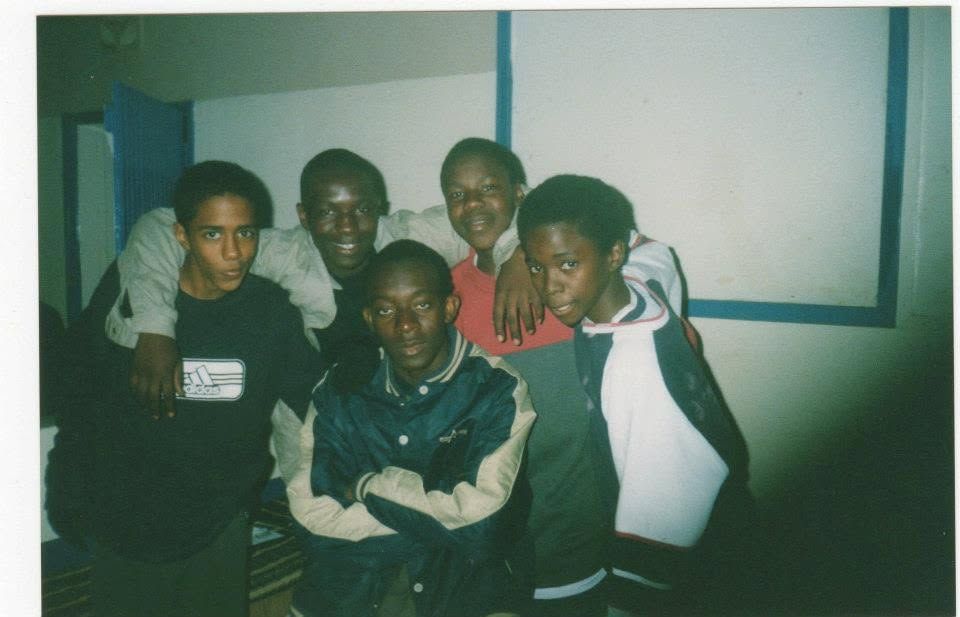
There's this thing that happens as one (and this is cheesy) gets older. I think this thing is a particularly male thing. You get to an age where the term “brother” or “bro” encompasses a remarkably wide age range. A 37 or 40-year-old man can be bros with guys who are 55 or 25. Much of it depends, of course, on whether you're operating at similar levels in life, but that range brings with it quite an extraordinary exposure to lived experience. In my (admittedly limited) experience, women are significantly more age-rank sensitive in this regard. I have yet to see a 30 year old woman be referred to as "sis" by a 55 year old woman.
I think in part these dynamics might be a reflection of the very significant biological experiences men and women experience. A woman at 55 is navigating menopause whilst a lady at 30 might possibly have not had children yet. The gulf in lived experience is perhaps more acute in women than it is men. Which isn't to say men of more advanced ages are the same as their younger peers. I remember once talking to a man in his 50s (who continuously referred to me as bro; I was 34) talking about how he would give anything to be 30 again. I obviously laughed a great deal at the notion because I obviously could not relate. At 34 I would almost certainly NOT give anything to be 20 again! But that's the nature of perspective. You have to get to the milestone to understand it.
In any case, I've found that as a gentleman--one's circle of friends inevitably includes people who've navigated divorce or divorces, buried loved ones, are progressing in their careers or struggling in them, contemplating marriage, dealing with health complications or even wrestling with addictions and everything in between. You will have old friends who turned out to become drivers and diligently work in that profession to provide for their families and others who quite literally may have built global digital ecosystems. It can be a massive spread of circumstances. As a consequence, one gets to learn from the experiences of others. Or at least one ought to. Some of those lessons concern things one should endeavour to do in life, but most of them, quite frankly, concern what not to do. You learn about the things that should remain, and a lot more perhaps about things to let go of.
That's what this essay is about. The things you learn when your fathers or erstwhile uncles become your bros.
One of the more sobering aspects of developing friendships with older gentlemen is that you begin to appreciate the cumulative consequences of seemingly inconsequential decisions. When you're 25, much of life exists in the realm of possibility. When you're 55 and beyond, a considerable portion of it exists in the realm of consequence. You're living in the momentum and shadow of long past decisions. Those distant choices you made about your health, relationships, finances, character and use of time have had several decades to compound. You can no longer speak of some of those things merely in terms of what might happen. They have happened. You're living in the world that an earlier version of yourself participated in creating. Those choices either create consequence debt you are dealing with, or alternatively consequence capital that will carry you forward for a long time; sometimes giving you quite a lot of capacity to sustain mistakes through life.
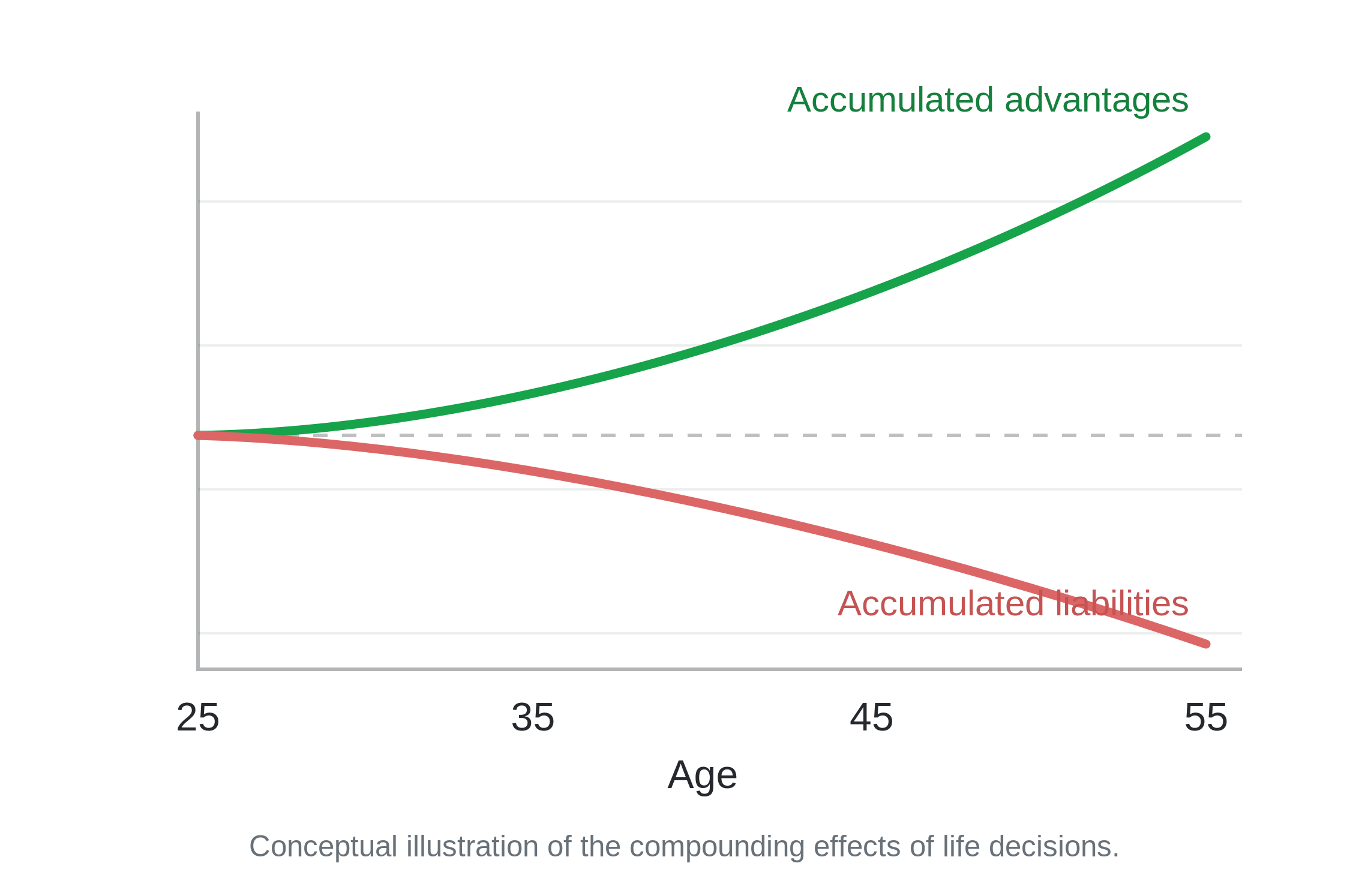
There's something quite instructive about being able to observe that process in other people, particularly people whose intellect, temperament or disposition towards life might not be all that dissimilar to your own. It becomes considerably harder to dismiss their mistakes as things you would never do when you understand the reasoning that informed those mistakes. You yourself would likely have made exactly the same choices they did. In some instances, you might even have made precisely the same decisions had you found yourself in their circumstances.
It is easy to recognise foolishness in its consequences. That's the benefit of hindsight. It is considerably more difficult to recognise it in its infancy, particularly when it presents itself as a virtue.
Take perseverance, for instance. I suspect that many of the men I have the greatest regard for are people who have an almost unreasonable capacity for perseverance. It's a particularly useful quality if you're an entrepreneur. Much of what one does as an entrepreneur involves maintaining one's conviction about something in the face of quite compelling evidence that one ought to be doing something else with one's life. There are periods during which the distinction between vision and delusion is almost entirely a matter of what eventually transpires.
The problem, of course, is that one can become so accustomed to the idea that perseverance is virtuous that one loses the capacity to recognise when it ceases to be so.
In the preceding essay, The Things That Remain, I wrote quite extensively about maintenance and the importance of developing the capacity to sustain the things one builds. I (obviously) still hold that view. But there is an important qualification to it. Not everything warrants maintenance. Not every problem warrants a solution, at least not from you. Not every relationship is capable of being repaired by the application of greater effort on your part. Not every undertaking deserves another decade of your life simply because you've already given it one. Sunk cost fallacy exists for a reason.
There is a peculiar difficulty here for people who derive a considerable portion of their identity from their capacity to solve problems. One develops a disposition towards life in which almost every undesirable circumstance is interpreted as a problem for which one simply hasn't yet devised an adequate solution. It is a rather empowering way to live. It is also, in certain circumstances, an incredibly foolish one.
Some things are not problems to be solved. They are realities to be accepted.
I think that one of the things a man must eventually learn to let go of is the idea that the application of his will to a situation will necessarily produce a desirable outcome. This is particularly true of circumstances involving other human beings. One cannot profess a belief in the sovereignty of the individual, as I did in my previous essay, whilst simultaneously refusing to accept the implications of other people's exercise of that sovereignty. Sometimes surrender is the healthiest and most prudent path.
People are entitled to make decisions that disappoint you. They are entitled to arrive at conclusions about their lives that are fundamentally incompatible with your own aspirations for them. They are entitled to decline opportunities you believe would be to their benefit. They are even entitled to misunderstand you.
That last one is particularly difficult. Everyone wants to be understood and accepted. But sometimes you just need to let that go. It is enough to understand yourself, weigh the merits of a path against alternative courses and make your decisions regardless of the social cost. People's acceptance can sometimes really just be a debt you can avoid.
There is a temptation, especially if you're accustomed to reasoning your way through disagreements, to believe that the principal impediment to the resolution of an interpersonal conflict is the inadequacy of the explanation you've furnished. So you explain yourself again. You elaborate upon the context, furnish more information and perhaps devise a more sophisticated articulation of the logic that informed your conduct. Sometimes this works. Sometimes the person understood you perfectly well the first time and simply doesn't agree with you. And sometimes they have an understanding of you that they have no particular interest in revising. Other times it may be an attempt to express your emotional context; why you feel a particular way about a thing and why you need empathy from whoever it is that you feel you need it from. Again, sometimes the prudent course is simply to let the need for that affirmation go.
There ought to be a point at which one becomes sufficiently comfortable with one's own conscience that one can afford to be misunderstood. This presupposes, of course, that one has subjected one's conduct to an honest examination and is not merely invoking the sovereignty of one's conscience as a convenient means of evading accountability.
One must be willing to be wrong. But one must also be willing to be thought wrong.
I think the inability to make that distinction accounts for an extraordinary amount of unnecessary conflict between human beings. Consider how much time people spend litigating the past with one another. The objective, ostensibly, is to resolve some outstanding matter. But quite often what one actually desires is a particular verdict. An acknowledgement that one was right. An admission that one was treated unjustly. An affirmation that one's intentions were good. You want the satisfaction that comes from that. But again, sometimes letting that go may give you the peace you actually need.
What happens if that acknowledgement never comes? Is the rest of one's life to be held hostage by its absence?
I rather suspect that there are men who've spent more years being aggrieved by the dissolution of their marriages than they spent being married. There are people whose entire conception of themselves is still informed by some injustice they suffered at the hands of a person who might scarcely think of them anymore. There are siblings who will go to their graves without speaking to one another on account of things that happened decades before their grandchildren were born.
What's remarkable about resentment is that it enables another person to continue to participate in the governance of your interior life long after they've ceased to participate in your actual life.
It is worth contemplating what exactly one derives from that arrangement.
Forgiveness, in this regard, is quite interesting. I think we sometimes conflate forgiveness with the restoration of a relationship to its prior state. They are distinct things though fundamentally related. One can forgive someone whilst simultaneously arriving at the conclusion that it would be imprudent to have them occupy the same place in one's life that they previously occupied. Forgiveness doesn't require amnesia. Nor does it require the pretence that what transpired was inconsequential. However there is also the example of Jesus forgiving Peter who three times denied him at his trial--and then proceeding to restore him to his original position. The principle here is humility is the precondition for restoration. All forgiveness ought to reach full restoration. The person doing the forgiveness should have the forbearance to restore. However in the absence of humility on the part of the offender, sometimes it is prudent to forgive but right that relationship off in terms of capacity for fellowship. As was the case with Peter, restoration is a dance that needs two.
For Christians in particular, there is a rather compelling theological basis for this disposition towards forgiveness and restoration. Consider the consistency with which the principle is articulated in Scripture:
“Bear with each other and forgive one another if any of you has a grievance against someone. Forgive as the Lord forgave you.” — Colossians 3:13
“Be kind and compassionate to one another, forgiving each other, just as in Christ God forgave you.” — Ephesians 4:32
Christ Himself makes the relationship between receiving and extending forgiveness quite explicit:
“For if you forgive other people when they sin against you, your heavenly Father will also forgive you. But if you do not forgive others their sins, your Father will not forgive your sins.” — Matthew 6:14–15
And, perhaps most importantly:
“A new command I give you: Love one another. As I have loved you, so you must love one another. By this everyone will know that you are my disciples, if you love one another.” — John 13:34–35
What's interesting about these passages is that forgiveness is something first extended to us by God. The reciprocation He expects of us is twofold: that we accept His gracious extension of forbearance and mercy, and that we endeavour to extend that same mercy to others who, like ourselves, may be entirely undeserving of it.
Jesus makes this particularly personal. Love as I have loved you. In other words, the standard by which the Christian is expected to love and forgive others is the manner in which Christ has loved and forgiven him.
And that forgiveness was not without considerable personal cost. Paul articulates it rather beautifully, in language not entirely dissimilar to the notion of consequence debt I referred to earlier:
“And you, who were dead in your trespasses and the uncircumcision of your flesh, God made alive together with him, having forgiven us all our trespasses, by canceling the record of debt that stood against us with its legal demands. This he set aside, nailing it to the cross.” — Colossians 2:13–14
There is something quite remarkable about the cancellation of that debt. It wasn't simply declared inconsequential. Christ assumed its cost Himself. The innocent for the guilty.
But it wasn't merely about a death. It was also about life. In the preceding verse, Paul writes:
“Having been buried with him in baptism, in which you were also raised with him through faith in the powerful working of God, who raised him from the dead.” — Colossians 2:12
The resurrection vindicates the sacrifice, and through faith we become participants in the life that followed it. To put it in the vernacular of the friendships I referred to earlier, He took the bullet for us because He had the capacity to take up His life again, and in so doing became the ultimate big brother to us. There is perhaps something of this in Paul's description of Christ as “the firstborn among many brethren” (Romans 8:29). You could say he is the ultimate big bro.
For the Christian, then, forgiveness and a willingness towards restoration are not merely matters of personal prudence or psychological well-being. They are fundamental obligations arising from an appreciation of one's own circumstances. Our standing before God is itself a function of undeserved forgiveness and restoration. It would be rather peculiar to receive such an extraordinary measure of grace whilst being unwilling to extend even a fraction of it to another human being.
Consequently, for Christians, letting go of even the most deserved anger is, quite literally, part of the job description. The operative words here are deserved anger. Some grievances are entirely legitimate, and the anger arising from them wholly justified. Yet, in light of what Christ did for us, even those grievances must eventually be relinquished, and the willingness to restore fellowship must become a moral imperative.
There is something profoundly equalising about this. At various points in our lives, all of us will occupy both positions: that of the offended and that of the offender. We will find ourselves needing to extend the very mercy that, under different circumstances, we will need to receive. And in neither instance will the deservingness of the recipient be the defining consideration.
The answer in both instances is grace.
And grace lets go.
In view of this, one ought to develop the capacity to acknowledge that one has wronged another person without being indefinitely consumed by shame on account of it. There are things that an earlier version of oneself did that the present version of oneself ought to find embarrassing. If there aren't, I would imagine that one hasn't grown very much.
The point of recognising one's immaturities is to cease to be immature in those respects. There is little virtue in spending the remainder of one's life despising oneself for having once been something one has since endeavoured not to be. Remember what you were, and use it as motivation to never be that person again; but let go of that shame.
Paul of Tarsus is an interesting person to contemplate in that respect. Here was a man who had actively participated in the persecution of the very people amongst whom he would subsequently devote the remainder of his life to labouring. He could not undo what he had done. He could, however, determine what he would do with the remainder of his life.
“Brethren, I count not myself to have apprehended: but this one thing I do, forgetting those things which are behind, and reaching forth unto those things which are before,
I press toward the mark for the prize of the high calling of God in Christ Jesus.” — Philippians 3:13–14
There is something rather beautiful about that. The past is neither denied nor allowed to determine the entirety of one's future.
Another thing I think men ought to learn to let go of is the idea that every investment must yield the return one originally envisaged.
I mean that in a much broader sense than the financial one. We invest time in people, relationships, institutions, careers and even particular conceptions of ourselves. We do so on the basis of some understanding of what might eventually transpire. As the years go by, the sheer magnitude of that investment can become the principal reason for its continuation.
There is a rather obvious parallel here with the concept of sunk costs in economics. A decision concerning the allocation of resources ought to be informed by the prospective utility of that allocation, not merely by the quantum of resources previously expended.
It's a relatively straightforward proposition when applied to money. It becomes considerably more complicated when applied to one's life.
How does one let go of a future one has spent years imagining? How does one walk away from something into which one has poured a considerable portion of oneself? Particularly when doing so entails confronting the possibility that one was mistaken about something one held to be of immense significance.
I don't think we adequately appreciate the extent to which human beings can become attached to things that have never actually existed. Sometimes what one is grieving is not the loss of something one had, but the loss of something one thought one would eventually have.
That imagined future might have occupied a considerable portion of one's interior life. One might have made decisions in anticipation of it, endured difficulties on account of it and forgone other possibilities in the hope of its eventual materialisation.
It is entirely understandable that relinquishing it would be painful.
But the fact that one was sincere in one's aspirations for a particular future does not mean that one is obliged to spend the remainder of one's life attempting to bring it into existence. There comes a point at which fidelity to an imagined future can constitute a form of infidelity to the life one actually has.
And life, incidentally, is happening whilst one is doing all of this.
One's children are getting older. One's parents are getting older. There are friends one hasn't seen in years. There are things one has always wanted to do but hasn't done. There are people who would appreciate a greater measure of one's presence in their lives. There is an entire world of experiences available to oneself that one might scarcely notice because one's energies are so disproportionately allocated to the resolution of some particular problem.
I wonder how many men arrive at the latter stages of their lives and discover that they spent an inordinate amount of their time attending to the things that caused them the greatest distress, rather than the things that afforded them the greatest joy.
There is probably a lesson in that about the allocation of attention. We are accustomed to thinking quite deliberately about the allocation of our capital, but perhaps not sufficiently deliberately about the allocation of our emotional and intellectual energies. Those are resources too. And unlike capital, there is a rather definite limit to the amount of time available to us in which to deploy them.
One ought to be at least as discerning about what one allows to occupy one's mind as one is about what one spends one's money on.
Then there is the matter of pride. I don't mean merely the sort of pride that causes a man to be incapable of apologising to his wife or admitting to his children that he was wrong. I also mean the pride that causes him to be incapable of acknowledging that he needs help.
I think there is a tendency amongst men, particularly men who have spent much of their adult lives being responsible for other people, to become rather uncomfortable with the idea of being the person in need of assistance. One becomes so accustomed to being the person to whom other people bring their problems that one scarcely knows what to do with one's own.
It is one of the reasons I think male friendships become increasingly important as one gets older. There is something of immense value in having people in one's life with whom one doesn't have to perform competence. People who don't require one to have the answer. People with whom one can have a conversation about the fact that one is struggling with something without feeling that one has somehow diminished oneself in their estimation. I think that is one of the benefits of maintaining old friendships, most especially with people you went to school with; they know the you that you were before the rest of life happened. They very often have the most sober perception of who you are.
Interestingly, one's willingness to be vulnerable with another man can afford him the permission to be similarly vulnerable with oneself. And one sometimes discovers that a person one has admired for years on account of their apparent mastery of life has been wrestling with many of the same things as oneself.
That is not a diminishment of the man. If anything, it furnishes one with a more complete appreciation of him.
I also think there is something to be said for letting go of certain ideas one developed about oneself when one was younger.
We make quite consequential decisions about who we intend to become at ages when we know remarkably little about the human experience. We then spend several decades attempting to fulfil a mandate issued to us by someone who, if we encountered him today, we might regard as a rather precocious but nonetheless inexperienced young man.
Why should my 25-year-old self have an indefinite veto over the decisions of my 45 or 55-year-old self?
There are things about that younger man that I would hope to retain. His curiosity, his audacity, his willingness to entertain possibilities that other people might regard as implausible. But surely the point of the intervening decades is that he should have learnt something. And some of that learning ought to result in a revision of what he considers important.
There is a distinction between betraying oneself and outgrowing oneself.
In my previous essay, I contemplated the degree to which my disposition towards achievement might be informed by vainglory. I think an interesting test of that would be to ask oneself whether one would still endeavour to do the things one does if there were no possibility of ever being personally distinguished on account of them.
Would I still build? Would I still find intellectual pursuits interesting? Would I still concern myself with the prosperity of people whose lives might intersect with mine? Would I still do those things if, a hundred years from now, no one knew that I had anything to do with them?
I would hope so.
Consider the number of people who've lived lives of extraordinary consequence without ever becoming people of great distinction. The grandmother whose sacrifices fundamentally altered the trajectory of several generations of her descendants. The teacher who, in the course of doing what he was paid to do, inspired a child to contemplate possibilities that had never occurred to him. The father who quietly and consistently discharged his obligations to his family for 50 years.
There will be no books written about the vast majority of those people. Yet much of what is good in the world is attributable to them.
Perhaps one of the things one ought to let go of is the necessity of being extraordinary, perfectionist or competent, whilst retaining the willingness to do extraordinary things. Do your best, but wait on the outcomes what ever they may be. Holding on to intent beyond consequence can often result in a fixation with delusion versus grounding in reality. We are partners with reality, not its masters. You do your bit and then the outcomes will be whatever they may be. If you fail, you learn from the experience and use that experience to fine tune your next approach.
There is a theological dimension to all of this that I find increasingly compelling. Much of the Christian experience involves the relinquishment of things that the natural man is inclined to hold on to. His grievances, his pride, his anxieties, his desire for vengeance, his attachment to worldly distinctions and, ultimately, his conviction that he is the final arbiter of what ought to transpire in his life.
This needn't result in passivity. Christ, in Gethsemane, expressed a very particular desire concerning what was about to transpire, but subordinated that desire to the will of His Father.
“Nevertheless not my will, but thine, be done.” — Luke 22:42
I find it interesting that the expression of that desire and the willingness to relinquish it coexist within the same prayer.
One can desire something earnestly without insisting upon it. One can work extraordinarily hard towards an outcome whilst recognising that one's life need not be rendered meaningless by its failure to materialise. One can love people without requiring them to become the people one wishes them to be.
And one can let go of things without having to convince oneself that they were never worth holding on to in the first place.
I think that last distinction is particularly important. There is a tendency to retrospectively diminish the value of the things we've lost in order to make their loss more tolerable. But surely one can acknowledge that something was beautiful, meaningful or worthy of one's devotion, and still accept that its season in one's life has come to an end.
Not everything that ends constitutes a failure.
Solomon, in Ecclesiastes, puts it rather succinctly:
“A time to get, and a time to lose; a time to keep, and a time to cast away.” — Ecclesiastes 3:6
What I appreciate about that passage is that neither keeping nor casting away is presented as inherently more virtuous than the other. The wisdom resides in understanding the time.
I suspect that if I am fortunate enough to live beyond 70, some younger man will sit across from me over a meal and listen to me speak about the things that have transpired in my life. He will probably recognise something of himself in the person I once was. I hope that some of what I tell him will be of use to him. That he will learn something from the things I built, the things I maintained and the things to which I remained faithful. I especially hope that for my son and nephews among whom I count the children of my friends.
But I also hope to be able to tell him about the things I had the wisdom to let go of, rather than merely the things that life eventually wrested from my hands. More importantly I hope I have the honesty to tell him that the wisdom was never mine but was borrowed from my big bros, my uncles and father.
In the final analysis, I think the two capacities are inseparable. One cannot devote oneself adequately to the things that warrant a lifetime of devotion if one is unwilling to relinquish the things that don't. And the tragedy would be to discover, towards the end of one's life, that one had exhausted oneself holding on to things of comparatively little consequence and, in so doing, neglected the very things one ought to have ensured would remain.
There are things to keep. There are things to cast away.
God grant us the wisdom to know which is which, and the courage to act accordingly. And if you're a gentleman reading this I hope you have the grace to befriend some youngsters and put them on game; and the humility to maintain those relationships with your own big bros and uncles that put you on too. In the end there are things one must be prepared to let go of as they learn life; but there must also be things that are guarded, prized, treasured and held tightly always. Knowing the difference is everything.