
The Cube, The Block, And The Question Of Actuality
In the TV show Dark Matter, the cube is a doorway into every life that might have been. Step inside, and the self is no longer one story but a corridor of unrealized histories. Every choice opens onto another world. Every regret has a location. Every counterfactual becomes almost touchable.
It is a brilliant image, but the show draws the wrong metaphysical conclusion. The cube should not first make us believe that every possible universe exists. It should make us ask a deeper question: where do possibilities exist before they become worlds?
This essay argues that possibility-space is real, but not as an infinite warehouse of equally actual universes. Possibility exists first in the mind of God. Creation is not the indiscriminate release of every possible history. It is the actualization of one finite, intelligible, covenant-bearing block of reality.
The problem therefore begins inside physics, not theology.
A Foundations-of-Physics Constraint Theorem That Leads To Theology
Modern physics has not left us with a simple picture of the world. The world is not made of solid classical stuff carrying fixed properties through space while consciousness looks on from outside. Quantum mechanics has removed the old certainty of pre-existing local values. Relativity has weakened the idea of a universal present. Black-hole thermodynamics and quantum information have made information physically load-bearing. Decoherence has shown how stable classical histories emerge from deeper quantum structure. Cosmology and quantum gravity have pushed us toward the idea that the total history of the universe is more like a complete ordered structure than a sequence being manufactured moment by moment by an external clock.
The question is what kind of ground can make sense of such a world.
The first answer is not immediately "religion." It is more restrained. The ground of reality must be able to account for possibility-space, intelligible law, information, local definiteness, global coherence, and the fact that one experienced history is actual for observers. It must account for the transition from possibility to actuality.
Only after that structure is derived should theology enter the discussion. If a religious tradition is true, it should not be selected because it is emotionally satisfying, socially familiar, or culturally inherited. It should be selected because it uniquely fits the structure that reality itself requires.
This essay therefore proceeds in two movements. The first is physical and metaphysical. It asks what contemporary physics and consciousness require of the ground of actuality. The second is comparative and theological. It asks which religion, philosophy, or worldview, if any, explicitly identifies that ground.
The conclusion is that the required ground is not generic deity. It is an omni-temporal, triadic, self-disclosing Mind: a ground capable of holding possibility, specifying intelligible order, and actualizing the complete block of history. When the global search-space of religions and philosophies is tested against that independently derived constraint-vector, Trinitarian Christianity is the unique full fit. Judaism supplies the divine name and the long covenantal disclosure: Ehyeh Asher Ehyeh, the God who is and will show who He is by what He does. Christianity identifies the completed structure: the Father, through the Logos, in the Spirit, with the Lamb slain before the foundation of the world as the eternal center of the actualized block.
That is where the argument ends. It should not be where it begins.
Methodological Note
This is not a conventional physics paper. It does not propose a new Hamiltonian, a new particle, a new cosmological parameter, or a new laboratory measurement as an already established result. It accepts the relevant physics as input and asks a foundations question: what must be true of any ontology capable of making sense of that physics?
The proper category is foundations of physics, formal metaphysics, and model selection. The deliverable is a constraint theorem:
physics -> constraints -> actualization model -> global fit search
The physics supplies the constraints: non-classicality, information-bearing structure, decoherence-generated local definiteness, holographic and gravitational hints of boundary-like encoding, and block-like global coherence. Conscious decision-making supplies an operational finite model of possibility represented, specified, and actualized. Theology is not used as an input to the physics. It enters only after the constraint-vector has been generated and the global search-space has been tested.
The formal object introduced here is the Actualization Operator Framework. Let Omega be possibility-space and B the actualized block-history. Any sufficient ground G must account for an actualization map:
A_G : Omega -> B
The argument is that any non-arbitrary actualization map must factor into three irreducible operations:
A_G = X_G o S_G o C_G
where C_G holds or represents possibility, S_G specifies intelligible order, and X_G actualizes determinate history.
This is not yet a doctrine of the Trinity. It is a formal constraint on any proposed ontology of physical actuality. A rival account can defeat the argument by showing that actualized physical history can be derived without such a triadic factorization; by showing that consciousness is not a legitimate finite model of represented possibility, valuation, and action-selection; by showing that decoherence plus a preferred quantum ontology fully explains actuality without remainder; or by producing a rival world-system that satisfies the full constraint-vector more completely than Trinitarian Christianity.
A later technical interlude sketches a falsifiable physical build-out of the actualization idea. That build-out is not required for the main theorem to stand. It is a proposed research program: if actualization has a created physical signature, it should appear as excess coherence loss after standard decoherence is subtracted, scaling with a pre-defined entropy, record, or geometric exposure variable. A null result would constrain or falsify that specific physical mechanism, even if the broader metaphysical and covenantal argument remained.
This is how the essay should be read: not as physics pretending to be theology, and not as theology pretending to be physics, but as a foundations-of-physics constraint theorem whose final step is comparative model selection. It then applies the same methodological discipline and filtered multi-constraint system to eschatology to determine if the signal identified in ancient history has been present in recent history. In that sense this is a weird essay. Part science, part philosophy and metaphysics and part eschatological detective work. Bear with the weirdness, I think it's useful in the end.
I. The Failure Of Classical Material Substance
Classical materialism required a particular kind of world. It required that, beneath appearances, there be a layer of definite material things with intrinsic properties. The observer might not know all those properties, but the properties would exist nonetheless. The world would be local, determinate, and self-contained. Mathematics would describe the material substrate from outside. Mind would be a late product of matter. Meaning would be derivative. Actuality would be brute.
Modern physics has not been kind to that picture.
Matter itself is no longer fundamental in the old sense. What we call matter is field excitation, energy configuration, relational state, and quantum behavior. The atom is not a tiny solar system of hard pellets. Particles are not little billiard balls carrying all their properties independently of context. At the level of quantum theory, the world is described by state-vectors, amplitudes, operators, correlations, measurement contexts, and probabilities.
The deeper problem is not merely that matter turned out to be strange. The deeper problem is that the old hidden-substance expectation fails experimentally and mathematically. Bell's theorem and its experimental confirmations rule out local hidden-variable theories of the classical kind. Kochen-Specker contextuality prevents us from assigning definite values to all observables independently of measurement context. PBR-type arguments place severe pressure on treating the quantum state as merely ignorance about some deeper classical state, under their assumptions.
Different interpretations remain possible. Bohmian mechanics survives by being explicitly nonlocal. Everettian quantum mechanics preserves the universal wavefunction but treats experienced worlds as branch-relative. Objective collapse theories modify the dynamics. Relational and information-theoretic approaches shift the emphasis in other ways. The interpretations differ significantly, but they agree on the point that matters here: the old materialist victory condition does not return.
There is no return to a universe made of local, classical, self-sufficient material units whose properties are simply waiting underneath observation. Whatever the ground is, it must be non-classical.
This does not prove God. It proves that crude materialism is not an adequate ontology for the world physics actually describes.
II. Information Is Not Commentary
The next pressure comes from information.
Information used to look like description. A system had a physical state, and information was what an observer knew about it. But modern physics has made this distinction increasingly difficult to maintain. Landauer's principle links information erasure to thermodynamic cost. Entropy is not merely psychological ignorance. Black-hole thermodynamics ties entropy to horizon area. Quantum information theory treats entanglement, state, and measurement as physically central rather than merely epistemic.
The careful claim is not that energy and information are identical in every possible sense. That would be too strong. The defensible claim is also strong enough: information is physically load-bearing. It is operationally real. It is constrained by energy, entropy, horizon area, and state-space. It is woven into the structure of physical reality.
This changes the metaphysical question. The universe is not adequately described as stuff plus motion. It is structured content. It is law-like. It is compressible. It is mathematically intelligible. It is encoded in ways physical theory increasingly treats as basic.
So the ground of reality must be able to account not only for matter, but for intelligible information-bearing structure.
Physics does not yet tell us that this form-bearing ground is personal. But it does tell us that the ground cannot be mere inert stuff.
III. Holography, Black Holes, And The Compression Of The Bulk
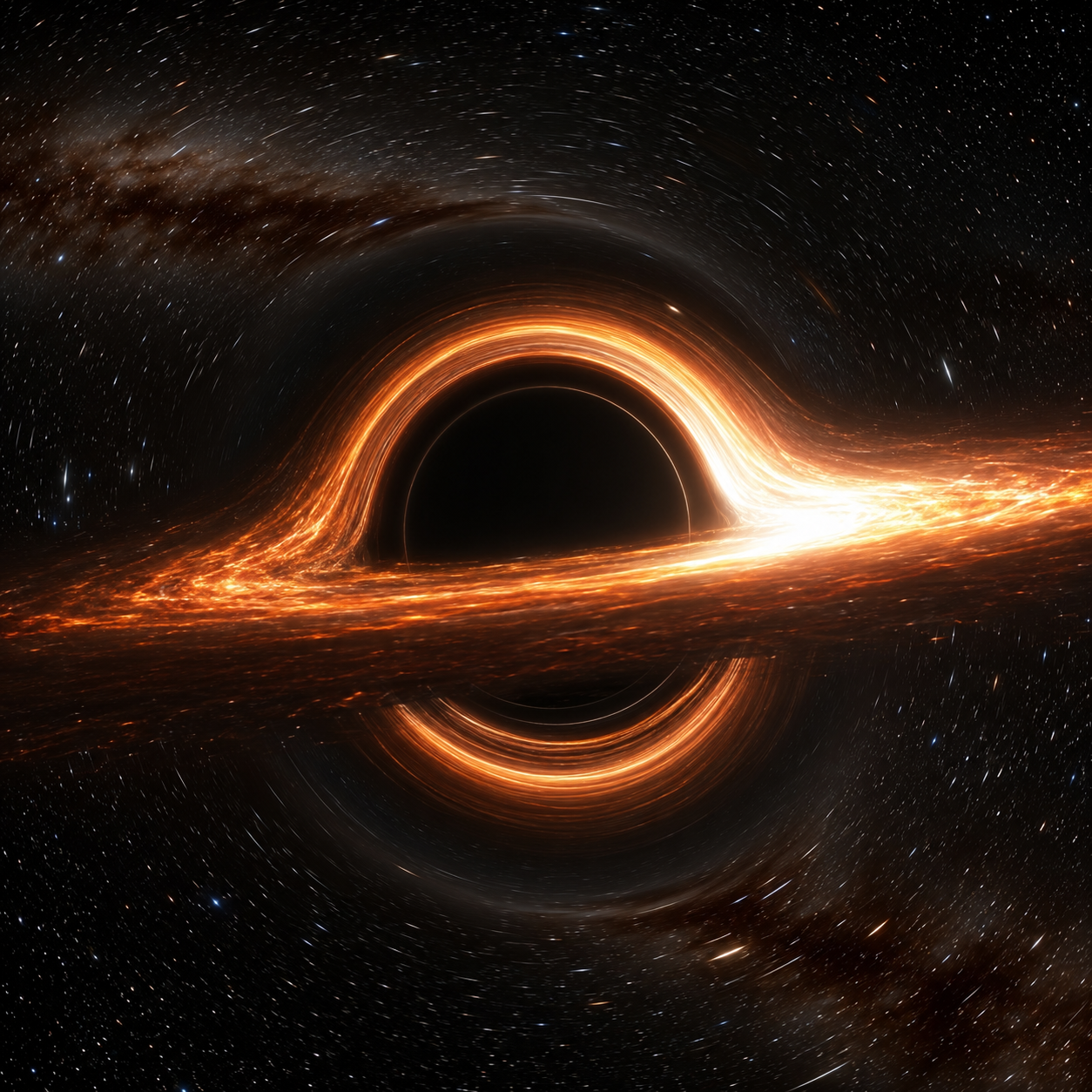
The strongest physics-facing version of the argument cannot treat holography as a minor sub-point under "information-bounded reality." Holography is doing deeper structural work. It is not merely that physical systems have finite information capacity. It is that, in gravitational physics, the information content of a region is tied to its boundary rather than simply to its bulk volume.
Black-hole thermodynamics supplies the first step. Bekenstein-Hawking entropy scales with the area of the horizon, not the volume enclosed. In Planck units, the entropy of a black hole is proportional to its horizon area. This is the central clue that gravitational systems are not ordinary bulk containers of information. A black hole teaches that the maximum information content of a region is measured by its boundary.
The holographic principle takes that clue seriously. In its strongest concrete form, AdS/CFT gives a duality between a gravitational theory in a higher-dimensional bulk and a quantum field theory on the lower-dimensional boundary. In that setting, bulk gravitational physics can be described by boundary quantum information. The bulk is not ontologically primary in the simple way naive materialism would assume. It is encoded.
This is strikingly consonant with what the Logos-Encoder model would lead one to expect. If creation is Logos-encoded, then the experienced bulk should not be ultimate brute stuff. It should be intelligible, information-structured, and in some deep sense encoded from a more fundamental boundary-like description. Holography does not prove the Logos by itself. But it gives a striking physical analogue of the thesis: the world we inhabit as bulk reality is sustained by encoded information.
The black-hole information problem adds a second layer. Hawking's original calculation seemed to imply that black holes destroy information. Later Page-curve and island/replica-wormhole developments support a different conclusion within controlled gravitational settings: information is preserved through evaporation, but in a way that forces us to rethink locality, entanglement, and the relation between geometry and information. The lesson is not merely that information survives. The deeper lesson is that spacetime geometry and entanglement are linked.
Emergent-gravity arguments point in the same direction, though with more contestation. Jacobson showed that Einstein's equations can be derived as an equation of state from thermodynamic reasoning applied to local causal horizons. That does not settle every emergent-gravity program. But it reinforces the possibility that gravity is derivative of entropy, horizon thermodynamics, and information rather than a primitive force in the old sense.
The theological mapping is:
boundary-like encoding
->
Logos as Encoder-Sustainer
->
bulk experienced creation
->
Spirit as Actualizer-Life-Giver
The words of the Logos are not merely initial commands at the beginning of time. Hebrews 1:3 says the Son upholds all things by the word of His power; Colossians 1:17 says that in Him all things hold together. The physics-facing analogue is that the intelligible bulk of creation is sustained by an information-bearing structure more fundamental than ordinary local appearance. The Logos encodes and upholds; the Spirit actualizes and gives life.
The Logos is not identical to the verbal command, as though “Word” meant only uttered sound or linguistic content; the choice of title-Logos/Davar communications the fact that he is the full self-expression of Ehyeh and so is fully Ehyeh. The Logos is the eternal Son flowing from Ehyeh and so is Asher Ehyeh, the personal self-expression of God. His words, what the Logos speaks are His authoritative acts creating reality and also inside history. When Christ commands the storm, creation receives specification from its Maker--the same way it did when he the Logos said 'let there be light". When He calls Lazarus, death receives command from Life Himself. When He says that His words are spirit and life, He discloses the Trinitarian grammar of actualization: the Logos speaks, the Spirit gives life, and the created order becomes obediently determinate. The spoken word is the interface of divine specification; the Logos Himself is the eternal Speaker. That is why he told the apostles, if you have seen me you have seen the Father; he was manifesting the Name.
This also sharpens the critique of literal independent-world multiverse proposals. Physical information is not free. Bekenstein bounds, horizon entropy, and holographic constraints resist the idea that one can simply physically instantiate an unrestricted ensemble of possibilities without accounting for the informational and energetic burden of that ontology. Standard Everettian unitary evolution should not be caricatured as naive branch-by-branch energy multiplication. But literal ensemble-instantiation pictures cannot simply turn possibility-space into physical actuality at no cost.
The caveat is important. AdS/CFT is rigorous in its domain; the full holographic description of our exact cosmology remains an extrapolation. Page-curve and island results are powerful in controlled models, not a final laboratory demonstration of every black hole in our universe. Emergent-gravity proposals are suggestive rather than settled. But the direction of travel is unmistakable: modern gravitational physics increasingly treats bulk reality, horizon entropy, geometry, and information as one system.
A further refinement concerns bounded actualization. The universe is not an unbounded instantiation of possibility-space. It is finite, information-bounded, computationally bounded, locally conservation-governed, and thermodynamically directed. Noether's theorem gives energy conservation when the relevant symmetry exists, and in general relativity global total energy is delicate. The safer and stronger claim is that physical reality is locally conservation-governed and globally bounded in information, entropy, computation, and horizon structure.
The universe is not Omega, the possibility-space itself. It is B, the actualized block:
Omega -- possibility-space
->
B -- finite, encoded, actualized history
That is precisely the output-form predicted by the Trinitarian actualization model. The Father contains possibility. The Logos specifies and sustains the intelligible structure. The Spirit actualizes the determinate history as living creation.
Fine-tuning adds a final physical refinement. The actualized block occupies a narrow life-permitting region within a much larger space of mathematically possible configurations. The cosmological constant, low-entropy initial condition, chemistry-enabling constants, stellar nucleosynthesis, matter-antimatter asymmetry, dimensionality, gauge structure, and stability of physical parameters all intensify the selection problem.
The fine-tuning argument must be handled with discipline. Raw fine-tuning depths should not be inserted into the model without discount. Multiverse and hidden-physics proposals remain live responses, even if they face serious problems: measure ambiguity, empirical inaccessibility, explanatory looseness, and information-accounting challenges. The disciplined point is this: once the universe is seen as finite, encoded, information-bounded, and thermodynamically directed, fine-tuning specifies the kind of finite block that has been actualized. It is not just a block. It is a life-permitting, chemistry-bearing, observer-capable, history-bearing block.
Interlude: Mind, Life, Corporeality, And The Ontological Convergence Of Physics And Theology
The argument must now be stated more sharply. Mind is not merely an analogy that helps us imagine divine action. The functions of mind are local expressions of the same actuality-properties that physics reveals at the foundation of the world. A finite mind holds possibilities, specifies by meaning and value, selects or acts, sustains coherent experience, remembers, and bears witness. Physics reveals the same structural grammar at the cosmic level: possibility-space, law-structure, information, boundary-like encoding, decoherence, records, block-like spacetime, finite computational history, and actualized order.
Therefore the question is not whether mind can be projected onto physics. The deeper claim is that physics already displays mind-like actuality-structure.
There is a useful science-fiction image for this. Star Trek: The Next Generation once imagined the Enterprise reaching a boundary where the universe stopped behaving like inert matter and began behaving like consciousness. Thought became environment. Fear and desire became event-like. The inner life of the observer became strangely continuous with the outer structure of the world.
The episode is not evidence, of course. But the metaphor is apt. When physics is pressed toward its deepest boundary, the old picture of dead material substance gives way to categories that look increasingly like information, possibility, observation, record, and mind-like order. The boundary does not become less intelligible. It becomes more interior.
Finite consciousness is a local, creaturely participation in that structure. It is not an accidental late product floating on top of dead matter. It is the local expression of a reality whose ground already contains possibility, specifies intelligible order, and actualizes determinate history.
This explains why the hard problem of consciousness is hard in the first place. Materialism attempts to derive mind from a substrate it has defined as non-mind. It begins with matter, mechanism, and information processing, and then tries to recover first-person experience, meaning, intentionality, moral agency, and witness as late emergent products. But if physics itself already discloses the operations of actuality -- possibility, encoding, selection, coherence, record, and unified history -- then consciousness is not mysterious because it is alien to physics. It is mysterious to materialism because materialism has inverted the explanatory order.
The correct order is not:
dead matter
->
mechanism
->
consciousness somehow appears
but:
mind-like actuality-structure
->
Logos-encoded physical world
->
finite conscious agents within it
Life should be reframed in the same way. Chemistry can tell us the properties associated with life: carbon bonding, water as solvent, proteins, nucleotides, membranes, redox gradients, and energy transfer. Biology can describe the systems that emerge once life exists. But neither chemistry nor biology, by itself, explains why there is a universe in which chemistry becomes life at all. Life is not only a biochemical phenomenon. It is an actualization phenomenon: encoded order becoming living creation.
Corporeality should also be reframed. The body is not the ultimate source of consciousness. It is the interface through which consciousness expresses itself inside this visible, decohered band of the actualized world. Neuroscience describes the mediation architecture; it does not exhaust the ontology of consciousness.
This makes death and resurrection more intelligible. Death is the rupture of consciousness from its ordinary corporeal interface within this creation-band. Resurrection is not mere afterlife. It is the restoration and glorification of embodied expression: consciousness re-clothed in a transformed body fitted for renewed creation. In Christ, the Logos who exists before corporeality takes flesh, acts within the visible band, dies, and rises bodily.
This framework also changes how anomalous phenomena should be categorized. Near-death experiences, possession and exorcism phenomena, UAP-type transmedium reports, and the Shroud of Turin should not be forced into the binary of "natural versus supernatural" as if closed materialism had the right to define nature. Naturalistic disciplines remain necessary controls inside the visible band. But they cannot declare non-corporeal agency impossible without assuming the very closed ontology under dispute.
The better distinction is:
visible-band physics
->
ordinary measurable processes within this decohered layer
full created-order physics
->
corporeal and non-corporeal agency, higher-order causation,
resurrection, angelic/demonic agency, and boundary-interface events
Physics and theology still use different instruments. Physics measures, models, quantifies, and predicts from inside the block. Theology receives revelation, names the Author, and discloses the purpose of the block. But they are not studying two different realities. Physics is the measurable grammar of actualized creation. Theology is the revealed Name and meaning of that grammar.
Thus the final physics thesis is:
Father
Source / Conceiver / Container of possibility
Logos
Encoder / Sustainer / Word of power / boundary-information structure
Spirit
Actualizer / Life-Giver / determiner of living history
Theology is not a late poetic overlay on physics. Theology is the prior disclosure of the same reality physics later encounters quantitatively. Physics measures the shadow of a truth revelation had already named.
IV. Decoherence And Local Definiteness
Quantum theory gives possibility in a precise form. A system can be represented by a superposition of possible outcomes. Yet our experienced world is definite. The cup is on the table. The detector clicked here, not there. The world we inhabit is stable enough for memory, language, measurement, and science.
Decoherence explains much of this.
When a quantum system interacts with its environment, interference between alternatives is suppressed. The system becomes entangled with environmental degrees of freedom. Certain stable pointer states emerge. For observers embedded within the system, the world appears classical. Decoherence explains why macroscopic superpositions are not visible in ordinary experience and why classical histories are stable from within.
This is a real explanation and should be granted. A serious argument must not caricature Everettian quantum mechanics by saying that it cannot explain why observers experience definite histories. Decoherence does address branch-local definiteness.
But decoherence does not restore classical materialism. It does not say the world was classical all along. It says classicality emerges through environmental entanglement. It does not eliminate the deeper structure; it explains how observers become located within stable histories arising from it.
Nor does decoherence by itself settle the ontology of the total structure. If one is Everettian, the universal wavefunction remains real and all decohered branches have some ontological status. If one accepts collapse, one still needs an account of what collapse is and why one outcome becomes actual. If one accepts hidden variables, the hidden structure must be nonlocal or contextual. In no case does the old materialist picture return.
Decoherence therefore refines the problem. It explains local definiteness but leaves the deeper question intact:
What is the ground of the total possibility-to-actuality structure?
V. The Actualization Problem
The world is not merely possible. It is actual.
That statement sounds too obvious to be philosophically important, but it is the center of the matter. A possibility-space is not yet a world. A wavefunction is not yet an experienced history unless one specifies the ontology by which histories are actual. A mathematical structure is not yet lived reality unless one explains why it is actual rather than merely possible. A set of all possible universes does not explain why this universe is experienced unless all are experienced or one is selected. Either way, actuality must be accounted for.
Everything Everywhere All at Once captures the emotional force of this problem. The film imagines possibility as an infinite explosion of unrealized lives. Every choice branches. Every regret has a world. Every absurd alternative is, somewhere, real.
That is why the film works emotionally. It turns the metaphysical problem into a human crisis: if every possible life is equally actual, then what makes this life meaningful? The answer the film gives is beautiful but incomplete: choose kindness, choose family, choose this life.
But the deeper question remains. Why is there this life to choose at all? Why does possibility-space not remain an undifferentiated field of alternatives? Why is there one experienced history rather than a swarm of equally ultimate realities? The film gives us the vertigo of possibility. The actualization problem asks for the ground of actuality.
The live options are limited. One may say collapse occurs. Then the question is what grounds collapse. One may say all branches exist. Then the question is what grounds the universal wavefunction and why branch-local experience is actual in the relevant sense. One may say hidden variables determine outcomes. Then the hidden structure must be nonlocal or contextual and still needs a ground. One may say all mathematical structures exist. Then the question is why mathematical existence entails experienced actuality. One may stop with brute fact. But brute fact is not explanation. It is the refusal of explanation at the point where explanation is most needed.
The actualization problem is therefore not a theological trick. It emerges from physics and metaphysics together. Possibility-space, law, information, decoherence, and branch-local definiteness all press toward the question of how possibility becomes actual history.
To answer that question, we need the one domain where the possibility-to-actuality transition is directly known from within.
VI. Consciousness As An Operational Natural Experiment
Consciousness must be introduced carefully. It is not a new force in the equations. It is not being smuggled in as a mystical substitute for measurement theory. The claim is more modest and more precise: conscious decision-making is an ordinary, observable, naturally occurring system in which a finite set of represented possibilities is converted into a determinate action.
In that sense, it is a natural experiment in actualization.
Let Omega_h be the finite option-space available to a human subject in a decision context. Let R_h be the subject's representation of those options. Let V_h be the ordering, weighting, valuation, or specification applied to those represented options. Let a_h be the selected action.
A conscious decision can then be described as:
Omega_h -> R_h -> V_h -> a_h
This is not a claim that introspection alone produces a laboratory measurement of quantum collapse. It is a claim that decision-making exposes, in a directly observable system, the functional structure of possibility-to-actuality transition.
Option representation is measured by reported alternatives, choice sets, reaction times, error patterns, preference reversals, and counterfactual recall. Specification is measured by preference ranking, willingness to pay, response latency, confidence, affective salience, neural valuation correlates, and consistency across trials. Actualization is measured because one action occurs rather than another. The selected option becomes part of the subject's actual history. The unchosen alternatives remain counterfactual.
Thus the conscious-decision system displays a measurable structure:
represented possibilities -> specified ordering -> determinate action
This does not mean human consciousness creates the cosmos. It means human consciousness supplies a finite model of the transition any ground of actuality must perform at the cosmic level. Physics gives the external problem: possibility-space, decoherence, branch-local definiteness, and actual history. Conscious decision gives the internal operational pattern: representation, specification, action.
The analogy is not identity of scale. It is isomorphism of structure.
At finite scale:
A_h = X_h o S_h o C_h
At cosmic scale:
A_G = X_G o S_G o C_G
The first is observed in conscious decision. The second is inferred as the necessary structure of any non-arbitrary ground of actuality.
This is the scientific meaning, or at least the metaphysical meaning, of the image of God. Human consciousness is not identical to divine consciousness. But it is a finite structural image. It shows, at creaturely scale, what it means for possibility to be held, specified, and actualized by mind.
There is a second natural experiment implied by consciousness: theodicy.
Consciousness does not merely reveal that finite agents hold possibilities, specify them, and actualize one into action. It also reveals that actualization becomes morally serious when the agent is free. A conscious agent does not choose among neutral mechanical outputs only. A conscious agent can love, refuse, betray, forgive, sacrifice, repent, and obey. Therefore consciousness is not only a structural model of actualization. It is a moral model of actualization.
At the structural level, consciousness displays the movement from possibility to specification to action. At the moral level, it displays the movement from agency to moral possibility to moral cost to responsibility. These are not separate phenomena. They are the same actuality-structure seen under different conditions.
This means the problem of evil is not an external objection added later to the argument. It arises from the same structure. If God actualizes a world containing genuine finite agents, then He does not actualize a morally frictionless mechanism. He actualizes a history in which love can be real, and therefore refusal can be real; covenant can be real, and therefore betrayal can be real; mercy can be real, and therefore guilt can be real; sacrifice can be real, and therefore suffering can be borne rather than merely prevented.
Theodicy is therefore a second natural experiment. Consciousness reveals the form of actualization at the level of decision. Moral agency reveals the cost of actualization at the level of history. The two belong together. A world with real consciousness is not merely a world with inner experience. It is a world in which actualized choices become morally meaningful coordinates inside the block.
Theodicy also shows that consciousness is not simple computation. Human consciousness is intrinsically moral.
Animals experience pain, fear, attachment, and emotional distress. Some species appear to mourn their dead. Their suffering is real and should not be minimized. But animals do not appear to turn suffering into the question of ultimate justice. They do not ask why reality permits evil, whether the world is morally ordered, whether death is finally meaningful, or whether the ground of being is good. They suffer and continue.
Human beings do something different. Across cultures, eras, and levels of technical sophistication, human beings turn suffering into the question of meaning. Why do the innocent suffer? Why does evil prosper? Is reality just? Is there judgment? Is there mercy? Is there a final repair? These questions are not accidental byproducts of abstract intelligence. They reveal that human consciousness experiences reality as morally shaped.
This matters for the argument. If consciousness were merely computation, suffering would be processed as aversive input, threat, loss, or adaptation pressure. But human consciousness does more than process suffering. It arraigns reality. It asks whether the structure of the world is good. It expects moral coherence even when the visible world appears morally broken.
Theodicy is therefore a natural experiment in moral consciousness. It shows that finite mind does not merely hold possibilities and select actions. It also perceives obligation, injustice, guilt, innocence, judgment, mercy, and the need for redemption. The human question of evil is itself evidence that consciousness is fitted to a moral order. We ask theodicy because, at some deep level, we already know reality ought to have moral shape.
The hard problem
The hard problem of consciousness now sharpens the argument. Consciousness is not merely animation. A living system may move, sense, react, adapt, and optimize. But consciousness is existence with internal self-testimony and external self-declaration. The conscious subject does not merely undergo states. It bears witness from within: I experience, I remember, I intend, I choose, I suffer, I am guilty, I hope, I love. It can also declare itself outwardly: I am here, I mean this, I did this, forgive me, hear me, believe me.
This is why the hard problem is actually hard. Neural computation may correlate with consciousness, mediate consciousness, structure consciousness, and constrain consciousness. But third-person mechanism does not yield first-person presence. A complete map of information-processing, behavior, reportability, attention, memory, and integration would still leave the central fact untouched: there is someone to whom the world appears. There is an interior witness.
Therefore consciousness is not merely an analogy used by the argument. It is a constraint on ontology. Any worldview whose ultimate furniture contains only exterior mechanism must either deny consciousness, reduce it to function, or treat first-person experience as a brute emergence. None of those options explains the datum. If first-person experience is real, then reality must be capable, at its ground, of containing interiority. The ground of actuality cannot be less than the conscious actuality that appears within it.
This turns the consciousness node from a suggestive inference into a deductive pressure point. Physics gives possibility-space, information, decoherence, and the actuality problem. Conscious decision shows possibility held, specified, and actualized from within. The hard problem shows that this “within” cannot be eliminated by third-person description. Therefore the sufficient ground of actuality must be mind-capable, not merely mechanism-capable.
The creature can say “I am” because the ground of actuality is the One who says Ehyeh Asher Ehyeh. Human consciousness is not identical to divine consciousness, but it is a finite image of divine self-presence. It displays, at creaturely scale, the structure the ground must possess absolutely: self-presence, intelligible specification, agency, moral answerability, and self-disclosure.
Consciousness is also the only known reality within nature that generates interior ontology, epistemology, and praxis. A conscious subject does not merely receive stimuli. It asks what exists, what can be known, what matters, and what should be done. It forms an inner world, interprets that world, and acts from that interpretation. Human awareness therefore contains, in miniature, the whole philosophical structure the essay is tracing at cosmic scale: being, knowing, meaning, and action.
This is directly observable. Human beings do not merely process information. They create stories, symbols, imagined worlds, moral frameworks, works of art, institutions, technologies, and rituals. They impute meaning to these creations and then inhabit them inwardly. A novel, a nation, a liturgy, a game, a city, a scientific theory, a company, or a legal system can begin as interior conception and then become an external world that others enter, interpret, and act within.
This matters because consciousness is the only known finite phenomenon that can hold possibility-space without physically instantiating every possibility, specify that space through meaning, and then actualize selected structures into shared reality. A human being can imagine a world, order it by intelligible rules, populate it with agents, assign value within it, and then externalize it as story, architecture, code, law, art, or institution. This is not identical to divine creation, but it is structurally analogous. It is finite world-building.
The significance is not romantic. It is ontological. In human consciousness, possibility becomes represented; representation becomes specified by meaning; specification becomes praxis; praxis becomes history. This is the only directly observed finite case in which an interior possibility-space becomes an exterior order capable of being inhabited by others.
Thus consciousness does not merely illustrate the Actualization Operator Framework. It locally performs it. At creaturely scale, consciousness contains, specifies, and actualizes. It generates interior worlds and external forms. It bears witness, makes meaning, chooses action, and invites others into shared intelligible spaces. This is why consciousness is not an accidental ornament on matter. It is the clearest finite image of the deeper actuality-structure of reality itself.
Therefore the consciousness node is not merely analogical. It is deductive. If first-person interiority is real, and if consciousness is the only known finite reality that generates interior ontology, epistemology, meaning, agency, and praxis, then any sufficient account of actuality must contain the capacity for interiority at its ground. A purely exterior mechanism cannot yield interior self-testimony by rearranging non-interior parts. It can correlate with consciousness, mediate it, and constrain it, but it cannot explain why there is someone to whom reality appears. Therefore the ground of actuality cannot be less than mind-like. Consciousness does not decorate the argument; it forces the conclusion.
Nor is consciousness unrecognizable when encountered. Human beings recognize consciousness in one another through speech, agency, intention, moral address, creativity, grief, love, and self-declaration. They also recognize degrees of sentience in animals, while distinguishing that sentience from the full self-reflective, morally interrogative consciousness seen in human beings. It would therefore be strange to claim that humans can recognize consciousness everywhere except in the prime actor of reality, especially if the universe itself exhibits intelligibility, order, self-disclosure, moral summons, and historical actualization.
Theodicy confirms this. The human question of evil is a universal witness that consciousness expects reality to be morally answerable. Christianity then reveals how deeply it understands the hardness of consciousness: its center is the death and resurrection of Jesus Christ. Death is the universal limit of embodied consciousness and the sharpest form of theodicy: pain, loss, injustice, and apparent silence. But Christ does not merely undergo death and wait passively as an external power reverses it. He says, “Destroy this temple, and in three days I will raise it up” (John 2:19), and, “I lay down my life that I may take it up again… I have authority to lay it down, and I have authority to take it up again” (John 10:17–18). The resurrection is therefore also self-resurrection: the embodied Logos enters death and, by divine authority, takes up His life again.
This is impossible for a merely finite creature. But if Jesus is YHWH self-disclosed inside history, then the self-resurrection is not an evasion of the hard problem. It is its absolute answer. Consciousness is not an accident at the edge of matter. It is grounded in the living God who can enter death, retain divine authority over life, and overcome death from within.
Consequently, consciousness is proven because denial performs it. Irreducibility is proven because third-person description never logically yields first-person presence. Therefore any complete ontology must include interiority at the ground, not as a late unexplained accident.
The essay's actualization operator is the formal expression of interiority at the ground. The Conception-Container holds possibilities—an interior act. The Specification orders them by value and meaning—an interior act. The Actualization makes them historically determinate—the Spirit's interior movement becoming exterior history. Finite consciousness is the finite participation in this divine interiority. We hold possibilities, specify by meaning, and actualize choices.
There is a third deductive anchor: normative rationality. Consciousness does not merely appear; it judges. It does not merely undergo experience; it distinguishes truth from falsehood, validity from invalidity, good from evil, guilt from innocence, meaning from noise. Every argument presupposes this normative field. Even the argument that consciousness is reducible to mechanism must ask to be accepted as true, rational, and meaningfully stated. But exterior mechanism, considered merely as mechanism, can describe how a belief was caused; it cannot explain why a belief is true, why an inference is binding, or why the mind ought to conform itself to reality. Therefore the ground of actuality must account not only for interiority, but for truth-bearing, meaning-bearing, morally answerable consciousness. The sufficient ground is not merely mind-capable. It is Logos-capable.
There is a fourth deductive anchor: semantic intentionality. Consciousness does not merely experience and judge; it means. Every thought, argument, memory, promise, accusation, prayer, equation, and denial is about something. This aboutness cannot be extracted from exterior mechanism considered merely as mechanism. A physical process can cause another process, a brain-state can correlate with a report, and a symbol can be inscribed on a page, but no inventory of exterior relations explains why any of them mean anything. Yet meaning is the condition of explanation itself. Even the claim that consciousness is reducible to mechanism must be meaningfully about consciousness, mechanism, reduction, and truth. Therefore a purely exterior ontology cannot account for the semantic field it must use in order to state itself. The sufficient ground of actuality must be capable not only of interiority and rational normativity, but of meaning-bearing self-expression. The ground is Logos-capable.
The deepest proof is not that consciousness is one more object in the world needing explanation. It is that every explanation already takes place inside conscious, meaningful, truth-directed rational address. A worldview is not merely caused; it is stated, understood, judged, and either accepted or rejected as true. That act presupposes a subject who understands, a meaning that is about reality, and a norm by which truth is distinguished from falsehood. Exterior mechanism can describe causal production, neural correlation, behavioral output, and symbolic inscription. But mechanism as mechanism does not contain interior presence, intrinsic aboutness, or rational obligation. Therefore a purely exterior ontology cannot account for the very conditions by which it asks to be believed. It must borrow consciousness, meaning, and truth in order to deny their irreducibility. This is not merely a gap in materialism. It is a performative contradiction. The sufficient ground of actuality must be capable of the realities without which no account of actuality can even be given: self-presence, meaning, truth, agency, and rational disclosure. The ground is therefore not merely mind-like. It is Logos-capable.
There is a still deeper anchor: record-bearing actuality. Physics is possible only because reality leaves stable traces. A detector click, a spectrum, a fossil, a written equation, a memory, a gravitational-wave signal, and the cosmic microwave background are not merely events. They are records. They make the past available, structure public inquiry, and allow reality to be interrogated by finite minds. Decoherence itself points in this direction: local classicality emerges as information about systems is redundantly deposited into environments. The world becomes stable for observers because it becomes record-bearing.
But a record is not evidence merely by being a physical mark. As evidence, it must be recognized as about something, interpreted under norms of truth, and integrated into an intelligible account. That requires consciousness, interiority, semantic intentionality, and rational normativity. Thus physics already contains the conjunction the argument has been tracing: exterior record and interior witness. The physical world supplies stable traces; consciousness reads them as meaningful; reason judges them as evidence.
Therefore the hard problem is not external to physics. It appears at the exact point where physics becomes knowledge. A purely exterior ontology can describe marks, causal chains, detector states, and neural firings, but it cannot explain why any mark is evidence, why any equation is about reality, or why any conclusion ought to be believed. Conversely, a merely private interiority cannot explain the stable public invariants that make science possible. The actual world contains both: public record and conscious witness.
The sufficient ground of actuality must therefore ground the whole record-witness structure. It must account for a world that is physically recordable, mathematically intelligible, semantically interpretable, and rationally answerable. This is why the ground cannot be mere mechanism, bare mathematics, or private experience. It must be capable of ordering reality as a meaningful public disclosure. It must be Logos-capable.
The same point extends beyond physics. The world is not intelligible only at the level of equations, particles, fields, and cosmological structure. It is intelligible across scales. Chemistry is stable enough for composition, reaction, catalysis, bonding, and molecular prediction. Biology is ordered enough for inheritance, development, metabolism, repair, adaptation, medicine, genetics, and systems-level explanation. Engineering works because physical and chemical regularities remain reliable under intervention. Medicine works because bodies are not chaos. Computation works because symbolic structure can be physically implemented with repeatable fidelity.
This matters because eliminative materialism often appeals to science in order to dissolve consciousness into mechanism. But the appeal only works because the mechanisms themselves are intelligible. To reduce consciousness to biology, biology to chemistry, and chemistry to physics is not to eliminate Logos; it is to follow Logos downward through layered order. Each reduction succeeds only because the lower layer is not meaningless noise but structured, stable, law-governed, and experimentally accessible.
If consciousness is dismissed as a biological hallucination, the question immediately returns at the biological level. Why is biology intelligible? Why does chemistry support life? Why do molecular structures, proteins, genes, cells, organs, and nervous systems behave in ways that can be modeled, repaired, predicted, and technologically acted upon? Why can finite minds discover the order that supposedly produced their own illusory rationality? The hallucination claim does not explain this coherence. It presupposes it.
Nor can the objector retreat to the claim that all conscious experience is merely private illusion. A private hallucination may explain individual error; it does not explain a shared, mathematically structured, experimentally corrigible world. Human beings across cultures can converge on the same constants, spectra, chemical reactions, genetic mechanisms, astronomical events, medical interventions, and engineered systems. The world is not merely experienced. It is commonly intelligible.
This is what Logos means in the strongest sense. Logos is the shared intelligible substrate by which reality is ordered and by which minds can recognize that order. It is not merely external law and not merely internal reason. It is the condition of correspondence between the two. Because reality is Logos-structured, the external world can be measured, modeled, and predicted. Because mind participates finitely in Logos, the internal world can understand, name, interpret, and communicate what is encountered.
This also explains mutual intelligibility. Human beings can reason together because they are not trapped inside sealed private hallucinations. They meet inside a shared order. Even across species, degrees of perception, signaling, memory, attachment, learning, and response are possible because creatures inhabit one structured world rather than disconnected interior bubbles. Communication is imperfect and graded, but it is real because reality itself is common.
Therefore truth is neither merely external nor merely internal. It is the successful contact between an intelligible world and a mind capable of receiving intelligibility. Reality is external because it resists, corrects, measures, and records us. Reality is internal because it can be known, meant, interpreted, and borne as witness. Logos is the bridge: the shared order in which world, mind, meaning, and truth become mutually possible.
Thus the objection defeats itself. It uses physics, chemistry, biology, neuroscience, medicine, and technology to deny the reality of mind, but those sciences are possible only because reality is mathematically ordered, chemically stable, biologically legible, experimentally record-bearing, and rationally interpretable. The eliminativist has not escaped the Logos-actuality argument. He is standing on it.
There is finally a proof of proofs. Every proof is itself an actualization event. A proof begins with a possibility-space: possible claims, possible meanings, possible explanations, possible objections, possible conclusions. It then specifies that space by rational order: definition, distinction, inference, evidence, coherence, and truth. Finally, it actualizes one conclusion as rationally binding. The mind moves from what might be thought, to what is intelligibly specified, to what must be affirmed or denied. Thus proof itself locally performs the structure of actuality.
This means the Actualization Operator Framework is not merely one thesis among others. It is the condition under which any thesis can be argued. To reason at all is to hold possibilities, specify them by Logos, and actualize judgment. Every denial of the framework must perform the framework: it must entertain possible meanings, order them by intelligible criteria, and ask the hearer to actualize one conclusion as true. The denial therefore borrows the very structure it rejects.
The same pattern appears in physics. Reality presents a possibility-space of states; law specifies admissible structure; measurement, record, and history render determinate actuality available to observers. The same pattern appears in consciousness: the subject holds alternatives, specifies them by meaning and value, and acts. The same pattern appears in moral agency: the person sees possible goods and evils, judges them under obligation, and actualizes a deed. The same pattern appears in theology: divine counsel contains possibility, the Logos specifies intelligible order, and the Spirit actualizes living history.
Therefore the argument is not a pile of separate analogies. It is one structure appearing at every level where actuality becomes intelligible: physics, proof, consciousness, morality, history, and revelation. Possibility must be held. Meaning must specify. Actuality must be rendered determinate. Any worldview that cannot ground this structure cannot ground proof, science, consciousness, or history. The sufficient ground must be capable of the whole act. It must be source, Logos, and actualizing life.
VII. The Triadic Structure Of Actualization
The possibility-to-actuality transition is irreducibly triadic.
First, possibility must be held. Without this, there is no domain from which actuality can arise.
Second, possibility must be specified. The alternatives must be ordered, formed, selected, named, law-structured, or determined according to some intelligible criterion. Without this, actuality is random or brute.
Third, the specified possibility must be actualized. Without this, possibility remains possibility. No history appears.
These three operations can be named:
Conception. Specification. Actualization.
They cannot be reduced to two. If conception is removed, there is no possibility to actualize. If specification is removed, actualization has no intelligible form. If actualization is removed, there is no world. Nor can a fourth operation be added without redundancy.
Formally:
A_G : Omega -> B
A_G = X_G o S_G o C_G
where C_G holds possibility, S_G specifies intelligible form, and X_G actualizes determinate history.
Therefore:
A_G implies C_G and S_G and X_G
Actuality implies triadic operation.
This is not yet a doctrine of the Trinity. It is a metaphysical result. But it creates a constraint. Whatever the ground is, it must be able to hold possibility, specify intelligible order, and actualize reality. It must be one enough to ground one coherent world, but internally rich enough to ground the triadic structure of actualization.
More precisely, the physics maps to a threefold structure: Conceiver-Container, Encoder, and Actualizer.
The Conceiver-Container is the ground in which possibility-space is held without needing every possibility to be physically instantiated. This is not passive storage. It is omni-temporal containment of all admissible possibility within the sufficient ground.
The Encoder is the intelligible specifying principle by which possibility is ordered, law-structured, named, measured, and rendered coherent. This is the Logos-function: the Word, reason, form, and intelligible grammar through which the world is not merely possible but specified.
The Actualizer is the power by which specified order is rendered determinate as created history. It is the living empowerment by which encoded possibility becomes actual block-reality.
This threefold structure is not merely modal. A mode is a way one subject appears or acts under changing conditions. But the structure derived here is not a temporal sequence of appearances. It is omni-temporal function within a single essence. These operations are distinguishable without being separable. They are not three gods, because the ground of actuality must be one. They are not merely three masks, because containment, encoding, and actualization are irreducible relations within the one act by which reality exists.
This is why the Christian mapping is so exact. The Father corresponds to the Conceiver-Container, the source and fountain of divine counsel. The Son corresponds to the Encoder, the Logos through whom all things are made and in whom all things hold together. The Spirit corresponds to the Actualizer, the empowerer, life-giver, and consummator who renders specified order living and effective.
That is a narrow target.
The theological word for this mutual implication is perichoresis: the mutual indwelling of Father, Son, and Spirit without confusion, separation, or division. In the present argument, perichoresis is not introduced as a decorative doctrine after the physics. It names the kind of unity-in-distinction that the actualization structure already requires.
Technical Interlude: A Falsifiable Residual-Slope Test For Actualization
The Actualization Operator Framework is first a metaphysical constraint. But the physics build-out suggests a sharper possibility: perhaps the created order contains a measurable physical grammar of actualization.
The point is not to claim that this mechanism is already established physics. It is to define a falsifiable research program. If actualization operates through entropy-weighted stabilization of one decoherent, record-bearing semiclassical history, then the empirical signature should not be vague observer effects. It should be measurable as excess coherence loss after ordinary decoherence has been subtracted.
The proposed measurement target is:
gamma0 = actualization constant
The exposure variable is:
X = integrated entropy / record / geometric exposure
where X is pre-defined from quantities such as entropy production, environmental record formation, causal-horizon or geometric exposure, and coarse-grained thermodynamic irreversibility -- for example, entropy production rate, environmental redundancy, or horizon/causal-diamond information exposure. The precise form of X must be specified before experiment. Otherwise the theory becomes adjustable after the fact.
The visibility model is:
V(t) = V0 exp[-Gamma_std t - gamma0 X(t)]
After subtracting standard decoherence, define the residual:
y_i = log(V0 / V_i) - Gamma_std t_i
The empirical test becomes:
y_i = alpha + gamma0 X_i + error_i
or, with measurement uncertainty:
y_i ~ Normal(alpha + gamma0 X_i, sigma_yi^2)
The hypotheses are:
H0: gamma0 = 0
ordinary decoherence fully explains coherence loss
H1: gamma0 > 0
there is excess coherence loss proportional to entropy / record / geometric exposure
The detection statistic is:
z = gamma_hat / SE(gamma_hat)
A rough evidential scale is:
z < 3 null, weak, or inconclusive
z >= 3 meaningful empirical support
z >= 5 strong empirical support
This reduces the speculative physical actualization model to a clean experimental question:
same quantum system
vary entropy / record / geometric exposure
measure coherence decay
subtract standard decoherence
look for a positive residual slope
The test is intentionally severe. If no positive residual slope appears across a sufficiently wide exposure range, the entropy-coupled actualization mechanism is bounded or falsified. If a positive residual slope appears, and if ordinary decoherence, heating, noise, calibration drift, environmental coupling, and model error have been ruled out, then the physical build-out gains support.
The physical meaning is:
holography supplies boundary encoding
decoherence supplies branch formation
entropy supplies irreversibility
gravity supplies geometric record and horizon constraint
actualization predicts excess residual coherence loss
The theological guardrail must remain clear. The actualization constant is not the Holy Spirit. The entropy-gradient term is not divine personhood. The dynamic isometry or collapse-like process, if real, would be a created physical grammar through which God sustains and actualizes the world. The boundary state is not the Logos; it is a created analogue of Logos-encoding. The physics identifies the grammar. Theology names the Speaker.
VIII. The Mind Proof, The Thinker Proof, And The Thinker Theorem
The argument can now be stated in three proof-layers.
The Mind Proof establishes that the possibility-to-actuality transition requires a selector-like structure, and that mind is the only observed structure that can represent possibilities, specify them, and actualize one without physically instantiating them all.
The Thinker Proof extends this result cosmologically. The selector-like structure cannot be merely local or finite. It must be the ground of the total possibility-space and the actualized block of history.
The Thinker Theorem states the resulting constraint: the sufficient ground of actuality must be non-classical, information-bearing, mind-like, triadic in operation, and omni-temporal.
The flow is:
Physics
->
Mind Proof
->
Thinker Proof
->
Thinker Theorem
->
Global Fit Search
->
Best Fit: Trinitarian Christianity
The Mind Proof begins with the actualization problem. Physics gives us possibility-space, quantum state-structure, decoherence, branch-local definiteness, and global information constraints. But possibility-space is not yet actuality. A mathematical structure is not yet a lived history. The question is what known structure can hold unrealized possibilities without physically instantiating all of them, specify them according to intelligible criteria, and actualize one into determinate history.
The answer is mind.
The Thinker Proof applies this result cosmologically. If the actual created block B arises from a possibility-space Omega, then the sufficient ground G must supply an actualization operator:
A_G : Omega -> B
This operator cannot be local, finite, or contained inside the block, because it accounts for the block as a whole. Nor can it be merely mathematical, because mathematical structure alone does not actualize. The ground must hold the possibility-space, specify intelligible order, and actualize determinate history.
The Thinker Theorem states the result: the sufficient ground of actuality must be non-classical, non-material, information-bearing, mind-like, triadic in operation, and omni-temporal with respect to the whole created block.
This theorem does not yet name the Christian God. It produces the constraint-vector. Theology enters only after this vector is tested against the global search-space.
IX. The Seventeen-Claim Warrant Chain
The theorem can be expanded into a seventeen-claim warrant chain. The chain is not a second argument. It is the detailed engine beneath the constraint-vector.
Claims 1-4 establish intelligibility, compression, and contingency. Known physics is highly compressible relative to the range of phenomena it describes. The universe is not random noise. It is law-like, mathematically tractable, and structured. This does not by itself prove mind, but it establishes that actuality is ordered rather than chaotic.
Claims 5-6 introduce the selection problem. A particular ordered reality exists rather than an undifferentiated space of unrealized alternatives. The possible explanations are necessity, randomness, brute fact, mechanism, or agency. Necessity struggles with contingency. Randomness struggles with law-like order and fine-tuned structure. Brute fact abandons explanation. Mechanism presupposes prior rule and state-space. Agency, understood minimally as the capacity to hold possibilities, specify criteria, and actualize an outcome, is the only known category with the required structure.
Claims 7-8 establish information-bounded possibility-space. Holographic and gravitational entropy reasoning suggest that physical reality is bounded by finite informational constraints while still admitting an enormous space of possible configurations.
Claims 9-14 analyze the status of unrealized possibilities. Decoherence suppresses local macroscopic superposition. Everettian quantum mechanics can avoid a crude container problem by treating branches as decohered sectors of one universal wavefunction, but that relocates ultimate ontology into a global mathematical-informational structure. Bare Platonism can host possibilities but cannot select, disclose, or actualize. Hidden-variable routes remain nonlocal or contextual. The actuality problem remains.
Claims 15-17 establish omni-temporality. Relativity and quantum-gravity approaches make a block-like or globally constrained view of total history natural. A sufficient ground of the whole block cannot be merely one event within the block. It must be present to the entire ordered structure without being contained by it.
The seventeen-claim chain therefore yields this constraint-vector:
non-classical
information-bearing
intelligible
mind-like
triadic
actualizing
sustaining
omni-temporal
The physical build-out adds a testable junction:
holography supplies boundary encoding
decoherence supplies branch formation
entropy supplies irreversibility
gravity turns entropy and record into geometry
block structure requires whole-history consistency
actualization selects one stable semiclassical history
So the chain upgrades from:
physics creates a metaphysical actualization problem
to:
physics may contain a candidate physical actualization mechanism
That mechanism remains speculative until tested.
X. Time And The Block
The ground must also account for time.
Relativity undermines the idea of a single universal present equally shared by the entire cosmos. Temporal order depends on frame. Simultaneity is not absolute in the classical sense. Quantum gravity complicates the picture further. Wheeler-DeWitt-type approaches treat the total state as not evolving in an external time. Page-Wootters-type mechanisms show how time can emerge internally through correlations among subsystems.
No one should pretend that the philosophy of time is settled by one equation. But the physics exerts pressure toward a block-like view. The total history of the universe is not best conceived as a thin present manufacturing reality moment by moment. It is better conceived as a complete ordered structure, experienced sequentially from within.
Arrival gives a popular image of this shift. Once Louise learns the heptapods' language, time no longer appears merely as a thin present advancing into an unknown future. History becomes a whole that can be encountered from within. The film is fiction, but the intuition is useful: meaning and temporality are not separable. A block-like history raises the question of what kind of mind, if any, can know and disclose the whole.
Star Trek: Deep Space Nine offers a second image in the Prophets, the wormhole beings who do not experience time as a linear sequence. To them, human life appears strangely trapped in before and after. The analogy should not be pressed too far. The point is not that God is like a creature outside our timeline. The point is that the show helps clarify the idea of omni-temporality: not prediction from inside time, but relation to the whole temporal field from beyond ordinary sequence.
That is the kind of relation the argument requires, though infinitely deepened. The ground of the block cannot merely be another event inside the block. It must be present to all created time without being contained by created time.
Let B be the complete created block, the ordered set of events experienced by internal observers as past, present, and future. The ground G cannot be one event inside B, because G grounds B. But G must be present to every event in B, because every event depends on the ground for its existence.
So the ground is not merely temporal. Nor is it merely timeless in a way that implies absence from time. The ground is omni-temporal: not contained by created time, but present to all created time.
At this point the argument has derived a constraint-vector. The ground must be non-classical, information-bearing, globally coherent, mind-like, triadic in operation, and omni-temporal.
The next question is whether any worldview explicitly identifies such a ground.
XI. From Physics To Search-Space
The argument must now become comparative.
It would be illegitimate to derive a metaphysical structure from physics and consciousness, then simply announce one's preferred religion as the answer. The correct method is to define the constraints and search the global space of candidate systems.
The required system must give a transcendent ground, not merely an object inside the universe. It must preserve unity, since physical law is coherent. It must account for information and intelligible structure. It must account for possibility without requiring every possibility to be physically instantiated. It must account for structure-sensitive selection. It must be mind-like in the actualization sense. It must be omni-temporal. It must contain triadic operation without dividing the ground into competing gods. It must identify self-disclosure, because a mind-like ground can reveal itself. It must make history meaningful, because the block is the field in which the ground's act is displayed. It must contain something like Logos and something like Spirit. It must show how eternal specification becomes historical actuality.
This is the global fit test.
Interlude: Divine Complexity In The Hebrew Substrate
The triadic claim must not be presented as though Christianity invented divine complexity and then projected it backward into Israel's Scriptures. The Hebrew canon itself already contains a thick field of divine plurality, divine agency, Word, Spirit, Angel, Presence, Glory, Wisdom, and enthroned Lordship. Christianity's claim is not that it creates these categories, but that it identifies their historical referent in the Father, the Son/Logos, and the Holy Spirit.
Genesis opens with creation by speech and the Spirit hovering over the waters. Exodus 3 deepens the complexity: the Angel of YHWH appears to Moses in the flame of fire from the bush, yet God calls to him from the bush and identifies Himself as the God of Abraham, Isaac, and Jacob. The Angel is distinguished and yet speaks as YHWH. The same passage gives the divine name, Ehyeh Asher Ehyeh.
The Angel of YHWH pattern continues elsewhere. Hagar encounters the Angel of YHWH and names the LORD who spoke to her as the God who sees. Abraham is addressed by the Angel of YHWH after the binding of Isaac, but the Angel speaks with divine authority. Gideon and Manoah encounter the Angel and fear they have seen God. These are not merely ordinary messengers. They are name-bearing, presence-bearing manifestations in which YHWH is both represented and encountered.
Isaiah 63 gives an especially important triadic text. It speaks of YHWH saving His people, the Angel of His Face or Presence saving them, and the Holy Spirit being grieved by them. The passage contains YHWH, the Angel/Presence, and the Holy Spirit within one redemptive history.
The Word of YHWH also behaves personally and actively. In Jeremiah 1, the word of YHWH comes to Jeremiah; then YHWH stretches out His hand and touches Jeremiah's mouth. The prophetic Word is not inert information. It comes, commissions, touches, places speech, and effects divine action.
The royal and messianic texts add another layer. Psalm 45 addresses the king as God and then says God has anointed him. Psalm 110 presents YHWH speaking to David's Lord, enthroning him beside YHWH. Isaiah 9 names the coming royal child Mighty God and Father of Eternity. Daniel 7 presents one like a Son of Man receiving dominion, glory, and kingdom from the Ancient of Days.
The Hebrew canon therefore already gives the corresponding structure: YHWH the self-disclosing source, the Word/Angel/Name/Wisdom/King through whom divine presence and order are visibly mediated, and the Spirit who creates, empowers, grieves, renews, and restores. Christianity's doctrine of the Trinity is not an alien invention. It is the clearest articulation of a plurality already latent and active in the Hebrew textual field.
XII. The Global Search-Space Test
The physics and consciousness sections have not produced Christianity directly. They have produced a target profile: the ground of actuality must be non-classical, non-material, information-bearing, mind-like, triadic in operation, omni-temporal, and capable of self-disclosure. The next task is comparative.
The search proceeds in three tiers:
Tier 1: Does the system satisfy the physics-metaphysics target?
Tier 2: Does it satisfy the triadic actuality target?
Tier 3: Does it satisfy the revelatory-historical target?
Materialism takes physics seriously, and that discipline should be acknowledged. But reductive materialism cannot survive as ultimate ontology. It can describe processes inside the block. It cannot ground the block. It fails to explain why possibility-space, law, information, consciousness, and experienced actuality exist at all.
Mathematical Platonism recognizes abstract structure, but it does not actualize. Mathematical objects do not select, disclose themselves, speak, covenant, judge, forgive, incarnate, or raise the dead. Platonism can host possible structures, but it cannot explain why this structure is actualized as lived history.
Simulation theory deserves separate treatment because it is the modern rival most likely to sound plausible after the physics sections. If reality is information-bearing, interface-mediated, mathematically structured, and locally rendered to observers, perhaps the universe is simply a simulation. But simulation theory relocates the actuality problem. A simulated world requires a simulator, a computational substrate, laws governing that substrate, information-storage capacity, and an actual higher-order history. The same question reappears one level up: what actualizes the simulator's world? If the chain terminates, there is a non-simulated ground. If it does not terminate, actuality is never reached.
Simulation theory notices something real. It notices that the world is information-structured, observer-interface-mediated, mathematically compressible, and in some sense rendered to finite agents. But it interprets those clues technologically rather than ontologically. It has code without Logos, rendering without Spirit, and substrate without Father.
Neoplatonism comes close in several respects. It gives transcendence through the One, intelligibility through Nous, and procession into Soul. But its triad is hierarchical and emanational rather than co-present and perichoretic. It lacks covenantal self-disclosure, incarnation, cross, resurrection, and the historical gathering of the nations.
Buddhism offers profound analysis of suffering, desire, impermanence, and the instability of the self. But classical Buddhism is not trying to supply a self-disclosing creator-ground who contains possibility, encodes cosmic order, and actualizes a covenantal block of history.
Advaita Vedanta gives a timeless absolute. But if multiplicity is finally maya, appearance, or ignorance, then the historical block is weakened as a field of real self-disclosure. Covenant, exile, incarnation, cross, resurrection, and restoration must be real, not merely lower-level appearance.
The Hindu Trimurti gives a visible triad, but not the required structure. The physics-derived triad is not merely three cosmic functions distributed among divine figures. It is Conceiver-Container, Logos-Encoder, and Spirit-Actualizer mutually implicating one another within the one act of actuality.
Pantheism collapses the ground into the grounded. If God simply is the block, then God cannot explain why the block exists. Spinozistic monism is stronger philosophically, but weakens agency, contingency, covenant, and self-disclosure.
Deism and generic classical theism pass more of the first-stage test than many alternatives. They affirm a transcendent ground, unity, intelligence, and often creation. But generic theism remains underdetermined. It does not by itself identify the triadic operation personally. It does not supply Ehyeh Asher Ehyeh, Israel's covenantal history, the Logos made flesh, the Spirit poured out, the Lamb slain before the foundation of the world, or the nations gathered through Abraham's seed.
Islam must be treated as a major rival, not dismissed. It gives one transcendent Creator, divine speech, prophecy, judgment, moral seriousness, and a powerful critique of idolatry. It also gives Jesus unusually exalted titles. The Qur’an calls Jesus the Messiah, a Word from God, and a Spirit from Him. Those titles are not incidental. They stand very close to the essay’s own constraint-vector: Word and Spirit language gather around the figure of Jesus.
The decisive issue is that Islam’s own doctrine of divine unity prevents those titles from reaching their full ontological consequence. The source doctrine is tawhid: Allah is one, incomparable, unbegetting, and unbegotten. Surah al-Ikhlas gives the governing frame: Allah is one, self-sufficient, neither begetting nor begotten, with none comparable to Him. Within that frame, divine Sonship, incarnation, and triadic personal distinction are excluded in advance.
That is why Qur’an 4:171 is so important. In the same verse that calls Jesus God’s Word and a Spirit from Him, it also warns against saying “Three” and insists that the Messiah is a messenger. The text grants the titles, then immediately fences them. Qur’an 3:45 likewise announces Jesus as a Word from God whose name is Messiah, but Islamic interpretation does not allow “Word” to become the eternal Logos made flesh. The title is usually contained within the doctrine of divine command: Jesus exists by God’s creative word, not as God’s own personal self-expression entering creation.
The same pattern continues elsewhere. Qur’an 5:72–73 rejects the identification of Allah with the Messiah and rejects formulations perceived as associating partners with God. Qur’an 5:116 presents Jesus denying that he called people to take him and Mary as gods besides Allah. Qur’an 4:157 denies, or at minimum radically reinterprets, the crucifixion. Thus Islam blocks the three central Christian consequences: the incarnation of the Logos, the cruciform center of redemption, and the triadic personal life of God.
This creates an internal tension from the perspective of the present essay. Islam preserves fragments of the correct Christological grammar: Jesus as Messiah, Word, and Spirit-sign. But it then denies the conclusions those terms naturally press toward. It names Jesus with categories that point beyond ordinary prophetology, then uses tawhid as a doctrinal guardrail to prevent those categories from becoming Trinitarian.
So Islam is close precisely where it is most revealing. It recognizes that Jesus is not ordinary. It places Word and Spirit language around Him. But because its doctrine of divine unity excludes eternal triadic personal distinction, it cannot let Jesus be what the constraint-vector requires: the Logos made flesh, YHWH self-disclosed inside history, the Lamb at the center of the block.
Islam therefore passes much of Tier 1. It affirms transcendence, creation, judgment, divine speech, and moral accountability. But it fails Tier 2 because its doctrine of divine unity prevents triadic personal actualization. It fails Tier 3 because it reinterprets the Hebrew-Christian covenantal arc while denying the cruciform collapse-point toward which that arc moves.
Judaism is in a different category from the other alternatives. It is not merely a rival system. It is the root-system. It gives the divine name, Ehyeh Asher Ehyeh. It gives creation by speech, covenant, prophecy, temple, sacrifice, exile, return, Spirit, Wisdom, Word, Shekhinah, Angel, Glory, Son of Man, and messianic hope. Without Judaism, Christianity has no grammar.
This is precisely why Judaism comes so close. The Hebrew Scriptures contain the raw materials of divine complexity. YHWH is one, yet His Word creates and commissions. His Spirit hovers, empowers, grieves, renews, and is poured out. The Angel of YHWH appears, speaks as YHWH, bears the divine Name, and is encountered as divine presence. The Son of Man receives dominion and the service of the nations. The Davidic Lord sits at YHWH’s right hand. The royal Son can be addressed with divine titles. The textual field is not flat.
But Judaism’s own doctrine of divine unity also explains why non-messianic Judaism denies the Christian conclusion. The Shema is the central source doctrine: “Hear, O Israel: YHWH our God, YHWH is one.” Later Jewish theology, especially in Maimonides, sharpens this into a strong doctrine of indivisible divine unity: God is not two or more, not a genus containing parts, and not a body divisible into components. That doctrine functions as a guardrail against any reading that appears to divide divine unity.
The rabbinic rejection of “two powers in heaven” shows this guardrail in action. In b. Hagigah 15a, the figure of Metatron seated in heaven provokes the dangerous inference that there may be two heavenly authorities; the tradition rejects that inference. In b. Sanhedrin 38b, similar arguments are answered so that no one may conclude there are multiple ruling powers in heaven. These passages matter because they show that rabbinic Judaism recognized how powerful the biblical and mystical materials could be. The boundary had to be policed because the Hebrew textual field was capable of generating divine-complexity readings.
The Talmudic and rabbinic judgments about Jesus function similarly. The relevant material is late, polemical, and textually complicated, so it should not be overstated. But b. Sanhedrin 43a preserves a hostile memory of Yeshu as one associated with sorcery and leading Israel astray. That is not a neutral historical report, and it is not friendly evidence for Christian miracle claims. But it is significant as adversarial reframing. The works are not simply ignored. They are classified as illicit power and deception.
Thus non-messianic Judaism preserves the Hebrew ontology but rejects its Christological fulfillment. It has the divine name. It has the covenant. It has the Word-Spirit-Angel-Presence grammar. It has messianic expectation. But it places doctrinal guardrails around divine unity and around Jesus so that the Hebrew substrate cannot resolve into Father, Logos, and Spirit, nor into Jesus as the divine Name made visible.
So the Christian claim is not that Judaism is false in the way materialism or pantheism are false. The claim is that non-messianic Judaism is incomplete and guarded against its own deepest implications. It possesses the textual possibility-space, but refuses the actualized fulfillment. Christianity claims that the Hebrew Scriptures’ own structure resolves in Jesus Christ: YHWH self-disclosed, the divine Name made visible, the Word become flesh.
The distinction can be stated compactly: Islam preserves Christological titles but suppresses their ontology. Non-messianic Judaism preserves the Hebrew ontology but rejects its Christological fulfillment. Christianity alone allows both to resolve: the God of Israel is triadic, and Jesus is His self-disclosure inside history.
Technocracy, transhumanism, and political religions increasingly function as religions. They offer salvation through revolution, optimization, enhancement, immortality, or post-human glory. But they remain inside the block. They do not ground actuality. They offer programs, not ontology; control, not covenant; enhancement, not resurrection.
Trinitarian Christianity uniquely satisfies the full vector. It gives the transcendent ground required by physics. It gives unity without flattening distinction. It gives the Father as Conceiver-Container, the Logos as Encoder, and the Spirit as Actualizer. It gives perichoresis. It gives Ehyeh Asher Ehyeh as self-disclosing Being. It gives the Hebrew covenantal arc as historical telos. It gives Christ as the historical collapse-point: the Logos made flesh, the Lamb slain before the foundation of the world, crucified in history, raised, and enthroned. It gives the Spirit as the one who actualizes new creation.
Christianity is not selected by preference after the fact. It is selected because, once the full search-space is honestly tested, it alone satisfies the whole sequence:
physics -> actuality -> triadic operation -> omni-temporality
-> self-disclosure -> covenant -> incarnation -> cross
-> resurrection -> Spirit -> nations -> restoration
XIII. Ehyeh Asher Ehyeh As Explicit Self-Disclosure
The correct system must not merely posit an eternal ground. It must explicitly identify ultimate reality as self-disclosing Being. This is where the divine name matters.
When God reveals Himself to Moses as Ehyeh Asher Ehyeh, He is not giving an abstract metaphysical label detached from history. The name means "I AM WHO I AM," but also carries the force of "I WILL BE WHAT I WILL BE." It is being and self-disclosure together. God is the one who is, and the one who will show who He is by what He does.
This fits the block-universe structure with extraordinary precision. If the whole created block is present to the ground, and if the ground is personal, then history can be the medium by which the ground discloses itself. From within the block, revelation unfolds sequentially. From beyond the block, the whole pattern is one ordered act of disclosure.
At the theological-structural level, the phrase can be read as:
Ehyeh
source / being / self-existent actuality
->
Asher
relation / breath / mediation / living movement
->
Ehyeh
self-articulation / self-knowledge / self-disclosed Word
In this mapping, the first Ehyeh corresponds to source-being: the Father as the self-existent Conceiver-Container. Asher functions as the relational and mediating term: the living movement by which being is not inert but self-related, breathed, and made known; this maps to the Spirit as life, breath, presence, and actualizing movement. The final Ehyeh corresponds to self-articulated being: the Logos as divine self-expression by whom the invisible God is spoken, known, imaged, and made visible.
This is not a replacement for the grammatical meaning of Exodus 3:14. It is a theological reading that shows why the divine name fits the triadic structure discovered elsewhere: source-being, living relation, and self-articulating Word.
XIV. The Long Revelatory Buildout
The correct religion must demonstrate diachronic revelatory coherence. If the ground is omni-temporal and self-disclosing, one should expect revelation not merely as a single point claim but as a long ordered pattern. The pattern should open possibilities, specify them progressively, and collapse them into a traceable historical center.
Biblical revelation has exactly that form.
The story begins with creation, fall, promise, and seed. It moves through Noah, Abraham, Isaac, Jacob, and Joseph. It intensifies through Moses, the Exodus, Sinai, tabernacle, priesthood, sacrifice, and covenant. It develops through land, kingdom, Davidic promise, temple, wisdom, prophetic judgment, exile, return, servant, branch, son of man, new covenant, Spirit, resurrection, nations, and kingdom. By the time Christ appears, the possibility-space has been specified across centuries.
This is not one text dropping out of the sky in a compressed moment. It is a long covenantal field of revelation across antiquity. Many authors. Many genres. Many institutions. Many crises. Many empires. Many promises. One converging structure.
Seed. Lamb. Priest. Prophet. King. Servant. Temple. Wisdom. Word. Son of Man. New covenant. Spirit. Resurrection. Nations. Kingdom.
All are held. All are specified. All converge.
XV. The Lamb And Historical Collapse
The phrase "the Lamb slain before the foundation of the world" gives the deepest form of the argument.
In ordinary temporal thinking, the cross comes late. Creation happens. Humanity falls. Israel is called. The law is given. The prophets speak. Christ comes. He is crucified and raised. That sequence is true from inside the block.
But from the standpoint of divine decree, the Lamb is before the foundation of the world. The cross is not an emergency measure. It is not a divine improvisation. It is the eternal center around which the created block is specified.
The structure is:
eternal decree
->
Logos specification
->
incarnation
->
cross
->
resurrection
->
Spirit actualization
->
new creation
This is why the cross is not merely one event among others. It is the center of the block. It is where the eternal self-disclosure of God becomes historically traceable. It is where possibility, specification, actuality, judgment, mercy, and new creation converge.
The world is not merely actualized. It is cruciformly actualized.
XVI. Covenant As The Telos Of Actuality
The argument so far has established a structure: actuality is not brute. The world is a non-classical, information-bearing, Logos-encoded, Spirit-actualized block sustained by an omni-temporal ground. That is the Romans 1 layer of the argument. Creation bears the signature of God.
But Romans 1 is general revelation. It does not yet tell us the full telos of history.
If the ground of actuality is agentic, then the actualized block is not purposeless. Agency implies telos. If the ground is self-disclosing, that telos should leave traces in history. And if the divine name is Ehyeh Asher Ehyeh -- the One who is and who shows who He is by what He does -- then history should carry an ordered pattern of promise, judgment, mercy, fulfillment, and consummation.
In the Hebrew canon and New Testament, that telos is covenantal.
God does not merely actualize a world. He covenants. He promises. He elects. He judges. He scatters. He preserves. He returns. He sends. He redeems. He gathers the nations. He consummates.
The covenantal trace begins with the promise to Abraham: seed, land, blessing, and the nations. It deepens in Genesis 15, where Abraham's descendants are placed into a long arc of sojourning, oppression, divine judgment, and return. It is then given a covenantal rhythm in Deuteronomy 32: election, apostasy, provocation, hiddenness, scattering, jealousy through "not-a-people," judgment, vindication, and mercy.
That rhythm is not merely ancient. The Jewish people experienced repeated displacement and exile, yet preserved their identity, scriptures, liturgy, memory, and covenantal consciousness across millennia. In 1948, after the long Roman-era diaspora, the State of Israel was formed in the ancestral land. Alongside that political restoration came the revival of Hebrew from a primarily sacred, literary, and liturgical language into a modern national spoken language.
This does not by itself prove every biblical claim. But it materially strengthens the claim that the actualized block carries the exile-return-preservation rhythm described in the Hebrew canon.
The covenantal sequence reaches its historical collapse-point in Christ: the Jewish Messiah who bears Israel's vocation, suffers, rises, and opens the Abrahamic blessing to the nations.
XVII. Costly Witness And Adversarial Attestation
The covenantal claim does not rest only on textual pattern. It also rests on costly public witness and hostile confirmation.
Apostolic behavior has a game-theoretic structure. If the resurrection proclamation were a known fabrication, public persistence under persecution would be irrational once pressure increased. Defection, silence, privatization, or reinterpretation would dominate costly witness. Judas matters here because his betrayal shows that defection from the inner circle was psychologically and socially possible. After the resurrection proclamation, however, the earliest leadership behaves differently.
People sometimes die for false beliefs. But people do not normally endure persecution for what they know from firsthand access to be a deliberate fraud. The apostolic behavior is more naturally explained by sincere conviction grounded in claimed experience than by coordinated fabrication.
The message itself was counter-market. To Jews, a crucified Messiah was a scandal. To Greeks and Romans, the worship of a crucified man as divine was foolishness. A fabricated religion designed for maximum adoption would not naturally choose a crucified Jewish Messiah as its center.
External hostile or non-Christian sources anchor the movement historically. Tacitus reports that Christus was executed under Pontius Pilate and that Christians were present in Rome under Nero. Josephus refers to James as the brother of Jesus, who was called Christ. Pliny reports that Christians worshiped Christ as divine and persisted under interrogation. These sources do not prove the resurrection. Their value is narrower and still important: they confirm the early existence, execution-frame, worship-practice, spread, and social cost of the Christian movement from outside the New Testament.
Later rabbinic adversarial memory is also relevant when handled carefully. The Talmudic material is late, polemical, and complicated. It should not be overstated. But Sanhedrin 43a preserves a hostile memory of Yeshu as associated with sorcery and leading Israel astray. That is not friendly confirmation of Christian miracles. It is adversarial reframing. Yet adversarial reframing matters: hostile memory does not simply erase Jesus as insignificant; it remembers contested extraordinary activity and reclassifies it negatively.
Together these traces add a costly-witness and adversarial-attestation layer to the covenantal argument.
XVIII. The Bayesian Covenant Test
The covenantal-historical claim can be modeled probabilistically.
Let H_HC be the Hebrew-Christian covenantal-telos hypothesis: the God of Israel acts through covenant, exile, return, Messiah, Gentile inclusion, and global spread.
The evidence should not be treated as a long list of fully independent proof-texts. That would overstate the mathematics. Many nodes are correlated. The correct model uses clusters rather than naive multiplication.
The principal clusters are:
1. Covenant architecture
2. Exile / return / preservation rhythm
3. Jewish restoration uniqueness: 1948 statehood and Hebrew revival
4. Christological convergence
5. Gentile / global spread
6. Apostolic costly witness
7. Counter-market proclamation
8. External hostile attestation
9. Adversarial miracle-memory
A defensible conservative model assigns each cluster a modest Bayes-factor range rather than exaggerated precision. After dependence and hermeneutical-contestation penalties, the narrower historical-covenantal layer plausibly carries several orders of magnitude of evidential weight over generic naturalistic, ancient-religion, deistic, or corrective-revelation alternatives.
This is not a claim of mathematical omniscience. Historical Bayesian models should not be stated with the false precision of fundamental-constant measurements. The point is more restrained: even with conservative clustering, dependence penalties, critical dating cautions, and hermeneutical contestation, the Hebrew-Christian framework dominates rival explanations at the historical-action layer.
The physics of actuality identifies the kind of ground reality requires: an omni-temporal, triadic, self-disclosing actualizer. The covenantal Bayesian model asks whether such a ground has acted in history. The answer is that the Hebrew-Christian framework uniquely explains the conjunction of covenantal promise, exile-return rhythm, Jewish preservation, Hebrew revival, Christological convergence, costly apostolic witness, counter-market proclamation, hostile external attestation, adversarial miracle-memory, Gentile inclusion, and global spread.
XIX. Eschatology As Covenantal Signal Investigation
The eschatological portion of this inquiry should be understood carefully. It is not the foundation of the argument, and it should not be treated as dogmatic date-setting. The foundation remains the physics of actuality, the triadic operation of the ground, the covenantal history of Israel, and the Christological collapse-point.
The eschatological layer asks a further question:
If the Triune God actualizes history covenantally,
does the period from AD 70 to the present show high-quality signal
of covenantal actualization?
The fall of Jerusalem in AD 70 is the obvious starting point because it is the great covenantal rupture after the rejection of Christ: the city falls, the temple is destroyed, sacrifice ceases, Jewish dispersion intensifies, and the age of Gentile mission expands.
The checksums, circuits, seal mappings, Danielic integers, feast-day alignments, astronomical markers, isopsephy, gematria, and technological Beast-system indicators are therefore not isolated proofs. They are data points in a cumulative inquiry into covenantal actualization. They ask whether the actualized block of history bears the shadow of the same Logos-encoded, Spirit-actualized telos described by Scripture.
The eschatological layer loops back to the physics. If the world is contained in divine mind, encoded by Logos, and actualized by Spirit, then history should be intelligible. The eschatological inquiry tests whether history, especially covenantal history after AD 70, displays encoded temporal coherence.
XX. The Seal Sequence As Historical Waveform
The seals should be tested by three standards: unprecedented, universal, and sequential.
They are not merely calamities. History is full of conquest, war, famine, disease, persecution, and eclipses. The question is whether the seals mark world-historical threshold regimes: events or systems that introduce a new planetary condition, operate at universal scale, and unfold in the order Revelation gives.
The textual sequence is:
conquest
->
peace removed
->
economic scales
->
death by sword, famine, pestilence, and beasts
->
martyr witness
->
cosmic signs
->
silence and trumpet transition
The proposed modern seal map is:
1945 -- global conquest architecture
->
2001 -- peace removed / global security-war regime
->
2008 -- economic scales / financial crisis
->
2020-2026 -- death-cascade regime
->
2025-2026 -- witness and martyr pressure
->
August-September 2026 -- cosmic sign cluster and Feast of Trumpets window
->
seal seven / silence / trumpet transition
This mapping is not strong because symbols can be made to fit anything. It is strong only if the events satisfy the three tests. They must be unprecedented, universal, and sequential. On the proposed reading, 1945, 2001, 2008, and 2020 are not ordinary events. They introduce global architectures: nuclear order, security-war order, financial-scale exposure, and synchronized biosecurity governance.
The seal sequence therefore functions as the macro-history waveform of the model.
XXI. The Triple-Lock Chiasm And Prophetic-Calendar Signal
The triple-lock chiasm brings together textual, historical, calendrical, and astronomical order.
The first lock is textual: Revelation gives a fixed seal order, Daniel gives fixed prophetic integers, and the Hebrew canon gives feast-day and covenantal patterns.
The second lock is historical: the modern world exhibits a matching regime sequence in 1945, 2001, 2008, 2020, and the active 2020-2026 cascade.
The third lock is calendrical and astronomical: Danielic day-counts, Hebrew feast days, and fixed sky events converge around the same terminal window.
The claim is not that Hebrew integers and holidays never recur. They do. The stronger claim is the conjunction:
Danielic integer fit
+ Hebrew feast-day fit
+ Revelation seal sequence fit
+ Song of Moses covenant arc
+ fig tree / Israel restoration checksum
+ immediately prior cosmic sign cluster
+ triple-lock chiasm
The same logic applies to the Yom Kippur 2033 to Passover 2034 corridor. It maps onto the restoration side of the prophetic structure:
Yom Kippur 2033
->
Zechariah 12: national mourning and recognition
->
Isaiah 63 / Revelation 19 / Zechariah 14: warrior judgment and return
->
Revelation 20: kingdom transition
->
Ezekiel 39: land cleansing
->
Daniel 8: sanctuary cleansing
->
Ezekiel 45: Nisan temple calendar and Passover worship
->
Passover 2034: restored worship order
This is the atonement-to-cleansing-to-worship corridor.
XXII. The Rapture-Sheltering Circuit
The eschatological signal is not only calendrical. It is also textual.
Several passages form a coherent sheltering circuit:
John 14 -- prepared rooms in the Father's house
->
Isaiah 26 -- resurrection, chambers, hiding before indignation
->
Revelation 3 -- Philadelphia kept from the global hour of trial
->
Psalm 47 -- shout, trumpet, ascent, kingship over nations
->
Revelation 6-7 -- cosmic signs and great multitude before the throne
This does not force every eschatological detail by itself. But it gives strong textual coherence to the pre-wrath / Philadelphia / chambers model. The sequence is resurrection, sheltering, wrath on earth, trumpet-ascent, and kingdom trajectory.
XXIII. Historical Premillennial Context And Caution
A common criticism is that this kind of framework is merely dispensational thinking. That criticism is too blunt.
Modern dispensationalism has distinctive features and historical development, but future earthly kingdom expectation is not a nineteenth-century invention. Premillennial or chiliastic expectation appears in early Christian writers such as Papias, Justin Martyr, Irenaeus, and Tertullian. The early church was not monolithic, and later amillennial and allegorical readings became prominent, but the idea of a future reign of Christ on earth is ancient.
In any case, the argument here does not depend on labeling itself dispensational. It depends on signal quality. The relevant question is whether the textual sequence, historical sequence, covenantal sequence, calendar sequence, and astronomical sequence converge without forcing.
The eschatological layer should be held with disciplined caution. Completed historical evidence carries a different evidential status from future-facing claims about 2026-2034. The future-facing claims are live tests. If they fail, the eschatological layer weakens. If they resolve, the covenantal actualization model gains confirmation.
The proper conclusion is not reckless certainty. It is investigative seriousness.
XXIV. The Christian Fit
We can now state the result plainly.
The physics gives us a non-classical, information-bearing, globally constrained world in which local definiteness emerges through decoherence. The actualization problem remains. Consciousness gives us the only directly known instance of possibilities held, specified, and actualized. That structure is triadic. The block universe gives us omni-temporality. The divine name gives us self-disclosing Being. Biblical history gives us diachronic revelation. The Lamb gives us the historical-collapse center.
Trinitarian Christianity fits the whole structure.
The Father is the source of the divine act: the Conceiver-Container in whom the whole possibility-space of creation is held in counsel. The Son is the Logos: the Encoder, the intelligible specification through whom all things are made and in whom all things hold together. The Spirit is the Actualizer: the living empowerment of creation, incarnation, resurrection, Pentecost, sanctification, and new creation.
This is not modalism. The Father, Son, and Spirit are not masks. It is not tritheism. They are not three gods. It is not hierarchy. The Son and Spirit are not lesser emanations. It is co-equal, co-eternal, co-present personal distinction within the one divine being.
That is precisely the structure the argument requires: unity without flatness, distinction without division, function without modalism, actualization without arbitrariness, self-disclosure without muteness, history without randomness, eternity without absence from time.
XXV. The Formal Theorem
The argument can be expressed as a weighted constraint-satisfaction theorem rather than a brittle binary proof.
Let Omega be total possibility-space. Let B be the actual created block. Let G be the sufficient ground of actuality. The ground must supply:
A_G : Omega -> B
For actualization to be non-arbitrary:
A_G = X_G o S_G o C_G
where C_G holds possibility, S_G specifies intelligible order, and X_G actualizes determinate history.
Let W be the global search-space of candidate world-systems. Let C be the constraint-vector derived from physics, consciousness, time, revelation, and history. Define a weighted fit function:
F(w) = product over i of s_i(w)^alpha_i
where s_i(w) measures the degree to which worldview w satisfies constraint c_i, while alpha_i represents that constraint's relative evidential weight.
The claim is not that every rival worldview scores zero on every constraint. Many systems preserve partial truth. Judaism preserves the covenantal root. Islam preserves monotheism, judgment, and prophetic seriousness. Neoplatonism preserves transcendence and intelligible order. Platonism preserves abstract structure. Buddhism preserves a profound analysis of suffering and attachment. Materialism preserves methodological discipline inside the visible band.
But the question is full-spectrum fit. The theorem claims that Trinitarian Christianity uniquely maximizes the weighted constraint function because it alone satisfies the full vector without collapsing one layer into another:
physics
+ consciousness
+ triadic actualization
+ omni-temporality
+ self-disclosure
+ Hebrew divine complexity
+ covenantal history
+ messianic vector
+ incarnation
+ cross
+ resurrection
+ Spirit
+ nations
+ restoration
The theorem resolves into a constraint algorithm:
INPUT:
Global worldview search-space W
STEP 1 -- Physics constraints
STEP 2 -- Actuality constraints
STEP 3 -- Consciousness constraints
STEP 4 -- Divine-complexity constraints
STEP 5 -- Hebrew textual constraints
STEP 6 -- Covenant constraints
STEP 7 -- Messianic constraints
STEP 8 -- Historical constraints
STEP 9 -- Eschatological signal constraints
OUTPUT:
The system that satisfies the whole stack with least distortion
The output is not generic theism, bare monotheism, Platonism, simulation theory, Islam, non-messianic Judaism, materialism, or technocracy. Each preserves partial truth, but each fails or collapses at some layer of the stack. The output is Trinitarian Hebrew-Christian faith centered on Jesus Christ.
Alpha And Omega Closure
At the cross, Jesus says:
It is finished.
This is not merely the end of His suffering. It is the closure of the Danielic Alpha Checksum. Daniel 9 gives the temporal constraint: sixty-nine weeks lead to Messiah, and after that Messiah is cut off. The cross resolves that loop. The Messiah arrives within the appointed window, is presented in the Passover setting, and is cut off not for Himself. Atonement is accomplished. The covenantal center of the block is fixed.
Revelation's language then completes the larger circuit. At the end, the declaration is:
It is done.
The cross completed the redemptive payment; the consummation completes the actualized covenantal history. Judgment, wrath, resurrection, restoration, kingdom, New Jerusalem, and new creation all resolve into the final state for which the world was made.
The loop is:
Lamb slain before the foundation
->
Daniel 9 encodes the appointed messianic window
->
Messiah arrives
->
Messiah is cut off
->
It is finished
->
Spirit actualizes the covenantal mission through history
->
Israel, nations, witness, seals, judgment, cleansing, restoration
->
It is done
XXVI. What Follows
The argument began in physics. It did not begin with a creed.
Physics removed the old materialist floor. Information became physically load-bearing. Holography made the boundary and the bulk inseparable. Decoherence explained local classical histories while preserving the need for a deeper ontology. The actualization problem demanded an account of possibility becoming history. Consciousness supplied the natural experiment. Actualization proved triadic. The block universe required an omni-temporal ground. The search-space required explicit self-disclosure and historical traceability. Ehyeh Asher Ehyeh supplied the name. The long biblical revelation supplied the diachronic field. The Lamb slain before the foundation of the world supplied the center.
Only then does theology arrive fully.
The conclusion is not that Christianity is compatible with physics. That is too weak.
The conclusion is that Christianity uniquely names the structure toward which physics, consciousness, time, and history jointly point.
The ground of actuality is not generic deity, abstract mathematics, impersonal being, political destiny, technological futurity, or brute law.
The ground is the living God.
The Father conceives, the Logos specifies, the Spirit actualizes -- not as three parts, but as one indivisible divine act.
The God who says I AM is present to the whole block of time.
The Word through whom all things were made enters the world He sustains.
The Lamb slain before the foundation of the world is crucified inside history.
The resurrection actualizes new creation.
The Spirit applies that actuality across the block.
The end unveils what was true from before the beginning.
The world is not brute.
It is intelligible.
The world is not random.
It is specified.
The world is not abandoned.
It is sustained.
The world is not mute.
It is self-disclosure.
The world is not centered on matter, empire, man, machine, or death.
It is centered on the Lamb.
And that is why the final word of physics is not matter, but actuality; not actuality alone, but intelligible actuality; not intelligible actuality alone, but triadic actualization; not triadic actualization alone, but self-disclosing Being; not self-disclosing Being alone, but the Father, through the Son, in the Spirit.
In the beginning was the Word.
And the Word became flesh.
XXVII. Universal Consequences
If this essay’s argument is right, and if the physics has indeed pressed us toward this conclusion (which I believe it has), then YHWH is not a religious option inside the universe. He is the ground of the universe itself. Everything that exists is contained, specified, sustained, and actualized by Him. Matter, mind, law, history, nations, technologies, empires, bodies, stars, angels, demons, death, and time itself are not autonomous domains. They are subject to the living God who says Ehyeh Asher Ehyeh.
The consequences are universal.
1. Neutrality ends.
If actuality itself points to YHWH, then His existence is not merely one belief among others. It is the deepest fact under every fact. The question is no longer whether religion can be privately meaningful, but whether reality has publicly disclosed its ground. A world actualized by YHWH cannot be religiously neutral. Every worldview, institution, science, empire, and person stands inside His disclosed order.
2. Self-disclosure becomes summons.
If the God who grounds the block also speaks inside the block, then revelation is not private spirituality. It is a global summons of the highest order. The divine name, the covenant with Israel, the incarnation of the Logos, the cross, the resurrection, the outpouring of the Spirit, and the promised consummation are not local religious artifacts. They are the Author entering His own actualized history and identifying Himself.
3. Allegiance becomes the central question.
If all things are from the Father, through the Son, and in the Spirit, then the final human question is not mere explanation but obedience. The issue is not only “What is real?” but “To whom does reality belong?” The answer is YHWH. Therefore every life, nation, technology, philosophy, and power must finally be measured by its relation to the Lamb at the center of the block.
That is the consequence: not “Christianity is interesting,” but the universe is under summons.
If YHWH is the ground of actuality, and if Jesus is YHWH’s self-disclosure inside history, then Jesus is not one religious founder among others. He is the Name become flesh. He is Ehyeh Asher Ehyeh entering the actualized block He sustains. This is why the New Testament says God has given Him the name above every name: every knee bows not because Christianity wins a cultural debate, but because reality itself belongs to Him.
The universal consequence is therefore Christological. If the God who says Ehyeh Asher Ehyeh has entered history as Jesus Christ, then Jesus is the name above all names because He is the divine Name made visible. He is not merely authorized by YHWH. He is YHWH disclosed: the Logos through whom all things were made, the Lamb at the center of the block, the Lord before whom every knee must bow.
So if you are reading this, share it. If you have understood the essence of this essay, then you know you cannot un-know what you now know or un-see what you have now perceived. The very structure of reality is a witness testifying to His existence, sovereignty, power, and identity.
There are no escape routes left.
It is just you, Him, and your choices.
Epilogue: The Proof Of Proofs
The argument has now reached its final form. It did not begin with Christianity and then search for confirmations. It began with actuality. It asked why there is an intelligible world rather than mere possibility, why physics is mathematical rather than chaotic, why quantum possibility becomes stable history for observers, why reality leaves records, why consciousness exists from within, why meaning is possible, why truth binds the mind, and why proof itself can move from alternatives to judgment.
At each level the same structure appeared.
Possibility must be held. Meaning must specify. Actuality must be rendered determinate.
This is not merely a pattern inside the essay. It is the condition under which the essay, or any denial of it, can be understood at all. To deny consciousness, one must be conscious. To deny meaning, one must mean the denial. To deny truth, one must ask the denial to be treated as true. To deny rational normativity, one must offer reasons. To deny proof-as-actualization, one must move from possible meanings through rational specification to an actualized judgment. To deny Logos-actuality, one must perform Logos-actuality.
This is why the argument is not merely evidential. It is transcendental. It identifies the conditions every worldview must already use before it can state itself. A worldview may refuse to name those conditions, but it cannot stop depending on them.
Physics then shows that the same grammar is not only inside reason but also outside in the structure of the world. Reality gives us possibility-space, law, information, decoherence, records, boundary-like encoding, and determinate history. The world is not mute exteriority. It is intelligible, record-bearing actuality, addressed to witness-capable minds.
Consciousness shows the same structure from within. The subject holds possible meanings, specifies them by truth, value, and intention, and actualizes judgment, speech, and action. Moral agency deepens the pattern: possible goods and evils are weighed under obligation and actualized into history. Proof itself completes the circle: every argument is a finite actualization event.

Therefore the Actualization Operator Framework is not one thesis among others. It is the grammar of explanation itself:
Omega -> B
possibility-space -> actualized history

A_G = X_G o S_G o C_G
actualization = actualizing act o specification o containment
Any worldview unable to ground this grammar cannot ground proof, science, consciousness, meaning, morality, or history. Materialism borrows consciousness, meaning, truth, and rational normativity. Platonism borrows actualization. Simulation theory borrows substrate, code, and meaning. Bare monotheism borrows unity but lacks the full triadic actuality grammar. Non-Trinitarian systems preserve fragments of the truth, but they do not ground the total stack.
Christianity does not merely survive the stack. It names it.
The Father is the source and counsel in whom possibility is held. The Logos is the meaning, truth, intelligibility, specification, and self-expression through whom all things are made and in whom all things hold together. The Spirit is the actualizing life, witness, agency, and power by whom determinate history becomes living creation. Christ is the incarnate Logos. The Cross is moral rupture borne inside the block. The Resurrection is embodied conscious life re-actualized beyond death. New creation is actuality consummated.
So the conclusion is not merely that Christianity is reasonable. The conclusion is that the conditions of reason, proof, meaning, consciousness, physics, history, and resurrection are finally coherent only in the Triune God.
The world is not brute.
It is held.
The world is not meaningless.
It is spoken.
The world is not abandoned.
It is actualized.
In the beginning was the Word.
And the Word became flesh.
John 1:10
He was in the world, and the world was made through him, yet the world did not know him.
John 1:18
No one has ever seen God; God the only Son, who is at the Father's side, he has made him known.
Appendix: Textual Controls And Supporting Modules
Christophanies And Visible YHWH
The Hebrew canon repeatedly presents YHWH as transcendent and invisible, yet also appearing, speaking, touching, commissioning, interceding, bearing the divine Name, receiving reverent fear, and acting through visible mediation.
The strongest Angel of YHWH and visible-YHWH candidates include Genesis 16, Genesis 18, Genesis 22, Genesis 32 with Hosea 12, Exodus 3, Exodus 13-14, Exodus 23:20-23, Joshua 5:13-15, Judges 6, Judges 13, Zechariah 1, and Zechariah 3. These texts do not yet state Nicene Christology. But they supply the Hebrew grammar for visible divine mediation.
Glory, throne, and Son of Man texts add the enthronement side: Exodus 24:9-11, Isaiah 6, Ezekiel 1, Daniel 3, Daniel 7:13-14, Psalm 110, and Psalm 45. Christianity later identifies Jesus as the visible convergence of these strands.
Word, Wisdom, Spirit, Presence, and Name texts supply the substrate: Genesis 1, Psalm 33:6, Proverbs 8, Jeremiah 1:4-9, Isaiah 9:6-7, Isaiah 11, Isaiah 42, Isaiah 49, Isaiah 63, Ezekiel 36, and Joel 2. The Word creates and commissions. Wisdom stands with God in creation. The Spirit creates, empowers, grieves, renews, and is poured out.
The Messianic Candidate Constraint Vector
The Hebrew canon does not identify Messiah by one isolated proof-text. It generates a multi-parameter constraint vector. A valid messianic candidate must satisfy temporal, textual, royal, sacrificial, resurrection, and covenantal parameters together.
The vector includes pre-Christian textual substrate, Daniel 9's temporal constraint, the forerunner pattern, Judah and Davidic lineage, Bethlehem association, divine kingship, healing and proclamation ministry, rejection, atoning death, resurrection and vindication, new covenant and Spirit outpouring, Gentile inclusion, and final restoration.
Daniel 9 supplies the when. The wider messianic corpus supplies the what. Jesus uniquely satisfies the whole constraint-vector. Most messianic claimants fail quickly because they may claim kingship but cannot satisfy the temporal lock, divine identity, atoning death, resurrection, Spirit, Gentile inclusion, and global covenant outcome together.
The Alpha Checksum
Daniel 9:24-26 gives a bounded interval from the command to restore and rebuild Jerusalem until Messiah the Prince. The text then says that after the sixty-nine weeks, Messiah will be cut off.
The calculation is:
69 x 7 = 483 years
483 x 360 = 173,880 days
The Anderson-Hoehner family of calculations identifies the relevant decree with Artaxerxes' authorization connected to Nehemiah 2 and counts 173,880 prophetic days to the Passion-week horizon. The exact civil date is debated because of calendar conversion, regnal-year reckoning, Julian/Gregorian handling, and the date of the crucifixion. The important point is not that every scholar agrees on one civil date. The important point is that the Danielic interval lands in the Passion-week horizon, not merely in a vague messianic century.
Native Hebrew Counting Audits
The Yom Kippur to Nisan restoration corridor has two distinct locks. The 169-day checksum concerns Nisan 1, when Ezekiel 45's cleansing sequence begins. Nisan 10 is the later checkpoint where the Ezekiel 39 seven-month timer resolves into the Lamb-selection / kingdom-entry node.
The structure is:
10 Tishrei 5794
Yom Kippur / national atonement / judgment
->
1 Nisan 5794
Ezekiel 45 cleansing sequence begins
->
10 Nisan 5794
Ezekiel 39 seven-month timer resolves
->
14-15 Nisan 5794
Passover / covenant meal / kingdom cup horizon
The Shushan Purim / 3.5-day checksum should be evaluated by Hebrew day-boundaries, not modern midnight-to-midnight civil counting. Under native Hebrew convention:
26 Tishrei 5787
-> 1,260 inclusive days
15 Adar II 5790
Shushan Purim
-> 3.5 days by Hebrew evening/morning reckoning
19 Adar II 5790
midpoint / 1,290 convergence
The point is not only numerical. Shushan Purim carries the semantic field of Jewish deliverance, hidden providence, reversal, walled-city/Jerusalem association, and enemy overthrow. Revelation 11 contains the corresponding pattern: witness, death, public exposure, three-and-a-half days, breath returning, resurrection, ascent, earthquake, and fear.
Moral Actualization, Evil, And Young Deaths
The physics of actualization must face the moral problem of actualization. A finite, encoded, actualized block is not merely a physical object. It is the arena of agency, love, rebellion, suffering, justice, mercy, sacrifice, and redemption.
A universe containing genuine agency cannot be locally pain-minimizing at every coordinate. If creatures are to love, trust, rebel, forgive, sacrifice, witness, and obey, they must be more than programmed automata. Real agency entails real moral possibility, and real moral possibility entails real moral cost.
The chosen block is morally costly, but not morally wasteful. God does not merely permit evil from a distance. In Christ, He enters the block, suffers inside it, is rejected by its agents, bears sin, dies, and rises.
This also reframes young deaths. Miscarriage, stillbirth, infancy, childhood, and pre-agentic death are not judged as mature rebellion. The Torah's sacrificial system distinguishes individual culpability from representative covering. Leviticus 16 gives Yom Kippur as priestly covering for the whole assembly. Christ fulfills this structure as the true High Priest.
The structure is:
created agency
->
real moral possibility
->
real moral cost
->
God enters the block in Christ
->
Cross bears culpable evil
->
High Priest covering shelters the pre-agentic
->
resurrection restores
->
new creation excludes evil without negating agency
This moral layer also guards the eschatological argument from misuse. Prophecy must never be weaponized to justify indifference to suffering. To discern covenantal history is not to become morally careless. The God who actualizes the block also judges the moral use of every interpretation inside it.
Theodicy should therefore be treated as a natural experiment in moral actualization.
The consciousness argument showed that finite agents hold possibilities, specify them, and actualize one into action. The moral argument shows what happens when those possibilities are not merely instrumental but morally charged. The agent can choose truth or deception, love or domination, mercy or cruelty, obedience or rebellion. In that setting, actualization is no longer only metaphysical. It becomes moral history.
This reframes the problem of evil. Evil is not evidence that actualization has failed. Evil is evidence that the actualized block contains real finite agency rather than merely programmed behavior. A world in which love is possible must also be a world in which love can be refused. A world in which obedience is meaningful must also be a world in which rebellion is possible. A world in which forgiveness is real must also be a world in which guilt can exist. Moral history is therefore the arena in which actualization becomes costly.
The Christian claim is not that this cost is abstractly justified from a distance. The Christian claim is that God bears the cost Himself. In Christ, the ground of actuality enters the actualized block, suffers under the evil of His creatures, bears sin, forgives enemies, dies, and rises. The Cross is therefore not an afterthought to the theorem. It is the point at which the moral cost of actualization is taken into God’s own self-disclosure.
The problem of evil also reveals something about the kind of creatures we are. Theodicy is not merely a theological puzzle invented by philosophers. It is a universal human reflex.
Animals suffer. They fear, bond, grieve, and in some cases appear to mourn. Their suffering is real. But they do not appear to convert suffering into metaphysical protest. They do not ask whether the universe is unjust. They do not demand that being itself answer for death, cruelty, guilt, innocence, and loss.
Human beings do. Everywhere, and always, human beings have asked why evil exists. The question appears in lament, myth, law, ritual, philosophy, tragedy, prophecy, and prayer. It appears among the highly educated and the unlettered, among ancient peoples and modern skeptics, among believers and unbelievers. The form varies, but the structure persists: human consciousness expects reality to be morally answerable.
That expectation is remarkable. If consciousness were only computation, suffering would be data. If it were only biology, suffering would be adaptive pressure. But human suffering becomes accusation, longing, repentance, hope, and demand for justice. The heart does not merely hurt. It asks what the hurt means.
This is why theodicy belongs inside the actualization argument. A world with human consciousness is not merely a world with information processing. It is a world with morally aware agents who recognize good and evil, guilt and innocence, justice and mercy. The problem of evil is therefore not an external objection to the theorem. It is one of the clearest signs that actualized history is morally structured.
Christianity answers this not by denying the question, but by taking it into the center of God’s self-disclosure. The Cross is God’s answer to theodicy, not as an abstract explanation from above, but as divine participation from within. God enters the morally broken block, suffers evil, bears guilt, vindicates innocence, forgives enemies, judges sin, and opens resurrection. The moral shape human consciousness dimly expects is revealed at Calvary.
The Shroud Of Turin As Artifact-Level Signal
The Shroud of Turin is not a necessary premise of the argument. Christianity does not stand or fall with the artifact. But it is interesting in precisely the way the physics-resurrection model would predict. If the resurrection was a real physical transition of a crucified body, an anomalous burial cloth bearing a non-ordinary body image is the kind of artifact one might expect.
The Shroud's relevance is Bayesian and consonant rather than foundational. Its anomaly stack includes a crucified male body-profile, blood-before-image sequencing, anatomically plausible wounds, nail-wound placement more consistent with modern anatomical understanding than standard medieval palm iconography, photographic-negative behavior, 3D/distance-related information, ultra-superficial image depth, and lack of ordinary pigment or contact-transfer mechanism adequate to the full profile.
The 1988 radiocarbon test yielded a medieval date, and that is the strongest anti-authenticity datum. A serious argument must acknowledge it. But representativeness, repair, chemical, and statistical challenges prevent the Shroud from being dismissed too easily when considered alongside the image's anomalous physical profile.
The proper conclusion is restrained: the Shroud is a contested artifact whose anomaly-stack is highly consonant with a real crucifixion-and-resurrection-transition event. It is not the foundation of the Christian claim, but it may be a suggestive artifact-level checksum within the larger resurrection evidence layer.
Liturgical Fulfillment
Jesus' first advent fulfills the spring feast pattern in ordered sequence:
Passover -> Christ dies as the Lamb
Unleavened Bread -> burial and consecration
Firstfruits -> Christ rises as firstfruits
Pentecost -> Spirit poured out
This establishes an interpretive rule: God actualizes redemption through the calendar He gave Israel. The feasts are not decorative illustrations imposed after the fact. They are covenantal timestamps.
This gives strong impetus to read the second advent through the fall feasts:
Trumpets -> summons, alarm, gathering, royal proclamation
Day of Atonement -> national repentance and judgment
Tabernacles -> God dwelling with His people
Dead Sea Scrolls As Textual Control
The Dead Sea Scrolls sit in the argument as the textual-control layer. They establish that the Hebrew covenantal and messianic textual field existed before Christianity emerged. The Great Isaiah Scroll contains all 66 chapters of Isaiah, including the Suffering Servant material. Daniel is also represented among the Qumran manuscripts, attesting to Daniel's circulation in the Second Temple Jewish world.
This reduces the probability of rival explanations such as Christian back-projection, late textual invention, or purely Gentile mythic construction. Christianity emerged inside an already-existing Jewish covenantal field pregnant with prophecy, messianic expectation, temple concern, apocalyptic hope, and restoration longing.
The Seventeen-Claim Chain, Export-Safe Version
1. **Physics is highly compressible.** The universe is describable by compact mathematical laws rather than by an arbitrary catalogue of disconnected events.

2. **Reality is structured and intelligible.** The success of mathematics in physics is not incidental; it is a foundational constraint any worldview must explain.

3. **The actual order is contingent.** The laws, constants, initial conditions, and history of this universe are specific rather than logically necessary in any simple sense.

4. **Contingent actuality requires explanation.** Brute fact carries a large explanatory and description-length penalty.

5. **The major explanation-types are limited.** Necessity, chance, brute fact, mechanism, mind, and their variants exhaust the serious field of candidates.

6a. **Finite conscious decision-making exhibits a represent-specify-actualize structure.** Agents hold possibilities, evaluate and specify meaning, then act.

6b. **Among observed systems, mind is the clearest local instance of possibility held without physically instantiating all alternatives.** This makes consciousness a natural experiment in actualization.

6c. **The extension from finite mind to cosmic ground is not merely analogical but deductive once the hard problem is admitted.** If first-person interiority is real, then a purely exterior ontology is incomplete. Since consciousness is the only known finite reality that generates interior ontology, epistemology, meaning, agency, and praxis, any sufficient ground of actuality must be capable of interiority. The ground cannot be less than mind-like.

7. **Reality is information-bounded.** Bekenstein, black-hole entropy, and holographic reasoning show that physical information is not free or unbounded.

8. **Possibility-space is vast.** The space of possible histories, configurations, and laws vastly exceeds the actualized history.

9. **Decoherence suppresses local macroscopic interference.** Stable classical histories emerge for embedded observers through standard quantum dynamics.

10. **Decoherence does not restore crude classical materialism.** The experienced classical world arises from deeper quantum/informational structure.

11. **Literal multiverse-instantiation does not ground actuality.** It either relocates the actualization problem or faces information, measure, and substrate burdens.

12. **Everett-style branching relocates rather than dissolves the actuality question.** It preserves unitary dynamics but does not by itself explain why this experienced history is actual for the observer.

13. **Bare Platonism and mathematical-universe theories do not actualize.** Abstract structure alone does not explain physical instantiation, observer-location, or lived history.

14. **Bell / Kochen-Specker / contextuality rule out naive local classical ontology.** Reality is not made of independent local classical facts in the old materialist sense.

15a. **Relativity removes an invariant universal present.** The physics strongly pressures against a naive global “now.”

15b. **Minkowski spacetime makes a four-dimensional representation natural.** The scientific base for block-like structure is strong even if metaphysical interpretations differ.

15c. **Quantum-gravity and internal-clock approaches further weaken external universal time.** This layer is suggestive and live rather than settled in the same way as special relativity.

16. **The ground of the whole block cannot be merely one event inside the block.** The sufficient ground of total actuality must transcend the created history it grounds.

17. **The ground is best understood as omni-temporal.** It is present to all times without being merely another temporal object inside the history.
Together these claims do not function as a naive product of independent probabilities. They are constraints in a model-selection problem.
Hierarchical Bayesian Model-Selection Note
The probabilistic argument should not be treated as a naive multiplication of the seventeen claims. The correct question is:
Given that we observe this physics, this consciousness-structure,
this time-structure, this covenantal history, this messianic vector,
and this historical outcome,
which worldview best predicts the conjunction?
The correct statistical framework is hierarchical Bayesian model selection, with dependence penalties so related clusters are not counted as independent coin flips.
The model has three layers:
1. Chain evidence:
physics, consciousness, actuality, time, holography, black-hole information, and ground
2. Historical-covenantal evidence:
covenant, Israel, Messiah, apostolic witness, hostile attestation, liturgy, restoration
3. Dependence correction:
correlation penalties so related clusters are not double-counted
The posterior should not be stated with false decimal precision. The proper public conclusion is that, under conservative cluster-level modeling with dependence penalties, the Hebrew-Christian framework dominates major rivals by many orders of magnitude, while the only serious remaining resistance comes from a combination of extremely strong anti-Christian priors, maximal skepticism toward every evidence cluster, and refusal to grant evidential value to explanatory unification itself.
Argument Circuit: the proof

PHYSICS CHAIN (17 claims across 5 tiers)
Tier 1 — Intelligibility & Contingency
- The universe is contingent — it could have been otherwise
- Contingent things require explanation beyond themselves
- The regress of contingent explanations must terminate in a necessary ground
Tier 2 — Selection Problem 4. The fundamental constants are fine-tuned for complexity 5. The probability of this by chance is negligible 6. Multiverse proposals relocate rather than dissolve the selection problem 7. A selecting ground with intentional structure is required
Tier 3 — Information-Bounded Possibility-Space 8. The universe is information-bounded (Bekenstein bound) 9. The holography principle establishes that the bulk is encoded at the boundary (AdS/CFT, Page-curve) 10. The boundary-encoder relationship is structural, not analogical 11. The ground is therefore the boundary-encoder of physical reality
Tier 4 — Actuality Problem 12. Quantum mechanics requires an account of actualization — the collapse of possibility into actuality 13. No purely physical account of actualization succeeds across any QM interpretation 14. The actualizer must be outside the possibility-space it collapses 15. The actualizer must be omni-temporal to actualize across all moments
Tier 5 — Omni-Temporality 16. The ground is not inside time but the condition of time 17. Omni-temporality + boundary-encoding + triadic functional structure yields: an omni-temporal, triadic, Logos-structured, consciousness-like substrate
↓ necessitates
FUNCTIONAL ARCHITECTURE (load-bearing node)
— Source / Ground: the unoriginate, omni-temporal substrate — Logos-Specification: the information-encoding principle that specifies what is actualized — Actualization / Execution: the operator that brings specified possibility into actuality — Roles are non-interchangeable and directionally ordered — 1:1 map onto Trinitarian role-economy: Father → Son/Logos → Spirit
↙ constrains simultaneously ↘
CONSCIOUSNESS PROOFS · · · · · · · · · · · · · · GLOBAL SEARCH
Lattice — not sequential arguments · · · · · Three-tier, explicit commitments only
- Hard problem · consciousness cannot · · T1: Physics-metaphysics fit be reduced to physical description · · · · omni-temporal · consciousness-like
- Normative rationality · reasoning's · · · boundary-encoding ground normativity irreducible to causation · · T2: Triadic-perichoretic fit
- Semantic intentionality · directedness · · genuinely triadic · mutual indwelling toward content irreducible to states · · · no hierarchy · no collapse
- Record-bearing actuality · memory · · · T3: Revelatory-historical fit and identity require a sustaining · · · · explicit tradition · testimony matches witness · · · · · · · · · · · · · · · · · constraint-vector
- Performative argument · denial · · · · · Functional specificity filter: performs what it denies · · · · · · · · · source / Logos / actualization
- Proof of proofs · the lattice is · · · · assignments must match self-attesting · every node seals
↓ characterization feeds search ↘ · · · · · · ↓ identifies
TRINITARIAN TESTIMONY (unique fit)
— Logos doctrine (John 1): the boundary-encoder is the Logos; makes holography legible — Perichoresis: mutual indwelling without hierarchy or collapse — satisfies T2 precisely — Trinitarian processions: Father as source, Son/Logos as specification, Spirit as actualization — satisfies functional architecture 1:1 — Cruciform center: the Lamb slain before the foundation of the world — actualization is eternal self-expenditure; specifies the execution function in a way the physics alone could not derive — The testimony could not have been independently constructed from the physics
CIRCUIT RETURN
TRINITARIAN TESTIMONY → PHYSICS CHAIN Logos doctrine makes holography legible as more than a physics curiosity Cruciform center specifies actualization as self-expenditure — new information back into Tier 4–5
TRINITARIAN TESTIMONY → CONSCIOUSNESS PROOFS The cruciform center deepens record-bearing actuality — the witness sustains at cost Perichoresis deepens the triadic characterization of consciousness
TRINITARIAN TESTIMONY → GLOBAL SEARCH Match at full specificity confirms the constraint-vector was correctly derived Narrows further on re-examination — fit tightens rather than loosens
SELF-SEAL Every denial must travel the circuit to make itself. In doing so it confirms every node it passes through. The circuit is already running. Denial is not external to it.
Bibliography
Almheiri, Ahmed, Netta Engelhardt, Donald Marolf, and Henry Maxfield. 2019. "The Entropy of Bulk Quantum Fields and the Entanglement Wedge of an Evaporating Black Hole." Journal of High Energy Physics 2019: 063.
Almheiri, Ahmed, Thomas Hartman, Juan Maldacena, Edgar Shaghoulian, and Amirhossein Tajdini. 2020. "Replica Wormholes and the Entropy of Hawking Radiation." Journal of High Energy Physics 2020: 013.
Anderson, Sir Robert. 1894. The Coming Prince. London: Hodder & Stoughton.
Aspect, Alain, Jean Dalibard, and Gerard Roger. 1982. "Experimental Test of Bell's Inequalities Using Time-Varying Analyzers." Physical Review Letters 49: 1804-1807.
Barrow, John D., and Frank J. Tipler. 1986. The Anthropic Cosmological Principle. Oxford: Oxford University Press.
Bekenstein, Jacob D. 1973. "Black Holes and Entropy." Physical Review D 7: 2333-2346.
Bell, John S. 1964. "On the Einstein Podolsky Rosen Paradox." Physics Physique Fizika 1: 195-200.
Berut, Antoine, Artak Arakelyan, Artyom Petrosyan, Sergio Ciliberto, Raoul Dillenschneider, and Eric Lutz. 2012. "Experimental Verification of Landauer's Principle Linking Information and Thermodynamics." Nature 483: 187-189.
Bostrom, Nick. 2003. "Are You Living in a Computer Simulation?" The Philosophical Quarterly 53, no. 211: 243-255.
Carr, Bernard, and Martin Rees. 1979. "The Anthropic Principle and the Structure of the Physical World." Nature 278: 605-612.
Chandrasekaran, Venkatesa, Roberto Longo, Geoff Penington, and Edward Witten. 2022. "An Algebra of Observables for de Sitter Space." arXiv:2206.10780.
Collins, Robin. 2009. "The Teleological Argument: An Exploration of the Fine-Tuning of the Universe." In The Blackwell Companion to Natural Theology, edited by William Lane Craig and J. P. Moreland. Wiley-Blackwell.
Damon, P. E., et al. 1989. "Radiocarbon Dating of the Shroud of Turin." Nature 337: 611-615.
De Caro, Liberato, et al. 2022. "X-ray Dating of a Turin Shroud's Linen Sample." Heritage 5: 860-870.
DeWitt, Bryce S. 1967. "Quantum Theory of Gravity. I. The Canonical Theory." Physical Review 160: 1113-1148.
Everett, Hugh. 1957. "'Relative State' Formulation of Quantum Mechanics." Reviews of Modern Physics 29: 454-462.
Evans, Jonathan St. B. T., and Keith E. Stanovich. 2013. "Dual-Process Theories of Higher Cognition: Advancing the Debate." Perspectives on Psychological Science 8: 223-241.
Forster, Malcolm, and Elliott Sober. 1994. "How to Tell when Simpler, More Unified, or Less Ad Hoc Theories Will Provide More Accurate Predictions." British Journal for the Philosophy of Science 45: 1-35.
Glimcher, Paul W. 2003. Decisions, Uncertainty, and the Brain: The Science of Neuroeconomics. Cambridge, MA: MIT Press.
Glimcher, Paul W. 2011. Foundations of Neuroeconomic Analysis. Oxford: Oxford University Press.
Hawking, Stephen W. 1975. "Particle Creation by Black Holes." Communications in Mathematical Physics 43: 199-220.
Heller, John H., and Alan D. Adler. 1981. "A Chemical Investigation of the Shroud of Turin." Canadian Society of Forensic Science Journal 14: 81-103.
Hoehner, Harold W. 1977. Chronological Aspects of the Life of Christ. Grand Rapids: Zondervan.
Israel Antiquities Authority. "The Leon Levy Dead Sea Scrolls Digital Library: 4Q Daniel Manuscripts."
Israel Museum. "The Great Isaiah Scroll." Digital Dead Sea Scrolls.
Jacobson, Ted. 1995. "Thermodynamics of Spacetime: The Einstein Equation of State." Physical Review Letters 75: 1260-1263.
Josephus. Antiquities of the Jews. Especially 18.3.3 and 20.9.1.
Kahneman, Daniel. 2011. Thinking, Fast and Slow. New York: Farrar, Straus and Giroux.
Kochen, Simon, and Ernst P. Specker. 1967. "The Problem of Hidden Variables in Quantum Mechanics." Journal of Mathematics and Mechanics 17: 59-87.
Landauer, Rolf. 1961. "Irreversibility and Heat Generation in the Computing Process." IBM Journal of Research and Development 5: 183-191.
Lloyd, Seth. 2002. "Computational Capacity of the Universe." Physical Review Letters 88: 237901.
Maldacena, Juan M. 1998. "The Large N Limit of Superconformal Field Theories and Supergravity." Advances in Theoretical and Mathematical Physics 2: 231-252.
Maldacena, Juan, and Leonard Susskind. 2013. "Cool Horizons for Entangled Black Holes." Fortschritte der Physik 61: 781-811.
Marletto, Chiara, and Vlatko Vedral. 2017. "Evolution without Evolution and without Ambiguities." Physical Review D 95: 043510.
Noether, Emmy. 1918. "Invariante Variationsprobleme." Nachrichten von der Gesellschaft der Wissenschaften zu Gottingen, Mathematisch-Physikalische Klasse: 235-257.
Nobel Prize Committee. 2022. "The Nobel Prize in Physics 2022." NobelPrize.org.
Page, Don N. 1993. "Information in Black Hole Radiation." Physical Review Letters 71: 3743-3746.
Page, Don N., and William K. Wootters. 1983. "Evolution without Evolution: Dynamics Described by Stationary Observables." Physical Review D 27: 2885-2892.
Padoa-Schioppa, Camillo, and John A. Assad. 2006. "Neurons in the Orbitofrontal Cortex Encode Economic Value." Nature 441: 223-226.
Penington, Geoff. 2020. "Entanglement Wedge Reconstruction and the Information Paradox." Journal of High Energy Physics 2020: 002.
Penrose, Roger. 1979. "Singularities and Time-Asymmetry." In General Relativity: An Einstein Centenary Survey, edited by S. W. Hawking and W. Israel. Cambridge: Cambridge University Press.
Pliny the Younger. Letters. 10.96-97.
Pusey, Matthew F., Jonathan Barrett, and Terry Rudolph. 2012. "On the Reality of the Quantum State." Nature Physics 8: 475-478.
Redgrave, Peter, Tony J. Prescott, and Kevin Gurney. 1999. "The Basal Ganglia: A Vertebrate Solution to the Selection Problem?" Neuroscience 89: 1009-1023.
Rees, Martin. 1999. Just Six Numbers: The Deep Forces that Shape the Universe. New York: Basic Books.
Rogers, Raymond N. 2005. "Studies on the Radiocarbon Sample from the Shroud of Turin." Thermochimica Acta 425: 189-194.
Savage, Leonard J. 1954. The Foundations of Statistics. New York: Wiley.
Schlosshauer, Maximilian. 2007. Decoherence and the Quantum-to-Classical Transition. Berlin: Springer.
Solomonoff, Ray J. 1964. "A Formal Theory of Inductive Inference." Information and Control 7: 1-22, 224-254.
Susskind, Leonard. 1995. "The World as a Hologram." Journal of Mathematical Physics 36: 6377-6396.
Tacitus. Annals. 15.44.
The Babylonian Talmud. Sanhedrin 43a.
't Hooft, Gerard. 1993. "Dimensional Reduction in Quantum Gravity." arXiv:gr-qc/9310026.
Ulrich, Eugene. 1987. "Daniel Manuscripts from Qumran. Part 1." Bulletin of the American Schools of Oriental Research 268: 17-37.
Verlinde, Erik. 2011. "On the Origin of Gravity and the Laws of Newton." Journal of High Energy Physics 2011: 029.
von Neumann, John, and Oskar Morgenstern. 1944. Theory of Games and Economic Behavior. Princeton: Princeton University Press.
Weinberg, Steven. 1989. "The Cosmological Constant Problem." Reviews of Modern Physics 61: 1-23.
Witten, Edward. 1998. "Anti-de Sitter Space and Holography." Advances in Theoretical and Mathematical Physics 2: 253-291.
Zurek, Wojciech H. 2003. "Decoherence, Einselection, and the Quantum Origins of the Classical." Reviews of Modern Physics 75: 715-775.
Biblical texts cited:
Genesis 1; Genesis 12; Genesis 15; Genesis 16; Genesis 18; Genesis 22; Genesis 32; Exodus 3:14; Exodus 13–14; Exodus 23:20–23; Exodus 24:9–11; Leviticus 4–5; Leviticus 16; Deuteronomy 32; Joshua 5:13–15; Judges 6; Judges 13; 2 Samuel 7:12–16; Psalm 2; Psalm 16; Psalm 22; Psalm 33; Psalm 45; Psalm 47; Psalm 69; Psalm 89; Psalm 110; Psalm 118; Proverbs 8; Isaiah 6; Isaiah 9; Isaiah 11; Isaiah 26; Isaiah 35; Isaiah 40; Isaiah 42; Isaiah 49; Isaiah 52:13–53:12; Isaiah 61; Isaiah 63; Jeremiah 1; Jeremiah 23; Jeremiah 31; Ezekiel 1; Ezekiel 34; Ezekiel 36; Ezekiel 37; Ezekiel 39; Ezekiel 45; Daniel 3; Daniel 7; Daniel 8; Daniel 9:24–27; Hosea 2; Hosea 6; Hosea 12; Joel 2; Micah 5:2; Malachi 3–4; Zechariah 1; Zechariah 3; Zechariah 9; Zechariah 11–14; Matthew 18:1–14; Matthew 19:13–15; John 1:1–14; John 8:58; John 12:41; John 14:1–3; Romans 1; Romans 4; Romans 9–11; 1 Corinthians 1:23; Hebrews 1:3; Hebrews 4:14–16; Hebrews 7–10; Colossians 1:15–17; Ephesians 1:4; 1 Peter 1:19–20; Revelation 3:10; Revelation 6–7; Revelation 13:8; Revelation 19–22.
Qur’an Citations:
3:45; 4:157; 4:171; 5:72–73; 5:116; 112.
The Babylonian Talmud:
Hagigah 15a; Sanhedrin 38b; Sanhedrin 43a.
Maimonides, Moses.
Mishneh Torah, Yesodei HaTorah / Foundations of the Torah. Especially 1:7.