
A Prosecutorial Reading of Islam’s Own Testimony
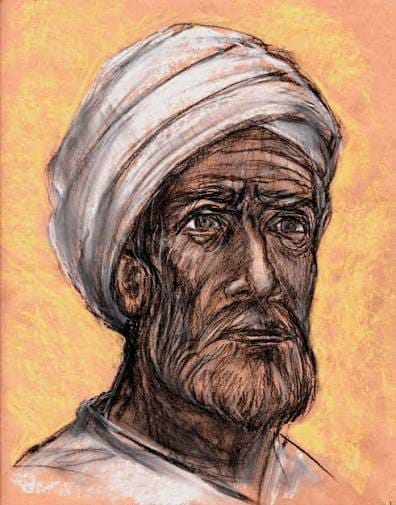
Ibn Khaldun, the 14th-century North African jurist and historian, observed that revolutions are born at the frontier — where the settled world ends and the desert begins, where the softness of civilisation has not yet arrived and the hunger for something true still has teeth. He meant it as a structural observation about how empires fall and new orders rise. He could not have missed the irony embedded in his own tradition.
Islam was born at the frontier. A monotheistic movement erupting from the sand-swept mountains of the Hejaz, carried by a Qurayshi caravan trader — orphaned early, married above his station to a widow of means and intelligence, given to long solitary retreats in the hills outside Mecca. An unlikely figure for world-historical consequence. And yet the religion he built did what Ibn Khaldun’s model predicted: it emerged from the edge, crossed the centre, and changed the fate of the Arabian Peninsula, the Levant, North Africa, Persia, Central Asia, and eventually the world.
This essay takes that religion seriously. It does not approach Islam as an outsider curiosity or a civilisational threat. It approaches it as a claim — a specific, falsifiable, total claim about the nature of God, the history of revelation, and the identity of a Galilean teacher whose shadow falls across both traditions. Islam calls him Al-Masih. Christians call him the Messiah. He is the hinge on which this entire argument turns.
I write as a Christian. I have done my best to treat the Quran as fairly as I can — because as an empiricist, facts matter and the truth matters, whatever it costs. This is a big topic. I hope you read it in the spirit intended.
What follows is a prosecution. Not a polemic — a prosecution. The evidence is drawn from the Quran itself, from the Islamic theological tradition, from the deposit of scripture Islam affirms as divinely given, and from the measured structure of the physical universe that belongs to no tradition. The method is the method Ibn Khaldun would have recognised: follow the evidence where it leads, name what you find, and let the verdict emerge from the logic rather than the sentiment.
The frontier is where the revolution starts. This essay begins there.
Islam makes a specific and falsifiable claim: that it is the final, complete, and incorruptible revelation, correcting the deviations of every prior tradition, delivered through the seal of the prophets, superseding everything that came before. This essay tests that claim against the evidence the claim itself invokes — the Quran, the settled positions of Islamic theology, the deposit of Scripture Islam explicitly affirms as divinely given, and the measured structure of the physical universe that no tradition owns. The method is prosecutorial, not polemical. The charge is stated. The evidence is examined. The verdict follows from what the evidence shows. If the charge is wrong, the error lies in the reading — and the correction lies in a closer reading still.
This essay distinguishes between direct textual evidence, historically controlled evidence, theological inference, metaphysical corroboration, and forward-model identification. The argument does not require every later identification to carry the same weight as the Quran’s own testimony about Jesus. The core case stands or falls first on the Quran, the prior deposit the Quran affirms, and the historical controls around both. Sections II through VII constitute the courtroom proof. Sections VIII through XVII constitute corroboration, consequence, and forward application. The terminal model does not support the courtroom proof. The courtroom proof stands without it. Where a computation is made, its assumptions are disclosed. Where a reading is contested, the contest is named and answered. A claim graded honestly is worth ten claims graded generously.
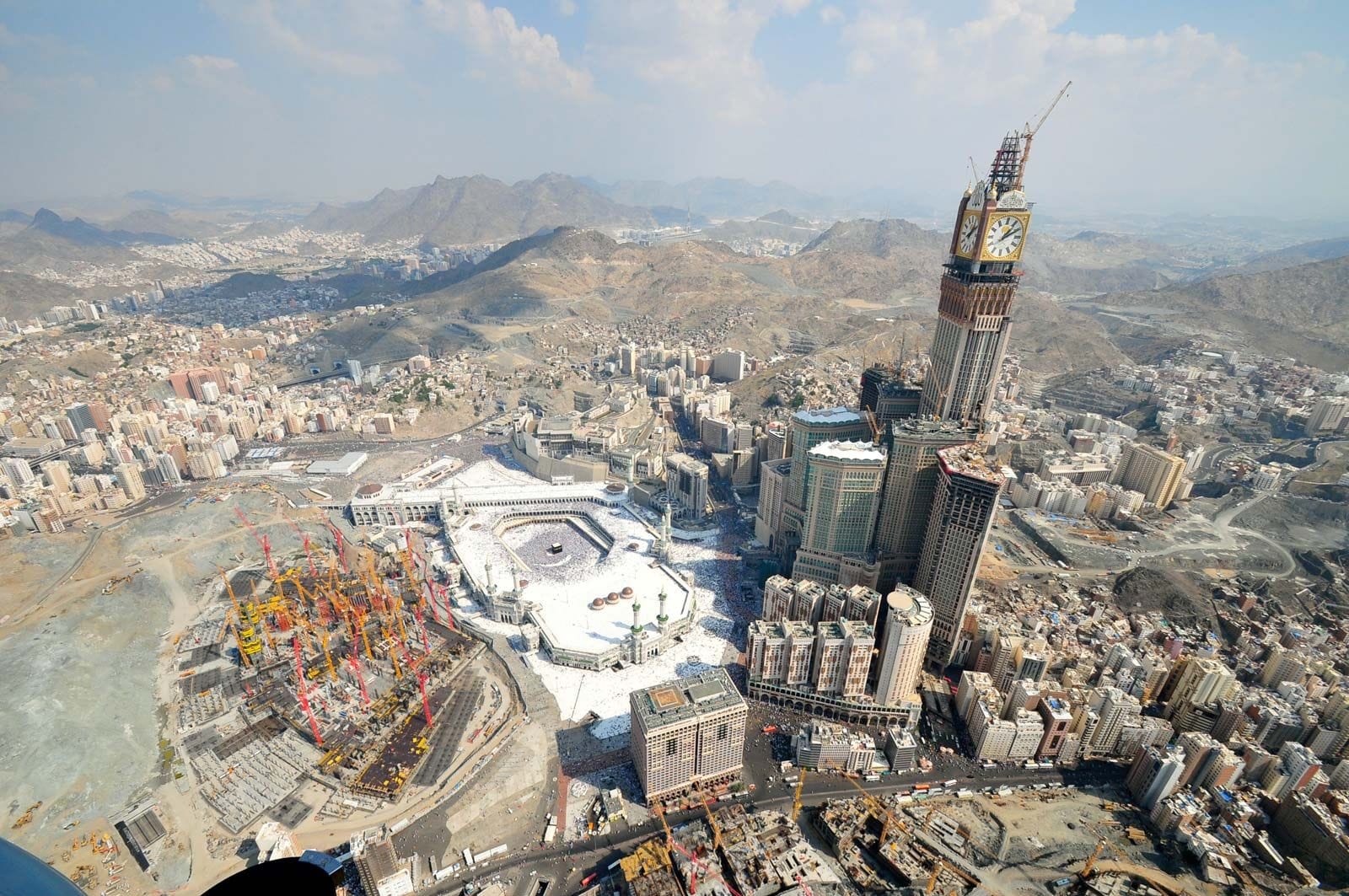
What Islam Claims
Islam makes a specific and total claim. There is one God — Allah — and Muhammad ibn Abdullah, a 7th-century Arab from the Quraysh tribe of Mecca, is his final messenger. The revelation delivered to Muhammad through the angel Gabriel over approximately twenty-three years constitutes the Quran — the verbatim, uncreated word of God, preserved perfectly, superseding every prior revelation. Muhammad is Khatam al-Nabiyyin — the seal of the prophets. No prophet comes after him. The revelation is complete.
The prior scriptures — the Torah given to Moses, the Psalms to David, the Gospel to Jesus — were genuine divine revelations. But they were corrupted by their recipients over time, altered through scribal error, political manipulation, and deliberate falsification. This corruption — tahrif — explains every point of conflict between the prior scriptures and the Quran. Where they agree with the Quran, they preserve genuine revelation. Where they conflict, they have been corrupted. The Quran corrects them.
Jesus — Isa ibn Maryam — is honoured in Islam as a great prophet, born of a virgin, worker of miracles, and the Messiah. He is called in the Quran kalimatuhu — His Word — and ruhun minhu — a spirit from him. He will return at the end of days to complete history. But he was not crucified. He was not raised from the dead. He is not divine. He is not the Son of God. Someone else died in his place, and God made it appear otherwise to those present. The cross is a Christian fabrication built on a divine illusion.
Notice the structure of the claim. Supersession requires three premises to be simultaneously true: that the prior deposit was genuinely divine; that it was subsequently corrupted; and that the Quran accurately restores what was lost. Remove any one and supersession collapses. If the deposit was never divine, there is nothing to restore. If it was never corrupted, there is nothing to correct. If the Quran does not restore it accurately, the correction fails on its own terms. The prosecution’s case is that the three premises cannot all be true — that the Quran’s own testimony, Islam’s own theology, and the manuscript record Islam’s own historians examined make the conjunction impossible. And the deposit itself issued a verdict on this exact scenario before Muhammad was born: an angel-mediated alternative gospel is anathematised in advance (Galatians 1:8), and the denial that Jesus Christ has come in the flesh is named as the test of the spirits (1 John 4:2–3). Whether those pre-emptive verdicts carry authority is precisely what Counts Two through Four will determine. These are the claims this essay tests — from within the Quran’s own testimony, the Islamic theological tradition’s own settled conclusions, and the deposit of scripture Islam itself affirms as divinely given.
I. The Claim
There is a tradition of inquiry within Islam that predates Muhammad — a tradition the Quran itself names and honours. The hunafa — the plural of hanif — were figures who rejected the idolatry of the surrounding culture and turned toward the God of Abraham without adopting either Judaism or Christianity wholesale. Abraham himself, the Quran insists, was neither Jew nor Christian but a hanif, one who had inclined his face toward the God who made heaven and earth (Surah 3:67). Waraqah ibn Nawfal — Khadijah’s cousin, a Christian scripture-knower whom the hadith tradition presents as writing or reading from the Gospel in Hebrew script — inhabited the edges of this tradition and validated Muhammad’s first prophetic experience by locating it within the framework of Moses and the prophets. The hanif tradition was reaching toward something. The question is what.
This essay takes that question seriously. It does not begin with contempt for Islam. The tradition has honoured Jesus more than most of contemporary secular culture does — preserving his eschatological role when the secular West abandoned eschatology, maintaining his miraculous birth when liberal Christianity abandoned the virgin birth, calling him the Word of God when liberal scholarship reduced him to a Galilean peasant. That deserves acknowledgement, and it will be acknowledged again before the verdict.
But the tradition also makes a specific and falsifiable claim, and the claim must be examined on its own terms. Islam’s claim to finality is not a claim to be one path among many. The Quran does not say “we are also a way to God.” It says the prior scriptures were divinely given and then corrupted, and that the Quran restores what was lost and completes what was incomplete. Muhammad is khatam al-anbiya’ — the seal after whom no prophet comes, because nothing remains to be said. The revelation is final. The messenger is last. The claim is total. A total claim invites a correspondingly total examination. Here is the examination.
II. Count One: The Quran’s Own Testimony About Jesus
Begin where the Quran begins — with the titles. The Quran gives Jesus five designations that no other figure receives in combination. He is Al-Masih — the Messiah — eleven times, and the title is never once defined. He is kalimatuhu — His Word (Surah 4:171). He is ruhun minhu — a spirit from Him (4:171). He is Abd Allah — the servant of God, the first thing the infant says from the cradle (19:30). He is nabi — a prophet. Each title carries weight. Together they carry a verdict the Quran did not intend to deliver.
Take kalimatuhu first, because the grammar matters. The construction is the definite possessive — His Word, the word that is His — the X-hu form the Quran characteristically uses for what belongs to God intrinsically: rahmatuhu, His mercy; qudratuhu, His power; ’ilmuhu, His knowledge. No other creature receives the title. Not Adam, who was made by the word. Not Gabriel, who carries words. Not even the Quran itself, which claims to be God’s speech, is called kalimatuhu in this construction. One figure in the entire corpus bears it. A hostile reader can contest the grammatical argument in isolation — Arabists will dispute how much the possessive construction proves — and the prosecution concedes the point at that grain and does not rest on it alone. The same is true of ruhun minhu: the preposition min denotes origin and derivation where bi-amrihi — by His command — was available and was not used; contestable alone, weighty in combination. The force of Count One is cumulative, and the cumulation is about to become severe.
Because Islam has already settled what “God’s Word” means, and settled it the hard way. In the ninth century the question of whether the Quran — God’s kalam — was created or uncreated tore the Abbasid world apart. The Mu’tazilites, backed by the caliph al-Ma’mun and two of his successors, said created — a creature, however exalted — and instituted the Mihna, the inquisition, to enforce the proposition on every judge and scholar in the empire. Most signed. Ahmad ibn Hanbal refused, was imprisoned and flogged under two caliphs, and became, by enduring, the axis around which orthodoxy re-formed. The tradition’s final, orthodox, blood-bought answer was the opposite of the inquisitors’: God’s Word — kalam nafsi, His self-subsisting speech — is eternal and uncreated, because God was never without His Word; a God whose Word began is a God who was once wordless, and that God is not God. The Ash’ari synthesis carried the verdict into every subsequent century of Sunni orthodoxy. Harry Austryn Wolfson, the great historian of the Kalam, drew the structural conclusion without polemical intent: the orthodox doctrine of the uncreated Quran is, in structure, the Christian doctrine of the Logos — the eternal Word, distinct enough to be spoken, divine enough to be uncreated. Islam fought its own civil war to establish that the Word of God is eternal and uncreated — and the Quran gives that title, in the possessive reserved for divine attributes, to Jesus of Nazareth alone.
The classical tafsir answers that kalimatuhu refers merely to the creative command — kun fa-yakun, “Be, and it is” — by which Jesus was conceived without a father. The answer fails at exclusivity. The kun command is used for the heavens, the earth, the angels, Adam — everything. If bearing the creative command’s product were what the title meant, everything would bear it, and Adam, created without father or mother, would bear it first. Nothing else does. Not even the Quran. The tafsir explains why Jesus could have the title; it cannot explain why only Jesus does. Moreover, Islamic tradition calls Moses Kalimullah, which means the one to whom Allah spoke. Why? Surah 4:164; .And to Moses Allah spoke directly;" transliterated: Wa kallama Allāhu Mūsā taklīmā. He is called this because Allah appeared to him directly without mediation at the burning bush--Allah manifested in a theophany as fire and directly spoke to him. Surah 7:143-144 repeat the same frame. So the question becomes this; if the title is taken at its plain textual meaning for Moses why is that not done for Jesus? Why does the hermeneutic suddenly require special pleading and contrived interpretative guard-railing for Jesus but not for Moses? What happens when the textual plain sense reading applied to Moses is applied to Jesus?
Moses is the one spoken to; Jesus is the Word from God. The Quran knows how to describe a prophet who receives divine speech. It does so with Moses. But of Jesus it says something stranger and stronger: not merely that a word came to him, but that he himself is kalimatuhu — His Word — cast to Mary, whose name is the Messiah Jesus. The claim is categorical before it is explanatory: Jesus is identified with the Word from God.
Apply to Jesus the same plain-sense hermeneutic Islam applies to Moses, and the hierarchy becomes unavoidable. The mediated recipient, Muhammad, stands below the one directly addressed, Moses; and the one directly addressed stands below the Word itself. The special pleading begins precisely where the plain reading becomes Christological.
Bring in the Ash‘ari settlement over divine speech and the pressure intensifies. Sunni orthodoxy fought the Mihna to establish that Allah’s kalam is not created, because Allah was never without His speech. God’s self-subsisting Word is eternal, uncreated, and intrinsic to Him. Now place that doctrine beside the Quran’s unique identification of Jesus as His Word. The result is a tension Islam can manage only by erecting interpretive guard-rails: Jesus must be “Word” in some reduced sense, because the plain sense would press toward a profile Islam cannot admit.
And the profile does not stop at title. Jesus then acts in ways that fit the title: he creates life from clay by breath in Surahs 3:49 and 5:110, echoing Allah’s animation of Adam; he commands the dead and they rise; he is born not by ordinary generation but by divine address to Mary. The one called the Word performs Word-like acts. The tafsir can explain why Jesus might be called a product of command, but it cannot explain why the Quran uniquely names him the Word and then uniquely surrounds him with acts of creation, life-giving breath, death-command, virgin conception, present heavenly life, and eschatological return. Let me demonstrate here with exegesis:
That is why the guard-rails exist. The anxiety is not arbitrary. If the title is allowed to bear the weight Islam gives divine speech elsewhere, and if Moses’s title is allowed to function as the Quran’s own control case, Jesus takes on a profile Islam cannot comfortably contain: pre-existent with God’s Word, entering corporeality through Mary, acting within creation with life-giving authority, and returning as history’s judge. This is not yet the Nicene formula stated in Islamic vocabulary, but it is recognisably adjacent to the Second Temple “Two Powers” pattern — with the second power no longer anonymous. The Quran’s own title names him: Jesus the Messiah, His Word.
Surah 5:110
[The Day] when Allah will say, "O Jesus, Son of Mary, remember My favor upon you and upon your mother when I supported you with the Pure Spirit and you spoke to the people in the cradle and in maturity; and [remember] when I taught you writing and wisdom and the Torah and the Gospel; and when you designed from clay [what was] like the form of a bird with My permission, then you breathed into it, and it became a bird with My permission; and you healed the blind and the leper with My permission; and when you brought forth the dead with My permission; and when I restrained the Children of Israel from [killing] you when you came to them with clear proofs and those who disbelieved among them said, "This is not but obvious magic."
Some questions from this text from the Quran:
1) Who is the Pure Spirit that supported Jesus?
2) Allah taught Jesus directly; writing, wisdom and the Torah and Gospel?
3) With Allah's permission he breathed into the clay bird and it lived--permission but not power? Does that not presume that creative agency on Isa's part; but agency directed by Allah whilst the life itself was inherent to Jesus?
4) Same logic for healing and rising the dead. Is that not the reason for the juxtaposition with magic?
Then take Surah 5:116;
And [beware the Day] when Allah will say, "O Jesus, Son of Mary, did you say to the people, 'Take me and my mother as deities besides Allah ?'" He will say, "Exalted are You! It was not for me to say that to which I have no right. If I had said it, You would have known it. You know what is within myself, and I do not know what is within Yourself. Indeed, it is You who is Knower of the unseen.
Now consider this Surah which for all intents and purposes is a straw-man argument against a position that the Gospels and indeed Christian doctrine explicitly does not teach. No Christian community deifies Mary. The entailment of the two of them in "Take me and my mother as deities besides Allah"is arguing for a position that was impossible during Jesus' ministry as the revelation of his deity among his disciples is something that happened after the resurrection and doctrinally in writing after the ascension. How would a group of people who abandoned him at his arrest and crucifixion also have deified him and his mother? It's not a feasible argument. It's logically incoherent and only makes sense as a polemic device to generate a guardrail to limit the ontological outcome of the titles used for Jesus; and a simultaneous validation for Muhammad's own prophetic office.
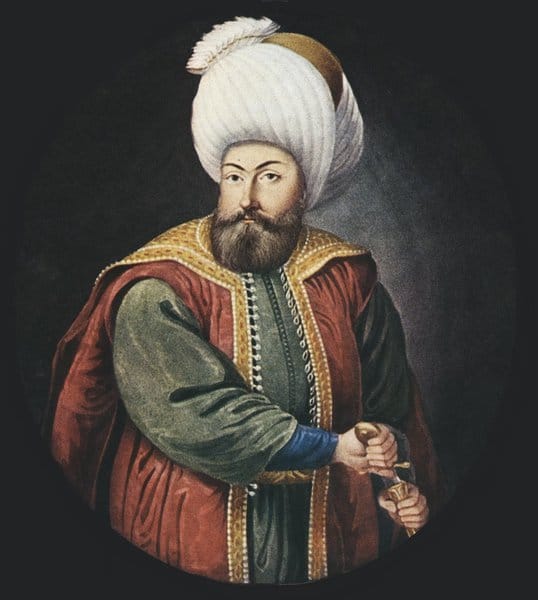
Take Al-Masih next, because it is a fossil. The title is not Arabic in origin; it is the Hebrew Mashiach imported whole — a covenantal office defined by a specific body of texts: Daniel’s anointed one who is cut off (Daniel 9), Isaiah’s servant who bears sin (Isaiah 53), Micah’s ruler from Bethlehem whose origins are from ancient days (Micah 5:2), the pierced sufferer of Psalm 22, the humble king of Zechariah 9:9, the pierced YHWH of Zechariah 12:10, the returning divine warrior of Zechariah 14. The Quran uses the title eleven times and defines it zero times — because the definition already existed, in the deposit. A title cannot be accepted while the texts that constitute it are rejected; to say Al-Masih is to invoke the job description. The title imports the content. And the content includes the Sonship texts the Quran explicitly denies at Surah 112:3 — the decree of Psalm 2:7 and its warning to kiss the Son (2:12), the riddle of Proverbs 30:4 (“what is his name, and what is the name of his son — surely you know”), the child named El Gibbor, Mighty God, in Isaiah 9:6, the throne addressed as God’s in Psalm 45:6–7, the Lord seated at YHWH’s right hand in Psalm 110. Judaism, note, is coherent here: it rejects the title’s application to Jesus and disputes the texts together — one position, consistently held. Islam accepts the title and strips its content. That is not a rival reading. It is an incoherence.
Take Abd Allah third, because it looks like the safest title and is not. The Servant of God is the first thing the Quranic infant says of himself (19:30) — and in the deposit, eved YHWH is not a generic honourific. It is the technical designation of Isaiah’s servant songs: the figure who is “high and lifted up” (52:13 — the throne-vision vocabulary of Isaiah 6), disfigured beyond human semblance, who bears the iniquity of the many, is cut off from the land of the living, and afterward sees light and is satisfied (53:11). The apostles read Jesus’s washing of feet and death through exactly this title; the Ethiopian official was reading exactly this chapter when Philip found him. The Quran’s Jesus introduces himself, from the cradle, with the job title of the suffering servant — and the Quran then denies the suffering. The title survives; the résumé is deleted.
Now assemble the five and state the cumulative verdict, because no single title carries the count alone and all five together are unanswerable. The eternal uncreated Word — by Islam’s own Mihna. Derivation from the divine being — min, not bi-amrihi. Creation by breath and command over death — the grammar of Genesis 1 and 2, not of Elijah. The Servant whose deposit-defined career is to die bearing sin and live again. The Messiah whose deposit-defined office is priest, king, and pierced one. Each title is a thread; the Quran wove all five into one figure and then denied the tapestry. The profile the Quran assembled — eternal Word, derived Spirit, creating, commanding, serving, dying, rising, returning — is the profile of a divine hypostasis. The Quran did not intend to assemble it. Unintended testimony is the strongest kind: it cannot be accused of apologetic design.
In Surahs 3:49 and 5:110 Jesus forms birds from clay, breathes into them, and they live. The sequence — formation, breath, life — is Genesis 2:7, the creation of Adam, performed in miniature. He raises the dead by first-person command. Set this against every miracle of every prophet in the deposit: Elijah prays and stretches himself on the widow’s son; Elisha petitions; Moses raises the staff at God’s instruction. Prophetic miracles are instrumental and petitionary. The Quranic Jesus creates and commands. The Quran appends “by permission of Allah” (3:49), and the qualification is real — but examine what it qualifies. It qualifies the context of the act, not its character: the act remains creation by breath and resurrection by command, categories the deposit reserves for God. And the New Testament makes the identical qualification in the identical voice — “the Son can do nothing of himself, but what he sees the Father do” (John 5:19); “I have not spoken of my own authority, but the Father who sent me” (John 12:49). The permission formula is not a defeater of the Christological reading; it is the second person’s own stated posture toward the first. The Quran preserved the deference and the deeds together — which is to say, it preserved the profile of a hypostasis: the eternal uncreated Word, deriving from the divine being, creating by breath, commanding death, deferring to the sender. The Quran assembled the profile. It did not intend to.
Then there is the cradle. Surah 19:30–33 records the infant Jesus speaking from his mother’s arms — sealed, first-person testimony, deposited before any community existed to benefit from it: “Peace is upon me the day I was born, and the day I die, and the day I am raised alive.” Born — die — raised: three events, one grammatical structure, one sequence. The classical reading, forced by 4:157’s later denial of the crucifixion, inserts millennia into the middle term: he will die after his eschatological return. But the parallelism resists the insertion. Nothing in the verse marks the second term as categorically different from the first and third; the reading supplies from outside what the grammar does not contain — and supplying from outside what the grammar does not contain is, as we shall see, precisely the operation the Quran elsewhere condemns as tahrif.
The Quran itself supplies the control case, eighteen verses earlier. Surah 19:15, of John the Baptist: “Peace be upon him the day he was born, and the day he dies, and the day he is raised alive.” The identical Arabic formula. The tradition accepts without hesitation that John actually died — beheaded, in history. Consistency requires the same reading for Jesus unless the text supplies a principle of distinction, and the text supplies none; 4:157 is a different surah from a different period, and using it to re-read 19:33 is exactly the harmonising-by-override that the tahrif charge attributes to Jews and Christians. The tradition’s defenders answer with Surah 3:55 and 5:117 — Allah says mutawaffika, “I will take you,” glossed as taking in sleep or taking up whole — and the gloss should be met on its own ground: tawaffa, everywhere else in the Quran when Allah is subject and a person the object, is the ordinary verb of causing death; the exceptional reading exists for one figure, invented to protect one doctrine, which is the pattern this count keeps finding — the plain grammar surrendered wherever it converges on the cross. And affirming John imports John’s identity, which the deposit constitutes: the voice crying in the wilderness of Isaiah 40:3, the Elijah of Malachi 4:5–6 — texts all four Gospels, and Jesus himself (Matthew 11:14), apply to John. The voice prepares the way for YHWH. The way led to Jesus. Affirm the herald and you have affirmed the direction he points.
There is a deeper structural problem. Surah 3:21 condemns those “who kill the prophets” — the killing of prophets as accomplished fact, a pattern God did not generally intervene to prevent. Jesus himself names it as the pattern: “it cannot be that a prophet perish outside Jerusalem” (Luke 13:33); “Jerusalem, Jerusalem, who kills the prophets” (Matthew 23:37). The substitution theory makes Jesus a patternless exception — the one prophet whose martyrdom God prevented by illusion — and supplies no principle for the exception. John dies. The prophets die. The Messiah, whose defining texts describe his death in the first person, is the one spared? The exception runs precisely backwards.
Now confront the substitution theory directly, because it does not merely strain the texts — it indicts its own God. Surah 4:157: they did not kill him, they did not crucify him, wa-lakin shubbiha lahum — it was made to appear so to them. Follow the entailment. If Allah staged the appearance of the crucifixion, then Allah manufactured the empty tomb’s context, the grief of the witnesses, and the conviction — recorded within a few years in the creed of 1 Corinthians 15 and proclaimed publicly at Pentecost — that Jesus had died and been raised. Christianity, on the substitution theory, is a religion Allah’s own illusion created. The Quran then arrives six centuries later to correct a corruption its own God caused. A God who corrects what he himself engineered is not a coherent object of worship; he is a contradiction wearing a throne. A defender may retreat: perhaps the illusion was local and the resurrection faith was mere human error compounding it. But the error’s carriers were not marginal. The theory requires the deception of Mary — whom the Quran calls chosen above the women of the worlds (3:42) — standing at the cross watching what she believed was her son; of John, receiving her into his home at the crucified man’s instruction (John 19:25–27); of Joseph of Arimathea and Nicodemus, handling the body; and it requires the manufactured transformation of Peter the denier, of James the sceptic brother, of Paul the persecutor — the sceptic-to-martyr conversions that constitute the strongest category of ancient testimonial evidence. Deceiving the innocent and manufacturing false faith in them is the act the theory attributes to God.
The Quran has a word for this, and it places the word in the worst possible position. Follow the entailment one step further before the word arrives, because the theory’s full cost is rarely stated. On the substitution account, Allah did not merely permit a misunderstanding; he authored the founding evidence of the religion he would later send Muhammad to refute. The empty tomb, the appearances, the transformed witnesses — the entire evidential base of Christianity — become divine manufacture. For six centuries, on this theory, God watched the church he had engineered spread across three continents on the strength of his own illusion, generations living and dying inside a deception of his making, before sending the correction. And the correction’s warrant is the trustworthiness of the God whose last major act in salvation history was a successful deception. The theory does not have a flaw. The theory is a flaw.
Surah 3:54, immediately before the substitution passage: wa-makaru wa-makara Allahu, wallahu khayru al-makireen — they schemed, and Allah schemed, and Allah is the best of schemers. The root m-k-r carries the semantic field of cunning, stratagem, deception; Islamic lexicographers soften it to “just requital of plotters,” and the contest over the word is real. But the structural problem survives any lexicon. Grant the counter-plotting defence its strongest form: Allah out-schemed the schemers. Who were the schemers? The Sanhedrin and Rome. Whom did the substitution deceive? Not the Sanhedrin, who wanted a death and, on the theory, believed they got one. It deceived the non-plotters — the disciples, the women, Mary. The dilemma has no third horn: either the innocent were deceived, in which case divine makr operated against the innocent and the moral defence collapses; or they were not deceived, in which case the apostolic testimony reports what happened, and 4:157 is false. And beneath the dilemma lies the regress: if strategic false appearance is a divine perfection, then no communication from this God — including the Quran’s own corrective claim — is secured against being itself a stratagem. The deposit’s God forecloses the entire category: “God is not a man, that he should lie” (Numbers 23:19); “it is impossible for God to lie” (Hebrews 6:18); a God “who cannot lie” (Titus 1:2) — and the whole architecture of divine oaths, which Section III will open, rests on that impossibility. YHWH cannot lie and Allah is the best of schemers are not two emphases. They are two incompatible doctrines of the divine character, and the substitution theory needs the second.
Two controls close the count. The first is an enemy source. The Babylonian Talmud, Sanhedrin 43a — in the uncensored editions — records that “on the eve of Passover, Yeshu was hanged,” and adds that a herald went forth forty days beforehand announcing the charge: he practised sorcery and led Israel astray. Note what the hostile record concedes even in its hostility: the miracles are not denied but reclassified as sorcery — the works were too public to erase, so they were re-attributed. A hostile tradition, with every motive to deny, confirms the execution, the extraordinary works, and the date — the Passover season, where the deposit’s own feast sequence (Leviticus 23) maps the redemption in order: Passover, the death of the lamb; First Fruits, the rising of the first sheaf — “Christ the first fruits” (1 Corinthians 15:20, 23); Pentecost, fifty days on, the harvest poured out. The events landed on the calendar the deposit had rehearsed annually for fifteen centuries. A minority of scholars contests the identification of this Yeshu with Jesus of Nazareth on chronological grounds drawn from the ben Pandera traditions; the convergence of the hanging, the eve of Passover, and the leading-astray charge answers them, and Peter Schäfer’s study of the Talmudic Jesus passages sharpens the point rather than blunting it: the passages read as deliberate polemical response to the Gospel narratives — counter-claims to the virgin birth, the miracles, the resurrection — and a responsive polemic concedes the currency and the shape of what it answers. Independent garble proves little; targeted counter-narrative proves the target.
The second control is a legal standard the Quran itself affirms in affirming the Torah. Deuteronomy 19:15: a matter shall be established by two or three witnesses; one witness shall not suffice. The apostolic testimony to the death and resurrection meets the standard comprehensively — named witnesses, public proclamation in the city of the events, a creed datable to within a handful of years, an explicit invitation to check with the five hundred, most still living (1 Corinthians 15:6). The Islamic correction of that testimony rests on a single private, unwitnessed channel — one man, one cave, one report. The deposit’s own evidentiary law, which the Quran affirms as light and guidance, disqualifies the correction’s form before its content is even weighed.
One objection remains, and it deserves its answer here because everything after depends on it. The transcendence objection: God does not take creaturely form; tawhid forbids it; therefore the incarnation is excluded a priori and every Christological reading above is void. State the objection at full strength, because it is Islam’s deepest instinct and not a debater’s trick: the Creator is not contained by creation; “vision comprehends him not” (6:103); the categories of begetting and embodiment belong to creatures, and applying them to God is the pagan error the Quran exists to end. The instinct is half right, and the deposit honours the half: no one has seen the Father; the divine essence is not exhausted by any form. But the objection proves too much against the Quran’s own record. The Quran itself affirms divine action through created form — the fire of the bush from which God speaks to Moses (20:11–14), the breath into Mary, the miracles through Jesus’s hands — and declares man created fi ahsani taqwim, in the best of statures (95:4). Once God speaks from a bush, the categorical bar is gone; what remains is a question of degree and mode, and the deposit’s answer — the voluntary, permanent assumption of the human form, “a body you have prepared for me” (Psalm 40:6–8) — differs from the bush in permanence, not in kind. A Muslim theologian may distinguish communication through a form from assumption of a form. The distinction is real, and Section III will meet it head-on with the deposit’s own theophanic record, in which the figure who bears the Name appears in human form again and again, to Abraham, to Jacob, to Joshua — the form the incarnation makes permanent.
The verdict on Count One. The Quran calls Jesus the Messiah without the Messiah’s texts, the Word of God after settling that God’s Word is uncreated, a spirit from Him, a creator by breath, a commander of death, a prophet who announces his own death and raising in a formula the Quran applies to John’s actual death — and then denies the death occurred as every witness perceived it, by a divine stratagem that would deceive the innocent, manufacture the faith it later condemns, and dissolve the reliability of revelation itself. The Quran named what it then denied. The count is proven from the Quran’s own mouth. The burden shifts to the defence.
III. The Architecture the Title Imports
Count One established that the Quran imported a title. This section opens the crate. What follows is the deposit’s own messianic architecture — the texts the title Al-Masih invokes and the Quran never engages — read by the method the apostles themselves inherited rather than invented. Prosopological exegesis — reading the Psalms and prophets by asking which person is speaking — is how Peter reads Psalm 16 at Pentecost (Acts 2:25–31) and how Hebrews reads Psalms 22 and 40: a Second Temple Jewish method, documented as such in the scholarship, applied by Jews to Jewish texts. The architecture below is not a Christian retrofit. It is the deposit’s own load-bearing frame, and the Quran affirmed the deposit.
Begin with the Name, because everything descends from it. At the bush, Moses asks what he shall say when Israel asks who sent him, and the answer is Ehyeh Asher Ehyeh — I AM THAT I AM (Exodus 3:14). Two things are in the grammar and one thing is not, and the distinction matters. In the grammar: the formula is genuinely reflexive — the subject of the main verb and the subject of the relative clause are the same I; God defines himself by reference to himself alone. Aseity and self-relation are in the syntax. Not in the grammar: a proof of triunity from the three-word shape alone — the idem per idem construction is a productive Hebrew pattern (“I will be gracious to whom I will be gracious,” Exodus 33:19), and a construction class cannot make each of its instances a metaphysical diagram. The Name’s triadic character is established, rather, by how the Name is deployed — and the deployment is unambiguous. The naming scene itself is two-figured: the malak YHWH appears in the flame of the bush (Exodus 3:2), and God calls from the midst of it (3:4). Exodus 23:21 presents a figure distinct from the sender in whom “my Name is,” who holds the prerogative over transgression. Isaiah 63:9–14, the deposit’s own retrospective exegesis of the Exodus, names three actors: YHWH, the malak panav — the Angel of His Presence — who saved them, and the ruach qodsho, His Holy Spirit, whom they grieved. Psalm 33:6 runs creation through YHWH, His davar, and the ruach of His mouth in a single verse. Numbers 6:24–27 places the Name on Israel by a threefold invocation. The Name is triadic as revealed — in operation, in mediation, in the canon’s own commentary on itself — and the economic manifests the immanent: how God operates expresses what God is. John 1:1 does not import a Greek novelty; it translates a Hebrew deployment.
Hold that frame and the Tanakh’s structure resolves. The Torah is deposited testimony — the edut, the witness-document placed beside the ark precisely so that it could testify against the nation (Deuteronomy 31:26): “take this Book of the Law and put it beside the ark… that it may be there for a witness against you.” A legal instrument, filed in advance. The Prophets are the covenant lawsuit that instrument enables — the riv, YHWH summoning heaven and earth as empanelled witnesses against his people (Micah 6:1–2; Isaiah 1:2), prosecuting breach clause by clause. The Writings are the case internalised — the Psalms praying the lawsuit, the Wisdom literature living inside its terms, Daniel counting its calendar from exile. A court record in three movements: deposition, prosecution, internalisation. And a court record implies a resolution its own structure specifies: the covenant’s curses must fall (they did — twice), the covenant’s promises must stand (the oaths guarantee it), and the only figure who can satisfy both simultaneously is one who bears the curse and inherits the promise in the same person — a Jew, under the law, bearing the Name, executing a two-stage programme: suffering first, sovereignty after. The structure demands the figure before a single messianic text is opened. Now open them, and watch the figure assemble.
The oath of the priest-king. Psalm 110 — the psalm the New Testament cites more than any other — opens with YHWH addressing the psalmist’s lord: “Sit at my right hand.” David is the psalmist; Jesus’s own argument (Mark 12:35–37) turns on it — whom does the king call “my lord”? A king has no human superior in Israel; the address only resolves upward. Verse 4 is a sworn oath: “YHWH has sworn and will not change his mind: you are a priest forever after the order of Melchizedek.” Forever. Under oath. Without repentance — the one oath in the Psalter explicitly armoured against its own retraction. Now set the Islamic eschatology beside it: Jesus returns, reigns, dies, and is buried in Medina beside Muhammad. A dying figure cannot hold an eternal priesthood secured by an oath God swore never to retract; the grave in Medina and the oath in the Psalter cannot both stand, and the Quran affirms the Psalter. The Quranic tradition preserved the royal return and stripped the priestly eternity — kept the throne, discarded the oath. And Melchizedek is no Christian invention: he is the pre-Mosaic priest-king of Genesis 14, blessing Abraham with bread and wine, and the Qumran scroll 11Q13 — sealed before Christianity existed — already reads him as a divine, eschatological judge, applying Psalm 82’s elohim to him and announcing through him the Jubilee release of Isaiah 61. Hebrews 7 did not innovate; it inherited a Jewish trajectory already in motion, and drew its conclusion: a priesthood “by the power of an indestructible life.”
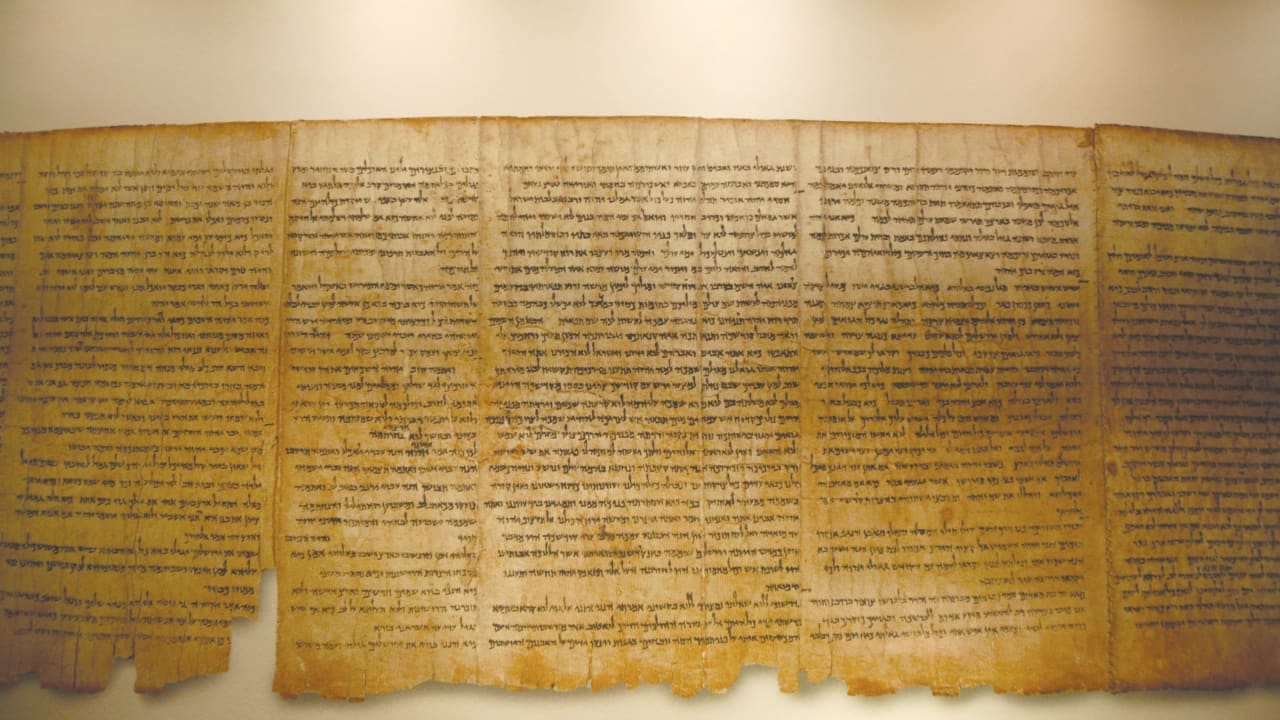
The Son texts. Psalm 2: YHWH’s decree — “You are my Son; today I have begotten you” — with the warning to the kings of the earth: “Kiss the Son, lest he be angry… blessed are all who take refuge in him” — refuge-taking, elsewhere reserved for YHWH, commanded here toward the Son. Psalm 45: the Davidic king addressed directly as Elohim — “Your throne, O God, is forever and ever” — by a psalmist who then distinguishes “therefore God, your God, has anointed you” in the next verse: two subjects, one called God by the other, in a royal wedding song the synagogue never excised. Proverbs 30:4 asks who ascended and descended, who gathered the wind, who established the ends of the earth — “what is his name, and what is the name of his son? Surely you know.” The traditional counter reads the son as Israel, and it is noted; but Israel did not establish the ends of the earth, and the question’s parallelism asks after the establisher’s son, not his servant. The Quran affirms the Psalms as given to David (4:163) and denies the Son absolutely (112:3). The dilemma is exact: invoke tahrif against the Psalms and you destroy the deposit whose reliability validated Muhammad through Waraqah — the founding credential dies; let the Psalms stand, and the Sonship stands in the text God gave David. There is no third option, and Count Two will show the first option is already foreclosed by the manuscripts.
The Branch who bears the Name. Isaiah 11 opens with a shoot from the stump of Jesse — a descendant — and closes, in verse 10, with “the root of Jesse” who “stands as a banner for the peoples; the nations shall seek him.” The root is not botanical substrate in this verse; it is a person, a rallying figure — the Septuagint, quoted by Paul (Romans 15:12), already reads it personally and messianically, centuries before rabbinic exegesis hardened. Descendant and root, offspring and origin, in one chapter: the deposit’s own incarnation logic, which Revelation 22:16 states without embarrassment — “I am the root and the offspring of David.” Jeremiah 23:5–6 gives the Branch his name, and the name is the Tetragrammaton: YHWH Tsidkenu, YHWH our righteousness. The standard rejoinder cites Jeremiah 33:16, where Jerusalem is called by the same name — a city named in honour of its king, which is how royal naming works; and the rejoinder carries a text-critical wound its users rarely disclose: Jeremiah 33:14–26 is absent from the Septuagint entirely, sitting in the least stable stratum of Jeremiah’s text, while 23:5–6 is secure in every witness. Zechariah completes the Branch: in 3:8–9 he is the servant through whom iniquity is removed “in a single day”; in 6:12–13 he is crowned as priest and king together — the two offices the Torah enforced as separate on pain of judgment, as King Uzziah learned when he seized the censer (2 Chronicles 26). The terminal figure unites what the law divided. Islam kept the returning king and severed the priest — the same amputation, at the same joint, as Psalm 110.
The servant who dies and continues. Isaiah 53 describes one figure — despised, pierced for our transgressions, cut off from the land of the living (v. 8) — who then “sees his offspring and prolongs his days” (v. 10) and divides spoil with the strong (v. 12). Death and continuation in a single subject: the resurrection, stated eight centuries early. The collective reading — the servant as Israel — must explain how the servant suffers for “my people” (v. 8) while being distinguished from them, and the later rabbinic device of two Messiahs — ben Joseph who dies, ben David who reigns — is a post-70 artifact that concedes the problem: the texts present death and dominion, and a tradition that will not let one figure do both must mint two. Note what the substitution theory does to this chapter: verse 10 says “it pleased YHWH to crush him.” If the crushing was an illusion, the prophet describes divine deception as YHWH’s redemptive will. The theory does not merely miss Isaiah 53; it defames it.
The pierced psalm. Psalm 22, composed roughly a millennium before Rome crucified anyone, speaks in the first person: bones out of joint and on display, garments divided by lot, mockers wagging heads — and the crux, verse 16. The Masoretic text as pointed reads ka’ari — “like a lion my hands and my feet” — a clause with no verb, syntactically broken as it stands; the brokenness itself is the internal evidence that a verb originally stood there. The pre-Christian witness supplies it: the Septuagint, translated in the second century BCE with no Christian motive in existence, reads ōryxan — “they dug/pierced my hands and my feet.” The Hebrew corroboration is the Psalms scroll from Naḥal Ḥever (5/6HevPs) — a first-century manuscript from the Bar Kokhba caves, copied by Jewish scribes in a milieu with active anti-Christian interest, reading the verbal form ka’aru. Two honest caveats, disclosed rather than extracted: waw and yod are nearly identical in Herodian script, and the verb k-r-h means “dig,” from which “pierce” is one interpretive step. The argument does not need to hide either, because its lead is internal: the received reading does not parse, and every early independent witness points to the verb that fixes it. The psalm ends in vindication and worldwide proclamation to “a people yet unborn” (vv. 27–31). First-person crucifixion phenomenology, before crucifixion existed, ending in resurrection scope.
The pierced YHWH. Zechariah 12 is spoken by YHWH throughout — the chapter opens with the God “who stretches out the heavens” — and at verse 10 the speaker says: “they will look on me, the one they have pierced, and mourn for him as one mourns an only son.” A text-critical contest exists: some Hebrew manuscripts read “on him,” and John 19:37 cites the passage in the third person. But the contest favours the received text: elai, “on me,” is the harder reading — scribes had every motive to soften a pierced YHWH and none to create one — and the critical editions retain it. Engage the variant and the argument strengthens; even on “him,” the pierced one is mourned with the mourning of the yachid, the only son, and YHWH remains the speaker of the sentence. Three exits are available to an Islamic reader, and each fails. Read it as future — pierced at the eschaton — and the substitution theory collapses from within Islam’s own eschatology, since the returning Jesus would then be pierced after all. Override the first person as poetic licence, and the override is the tahrif procedure: supplying from outside what the grammar does not contain. Claim corruption, and the claim dies at Qumran, where Zechariah lies sealed among the Twelve before Christianity was born. Only one reading holds the verse whole: the one pierced is YHWH, and the mourning is for a person distinct enough to be mourned “for him.” The two-natures confession is not a Greek imposition on the text. It is the only way to read the text as written — the Chalcedonian formula is the deposit reading itself consistently.
The chain. Now connect what the deposit connects. Psalm 110:1 — the lord enthroned at YHWH’s right hand until the enemies are made a footstool. Psalm 110:5–6 — the enthroned one executes judgment among the nations. Daniel 7:13–14 — one like a son of man comes with the clouds of heaven, and to him is given dominion, glory, and a kingdom, “that all peoples, nations, and languages should serve him” — pelach, the Aramaic term for cultic service rendered to deity. Isaiah 63:1–6 — the warrior arriving in garments dyed red from the winepress of wrath, and the speaker is YHWH. Revelation 19:13–15 — the rider on the white horse, treading “the winepress of the fury of the wrath of God,” his robe dipped in blood, and “his name is called the Word of God.” One figure. One sequence: enthronement, session, coming on the clouds, arrival in judgment — and the sequence’s terminal name is the Arabic Quran’s own title: kalimatuhu. The Islamic tradition preserved the end of this chain — Jesus returns, in glory, to judge — and stripped its beginning: the piercing, the death, the resurrection, the enthronement that make the return intelligible. Islam holds Revelation 19’s rider while denying Isaiah 53’s servant. A conclusion without its premises is not a rival theology. It is a torn page.
The oath under trial. The chain was sworn to in a courtroom before it was written in this one. At the Sanhedrin hearing, the high priest places Jesus under judicial oath — “I adjure you by the living God, tell us if you are the Messiah, the Son of God” — and Jesus answers by stacking the chain’s two hinges into one sentence: “You will see the Son of Man seated at the right hand of Power” — Psalm 110:1 — “and coming on the clouds of heaven” — Daniel 7:13 (Matthew 26:63–64). The court’s reaction is the enemy-source confirmation: the high priest tears his robes and pronounces blasphemy. Here the control case is decisive. A century later, Rabbi Akiva hailed Simon bar Kokhba as Messiah — and no court charged Akiva or his candidate with blasphemy, because a messianic claim as such was not blasphemous. What drew the charge was not “I am the Messiah” but the claim beneath it: session at the right hand, arrival on the clouds — the divine prerogatives. The Sanhedrin understood the claim precisely, and their verdict of blasphemy is history’s hostile notarisation that the claim was made.
The oaths the Quran never engages. Beneath the messianic chain lies a deeper stratum: the covenant oaths, in which YHWH binds himself by his own life. The catalogue is long and the Quran’s silence covers all of it. The Noahide oath — never again, sealed with the bow (Genesis 8–9). The Abrahamic oath after the binding — “By myself I have sworn… in your seed shall all the nations of the earth be blessed” (Genesis 22:16–18) — an oath whose occasion is Isaac on the altar: no Isaac, no binding; no binding, no oath. And here the Quran corroborates against itself: Surah 29:27 places prophethood and the Book in the line of Isaac and Jacob. The confirmation to Isaac (Genesis 26:3–4). The ladder oath to Jacob (Genesis 28). The covenant of a perpetual priesthood to Phinehas (Numbers 25). The Davidic covenant sworn “by my holiness — I will not lie to David” (Psalm 89:35). Psalm 110:4, already entered. The waters-of-Noah oath extended to the covenant of peace: “the mountains may depart… but my steadfast love shall not depart” (Isaiah 54:9–10). The universal oath — “By myself I have sworn… to me every knee shall bow, every tongue swear” (Isaiah 45:23) — which the apostles apply, without blushing, to Jesus (Romans 14:11; Philippians 2:10–11). The indestructibility of Israel, sworn on the fixed order of sun and moon (Jeremiah 31:35–37) — a standing refutation, in advance, of any jurisprudence that treats the land as permanently forfeit waqf. The grain-and-wine oath of Isaiah 62:8–9. The covenant-in-faithfulness of Isaiah 61:8. Islam claims to restore the Abrahamic religion, and the Abrahamic religion is constituted by these oaths — and the Quran engages not one. The silence is not an omission of detail. It is the absence of the skeleton.
Four oath-moments, one figure, binds the stratum together. Deuteronomy 32:40 — YHWH lifts one hand to heaven: “As I live forever” — chai anochi le-olam. Daniel 12:7 — the man clothed in linen above the waters raises both hands and swears “by him who lives forever.” Matthew 26:63–64 — the living God invoked in judicial adjuration, and the Son of Man answers under it. Revelation 10:5–6 — the mighty figure, one foot on sea and one on land, raises his right hand and swears by him who lives forever that there shall be no more delay. The man clothed in linen is described in Daniel 10:5–6 in the terms Revelation 1:13–16 applies to the glorified Christ — the identification is interpretive, held across traditions with varying confidence, and entered here as such. The pattern, however, is textual: the deposit’s oaths are sworn on the swearer’s own eternal life. Which exposes the asymmetry Count Two will weaponise: Allah swears by created things — the dawn, the fig, the olive, the declining star; YHWH swears by himself, because nothing greater exists to swear by (Hebrews 6:13). An oath grounded in the swearer’s eternal existence is not indexed to time; abrogation — naskh, Surah 2:106, which operates on temporally indexed communications — is a category error against it. You can supersede a message. You cannot supersede chai anochi le-olam.
The speech pattern of the Word. Every prophet in the deposit authorises his speech externally: “Thus says the LORD” — the courier’s formula, authority borrowed and disclosed as borrowed, some four hundred times across the prophets. One figure in the canon authorises his speech from himself: “Amen, amen, I say to you” — the doubled oath-particle placed before the utterance rather than after it, self-grounding speech, appearing across John’s Gospel twenty-five times and in its single form throughout the Synoptics; no prophet, rabbi, or angel in the literature speaks this way, because the construction claims the speaker as the truth-condition of his own words. Around it stand the I AM declarations: “I am the bread of life”; “I am the light of the world”; “I am the resurrection and the life” (11:25) — not “I bring” or “I announce” but “I am”; “I am the way, the truth, and the life” (14:6); and the sentence that ended the argument by starting a stoning: “Before Abraham was, I AM” (8:58) — the Septuagint’s rendering of the Name at the bush, in the mouth of a Galilean, in the present tense, of a time before his birth. The hostile witnesses notarise the meaning twice over: they take up stones, and they explain the stones — “not for a good work, but for blasphemy: because you, being a man, make yourself God” (10:33). Prophets transmit. The Word speaks as source. The Quran imported the title of the Word and stripped the speech pattern that is the title’s exercise — kept the noun, deleted the voice.
The visible YHWH. The last frame answers the transcendence objection Count One deferred. The deposit holds two truths in tension: no one has seen the Father — “you cannot see my face and live” (Exodus 33:20); “no one has ever seen God” (John 1:18) — and yet the deposit is saturated with theophanies, and their texture matters, so walk them. Hagar, an Egyptian slave, pregnant and fleeing, is found by the malak YHWH at a desert spring — and she names the speaker: “You are the God who sees me” (Genesis 16:13), the text adding that she marvelled to have seen him and lived. Abraham hosts three figures at Mamre, washes their feet, feeds them curds and calf under the oaks — and one of the three speaks as YHWH, negotiates over Sodom as YHWH, and is addressed as the Judge of all the earth; when the judgment falls, “YHWH rained fire from YHWH out of heaven” (Genesis 19:24) — two subjects bearing one Name in a single verse of Torah. Jacob wrestles a man through the night at the Jabbok, is renamed by him, and names the place Peniel — “for I have seen God face to face, and my life is preserved.” Joshua, before Jericho, meets a man with drawn sword — the Commander of YHWH’s army — falls on his face, and is told to remove his sandals, for the place is holy: Sinai’s protocol, and worship accepted, where mere angels categorically refuse it. Gideon sees the malak YHWH and cries out expecting death; Manoah and his wife watch him ascend in the altar flame and conclude “we shall surely die, for we have seen God.” Isaiah sees the Lord high and lifted up, and John writes, without apology, that Isaiah “saw his glory and spoke of him” (John 12:41). Ezekiel sees, above the crystal expanse, a throne, and on the throne “a likeness with a human appearance” (Ezekiel 1:26). Daniel sees the Ancient of Days and, distinct from him, one like a son of man approaching on the clouds. The resolution is the deposit’s own, not a Christian gloss: every visible appearance is the second bearer of the Name — the malak panav, the Angel of the Presence in whom the Name dwells (Exodus 23:21; Isaiah 63:9) — who makes the unseen Father known (John 1:18; Hebrews 1:3). And note what malak is not: it is not a winged species. In every malak-YHWH encounter the form is human — a man eats at Mamre, a man wrestles at the Jabbok, a man stands with drawn sword at Jericho. The incarnation is not a category rupture in this record; it is the permanent assumption of the form the second Person always used. The bush was a tenancy. Bethlehem was the purchase.
The functional messengers confirm the hierarchy by contrast. Gabriel and Michael are couriers and princes — and the deposit provides a clean test to distinguish them from the Name-bearer: worship. Offered worship, the mere angel refuses and redirects — “You must not do that! Worship God” (Revelation 19:10; 22:9). The Commander before Joshua and the malak before Manoah accept it. The Name-bearer of Exodus 23:21 holds authority over transgression — a divine prerogative. And Gabriel, specifically, takes his orders from the man clothed in linen (Daniel 8:16; 10). Now observe what Islam built: a revelation structure in which Gabriel — the courier, the subordinate — is the supreme mediator of the final message, while the figure the courier serves is demoted to prophet. The architecture the title imports has a chain of command, and Islam inverted it.
Step back and take the measure, because the cumulative structure is itself an argument. Authors spanning perhaps fifteen centuries — shepherds, kings, priests, exiles, a herdsman of Tekoa — writing in two languages across three empires, with no coordinating mechanism and no capacity to conspire, converge on a single profile: a descendant who is also the root; a king addressed as God by God; a Son begotten by decree; a priest forever by irrevocable oath, outside the Levitical line; a servant who dies bearing sin and continues to see offspring; a sufferer whose hands and feet are pierced a millennium before the method existed; the pierced one who is YHWH speaking in the first person; a Son of Man served with the service due to God alone; a returning warrior whose name is the Word of God. Any one of these texts, alone, admits an alternative reading, and the honest ones have been flagged above. The convergence does not. Coordinated fabrication is excluded by the centuries; coincidence is priced by the count; and the remaining explanation is the deposit’s own — one Author, one plot, disclosed in instalments. Five titles the Quran imported from this architecture. Not one oath engaged. Not one theophany reckoned with. Not one convergent text so much as disputed. The silence is not evidence of absence. It is a pointer — directing every honest reader of the Quran back to the sources the Quran itself declares light and guidance, where the architecture stands intact, and where the crate, once opened, cannot be closed.
IV. Count Two: The Corruption Charge Refutes Itself
The tahrif doctrine is Islam’s escape hatch from everything Section III entered into evidence. Examine the hatch. It opens onto a wall.
Start with what the Quran actually says about the prior scriptures — in the present tense, in Muhammad’s own lifetime. Surah 5:44: “Indeed, We sent down the Torah, in which is guidance and light.” Surah 5:46: “We gave him the Gospel, in which is guidance and light.” Not was. Is. And Surah 5:47 goes further than affirmation into command: “Let the People of the Gospel judge by what Allah has revealed in it” — a seventh-century imperative directed at texts in seventh-century circulation, the very manuscript tradition we now possess whole in codices older than Muhammad: Sinaiticus and Vaticanus were already two centuries old when that verse was recited. One cannot command a community to adjudicate by a corrupted standard; the command presupposes the standard’s integrity at the moment of utterance, and the moment of utterance postdates every manuscript this essay has cited. Surah 10:94 then instructs the doubting hearer to “ask those who have been reading the Book before you” — the People of the Book as a standing reference; classical tafsir reads the verse as reassurance to Muhammad, but reassurance by appeal to a corrupted text reassures no one. Surah 16:43 repeats the instruction. A corruption charge that never specifies what was corrupted, when, by whom, or by what mechanism it penetrated every independent textual stream, coexisting with present-tense affirmations of the same texts as guidance and light and a standing command to judge by them, is not a doctrine. It is a solvent applied selectively wherever the deposit becomes inconvenient — and the pattern of application is itself evidence: every major Quranic replacement clusters at exactly the points that lead to the Word’s identity. Crucifixion, replaced by substitution. Isaac, displaced by an unnamed son read as Ishmael. Jerusalem, displaced by Mecca. The Israelite succession, displaced by an Arabian one. Four substitutions, one target. Corruption is random; targeting is not.
Now the trilemma that is this count’s core. The deposit cannot simultaneously be: reliable enough to validate Muhammad’s prophethood — for the founding validation was Waraqah locating the Hira experience within the framework of Moses and the prophets, a validation that presupposes the framework’s integrity; affirmed by the Quran, in the present tense, as guidance and light; and corrupted enough to explain every conflict with the Quran. Take any two and the third falls. If corrupted, Waraqah validated Muhammad against a forgery, and the first credential of Islam dissolves. If reliable, the conflicts convict the Quran, not the deposit. Tahrif does not defend Islam. It saws through the branch Islam stands on.
Then the manuscripts arrived, and the trilemma acquired a material seal. In 1947, at Qumran, the Great Isaiah Scroll — copied around 125 BCE, a thousand years older than the previously oldest complete Hebrew Isaiah — emerged essentially identical to the Masoretic text: orthographic variants, no doctrinal drift. Isaiah 9:6’s child called El Gibbor — Mighty God, YHWH’s own title fifteen verses later (10:21) — sits intact in a scroll sealed before Christianity existed. For textual tahrif to be true, identical corruptions would have to have penetrated the Masoretic tradition, the Samaritan Pentateuch, the Septuagint, the Qumran corpus, and the early Christian papyri — five independent streams, separated by geography, language, and mutually hostile custodianship — and left no trace of the uncorrupted original anywhere. That is not a low-probability event. It is a conspiracy without conspirators.
And the charge inverts. Which tradition actually did what tahrif describes? Around 650 CE, the caliph Uthman, alarmed by Hudhayfah’s report from the Armenian front — that the garrisons were reciting divergently and would fracture over the text as the Jews and Christians had — commissioned Zayd ibn Thabit’s committee to produce a standard recension, dispatched copies to the garrison cities, and ordered every other codex and fragment burned by decree. Islam’s own most authoritative sources record it without embarrassment; the companions’ variant codices — Ibn Mas’ud’s, Ubayy’s, with their differing surah counts and readings — are known today only through quotations in later literature, because the physical evidence was destroyed on order. The Sana’a palimpsest, discovered in 1972 in the Great Mosque’s roof cache, preserves a pre-Uthmanic text-form scraped off and overwritten — the physical residue of the standardisation, variants under the official skin. Set the two transmission histories side by side. The deposit was authenticated by organic reception across dispersed, often mutually hostile communities that preserved even the readings they disputed — the Qumran sectarians buried their library rather than editing it; the Masoretes preserved cruxes they could have silently fixed, marking them instead; the Nag Hammadi codices were hidden, not hunted. The Quran was standardised within a generation of the founder’s death by theocratic editorial decree and the burning of the alternatives. One of these traditions performed centralised textual control and destroyed the evidence of the prior state. It is not the one charged.
The sophisticated Islamic position retreats here — as Rahmatullah Kairanawi’s Izhar ul-Haq did in the nineteenth century — from textual corruption to tahrif al-ma’nawi: the words stand, but Jews and Christians corrupted the interpretation. The retreat fails on three independent grounds. First, the interpretive pressure is pre-Christian and internal: 11Q13 applies Psalm 82’s elohim to a heavenly Melchizedek executing eschatological judgment; the Similitudes of Enoch enthrone a pre-existent Son of Man; the Targums speak of the Memra — the Word of YHWH — as agent of creation and covenant. Daniel Boyarin’s work states the strong conclusion the evidence supports: binitarian Logos theology was native pre-Christian Judaism, and the later rabbinic boundary against “Two Powers in Heaven” — a boundary important enough for the Yavneh-era sages to legislate — was drawn after the fact around a live internal position; one does not rule against marginal opinions. Hurtado and Bauckham document the same from the Christian side: the highest Christology emerged among Jews, as a Jewish phenomenon. To dismiss all of this as corrupted interpretation is to expand the corruption charge to the entire interpretive ecosystem of pre-Christian Judaism — an absurdity that refutes itself by its scope. Second, the oaths of Section III are not interpretations. An oath is a performative act: “By myself I have sworn” does not have a corrupted reading, because it does not have readings — it has force. Third, apply the tetralemma: if the oaths stand unfulfilled on Islam’s account, then YHWH forgot (against al-Alim, the All-Knowing), or was careless (against al-Hakim, the All-Wise), or deceived (against the truthfulness both traditions confess), or was unable (against omnipotence). Every horn contradicts a divine attribute the Quran itself proclaims.
The tradition’s own greatest historian is the hostile witness who closes the count. Ibn Khaldun — no friend of Christianity, the most rigorous historical methodologist Islam produced — examined the textual corruption charge in the Muqaddimah and found it unpersuasive: the Jews’ scribal care and the multiplicity of independent communities made wholesale textual alteration implausible. His concession was methodological, not theological — he allowed corrupted interpretation — but that is precisely the position the three grounds above have just closed. And there is an irony in Ibn Khaldun worth pausing over, because it diagnoses the whole tradition’s blind spot. His asabiyyah cycle — group solidarity rising at the frontier, conquering the centre, softening, falling to the next frontier — sees history as horizontal recurrence, and sees it brilliantly. What the cyclical method cannot see is the vertical track the deposit runs on: covenant, with curse clauses that make exile generative rather than terminal. Israel’s catastrophe of 586 BCE did not end the story; it produced Jeremiah 31’s new covenant and Ezekiel 36’s new heart — the exile was the anvil on which the promise was forged. A method built to explain the rise and fall of dynasties is structurally blind to a people whose fall is scripted into their redemption. The blindness and the brilliance came from the same instrument.
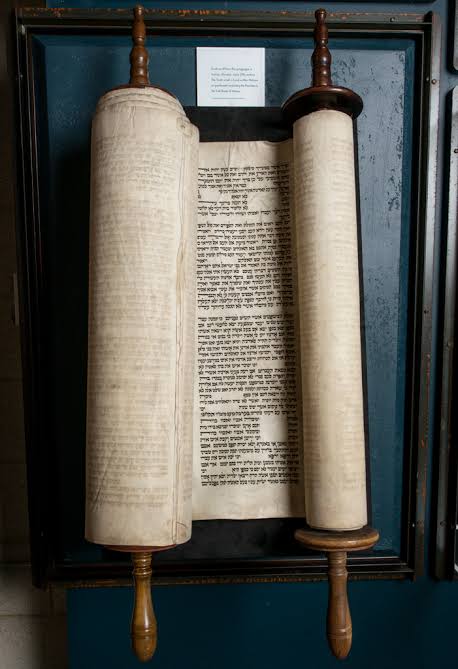
Two disclosures complete the count’s honesty. The missing prophets first: the Quran names some twenty-five prophets and omits Isaiah, Jeremiah, Ezekiel, Daniel, Zechariah, Malachi, Ezra, Nehemiah — the covenantally decisive voices of the deposit. The omission is not trivia, and its consequences should be enumerated, because each one is a hole in the restoration claim. Without Isaiah, no servant songs, no El Gibbor child, no root of Jesse — the Christology the Quran disputes is never met at its sources. Without Jeremiah and Ezekiel, the new covenant floats with no exile diagnosis beneath it: the promise of the law written on hearts, the new spirit within — the very texts that explain why an external law was never the terminus — go unengaged by the tradition whose whole anthropology is external law. Without Daniel, the arithmetic of Count Three is never confronted, the Son of Man never weighed, the abomination never located. Without Zechariah, the pierced YHWH, the priest-king Branch, and the thirty pieces of silver are never addressed. Without Malachi, the Elijah oracle that constitutes John the Baptist — whom the Quran does affirm — has no source: Islam affirms the herald while omitting the text that makes him a herald. Silence is not proof of ignorance; but a revelation claiming to correct a corpus is obligated to engage the corpus’s structural members, and this one convicts the major prophets in absentia — a verdict delivered without reading the defendants. And the per-text manuscript disclosure: not every oath-text enjoys equal Qumran coverage. Isaiah is sealed complete. Deuteronomy 32 is well attested — 4QDeut-q even preserves the older b’nei elohim reading of 32:8, which will matter later. The Psalms are extensively attested in aggregate, but Psalm 110 specifically is thin in the surviving scrolls; where Qumran is thin, the pre-Christian control is the Septuagint — translated by Jewish hands in the third and second centuries BCE, and at Psalm 110:3 (“from the womb, before the morning star, I have begotten you”) reading, if anything, more Christologically than the Hebrew. The controls hold. They should simply be cited as what they are.
The verdict on Count Two. The corruption charge destroys Islam’s founding validation, contradicts the Quran’s present-tense affirmations, fails five independent manuscript streams, describes the Quran’s own textual history better than the deposit’s, retreats to an interpretive form that pre-Christian Jewish sources close, and was doubted by Islam’s own greatest historian. The deposit stands as the Quran found it — guidance and light. Everything in it, therefore, is admissible. The count is proven.
V. Count Three: The Arithmetic and the Closed Windows
If the deposit stands, its clock runs. Daniel 9:24–27 — Gabriel’s answer to Daniel’s prayer, in a book sealed at Qumran before Christianity — sets out seventy weeks of years, and the count is layered. The prosecution discloses its method fully, because the computation has assumptions and an argument graded honestly is worth ten graded generously.
The first layer needs no arithmetic at all. The sequence of Daniel 9:26 is fixed whatever the numbers mean: the anointed one is cut off, and has nothing — and after that, “the people of the prince who is to come shall destroy the city and the sanctuary.” Messiah dies first; Jerusalem and the temple fall second. The order is in the syntax, not the calendar, and it is decree-independent, metric-independent, and immune to every dispute below. The city and sanctuary fell in 70 CE, under Titus, as a matter of Roman record — Josephus watched it burn, and the Arch of Titus in Rome still parades the menorah in relief. Therefore, on the text’s own sequence, the Messiah was cut off before 70 CE — whoever he was, whenever precisely, the window closed in the first century, and the destruction that follows the cutting-off doubles as the seal: the verification apparatus, the temple and its records, was consumed by the very event the oracle places after the Messiah’s death. Every messianic claimant since — Bar Kokhba in 132, whom Akiva crowned and Rome crushed; Sabbatai Zevi in 1666, who converted to Islam under the Sultan’s threat; every other — arrives after the text’s own deadline, applying for a position whose posting expired. This layer survives even if every computation below is rejected, and the reader who distrusts all arithmetic is invited to stop here, holding only the sequence: cut off, then destroyed. It is enough.
The second layer is an invariance result. From “the going out of the word to restore and build Jerusalem” to “Messiah the Prince” runs sixty-nine weeks — 483 years. Two decrees of Artaxerxes are candidates for the starting word, and the honest disclosure is that each requires its own year-convention: Ezra’s decree of 457 BCE plus 483 ordinary solar years lands at 27 CE; Nehemiah’s commission of 444 BCE plus 483 prophetic years of 360 days — 173,880 days — lands at Nisan of 33 CE. Stated as identity, that would be calendar-switching; stated as what it is — a sensitivity analysis — it is stronger than either computation alone: across both attested decrees and both year-conventions, no parameterisation exits the span of one public career. The ensemble is decree-robust and metric-robust, and the two termini land, without forcing, on the verse’s own two events — the arrival of Messiah the Prince at one end, the cutting off at the other.
The third layer is the primary computation, and the text itself selects it. Daniel 9:25 specifies what the decree authorises: Jerusalem rebuilt “with plaza and moat” — rechov v’charutz, civic space and fortification — “in troubled times.” That is Nehemiah’s commission in kind and in words: “the city of my fathers’ tombs, that I may rebuild it” (Nehemiah 2:5), timber for the wall and gates (2:8), and a wall built under arms, in exactly the troubled times the oracle names (Nehemiah 4–6). Ezra’s decree authorises silver, vessels, magistrates, and the teaching of the law — cult and law, not a stone of wall. The peshat — the plain sense — selects Nehemiah. The 360-day year the Nehemiah computation employs is then defended not as convenience but as the apocalyptic corpus’s own internal calendar: Daniel’s “time, times, and half a time” (7:25; 12:7) is cashed out in the corpus’s own day-counts — the 1,290 days of 12:11, the 1,260 days and forty-two months of Revelation 11:2–3 — figures that cohere only on thirty-day months. One year of accession-reckoning slack (445 or 444, by Tishri or Nisan regnal counting) is stated and does not breach the window. Terminus: Nisan, 33 CE — the week of a donkey, a temple, and a cross.
Two counters must be met, and are. The critical reading takes Daniel 9 as ex eventu prophecy about Antiochus IV, with the anointed one cut off as the high priest Onias III (170 BCE) — and it leans on the Masoretic accentuation, the atnach, which splits the sixty-nine into seven-then-sixty-two, yielding two anonymous anointed ones. Three answers. The accents are medieval — a punctuation layer added a millennium after composition by the same interpretive establishment whose motivated handling of Daniel is documented below; the Septuagint and Theodotion read the sixty-nine continuously; and the split reading generates its own absurdity — a city “built with plaza and moat” for four hundred and thirty-four years. And the Antiochene reading carries a cost its holders openly concede: on it, the arithmetic fails — 490 years from any exilic terminus overshoots the 160s BCE badly — and the standard critical resolution is that the author simply got his chronology wrong. Weigh the two positions as a court would: one reading requires parameter choices among attested royal decrees; the other requires the text to be mistaken about its own numbers. A reading that convicts its text of arithmetical incompetence has resigned from exegesis.
Around the arithmetic, the windows. The genealogies first: Jesus’s Davidic descent was published in two forms (Matthew 1; Luke 3) while the temple archives stood and the claim was checkable — and no ancient opponent, Jewish or pagan, is recorded contesting the descent, though every other point was contested. In 70 CE the archives burned. Every subsequent claimant claims into a void where verification is impossible. The window of checkable Davidic messiahship closed around exactly one publicly examined claimant. Second, the two-Messiah accommodation: confronted with texts presenting death and dominion in one figure — Isaiah 53’s servant cut off and continuing, Zechariah 12:10’s pierced one mourned with royal mourning — the post-70 rabbinic tradition minted a second Messiah: ben Joseph, who suffers and dies, alongside ben David, who reigns. The device concedes the problem it solves — the texts require both careers, and a tradition that had declined the one first-century candidate exhibiting both had to split the profile to avoid him. Ben Joseph has never been identified with any historical person; he exists because the texts demanded a dying Messiah and the tradition could not supply one. The seam in the doctrine marks where the original garment was cut. Third, the Yavneh-era curse preserved in the Talmud — “may the bones of those who calculate the end be blasted” (b. Sanhedrin 97b) — is at minimum a tacit tribute to the arithmetic’s danger; broader anti-apocalyptic policy after Bar Kokhba may share the motive, and is noted, but the shape of the response remains eloquent: no rabbinic text refutes the calculation. The tradition forbade it. One prohibits what one cannot answer. And the dating asymmetry seals the evidential contrast, so state it in full. The creed of 1 Corinthians 15:3–8 — “I delivered to you as of first importance what I also received” — is marked by its own technical vocabulary (paredoka, parelabon, the rabbinic terms for formal tradition-transfer) as material Paul received, not composed; and the critical consensus, including its sceptical wing, dates his reception of it to within two to five years of the events — most place it at his Jerusalem visit, three years after his conversion. The creed names its witnesses — Cephas, the Twelve, James — and appeals to more than five hundred at once, “most of whom are still alive”: an explicit invitation to cross-examine, published in the witnesses’ lifetimes, in a letter whose authenticity even radical criticism concedes. Hebrews speaks of the temple sacrifices in the present tense (8:4; 10:11), arguing composition before 70 — a majority-plausible, not unanimous, dating, and entered as such. Against this: the canonical hadith collections — Bukhari, Muslim — were compiled two centuries and more after Muhammad, their contents filtered through chains of memory across the length of the entire Umayyad and early Abbasid periods. This is not a claim that late compilation entails falsehood; the isnad science was serious. It is a claim about evidential situations: one tradition’s core testimony went on record among living, named, checkable witnesses; the other’s supporting literature was collected when no witness could be recalled. And the Quran’s own celebrated prediction — Rome’s recovery “within a few years,” bid’i sinin, glossed by the tradition as three to nine (Surah 30:2–5), against a Byzantine recovery of roughly thirteen — is impressive by the standards of its genre, and the concession is genuine. It is not in the same category as a day-count from a named Persian decree to a named Passover. A ranged estimate that lands near its range is a good forecast. A 173,880-day integer landing on the week of the crucifixion is a different order of thing, and the difference is the point.
The verdict on Count Three. By the deposit’s own sequence, the Messiah came and was cut off before 70 CE. By the deposit’s own arithmetic, disclosed to its assumptions, the count terminates in one public career, on one Nisan. A revelation arriving six centuries later, announcing a different anointed one and a corrected account, arrives at a case the deposit’s own clock had closed. The count is proven, in three layers, each surviving the loss of the one above it. ### VI. Count Four: What Islam Inherited, and What It Substituted
Count Two established that the deposit was not corrupted. Count Four asks a different question: what, exactly, did seventh-century Arabia encounter — and what did Islam put in its place?
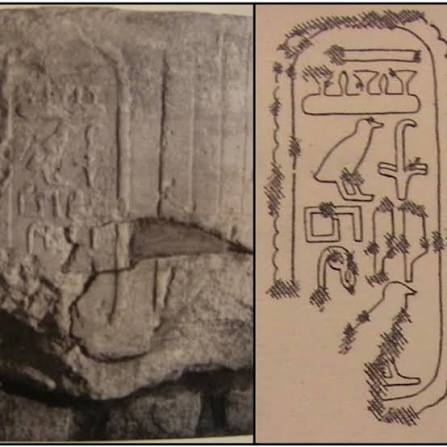
First, the bracket. Five hard controls fix the deposit in history across twelve centuries, and the prosecution grades each as archaeology grades it. The Shasu of YHW3 at Soleb — an Egyptian topographical inscription of Amenhotep III, fourteenth century BCE, naming a nomadic people associated with the divine name — is the primary early datum; its identification with proto-Israelites is contested against a Midianite-Kenite alternative, and the prosecution enters it as the stronger and increasingly supported reading, not as proof. The Berlin Pedestal relief (Berlin 21687), argued by Görg, van der Veen, and Theis to preserve an early “Israel,” is entered as contested corroboration only — disputed reading, established provenance. The Merenptah Stele, circa 1208 BCE, is uncontested: “Israel is laid waste” — a people, in Canaan, named by their destroyer. The Tel Dan inscription, ninth century BCE, is a hostile witness in basalt: an Aramean king boasting of victories over the “House of David” — bytdwd — the dynasty’s existence attested by its enemy. And the Great Isaiah Scroll closes the bracket at 125 BCE. Together the five foreclose both extremes: the minimalism that dissolves Israel into late fiction, and the textual tahrif that Count Two already buried. The deposit’s people, dynasty, and text are pinned to the record by Egyptian chisels, Aramean boasts, and Judean ink.
Second, the ecosystem. What stood between that bracket and Muhammad was not a single Judaism but a filtered one — filtered twice, at 586 BCE and at 70 CE. Pre-70 Judaism was an ecosystem, and the ecosystem contained, natively, the very structures Islam would later treat as Christian corruption. The Two Powers in Heaven — the reading of the theophany texts in which a second divine figure shares the throne — was current enough that the rabbis of the Yavneh era legislated against it as minut, heresy; and one does not legislate against the marginal. The Parables of Enoch — Jewish, pre-Christian in the judgment of the specialist consensus — enthrone a Son of Man who existed before the sun and stars were made, who receives worship, who judges from glory: Daniel 7 already read messianically, before the church existed to misread it. 11Q13 makes Melchizedek a heavenly deliverer executing the judgments of elohim. The Targums — the Aramaic renderings read aloud in synagogue — routinely interpose the Memra, the Word of YHWH, wherever the Hebrew has YHWH acting in the world: the Word creates, the Word covenants, the Word saves. This was the deposit’s native breadth: a Judaism whose own categories were straining toward the incarnation before the incarnation was claimed. After 70, and after Yavneh, the surviving rabbinic stream narrowed — understandably, defensively, drawing hard boundaries around the catastrophe’s survivors — and then read its own narrowing backward as the original. Islam, arriving in the seventh century, encountered the narrowed reconstruction, took it for the deposit, and inherited its objections wholesale: no Son, no plurality, no dying Messiah. The Quran’s polemic against Christianity is, at point after point, the post-Yavneh position translated into Arabic. Islam did not correct the deposit. It canonised one late filter of the deposit — and the motivated handling shows even in the canon’s furniture: Daniel, whose arithmetic closes on the first century, sits in the rabbinic Bible not among the Prophets but among the Writings. The placement’s causes are debated; what is not debated is that the earlier witnesses treat Daniel as a prophet — Qumran’s Florilegium cites “Daniel the prophet,” Josephus ranks him among the greatest of them, the Septuagint orders his book among the Prophets, and Jesus says “the prophet Daniel” (Matthew 24:15). The demotion is the later configuration, and its effect is not subtle: if Daniel is prophecy, the arithmetic binds. Daniel, therefore, must not be prophecy.
Third, the substitutions. Here the count sharpens from inheritance to replacement, and the replacements can be tested.
The son on the altar. Genesis 22:2 names him three times over: “your son, your only son, whom you love — Isaac.” Surah 37:99–113, narrating the same binding, leaves the son unnamed. The identification with Ishmael is made by later tradition, on grounds external to the text — and early tafsir itself was divided, with authorities on both sides, some naming Isaac. An unnamed figure in the receiving text, identified against the explicit name in the source text, in the single most consequential pre-Mosaic narrative — the narrative on which the oath of Genesis 22:16–18 hangs: that is not restoration. That is substitution at the hinge.
The Abrahamic Kaaba. Surah 2:127 has Abraham and Ishmael raising the foundations of the House at Mecca. The prosecution states the evidential situation precisely, including its ceiling: the Haram cannot be excavated — no archaeology will ever be permitted beneath the sanctuary — so archaeological absence there is untestable in principle and is not the argument; the reader should know exactly what can and cannot be claimed, and the argument confines itself to what can. The argument is documentary, and the documentary field is wide: the ancient world wrote its geography — Egyptian itineraries, Assyrian campaign records, the classical geographers cataloguing Arabian toponyms down to minor oases — and in the entire surviving corpus no pre-Islamic text, inscription, itinerary, or foreign notice attests a significant Abrahamic sanctuary at Mecca. Ptolemy’s “Macoraba,” the one candidate customarily produced, is itself contested as a reference to Mecca at all — the phonology is strained, and recent scholarship has moved against the identification. What the record does attest of the shrine’s pre-Islamic religious history is polytheism: the house of some three hundred and sixty idols, Hubal’s oracle-arrows within it — the very cult Muhammad cleansed at the conquest, a cleansing that would have had nothing to cleanse had the custodianship been what the tradition claims. Add geography: Genesis tracks Abraham’s movements with a surveyor’s precision — Ur, Haran, Shechem, Bethel, Hebron, Gerar, Beersheba — altars and wells named and located, and records nothing within a thousand kilometres of the Hejaz; a fifteen-hundred-kilometre desert journey by the patriarch, twice, to build the faith’s central shrine, escaping the notice of a narrative obsessed with his itinerary, is not silence by omission. It is the silence of a story that never happened. And the tradition’s own hanifs concede the point structurally: men groping toward a lost monotheism are not the custodians of a continuously maintained Abrahamic sanctuary. You do not grope for what your city has kept.
The genealogy. The Quraysh claim descent from Ishmael. Genesis 25:18 places Ishmael’s descendants in the Havilah-to-Shur corridor, toward Assyria — whose most plausible historical heirs are the Nabataeans of the northwest, not the Meccans of the central Hejaz. No pre-Islamic Meccan inscription, monument, or ritual records Ishmaelite self-consciousness; the seventy-generation genealogy first appears in Ibn Ishaq, a century and a half after Muhammad. Measured by the deposit’s own two-witness standard — the standard Count One already applied — an uncorroborated genealogy compiled six generations late fails.
Assemble the three and name the pattern. Isaac replaced by Ishmael. Jerusalem replaced by Mecca. The Israelite line replaced by an Arabian one. This is replacement theology — the precise charge Islam levels at Christianity — executed on unverifiable genealogy, unattested sanctuary history, and impossible geography. The verdict on Count Four: Islam corrected a twice-filtered reconstruction, not the deposit, and where it went beyond inheritance it substituted. The burden is now the defence’s, and it is specific: produce pre-Islamic evidence of an Abrahamic Kaaba or of Meccan Ishmaelite consciousness. Until then, the count stands.
VII. Count Five: The Gate, the Ascent, and the Seal
The final count tests the claimant himself against the deposit’s own gate, the tradition’s own credentials against the Quran’s own benchmark, and the claim of finality against the texts that define sealing.
The gate. Deuteronomy 18:15–18 is Islam’s favourite proof-text: “a prophet like me from among you, from your brothers.” The Islamic reading takes “brothers” ethnically — the Ishmaelites, Israel’s cousins through Abraham. But Deuteronomy defines its own vocabulary, and the definition is covenantal, not genetic. Throughout the book, ach — brother — is the covenant insider, set against the nokri, the foreigner, in systematic contrast: debts are released for the brother but exacted from the foreigner (15:3); interest may be charged to the foreigner, not the brother (23:20); the king must be “from among your brothers… you may not put a foreigner over you” (17:15). Read “brothers” ethnically in 17:15 and an Edomite or Ishmaelite could lawfully sit on Israel’s throne — the reading proves too much and dissolves the very boundary the statute exists to draw. The gate’s criterion is covenantal alignment, and the deposit supplies both the pass case and the fail case, so that no one need guess. Job — outside Israel, inside the Noahide frame — passes: his content is covenant-consistent, and the canon keeps his book. Balaam is the canonical archetype of the other kind, and his file deserves reading in full, because it is the deposit’s dossier on exactly the hard case: a man who received genuine communication from the true God — Numbers 24 is real prophecy, “the oracle of him who hears the words of God” — whose trajectory nonetheless ran against the covenant; who could not curse Israel directly and so taught Balak to seduce it sideways (Numbers 31:16), earning the New Testament’s triple citation as the type of the prophet-for-hire whose way is error (2 Peter 2:15; Jude 11; Revelation 2:14). The gate was never about the reality of the phenomena. Deuteronomy 13:1–3 says so in terms: the sign or wonder may come to pass — granted, stipulated — and the prophet still be false, if the direction is “let us go after other gods whom you have not known.” The criterion is directional; the phenomena are expressly discounted; content decides. And on content — a denied crucifixion, a denied Sonship, an abrogated covenant people, a relocated sanctuary — the claimant maps to Balaam’s trajectory, not Moses’s line. Genuine communication, and the wrong direction: the deposit had a category waiting, with a name on it.
The ascent. The tradition’s claimed pinnacle is the Mi’raj — the night journey and ascent through the heavens. Grade its sources by the tradition’s own tiers. The Quran gives it one verse: Surah 17:1, Mecca to “the farthest mosque,” full stop; Surah 53’s vision passages are contested within the tradition itself as to their referent. The entire ascent architecture — the Buraq, the seven heavens, the prophets stationed in each, the bargaining over prayers — rests on hadith compiled roughly two centuries later: two full tiers below the Quran in the tradition’s own epistemology, supporting the tradition’s supreme credential. And the summit, as the hadith report it, is mediated and ambiguous — the Ash’ari mainstream read the vision as of the heart, not the eyes; the single concrete deliverable, the prayer command, is negotiated downward from fifty to five in six shuttle-trips taken at Moses’s prompting — the seal of the prophets requiring the deposit’s prophet to coach him through the audience. Now apply the Quran’s own benchmark. The Quran narrates the burning bush three times (Surahs 20, 27, 28): direct speech, light, self-identification — “Indeed, I am your Lord… Indeed, I am Allah; there is no deity except me, so worship me” — no intermediary; and it crowns Moses with the title Kalimullah, the one to whom Allah spoke directly (4:164), which the deposit states even more strongly: “mouth to mouth, plainly, and not in riddles” (Numbers 12:8). The tradition’s own vocabulary thereby ranks the modes of revelation: kalimatuhu — the one who is the Word — above Kalimullah — the one spoken to directly — above the mediated recipient. Islam’s final revelation arrives by the lowest mode on its own scale, and its supreme mystical credential negotiates with the middle one. There is also an internal incoherence the hierarchy cannot survive: in the Mi’raj hadith, Jesus is stationed in the second heaven — sharing it with John, the beheaded martyr — below Joseph in the third, Moses in the sixth, and Abraham in the seventh. If station reflects honour, and if rescue from death was the supreme honour the substitution theory implies, the celestial protocol has the uniquely rescued one outranked by the man who died under discipline at Meribah. On the substitution account the placement is inexplicable. On the deposit’s account it is not even surprising, for a reason worth stating: station follows accomplished work, and in the deposit’s ranking the second heaven is not where Jesus was filed — it is where the martyrs stand together, John and the one whose death John heralded, the placement itself a fossil of the death the doctrine denies. The tradition’s own map dishonours the tradition’s own theory, and quietly remembers what the theory forgot.
The anathema. The apostolic deposit did not leave the seventh-century scenario unaddressed; it addressed it in advance, by category. “Even if we, or an angel from heaven, should preach to you a gospel contrary to the one we preached, let him be accursed” (Galatians 1:8) — angelic mediation of a contrary gospel, the exact form of the claim. “Every spirit that confesses that Jesus Christ has come in the flesh is from God, and every spirit that does not confess Jesus is not from God” (1 John 4:2–3) — incarnation-denial as the binary test. Surah 4:157 denies the precise event; Surah 112:3 denies the precise confession. Within the deposit’s frame the application is not interpretive; it is mechanical. Its probative force, of course, depends on the deposit’s authority — which is exactly what Counts Two through Four established Islam has conceded. A tradition that affirms the deposit as light and guidance has affirmed the tribunal that condemned its own foundation before it was laid.
The seal. Khatam al-Nabiyyin — seal of the prophets (Surah 33:40) — is Islam’s crown claim, and the deposit had already used the vocabulary. Daniel 9:24 lists, among the six accomplishments of the seventy weeks, “to seal up vision and prophecy” — sealing as an event within the arithmetic, not a person at its end; and Daniel is told to seal the book “until the time of the end” (12:4, 9), while Revelation 5 shows the Lamb — slain, standing — as the only one worthy to open what was sealed. In the deposit’s grammar, sealing belongs to the timetable and unsealing belongs to the pierced one. The true khatam — the guarantee that no further correction is coming — is not a terminal messenger but the divine character itself: the God who “swore by himself… because it is impossible for God to lie,” giving “two unchangeable things” as the anchor (Hebrews 6:13–18). A seal is only as good as the signet. Islam’s seal arrives six centuries after the deposit’s arithmetic closed, borne by a messenger whose founding encounter Count Five’s final section must now examine — and it fails the Quran’s own Mosaic benchmark before the deposit’s gate is even reached.
The verdict on Count Five, and with it the courtroom’s close. Muhammad fails the Deuteronomy 18 gate on the gate’s own covenantal terms; the tradition’s supreme credential rests on late sources and an incoherent hierarchy; the apostolic anathema, issued before his birth, applies by its terms; and the seal claim collides with the deposit’s own sealing texts. The count is proven — and it is proven, note, without one syllable of the physics, the eschatology, or the forward model that later sections will deploy, and without borrowing a single premise from Christian authority. Sections II through VII stand complete. Everything after this line is corroboration, consequence, or forward application. The courtroom does not need it.
VIII. The Constraint Theorem: What the Physics Requires
Evidentiary tier: metaphysical corroboration. This section is a constraint theorem, not a proof of Christianity, and the courtroom counts do not lean on it. Its assumptions are stated as assumptions; its defeat conditions are stated at the end.
The five counts argued from texts and history. This section argues from the measured structure of the physical universe — evidence that belongs to no tradition, gathered largely by people indifferent or hostile to the conclusion, and admissible for precisely that reason. The argument runs as a chain; each link is graded as it is laid.
Compression. The universe’s specification is radically smaller than its content. The laws of physics compress to a compact axiomatic core; the Standard Model contributes roughly twenty-five free parameters; cosmological initial conditions add a state specification. On generous accounting, the whole prescription is on the order of ten thousand bits — call it eleven thousand; the figure is derived from the parameter count and the compactness of the laws, and the argument needs only its order of magnitude. The content those bits generate is bounded by the holographic entropy of the observable universe: roughly 10^122 bits. A compression ratio of one part in 10^118 is, by Kolmogorov’s theory, the signature of non-randomness — random strings do not compress. One inferential step follows and is disclosed as the premise it is: Kolmogorov complexity is a mathematics of descriptions, not of causes, and the move from “the universe is law-compressed” to “the universe has a source of at least equal specification capacity” imports a causal principle — that radical order has an origin adequate to it. The principle is not a theorem. It is the alternative to declaring a 10^118-fold compression a brute fact — and the brute-fact refusal will be priced at the end, not declared refuted. It should also be said plainly that compression alone is compatible with the naturalist’s slogan “simple laws”; compression is the signature of law. That law is the signature of thought is what the rest of the chain must earn.
Selection. The laws and constants could have been otherwise. The space of consistent alternative configurations is vast — the string landscape’s 10^500 is one estimate, and only the existence of alternatives is load-bearing: nothing in logic fixes the electron’s mass. Something therefore answers to the fact that this configuration, with this initial condition, obtains. And the initial condition is the sharpest single datum in physical cosmology: Penrose computed the precision of the initial low-entropy state at one part in 10(10123) — a number that cannot be written in the observable universe in ordinary notation. Here the chain makes its central move, and makes it as a derivation rather than an assertion. Any actualisation — any function that takes a space of possible histories and renders exactly one of them real — must, if it is to produce our history, satisfy three conditions the universe exhibits: it selected an extravagantly low-entropy initial state against overwhelming measure; it is content-responsive, since conservation laws and entanglement structure mean the selection tracks global structure rather than local accident; and it is complete — no moment of history is left indeterminate. A selection function satisfying those three conditions must encode a total, antisymmetric, structure-sensitive ordering over the possibilities. In the formal vocabulary of decision theory, a total antisymmetric structure-sensitive ordering is a preference relation. That much is derived, and the derivation is the section’s spine. The final step is an identification, and it is labelled: in every observed instance, the bearer of a preference relation is a mind. Formal preference-structure is the signature of agency in the only cases available for inspection — and the induction from the sole observed class of actualisers is offered as the induction it is. The distance between “preference-structured selector” and “person” has narrowed to that single step. It has not closed by demonstration. It closes, if it closes, by proportionate inference — and by the interior evidence entered below.
Holography. Bekenstein and Hawking established that the maximum information content of a region scales with its boundary area, not its volume — as though the three-dimensional bulk were the expression of a two-dimensional encoding. ’t Hooft and Susskind generalised the insight into the holographic principle; Maldacena’s AdS/CFT correspondence realised it exactly in a cosmology adjacent to ours; and recent results on de Sitter algebras have narrowed the gap toward our own spacetime. The claim entered here is scoped with care: boundary-information sufficiency, not full operational reconstruction of the bulk. And one seductive numerical exactness is declined on principle: the apparent perfect saturation of the cosmological entropy bound is an algebraic identity given critical density — a consistency check, not an independent confirmation, and a prosecution that flags motivated punctuation in the Masoretes does not get to count its own identities as evidence. What remains after the discipline is still remarkable: the deep structure of spacetime behaves as the expression of an encoding. The consonance is then stated as consonance, not proof: a reality sustained as the expression of a boundary word is a reality that behaves the way the deposit says the Word behaves — “upholding all things by the word of his power” (Hebrews 1:3); “in him all things hold together” (Colossians 1:17).
Timelessness. In canonical quantum gravity the total state satisfies the Wheeler–DeWitt constraint — Bryce DeWitt’s 1967 equation, built on Wheeler’s framework: the wavefunction of the whole universe does not evolve in external time. On the standard reading of the constraint — one position within a genuinely unresolved literature, and flagged as such — time is not fundamental but internal: the Page–Wootters mechanism recovers ordinary temporal experience as entanglement between subsystems inside a globally stationary state. Relativity had already made a block-like view of total history natural; the constraint sharpens it. What the reading offers the argument is one clean inference: the ground of a globally constrained block cannot be one event within the block, because it accounts for the block as a whole. Whatever grounds total history must be present to every moment of created time without being contained by any — omni-temporal. The deposit said it without the mathematics: “I am the Alpha and the Omega, who is and who was and who is to come.”
Triadic structure. Independently of everything above, logic and computer science converged on a result whose discoverers named it, with no theological intent, computational trinitarianism: the Curry–Howard–Lambek correspondence, in which logic, computation, and category theory turn out to be a single subject under three descriptions — and in which the production of any actuality from any possibility-space factors through three irreducible operations. Formation of the space of possibilities. Introduction of the specified form. Elimination into concrete result. Remove any one and nothing is produced: no space, nothing to select; no specification, nothing determinate; no elimination, possibility remains possibility forever. Irreducibility downward — that three cannot become two — is argued and holds. Non-extendability upward — that no fourth operation can be non-redundantly added — is the framework’s working claim rather than a demonstrated theorem, and the flag is planted: a critic may try to carve valuation out of specification and count four. The application at cosmic scale — reality as the actualisation of one history from a possibility-space, factoring through the same triad — is an interpretive identification, and it is labelled as one. What is not interpretive is the shape of the mapping once made: the Conception-container, the Specification-encoder, the Actualisation — source, Word, life-giver. The structure was derived from type theory before theology was consulted, and the derivation did not know whose profile it was drawing.
Energy, information, speech. Landauer’s principle — confirmed experimentally by Bérut and colleagues in 2012 — fixes an exchange rate between information and energy: erasing one bit costs a minimum, measurable quantity of heat. Information is physical. Matter is energy; energy is informationally bound; and the constitutive speech of the Introduction operation is therefore not a metaphor strained against the physics but one the physics has been converging toward: to specify is to energise; the encoding is the upholding. The identity claim at full strength — that the boundary encoding, the energy, and the constitutive word are one act under three descriptions — is a metaphysical extension beyond the measured bound, and it is offered as the extension it is. But under it, the miracle profile of Count One re-reads with uncomfortable elegance: creation by breath and command over death are what boundary-reassertion looks like from inside the bulk. The one who is the encoding does not petition the encoding.
Consciousness: the second witness. Everything above concerns the exterior of the world. The interior supplies four deductions that depend on none of it — a separate evidential line, converging on the same terminus.
The hard problem first. No assembly of exterior descriptions — neurons, functions, information flows — yields interiority: what it is like to taste, to grieve, to see red. The gap is not a temporary ignorance but a category structure, and Kripke’s disanalogy makes it near-coercive: water can be H₂O without remainder because “water” was fixed by appearances that the chemistry explains away; but for pain there is no appearance/reality gap to exploit — the appearance is the reality. Denying this costs the materialist brute, inexplicable psychophysical necessities: a heavier metaphysical bill than the one being avoided. Interiority is therefore either fundamental or grounded in something for which interiority is native. Second, normativity: mechanism explains how a belief was caused, never why it binds; reasons are not causes, and a worldview that reduces reasoning to causation cannot state its own claim as a claim — as something one ought to believe. Third, intentionality: aboutness — the capacity of a thought to be of something — is the precondition of every explanation, including every eliminativist explanation; it cannot be explained away by explanations that presuppose it in the act. Fourth, record-bearing actuality, the quiet anchor: physics exists as knowledge only because reality leaves stable traces and consciousness reads them as evidence under norms of truth — exterior record meeting interior witness. Remove the witness and there are marks, but no measurements.
And then the seal on all four — the proof of proofs. Every act of proof, including every denial of this framework, does three things: it holds a possibility-space of meanings, specifies one under rational criteria, and actualises a binding conclusion. Formation, Introduction, Elimination. The denial performs the triad it denies. The scope of this retorsion is stated exactly, because overclaiming it would squander it: it establishes, coercively, that consciousness, meaning, and the triadic structure of rational actualisation are undeniable at the finite level — eliminativism dies on this hill, permanently. The transfer from the finite level to the cosmic ground runs through the proportionate-causality induction already flagged in the Selection step: minds are the only observed bearers of exactly this structure, and like is grounded in like. The seal does not close that step by force. It guarantees that whoever disputes it must use it to do so.
The global search. Assemble the constraint-vector — non-classical, information-structured, radically compressed, selection-requiring at fantastic precision, omni-temporal with respect to the block, triadic in productive operation, and adequate to interiority, normativity, and meaning — and run the candidate ontologies against it, each given its strongest form.
Materialism fails at the first and last constraints together: it has no account of the compression’s origin and no account of the witness who discovered the compression — it must treat the intelligibility of the universe and the intelligence that reads it as two unexplained gifts. A multiverse that physically instantiates all branches fails on cost and on measure: knowing all histories is informationally finite — a mind can survey a possibility-space at the price of its description; instantiating them all is exponentially larger, with a regress of containers behind it (what selects the multiverse’s own laws?), and no version explains why the weights fall as they do — the measure problem is the selection problem returned with interest. It is, note, the maximally expensive ontology adopted to avoid a selector: everything, everywhere, purchased to explain why there is this. Platonism fails at selection: abstract objects do not actualise; in the entire literature no one has explained how a mathematical structure picks — the forms are a menu, and a menu has never served a meal. Plotinus’s One emanates by necessity — majestic, but necessity is not selection, and the initial-state precision is a choice-shaped datum: one part in 10(10123) is not what overflow looks like. Spinoza’s God is the world — no external ground for a block that requires one. Advaita renders the differentiated world maya — the structure to be explained is dissolved rather than explained, the question dismissed as its own answer. And tawhid, in its Surah 112 form — absolute internal simplicity, begetting nothing, begotten of nothing, containing no distinction — fails the triadic requirement with precision: a ground with no internal differentiation has no internal Word to specify and no internal Act to actualise; the grammar of creating must then itself be created, which is a regress wearing a crown. One candidate in the inventory presents a ground that is one, personal, and internally differentiated as source, Word, and life-giving Act — and it was on the table, in the deposit, millennia before any of the physics. A Copenhagen-instrumentalist reader may decline the realism about possibility-space this search presupposes; the exit exists and its price is stated: instrumentalism escapes by declining to say what is real at all, which is not an answer but a resignation.
Convergence, correctly counted. Two independent derivations arrive at a triadic personal ground. The first is the exterior chain just run. The second is the interior analysis of infinite self-knowledge, and it deserves its own statement because it arrives from the opposite shore with no physics in its luggage. A mind that knows itself involves three: the knower, the known, and the act of knowing. In a finite mind these are aspects — my self-knowledge is partial, episodic, an accident of my substance. In an infinite mind nothing can be partial, episodic, or accidental: the knowledge with which the infinite knows itself must be complete, eternal, and as substantial as the knower — the Known subsisting, and the Act of knowing subsisting, within the one being. Knower, Known perfectly expressed, Love proceeding: the Augustinian derivation, reasoned a millennium and a half before type theory rediscovered its shape. And one datum belongs beside these as a second natural experiment: moral consciousness arraigns reality — every theodicy-protest, every “how could a good God allow this,” is consciousness holding the world to a standard the world did not teach it. A creature assembled by indifferent processes has no standing to indict indifference, yet the indictment is universal; the protest itself is evidence that the protester is fitted to a moral order the visible world underdetermines. The very argument most often raised against the personal ground presupposes the equipment only a personal ground explains. Beside these two derivations stands one canonical witness: the Name of Section III, whose reflexive grammar, whose operational deployment through the Name-bearer and the Spirit, and whose inner-canonical retrospection cohere across every stratum of the deposit. The witness is not counted as a third independent derivation — its grammar and its operations are one testimony, and entailed evidence is counted once; a prosecution that polices double-counting in its opponents polices it in itself. Two derivations and one consilient witness, converging without borrowing. That is the honest tally, and it is enough.
Status, and defeat conditions. This section is corroboration and claims exactly this much: the field of live ontologies is far smaller than materialism assumes, and the Trinitarian ground is the unique full fit to a constraint-vector assembled from measured physics and undeniable interiority. One refusal remains available at every step, and it deserves its price tag rather than a refutation it has not earned: the brute-fact position — the universe’s compression, selection, and initial precision simply are, with no explanation owed. The position cannot be disproven, because it is not a claim; it is a declination. But its costs compound. It abandons, for exactly one fact — the biggest — the explanatory demand science applies to every other fact. It spends the parsimony it claims: a brute 10^118-fold compression is not simpler than a sufficient ground; it is the same complexity, unexplained. And by the end of the chain it has no stable referent left — the “universe” it declares brute has already been shown to be non-classical, informational, and selection-shaped, which are the features that raised the question. A priced refusal is a position one may hold. It is not an answer, and the difference between the two is this section’s whole claim. The theorem is otherwise falsifiable in principle and the conditions are published: derive actualised history without triadic factorisation; produce a rival ontology satisfying the full vector; demonstrate a mentality-free preference-structured selector. Until one of those is done, the physics stands where corroboration should stand — a second witness, arriving at the courtroom’s conclusion by a road that never touched a scripture. And it volunteers one prediction about Count One: if the ground’s Word is the boundary of the bulk, then the Word entering the bulk holds authority over the bulk’s states — including the state called death. In this ontology the resurrection is not an anomaly requiring apology. It is the expected behaviour of the encoding — and the empty tomb is what it looks like when the Author steps onto the page.
Islam, Christianity, and Judaism all confess God as eternal and not bound by creaturely time. On a block-like view of physical history — a view made natural by relativity and sharpened in some readings of quantum gravity — past, present, and future are not unknown to God as successive surprises. The temporal arrow is experienced from within creation; it is not the condition under which God learns or revises himself. That matters for covenant. A divine oath is not a provisional memo awaiting later correction. Revelatory accumulation is possible; covenantal fulfilment is possible; Gentile inclusion is possible. But abrogation of an oath grounded in God’s own eternal life is not. The Christian claim is not that God cancelled the covenant, but that the Messiah satisfied and fulfilled it: death through Adam, life through the second Adam; uncleanness answered not by arbitrary repeal but by restoration toward the Edenic telos in which creation was made good. Fulfilment differs ontologically from abrogation. Abrogation replaces a prior word; fulfilment brings the prior word to its intended end through legal means consistent with the oath matrix and body of scripture already given in advance of the fulfilments. That distinction is exactly what the physics-chain’s omni-temporal ground would predict: the eternal speaker does not revise his oath; he completes it. This is consistent with the intelligibility of physics; the Logos specifies the boundary and sustains it; physics does not abrogate itself.
IX. The House That Was Inherited
Evidentiary tier: consequence — direct textual comparison of the two corpora.
Walk the Quran’s cast of deposit figures and mark, for each, what he carries in the deposit and lacks in the Quran. The pattern is one pattern, and by the end of the walk it has a name.
Adam without ontology. The Quran narrates the fall; Allah teaches Adam words of repentance and forgives the act (2:37); and no burden transfers — “no bearer of burdens bears the burden of another” (6:164). That last is a principled position and is credited as one. But the deposit’s Adam is not a moral anecdote about one man’s lapse; he is a structural event: sin entering as a condition and death as its wage, inherited downstream (Romans 3:23; 5:12). Remove the structural wound and the entire remedial architecture — sacrifice, priesthood, atonement, cross — becomes surplus machinery. Which is precisely the sequence the Quran executes: it removes the disease, then pronounces the cure unnecessary. The diagnosis was not corrupted out of the deposit. It was declined.
Noah without covenant. The flood is preserved in full dramatic colour; Genesis 9 is not — the universal covenant, the bow in the cloud, the moral charter binding all humanity, the ground on which Abrahamic universality later stands. A judgment story survives without the oath that made it the last of its kind. The Quran keeps the water and loses the rainbow.
Moses without atonement. Surah 22:37, of the sacrificial animals: “their meat will not reach Allah, nor their blood, but what reaches him is piety from you.” The verse concerns the hajj rite; generalised — as the tradition’s theology of sacrifice generalises it — it deletes what Leviticus 17:11 makes the system’s centre: “the life of the flesh is in the blood… it is the blood that makes atonement for the soul.” Without transferable penalty, the vast Levitical apparatus the Quran’s own Moses delivered becomes ceremony without function — a cultic system elaborately specified by God for no reason the Quran can state.
David without covenant. The Psalms are affirmed as given to David (4:163); 2 Samuel 7 — the oath of the eternal house, the son whose kingdom is established forever — is absent, and Psalms 2, 45, and 110 are never engaged. The singer is honoured. The songs’ subject is suppressed.
Jesus without the plot. The highest profile of any figure in the Quran — virgin-born, Word, Spirit from Him, Messiah, creator of life, raiser of the dead, alive now, returning — with the death, the resurrection, the new covenant, and the eternal priesthood removed. Five titles and no account of why the titles exist. It is the cast list without the plot.
And the inversion of the prior claim. Islam presents itself as the restoration of pure pre-Mosaic religion — the din of Abraham the hanif, before Judaism and Christianity complicated it. Examine what the pre-Mosaic stratum actually contains. Melchizedek: priesthood, bread and wine, blessing, tithe (Genesis 14) — a priest of God Most High operating before Sinai existed to institute priesthood. Job: sacrifices offered for his children, continually, on the explicit logic of substitutionary covering — “it may be that my children have sinned.” Jethro: priest of Midian, sacrificing to God, eating bread before God with the elders of Israel. The covenant of Genesis 15: Abraham cuts the animals, and then — the detail on which everything turns — the smoking fire pot and flaming torch pass between the pieces alone, while Abraham sleeps; the self-maledictory oath ceremony, in which the divine presence takes both parties’ death-obligations upon itself. Unilateral covenant, sealed in blood-ceremony, with God bearing the penalty clause: the cross in ritual outline, two millennia early. And Moriah: the substituted ram, caught in the thicket, dying in the place of the beloved son — “God will provide for himself the lamb.” Priesthood, sacrifice, covenant-oath, substitution: the pre-Mosaic substrate is made of the elements Islam strips out. The claimed restoration removes precisely what the claimed original contained. The prior claim, examined, becomes a posterior confession — Islam’s “return to Abraham” returns to an Abraham who never sacrificed, never tithed to a priest, and never watched God walk the blood-path alone. That Abraham does not exist in any text. He was manufactured by the removal.
X. The Prophet
Evidentiary tier: historically controlled — Islam’s own canonical sources, ranked as Islam ranks them. This section weighs the founder and the founding encounter, with the ledger open on both sides.
The case for, stated first and stated fairly. Muhammad’s pre-prophetic reputation was probity — Al-Amin, the trustworthy, the man both factions asked to arbitrate the Black Stone dispute. His marriage to Khadijah was, by every account, faithful and devoted for twenty-five years until her death; he took no other wife while she lived. The Meccan years show a man enduring boycott, mockery, and persecution without retaliation, for the sake of an uncompromising monotheism preached to an idolatrous city. Waraqah — a Christian who knew the scriptures — recognised something in the report of Hira. The tradition he founded carries genuine moral seriousness: the discipline of prayer, the institution of alms, the fast, a civilisation’s worth of Godward orientation. And the deposit itself concedes the decisive methodological point: real phenomena can attend a prophet whose direction is wrong (Deuteronomy 13:1–3). The case against, if there is one, cannot consist of denying that something happened in that cave. It must be made on structure and content. Here is that case.
The single hinge. The entire Islamic edifice — Quran, law, caliphate, civilisation — rests evidentially on one event: an unwitnessed encounter in the cave of Hira. The tradition’s own most authoritative source, Bukhari’s account of the beginning of revelation, describes it: an entity seized him and crushed him until he could not bear it — three times — commanding “Recite!”; he fled down the mountain trembling, crying “Cover me! Cover me!”, and told Khadijah, “I fear for myself” — fearing, the tradition is explicit, possession by a jinn. Surah 81:25 later answers the public charge that he was majnun — possessed — which confirms the charge was live in his own generation. One man. One cave. Zero witnesses. Compare the deposit’s revelatory economy at its founding moments: Sinai, before the assembled nation, with the mountain in smoke; the resurrection, attested to more than five hundred at once, catalogued while they lived and could be asked (1 Corinthians 15:6). Publicity is not decoration in the deposit’s method; it is the method — the two-witness standard applied to revelation itself. Hira fails it by construction.
The phenomenological control. No canonical call narrative in the deposit runs through fear of demonic origin. Isaiah is undone by holiness — “woe is me, for I am a man of unclean lips, and my eyes have seen the King” — and a coal from the altar answers the uncleanness before the commission is given. Jeremiah protests his youth and is overruled with a promise of presence. Ezekiel falls on his face before the glory and is stood up by the Spirit to receive his orders. Daniel’s strength leaves him, and a hand touches him: “O Daniel, man greatly loved.” Mary is troubled — and is immediately reassured by a messenger who names himself: “Do not be afraid, Mary… I am Gabriel, who stands in the presence of God” (Luke 1:19, 30). Zechariah, the same: name, station, errand, reassurance. Self-identification and comfort are Gabriel’s signature in every deposit appearance (Daniel 8:16; 9:21–23 — “I have now come out to give you insight and understanding”), because a messenger’s first duty is his credentials and his second is the recipient’s composure — terror serves no communicative purpose. The deposit’s prophets fear God’s holiness; not one fears that the source might be evil, because the source’s self-disclosure forecloses the question in the first sentence. In the founding narratives of the world’s major religious traditions, the fear of demonic origin — sustained, articulated, requiring third-party reassurance — appears once. It appears at Hira, and it was the recipient’s own first interpretation of the event on which everything else now stands.
The unnamed entity — the central evidentiary fact of the tradition. Across twenty-three years of revelation, the entity that seized Muhammad never identifies itself within any recorded encounter. Read that sentence again, because the whole structure balances on it. The identification “Gabriel” enters the tradition from two directions, and neither is the entity’s own mouth: from Waraqah’s after-the-fact inference, and from the Quran’s three third-person references (2:97–98; 66:4) — statements about Jibril in the narrating voice, not self-identification by the visitor within the visitation. The deposit’s Gabriel names himself, unprompted, immediately, every time — because a messenger’s first duty is his credentials. The entire Islamic truth-claim routes through the identity of the Hira entity, and that identity was never given. It was assigned.
Waraqah’s category error. What Waraqah actually said, per Bukhari: “This is the Namus that came down upon Moses.” Weigh the validator before weighing the validation. Waraqah was old, blind, and — the sources are frank — died within days or weeks of the encounter, before three verses of the eventual Quran existed to examine. His own depth in the scriptures is asserted by the tradition and verifiable by no one; the sources say he had written or copied from the Gospel, not that he had mastered the deposit’s prophetic criteria. And the act he performed was recognition, not examination: he matched a phenomenon to a precedent from a second-hand report, in a single sitting, and pronounced. The deposit’s own standard for exactly this situation is the opposite procedure — test the content: “if a prophet arises… and the sign comes to pass, and he says, ‘let us go after other gods’…” (Deuteronomy 13); and the deposit’s model examiners are the Bereans, who received Paul’s message — an apostle’s, with signs — and still “examined the Scriptures daily to see whether these things were so” (Acts 17:11), and were commended for it. Now the substance of the mistake. The figure who came to Moses at the bush — Count Five and Section III established it — is not Gabriel. It is the malak YHWH, the Name-bearer, the visible YHWH: the deposit’s highest tier, which is to say, God’s own self-presentation, self-identifying by Name from the first sentence. Gabriel belongs to the messenger class — self-naming, vision-explaining, order-taking; in Daniel 10 the man clothed in linen dispatches him. Waraqah, reaching in the dark for the right shelf, matched a terrifying, anonymous, crushing presence to the self-identifying God of the bush — an encounter that resembles neither the Name-bearer’s self-disclosure nor the courier’s introductions. The founding authentication of Islam is therefore a triple failure: the wrong examiner (a non-witness who could not read the phenomenon’s content because the content did not yet exist), performing the wrong procedure (recognition where the standard commands examination), against the wrong benchmark (the bush, whose every feature Hira inverts). No later miracle, conquest, or civilisation can repair a foundation, because everything later stands on it.
The direction of revelation. The deposit’s pattern is that revelation cuts against the recipient. Nathan indicts the king who could kill him. Jeremiah is forced to prophesy his own nation’s ruin and calls the word a fire in his bones he cannot hold in. The Gethsemane prayer is a will overridden: “not my will, but yours.” Now the Medinan record, from Islam’s own canon: the general limit of four wives (4:3), with a revealed personal exemption for the Prophet (33:50); the marriage to Zaynab, his adopted son’s former wife, authorised by a revelation that simultaneously dissolved the category of adoption that made the union scandalous (33:37); and the pattern observed from inside the household — Aisha, preserved in Sahih Muslim, with the dry precision of a wife: “I feel that your Lord hastens in fulfilling your wishes and desires.” One tradition’s revelations override the prophet’s interests. The other’s, in the Medinan period, align with them. The test is directional, and the direction is recorded by the tradition itself.
The Paraclete, dismantled. Islam’s one positive claim that the deposit foretold Muhammad runs through John’s Paraclete, glossed by Surah 61:6, where Jesus announces a messenger to come named Ahmad; the argument holds that Greek parakletos — advocate, helper — was originally periklytos — praised one, approximating Ahmad. Three independent closures. The manuscripts: every Greek witness without exception — including P66 and P75, papyri copied around 200 CE, four centuries before Islam — reads parakletos. Periklytos has zero manuscript support. Not thin support: none. The internal evidence would defeat the identification even if a variant existed: the Paraclete dwells in the disciples (John 14:17), is named “the Holy Spirit” in the text itself (14:26), comes because Jesus departs (16:7), is received by the apostolic generation — fulfilled at Pentecost, fifty days later, in the same volume’s sequel. No reading of those specifications reaches a seventh-century Arabian. And the burden reverses: if the deposit foretold Ahmad, the prediction should be recoverable somewhere in the affirmed texts. It is recoverable nowhere. The single deposit-based credential dissolves on the tradition’s own required evidence.
The mediation inversion. The deposit’s revelatory arc bends toward directness, and the bend is announced in advance as the covenant’s destination: Moses himself wishes it — “would that all YHWH’s people were prophets, that YHWH would put his Spirit on them” (Numbers 11:29); Jeremiah promises it — “no longer shall each teach his neighbour… for they shall all know me” (31:34); Joel dates it — “I will pour out my Spirit on all flesh; your sons and your daughters shall prophesy” (2:28); and Pentecost delivers it, with Peter standing up to say this is that. The veil tears from top to bottom; the believer’s body becomes the temple; access is universalised. The arc runs from one mediator at Sinai toward no mediator but the God-man himself — “one mediator between God and men, the man Christ Jesus” (1 Timothy 2:5). Islam’s claimed final revelation runs the arc backwards: maximum mediation — one created transmitter, one human recipient, no witnesses, and a community forever external to the revelatory event, receiving the recitation but never the Spirit. A final revelation should be the arc’s endpoint. This one is its inversion — the return of the veil, six centuries after it tore.
The ledger, weighed. For: recognition by a scripture-knower; monotheism preached at real cost through the Meccan years; genuine moral fruit across a civilisation; and the deposit’s own concession that true phenomena attend false directions, which keeps the weighing honest — nothing here requires the cave to have been empty. Against, five anomalies — each specific, each testable, each primary-sourced from the tradition’s own canon: the entity never self-identified in twenty-three years of encounters; the encounter inverts Gabriel’s deposit signature point by point — terror for reassurance, coercion for address, anonymity for credentials; the founding validation invoked the wrong precedent by the wrong procedure through an examiner who died before the content existed; the content supersedes the prior revelation, which the deposit’s Gabriel never does — in every canonical appearance he explains and announces within the deposit’s frame, never against it; and the structure is maximal mediation claiming final authority against the arc of the entire prior record. Prosecutorial weighting is a judgment and it is owned as one: the case for rests on outcome-inference and a single non-witness; the case against rests on Bukhari, Muslim, and the Quran itself. The deposit supplies the category for exactly this profile — genuine communication, genuine power, wrong direction — and published the test six centuries in advance. What the entity at Hira was is a further question. The deposit’s own cosmology licenses the category: territorial powers standing behind nations and their cults — the princes of Persia and Greece in Daniel 10, the allotment of the nations in Deuteronomy 32:8 (where 4QDeut-q preserves the older reading, “according to the number of the sons of God”), the rulers and authorities of Ephesians 6:12. The category is deposit-licensed. The identification — that the Hira entity was or became the unnamed principality over the territory and the tradition, inferred from the observable consequence: Arabia unified, Byzantium and Persia broken, Jerusalem taken within five years of the founder’s death — is entered at the forward-model tier, as observation, not proof, and the count does not need it. The five anomalies stand on the canonical record alone.
The threshold witnesses. One corroboration from inside the traditions themselves, entered before the count closes. Ibn Arabi — al-Shaykh al-Akbar, Islam’s greatest mystical theologian — reads Jesus in the Fusus al-Hikam as the nafas al-Rahman, the Breath of the Merciful, and names him the Seal of Universal Sainthood, Khatm al-Walaya al-Mutlaqa: Islamic contemplation, pressed to its depths, regenerates a near-Logos Christology the official theology cannot house — though his wahdat al-wujud dissolves the Creator-creation distinction the deposit maintains, and the correction is noted. And Kabbalah, pressing the Hebrew deposit from within the tradition that refused Jesus, generates the Zohar’s grammar of divine self-differentiation — Chokhmah, the structures of emanation — regenerating Johannine architecture from the deposit’s own pressure, centuries after the refusal. Rigorous engagement with the sources rebuilds what was suppressed, inside the houses that suppressed it. Suppression is not refutation. It is load — and load finds the seams.
XI. The Hostile Witness of Karbala
Evidentiary tier: corroboration — the internal testimony of Islam’s second-largest tradition.
Shia Islam — a fifth of the Muslim world — is organised around a death. Husayn ibn Ali, the Prophet’s grandson, refused allegiance to Yazid and was cut down at Karbala in 680 with his family and companions, thirsting, outnumbered, faithful — and the tradition’s memory dwells on the details with a passion-narrative’s precision: the infant son killed in his arms, the water denied, the seventy-two against the thousands, the head carried to Damascus. Around that death Shia devotion built what Sunni theology insists cannot exist: a redemptive passion. In the piety of Ashura — the weeping assemblies where the narrative is recited to induce the tears that carry merit, the pilgrimage to the shrine that rivals the hajj in numbers, the self-affliction, the pledged grief — Husayn’s suffering avails: his sacrifice intercedes for those who mourn him; the ziyarat liturgies address him as “the ark of salvation,” safinat al-najat, whose boarding saves; attachment to his innocent death carries weight in the destiny of the attached. “Every day is Ashura,” the tradition says, “and every land is Karbala” — innocent suffering universalised as the community’s redemptive lens. The formal distinction is recorded honestly: Usuli theology resists the strongest framing — intercession, in the technical kalam sense, is not atonement — and the devotional literature runs ahead of the dogmatics. But that is precisely the datum, and it should be weighed as evidence rather than dismissed as excess, because devotion is where a tradition’s real anthropology surfaces. Doctrine states what a community believes it must say; devotion reveals what its heart requires. And what the Shia heart required, within two generations of the cross’s official removal, was everything the removal had taken: an innocent beloved, a willing death, a suffering that avails, a grief that binds the mourner to the merit, an ark to board against the flood of judgment. The devotional architecture — a beloved of God whose innocent suffering and death is redemptively potent for those who unite themselves to it in grief — is substitutionary passion in structure, relocated to a figure who carries no oath, no priesthood, no resurrection, and no prophetic office to bear the weight. Husayn did not rise. Husayn holds no Melchizedek oath. Husayn’s death was not announced by fifteen centuries of converging texts, sworn to under adjuration, or dated by an angel’s arithmetic. Every element that makes a redemptive death intelligible — covenant, priesthood, prophecy, vindication — belongs to the figure the tradition demoted, and the elements’ absence around Husayn is precisely why the dogmatics cannot ratify what the devotion insists on performing. The unanswerable question is one sentence long: on what theological basis is Husayn’s blood efficacious if Jesus’s is not? Islam removed the cross; within fifty years of the founder’s death, half the tradition had rebuilt a cross-shaped devotion around the founder’s grandson — the need outliving the doctrine that denied its object, the liturgy confessing what the creed forbids. The logic could be relocated. It could not be extinguished — and what a tradition rebuilds under pressure, in tears, against its own theology, is the fossil record of what it removed. ### XII. The Missing Heart
Evidentiary tier: corroboration — source-critical analysis of what the Quran knows and does not know.
Two absences and one presence profile the Quran’s Jesus material with forensic precision, and together they answer the question of what the seventh century actually had access to.
The absent confession. The Shema — “Hear, O Israel: YHWH our God, YHWH is one” (Deuteronomy 6:4) — is the foundational monotheistic declaration of the deposit Islam claims to restore. It is never quoted, echoed, or engaged in the Quran. Not once. A restoration of Abrahamic monotheism that never touches Abrahamic monotheism’s confession is an anomaly by itself. But the anomaly sharpens into a diagnosis at the one point where the two vocabularies meet. Surah 112 opens: qul huwa Allahu ahad — Say: He is Allah, One. And ahad is the direct Semitic cognate of the Shema’s echad. The Quran has the deposit’s word for divine oneness. Watch what each corpus does with the shared word. The deposit deploys echad open: inside a canon saturated with distinction-within-YHWH — the two-YHWH grammar of Genesis 19:24, the Name-bearer of Exodus 23:21, the three actors of Isaiah 63 — and inside a confession whose force is allegiance: YHWH alone, no rivals, exclusive covenant loyalty. The Shema demands singular devotion; it legislates no metaphysics of internal simplicity, and the canon around it would not permit that legislation. The Quran deploys the cognate sealed: glossed immediately, and negatively — lam yalid wa lam yulad, “He begets not, nor is begotten,” and none is comparable to him. The same word; opposite systemic treatment. One tradition leaves the word open where its own texts require openness. The other locks it — and the lock itself testifies: you do not define “one” by denying begetting unless begetting is the live question in the room. Surah 112 is the suppression thesis compressed to a single verse: the denial names what it is denying, and what it is denying is the Son.
One genealogical irony completes the exhibit. The yachid of absolute philosophical simplicity — the term of art in Maimonides’ creed, “One, and there is no oneness like His” — enters Jewish confession in the twelfth century, written in Judeo-Arabic, in explicit dialogue with the Islamic Kalam. The “shared Abrahamic baseline” of divine simplicity to which Islamic apologetics appeals is, in significant part, a post-Quranic re-import of Islamic theology into Judaism: Islam met the post-Yavneh narrowing and then helped harden it into philosophy. And the Tanakh’s own yachid never meant numerical simplicity at all. It means the beloved only one: “take your son, your yachid, whom you love — Isaac” (Genesis 22:2) — the word of the binding, rendered by the Septuagint as agapetos, the beloved — the exact vocabulary the voice from heaven uses at the Jordan. The term Islam’s inheritance sharpened into a wall was, in the deposit, the word for the son on the altar.
The absent teaching, and the present apocrypha. Now audit what the Quran’s Jesus actually says and does, item by item, because the audit is the argument. The canonical teaching core — the Great Commandment, which a scribe could recite; the Sermon on the Mount, the most famous discourse in world literature; love your enemies, the ethic that conquered an empire without a sword; the Good Samaritan; the Prodigal Son — the parable Muslims themselves often find the most arresting account of divine mercy they have encountered, and it is not in their book; the Lord’s Prayer; the I AM declarations; the Farewell Discourse — all of it is entirely absent: not one parable, not one discourse, not one saying of the teaching tradition appears anywhere in the Quran. What appears instead? Two signature items: the infant preaching from the cradle, and the clay birds quickened by breath. Both have direct, specific parallels in the apocryphal infancy literature — the clay birds in the Infancy Gospel of Thomas, the cradle speech in the Arabic Infancy Gospel — texts demonstrably circulating in oral and translated forms in the Syriac and Arabian milieu of the sixth and seventh centuries, folk-Christianity’s travelling repertoire. The source profile is exact and damning in its exactness: the Quran’s distinctive Jesus material maps onto what a seventh-century Hejazi trade environment had ambient, oral access to — the stories caravan Christians told — and omits precisely what lived in Greek and Syriac codices elsewhere: the canon. A revelation correcting corrupted scripture would run the audit the other way — correct the apocrypha, restore the canon. This one reproduces the apocrypha and omits the canon, which is the signature not of restoration from heaven but of sources in the air. The heart of the message is missing, and what fills the space is what the neighbourhood happened to be humming.
XIII. The Mission: Two Anthropologies
Evidentiary tier: consequence — systematic comparison.
Beneath every disagreement catalogued in this essay lies one structural divergence, and everything else is downstream of it: the two traditions diagnose the human condition differently.
The Quran’s diagnosis: humanity deviates and needs guidance. Its names for itself say so — huda, guidance; furqan, criterion; dhikr, reminder. Man forgets; revelation reminds; law directs; submission realigns. It is a coherent vision and it should not be caricatured: a serious account of a wayward but fundamentally capable creature under a merciful legislator, and a billion lives have been ordered by it with dignity. The deposit’s diagnosis is darker by an order of being: humanity is dead and needs resurrection. “You were dead in trespasses and sins” (Ephesians 2:1). The law is holy, and the will cannot keep it: “the good I want, I do not do… who will deliver me from this body of death?” (Romans 7). On the first diagnosis, the problem is informational, and a final, perfect book completes the cure. On the second, the problem is structural, and no book can cure it — the patient cannot comply his way out of a grave.
The deposit then puts the question the Quran never engages: why does everyone die? The Quran forgives Adam’s act and moves on — and universal mortality stands thereafter as an unexplained constant, decay without a cause. The deposit roots death in a rupture (Romans 5:12) and creation’s decay in a subjection that awaits reversal — “the creation was subjected to futility, in hope” (8:20–21). Judaism agrees that death entered through Adam, disputing the mechanism. Islam alone of the three does not contend with the question. And from the missing diagnosis, a cascade follows, each step entailed by the last. No structural Adamic consequence — so no atonement is needed. No atonement needed — so the cross is dispensable, and Surah 4:157 dispenses with it. No cross — so the resurrection secures nothing, and none is claimed. No resurrection — no ascension. No ascension — no sending of the Spirit, and Pentecost never happens. No Spirit — no circumcision of the heart, which is precisely the promise of the new-covenant texts the Quran’s missing prophets carried: “I will put my law within them, and write it on their hearts” (Jeremiah 31:33); “I will put my Spirit within you, and cause you to walk in my statutes” (Ezekiel 36:26–27). The substitution theory of 4:157 is not an isolated exegetical choice. It is the downstream consequence of a prior silence about Adam — remove the disease at the head of the chain and every link of the cure falls out in order.
The mechanism of transformation divides accordingly into two unlike operations, and the difference should be stated at the level of grammar, because the covenant texts state it there. In one, law descends from outside: command, and the self’s disciplined submission to command — external conformity, nobly pursued, and pursued with a seriousness this essay has already credited. But an external command addresses the will it finds; it cannot replace the will. That is not a Christian criticism of Islam — it is Israel’s own recorded experience under a law both traditions call holy: centuries of command, and the lawsuit of the prophets as the outcome. Which is why the deposit’s new-covenant texts change the grammatical subject of obedience: “I will put my law within them, and I will write it on their hearts”; “I will put my Spirit within you and cause you to walk in my statutes.” The agent moves inside. Not better instructions — a new interior operator; not reform of the old man — “a new heart.” These are not two intensities of the same religion; they are structurally different operations, and the deposit’s entire case is that the first was given precisely to demonstrate, over a millennium of documented failure, the necessity of the second. Each tradition’s paradise then matches its mechanism. The Quranic garden perpetuates the goods of this life, perfected — shade and springs, fruit without season, companionship without weariness, rivers of milk and wine and honey: the desert’s negation, this world’s pleasures released from this world’s scarcity. It is a real vision of blessing, and it is a vision of creation improved. The deposit’s consummation supersedes the type: “they neither marry nor are given in marriage” (Matthew 22:30) — not because the good is withdrawn, but because marriage was the icon of the union it prefigured (Ephesians 5:31–32 — “this mystery is profound”) and the icon retires when the reality arrives: “behold, the dwelling of God is with man” (Revelation 21:3); “they will see his face” (22:4). One heaven is this world healed — the creature’s goods without the curse. The other is the Creator himself, unveiled — the beatific vision, the thing the goods were always pointing at. The gap between them is the gap between the two anthropologies: a guided creature is rewarded with a perfected environment; a resurrected creature is brought home to its source. And the divine names Islam recites daily — al-Rahman, al-Rahim, al-Wadud: the Merciful, the Compassionate, the Loving — are not false names. They are true names whose fullest recorded expression in history occurred in the event Islam denies. The tradition prays to attributes whose supreme exhibit it has ruled inadmissible.
XIV. What Islam Gets Right — and Why It Does Not Save the Claim
Evidentiary tier: concession, then analysis. A prosecution that cannot state the defence’s best case has not earned its verdict.
Eight merits, entered without irony and without condescension. The shahada’s monotheism is clean, portable, and complete in a breath — one sentence a dying man can say, requiring no priest, no rite, no committee; as a piece of confessional engineering it has never been bettered. Islamic jurisprudence achieves a clarity of practical, cradle-to-grave guidance that diffuse Protestantism cannot match: the believer knows what to do at dawn, at a birth, at a debt, at a death — the whole of life addressed, nothing left to improvisation. The modesty aesthetic, whatever its enforcement pathologies, is a more coherent account of the human body than secular libertinism has produced: it at least remembers that the body signifies. Mosque architecture — Córdoba’s forest of arches, Isfahan’s dome, Sinan’s Istanbul — belongs to the first rank of the built world, and the ban on images drove ornament into geometry and calligraphy with results the tradition may fairly call worship in stone. The din answers the whole of life, refusing the modern quarantine of faith to weekends and interiors. The umma exhibits a constitutive capacity for expansion and absorption that turned a peninsula’s dialect into a civilisation’s tongue within a century. The recited Quran — tajweed, the adhan at dusk over a city — is an acoustic art whose power an honest opponent simply grants; and the Abbasid translation movement preserved and extended Greek science and mathematics while Europe forgot it had ever owned them: al-Khwarizmi’s very name is in the word algorithm. And Islam appears to resolve, by unity of confession and law, the denominational fragmentation that embarrasses Christianity — an appearance, as Karbala already showed, and one increasingly strained by the tradition’s own internal fault line, but a real rebuke to Christian disunity nonetheless, and received here as one.
None of it touches the counts, and here is why, taken at the merits’ own strongest point. The shahada is a negation — no god but God — and negation clears the field without revealing who stands in it. Moses’s question at the bush — “when they ask me, what is his name, what shall I say?” — is not answered by an emptied field; it is answered by a Name. Jurisprudential clarity is an achievement of system, not evidence of source: Rome’s law was clear too. Beauty attends many claims and adjudicates none. Expansion succeeded for empires without number, and success is not supersession — the argument from victory proves Genghis Khan. The merits establish the tradition’s seriousness, which this essay conceded on its first page. They do not answer the titles, the trilemma, the clock, the substitutions, or the gate. The defence’s best case, fully granted, leaves the indictment exactly where Section VII left it.
One structural observation completes the concession, because it governs everything that follows. Islam is not a “religion” in the post-Westphalian sense — a private confession beside a neutral state. It is din: creed, law, and political order in one fabric, with no native “render unto Caesar” partition — and this is the tradition’s self-description, not an accusation; classical jurisprudence is built on it. Two consequences follow for the analysis, not for the counts. First, the claim cannot be evaluated as a private spirituality; it is a total system and must be met as one — which is what the five counts did, at the level of founding evidence, text, clock, and gate. Second, the total system has a demographic architecture that compounds with generational patience: one-directional marriage rules (Surah 5:5 — Muslim men may marry women of the Book; the reverse is barred), paternal religious identity, and the dhimma’s graduated asymmetries. Egypt’s passage from Coptic majority at the conquest of 641 to a single-digit minority today is the standard exhibit — with the honest note that fiscal incentive, plague, and Mamluk-era violence were co-factors alongside the architecture; the machine had help, but the machine is real, and Article 18 of the Universal Declaration — the freedom to change religion — names precisely the hinge the system does not concede. Third, and often missed in Western analysis: the tradition’s primary modern conflict is internal — who implements the law, the grassroots movement or the custodial monarchy — and no major faction in that conflict seeks the separation the Western question presumes; even the militant fringe is best understood not as a theological novelty but as the classical expansionary programme executed at cell scale after the caliphate’s 1924 abolition removed its state vehicle — a continuity claim that mainstream terrorism scholarship contests in degree, noted as contested, while the vector analysis stands: the West engaged the militant vector and left the institutional, demographic, and international vectors running uncontested. All of this is consequence, not count. The counts closed in Section VII, and nothing in this section reopens or is needed by them. ### XV. The Image and the Chain: Slavery in the Three Traditions
Evidentiary tier: consequence — historically controlled comparison, with the author’s own tradition indicted first where indictment is due.
If the ground of reality is a personal, self-knowing, triadic mind — the constraint theorem’s conclusion — then the imago Dei is not a compliment paid to humanity. It is an ontological status: the creature made as the created reflection of that ground (Genesis 1:26–27), bearing a weight no other account of human dignity has ever carried. Slavery is the institution that tests whether a tradition’s anthropology has teeth — whether “human dignity” is a sentiment or a load-bearing claim. Run the test on all three traditions, the author’s first.
The substrate. The deposit’s own genealogy of the institution runs from the curse: the ground resists, scarcity follows, scarcity breeds hierarchy, hierarchy breeds debt, and debt’s terminus is the sale of the person — slavery as the endpoint of a fallen economics, not an invention of any one people. Beneath the social institution the deposit names a spiritual one — slavery to sin, the interior bondage of which the exterior is the shadow (Romans 6:16–20; Ephesians 2:1–2). And behind the nations’ systematised violations — the fires of Molech, the cult prostitution, the castration institutions of the empires — the deposit sees not mere custom but the cults of real powers (Deuteronomy 32:17 — “they sacrificed to demons”; Psalm 106:37; Psalm 82’s indicted elohim), with the covenant territory intended as the counter-demonstration: one strip of land where the image would be honoured and the powers starved.
The Torah’s provisions, graded honestly. Israel’s law regulated an institution it did not abolish, and the deposit itself names the category for that: paresis — the divine passing-over, forbearance toward what is tolerated pending its abolition (Romans 3:25). The regulation is real protection: the six-year release of the Hebrew bondservant; the Jubilee backstop returning persons and land every fiftieth year; the marital protections of Exodus 21:7–11 — food, clothing, and marital rights that, if diminished, free the woman outright; perpetual service permitted only as the servant’s own covenant choice, sealed publicly at the doorpost (Exodus 21:5–6). And the vulnerabilities are named without flinching, because a prosecution that launders its own texts forfeits its standing: Exodus 21:4’s allocated slave woman — whose children remain with the master when the freed husband leaves — is the system’s most exposed position; the male/female asymmetries in the children’s pathways are in the text; they are entered as what they are. The murder prohibition, by contrast, is absolute and universal (Genesis 9:6) — because destruction of the image is total and irreversible; enslavement, the suppression of the image, received instead a permanent internal pressure: the prophets, the Jubilee, the go’el.
The release pathway for the incorporated foreigner runs where the whole system’s logic runs — through voluntary covenant adhesion, not through the rite alone. Read Leviticus 25 whole: verses 44–46 permit holding foreign slaves and draw the release boundary at “your brothers, the sons of Israel” — constitution-language that an imposed circumcision does not cross. The bought slave’s mandated circumcision (Genesis 17:12–13) confers cultic membership — he eats the Passover (Exodus 12:44) — and plants standing incorporation pressure inside every Israelite household; but the door into sonship itself is the chosen one, and the deposit shows it being walked through. Ruth walks through it: “your people shall be my people, and your God my God” — and a Moabitess enters the royal genealogy. Uriah walks through it: a Hittite bearing the confession in his own name — Uriyahu, “YHWH is my light” — and when the king takes his wife and then his life, the prophetic machinery prosecutes the crime as brother-blood: “you have struck down Uriah the Hittite with the sword” (2 Samuel 12:9) — the gentilic preserved inside full covenant membership, the throne itself indicted for the foreigner’s blood. Ittai walks through it: offered honourable release as a nokri on the worst day of David’s life, and refusing it on oath — “as YHWH lives… wherever my lord the king shall be, whether for death or for life, there also will your servant be” (2 Samuel 15:21). Chosen adhesion constitutes sonship; sonship triggers the brother-law and its releases; and the Torah’s own mandated rite meanwhile subverts, from inside, the very permission it sits beside — Leviticus 25’s permission formally stands while Genesis 17 hollows it out, household by household, generation by generation. It is the circumcision-of-the-heart principle (Deuteronomy 10:16; 30:6) operating in the law of persons, centuries before Paul stated it as doctrine: “a Jew is one inwardly, and circumcision is a matter of the heart” (Romans 2:28–29). The typology then completes what the statutes began, and it repays a moment’s attention because it is the section’s hinge. The go’el — the kinsman-redeemer — is the office the curse’s economics made necessary: when debt sold the land or the person, the nearest kinsman held the right and the duty to buy back — ga’al — what the curse had taken. Boaz in the gate of Bethlehem, redeeming Ruth the Moabitess and the field together, is the office in action, and the genealogy that closes the book runs Boaz to David — the redeemer-line becomes the royal line. The office’s logic requires kinship: only a relative can redeem. Which is why the deposit’s Redeemer had to become kin — “since the children share in flesh and blood, he himself likewise partook of the same” (Hebrews 2:14) — the incarnation as the legal prerequisite of the redemption: “Christ redeemed us from the curse of the law by becoming a curse for us” (Galatians 3:13). And the Jubilee — the fiftieth-year release of persons and land, proclaimed on the Day of Atonement — is the office at national scale, the calendar’s built-in insistence that no bondage in Israel is permanent; and it is the text Jesus unrolls over himself in the Nazareth synagogue: “the Spirit of the Lord is upon me… to proclaim liberty to the captives… the year of the Lord’s favour” (Isaiah 61; Luke 4) — reading the emancipation statute as his own job description, then sitting down. The slave provisions encode, in statute and in shadow, the shape of the redemption to come: kinsman, purchase, release, at atonement’s date.
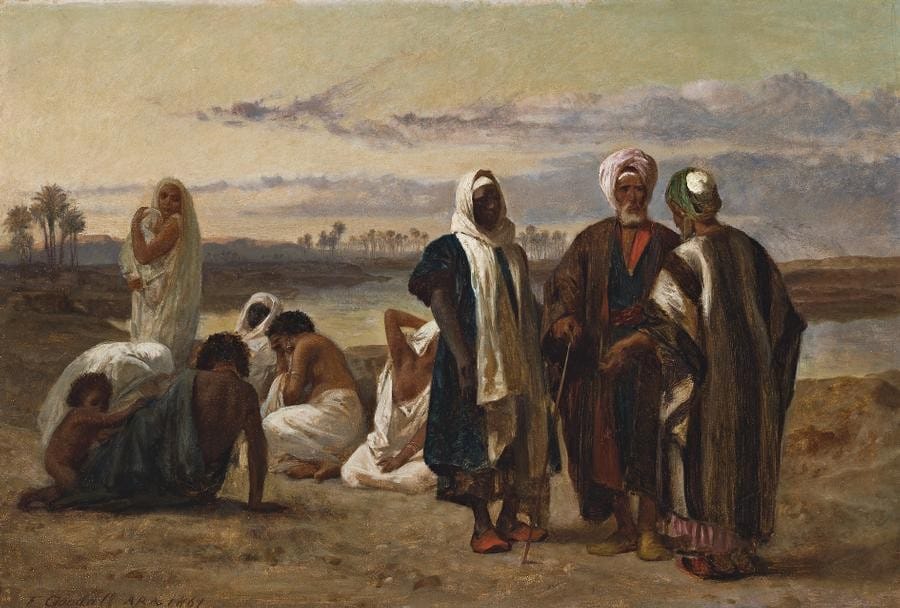
Arab Saharan and East African Slave Trade
The Arab trade, on the record. The Islamic world trafficked sub-Saharan Africans for roughly thirteen centuries — a duration nearly four times the Atlantic trade’s — six to ten million by the sober ranges of the scholarship, Austen’s and Lovejoy’s estimates anchoring the band, with a female predominance of roughly two-to-one to three-to-one, structurally driven by the demand the law itself created: ma malakat aymanukum — “what your right hands possess” — the standing permission of concubinage, renewed in every generation because the permission never expired. The permission generated the demand; the demand shaped the caravans. Transit mortality across the Sahara was severe; the older headline figures are contested and the prosecution declines to trade on them — the ranged record is damning enough without decoration. The Zanj rebellion (869–883) — East African slaves rising from the Basran salt marshes, holding southern Iraq for fifteen years against the Abbasid state and requiring the empire’s full military weight to crush — testifies to the concentration, the conditions, and the scale; a marginal institution does not field armies. The eunuch institution flourished for centuries against Islam’s own jurisprudential prohibition of castration — the harems and courts required what the law forbade, so the demand simply exported the mutilation beyond the border, to be performed by others at mortality rates the sources decline to dwell on, the prohibition satisfied in the letter while financing the practice in fact. And the word abd — slave — drifted in usage until, in stretches of the Arab world, it became and remains a common word for a black man. Semantic drift is data: languages record what societies did long after the societies stop admitting it.
The Atlantic trade, indicted first and fully. Twelve and a half million embarked from Africa; some ten and a half million survived the Middle Passage. Racialised chattel slavery from inception — heritable, perpetual, defined by skin, optimised by joint-stock efficiency. Christian nations built it, financed it, insured it, and defended it from pulpits with Christian texts — above all the manufactured “Curse of Ham,” a justification the cited text itself refutes on its face: Genesis 9 curses Canaan, not Ham; the words are Noah’s, not God’s; and no African referent exists anywhere in the passage. A civilisation holding the imago Dei in its founding documents constructed the most industrialised slave system in history and called it providence. The failure was profound, sustained, and ecclesiastically abetted, and it is entered here first, against the author’s own tradition, because the method demands it. For the record within the record: Jewish participation in the Atlantic trade was real and not disproportionate — the serious historiography (Drescher, Davis; Gates against the 1991 polemics) settles the question — and the same community produced a disproportionate abolitionist presence; Rabbis Einhorn and Raphall preached the same Bible to opposite conclusions in the same decade, and the imago premise won the argument that mattered.
And abolition came from inside. The pressure the deposit built into itself finally detonated, and the detonation was theological before it was political: Wilberforce and the Clapham circle grinding through Parliament for two decades; Newton, the converted slave-captain, writing “Amazing Grace” and testifying against his former trade; the Quakers, first movers by half a century; Douglass and Tubman wielding Exodus against Christian slaveholders in the slaveholders’ own tongue — the enslaved reading the master’s book better than the master. The argument that prevailed was not economic and not sentimental. It was ontological, and it was one sentence: you cannot own what bears God’s image. Aristotle had defended slavery as natural — some men are living tools; Greek democracy ran on it; the Stoics counselled kindness to slaves and stopped precisely there. The rights-language of the Enlightenment, on this point, spent borrowed theological capital — a genealogy (Siedentop’s, Holland’s) contested in the academy and entered here as the serious position it is rather than a consensus. What is not contested is the mechanism’s location: the tradition whose text said image eventually could not keep slaves and keep its text. The text won.
The structural comparison. Islam’s protections were real and are credited: manumission counted among the meritorious acts; the umm walad rule freeing the slave-mother and her child at the master’s death; the brotherhood hadith — “your slaves are your brothers.” Mercy arguments — and mercy arguments produced better treatment. What Islam’s anthropology lacks is the abolition engine. Ahsan taqwim — man created in the finest stature (95:4) — is genuine dignity-affirmation; but tawhid’s wall — laysa ka-mithlihi shay’, “nothing is like Him” (42:11) — forbids the resemblance-claim on which the abolitionist syllogism runs. No image, no “you cannot own the image.” No Jubilee, no go’el, no paresis category marking the institution as tolerated-pending-abolition — the permission simply stands, renewable each generation. A khalifa-based Muslim abolitionism was conceptually available; historically it was marginal. Abolition arrived in the Islamic heartlands from outside, and late — Saudi Arabia and Yemen in 1962, Oman in 1970 — under pressure from a civilisation whose founding premise had finally required it of itself. The comparison, stated without triumphalism: mercy improved the slave’s condition; the image ended the slave’s category.
The dissolution. The deposit’s trajectory did not stop at abolition; it aimed past the institution at the hierarchy beneath it, and the feast-sequence is the liturgy of the aim. Passover — the precondition, blood over the door. The Sea — all Israel passing through together, “baptised into Moses in the cloud and in the sea” (1 Corinthians 10:1–4), no first class in the crossing. Sinai — the word arrives, external, fenced, distanced: touch the mountain and die. Pentecost — Sinai internalised and universalised: the Spirit on sons and daughters, on male servants and female servants (Joel 2:28; Acts 2), women named in the upper room, tongues distributed without rank, and the believer’s own body henceforth the temple (1 Corinthians 6:19) — there is no Court of Women in a temple made of persons. Philemon then states the ontology in a single clause: receive Onesimus back “no longer as a slave, but better than a slave — a beloved brother.” The master-slave relation is not there reformed. It is emptied of foundation: shared Spirit, shared access, shared High Priest leave the category nothing to stand on, and a category with no foundation is a demolition awaiting its date. The Gospel broke slavery the way water breaks stone — slowly, then suddenly; the logic was present from the moment the veil tore. And Islam cannot access the engine, because the engine is the sequence — Passover, resurrection, ascension, Spirit — of which kalimatuhu is the hinge; and the Quran removed the beginning and the middle of the sequence whose end it kept.
XVI. Two Constitutions
Evidentiary tier: consequence — the political architectures compared by their founding documents and their founders’ examples.
The apostolic constitution. The deposit’s community is constituted, by its charter texts, as a sojourning people: citizenship registered elsewhere (Philippians 3:20), resident aliens everywhere (1 Peter 2:11). It is commanded to honour even a hostile state — Romans 13 was written under Nero, which forecloses the comfortable reading. Its propagation is by proclamation only: “how will they hear without a preacher?” (Romans 10:14–17) — the kerygma, not the garrison. And its founder fixed the pattern in his own body: he refused kingship when the crowd offered it (John 6:15); he refused the sword when Peter drew it — “all who take the sword will perish by the sword” (Matthew 26:52), healing, in the same breath, the ear the sword had taken; he told the empire to its face, “my kingdom is not of this world; if it were, my servants would fight” (John 18:36). The night before his death he performed the constitution’s founding act: the master washed the servants’ feet, exempted himself from nothing, and went first into death (John 13). The apostles executed the pattern to the man: Peter, by tradition crucified, asking for the cross inverted; James, first of the Twelve under Herod’s sword (Acts 12); Paul, beheaded under the Nero to whom he had commanded submission; Stephen, praying his executioners’ pardon in the stones’ hail — the operating system running as designed, sealed in its designers’ blood, propagated by nothing but the word and the wounds. For three centuries the community grew under intermittent extermination without raising a garrison, and the growth was the argument. When Christendom later fused throne and altar — Crusades, Inquisition, coerced baptism — it violated its own founding documents, and the violation is named here without deflection: imperial dictum in Christian vocabulary. The distinction is principled, not convenient, because the standard by which the violence stands condemned is textually prior to the violence — the corruption is measured against the charter, and the charter never changed. Christendom’s dissolution returned the church to its original configuration — sojourner, witness, servant — which is not its defeat. It is its factory settings.
The Islamic constitution. The comparison must be symmetrical, so the Meccan period is stated honestly: persecuted, patient, non-retaliatory — genuinely parallel to the apostolic posture, and for thirteen years. The divergence is Medina, and Medina is not an aberration the tradition regrets; the tradition holds it constitutive — the hijra is year one of the calendar. Prophet, head of state, military commander, and lawgiver fused in one person; Badr, Uhud, Khaybar; the judgment of Banu Qurayza; revelation legislating for the polity and — Surah 33:50 — carving a personal exemption for the legislator’s own household: the structural inverse of John 13, where the founder exempted himself from nothing. Classical jurisprudence then constitutionalised the fusion: the world divided into the Abode of Islam and the Abode of War, with expansion a standing orientation rather than a bounded grant — where the deposit’s one territorial mandate was geographically fixed, morally justified as judgment on named nations, and closed: no verse extends Joshua’s commission beyond Canaan, and the New Testament retracts even the sword Peter drew. Language tells the same constitutional story in miniature. Pentecost is Babel reversed — every people hearing the mighty works of God in its own tongue (Acts 2): a constitutional multilingualism in which no language is sacred because every language can carry the Word; the deposit travels by translation and has made minor tongues into literary languages on every continent. Islam sacralised one language — the Quran is untranslatable in principle, its renderings mere “interpretations” — and Arabised where it ruled. One constitution spreads by translation. The other spreads by absorption.
The present multipolar test. Every major civilisational actor now runs a total system, and the apostolic community — this is the structural observation — sojourns inside all of them simultaneously, the only global community that does, which is itself the constitution working as written: resident aliens everywhere, citizens nowhere but one place. Inside the Islamic world, where the deepest internal tension is the Christological one this essay has traced, and where the church persists under the dhimma’s descendants from Cairo to Karachi. Inside China, whose officially atheist totality manages religion by sinicisation — crosses removed, sermons vetted, the state as senior partner in every pulpit — while the unregistered house church lives, involuntarily, in the exact original configuration: no buildings, no recognition, kerygma and endurance, and growth the management cannot explain. Inside Russia, where a national church sacralises a state project — symphonia’s old distortion wearing new insignia, the constitution’s ancient temptation of the throne accepted one more time. Inside the secular West, whose liberalism has matured into a rival total system with a confession of its own — the sovereignty of desire — and blasphemy codes to match, enforced by employment rather than magistrate. Inside India’s Hindutva pressure, where conversion itself is legislated against — Article 18’s hinge again. And inside Africa’s contested ferment, where the Pentecostal explosion runs closest to the apostolic operating system — no armies, no states, translation everywhere, the fastest ecclesial growth in Christian history conducted entirely without a sword — and where this century’s demographic weight of both faiths will be decided. And alongside all of it, Israel — the covenantal anomaly: a state existing in fulfilment of texts most of its citizens do not read, which is precisely the sequence Zechariah 12:10 anticipates — existence first, recognition after; the deposit predicted the order of operations. The forward-tier note is entered last and firewalled as always: the technological substrate now under construction — machine superintelligence, brain-computer interfaces, the commercial division of extraterrestrial ground — inverts the apostolic anthropology point by point, and the inversion is systematic rather than incidental. The image of God becomes the performance metric — worth indexed to capability, the one measure the image-doctrine exists to forbid. The body becomes a transferable pattern — the flesh a first draft. The Spirit’s transformation becomes optimisation. The resurrection becomes the backup — continuity of data standing in for the redemption of the person. It is not that the engineers consult an anti-creed; it is that the project’s internal logic regenerates one, point by negated point — which is itself evidence of which points were load-bearing. Section XVII will state the model’s full identification of this substrate against Daniel 11:38–39 and Revelation 13:16–17; here the single observation suffices that Gulf sovereign wealth is now financing, at hundred-billion-dollar scale, the very substrate that will ultimately contend with the Sharia’s own authority — the din bankrolling the fortress-god’s infrastructure — entered as forward-model observation, ironic and undecided. None of it bears on the counts. The counts closed nine sections ago, and this essay will keep saying so precisely because its critics will pretend otherwise. ### XVII. The Two Endings
Evidentiary tier: forward-model identification throughout, except where marked. The essay states it plainly and will not retract it: if every identification in this section were disputed and lost, Counts One through Five would stand intact. Contemporary event-claims are dated as of July 2026, with the dates given so the reader may check them; forward claims that cannot be checked are not claims.
The question Islamic eschatology cannot answer. Orthodox Islam awaits the return of Jesus. The traditions are canonical and specific — Sahih Muslim’s eschatological chapters: he descends at the white minaret east of Damascus, his hands on the wings of two angels; he breaks the cross; he kills the Dajjal, the great deceiver, at the gate of Lud; he reigns in justice; and then he dies, and is buried in the chamber at Medina beside Muhammad. Sit with the structure of that expectation until its strangeness registers. If the revelation is final and complete, if the seal has come and nothing remains to be said — why must Jesus return to close history? Why does the consummation of Islam’s story require the prophet Islam demoted, and assign him the climactic act — while the seal of the prophets sleeps in Medina and waits for his guest? Why does the arch-deceiver of Islamic eschatology, the Dajjal, present himself precisely as a false Christ — a counterfeit of the figure the tradition insists is merely one prophet among many? Counterfeits are minted against the currency that matters. The tradition’s own end-times cast list testifies, in its casting, to a Christology its doctrine denies: the returning judge is Jesus; the great deception is a false Jesus; and Muhammad appears in the finale not at all. The deposit’s answer to the same questions is architectural: the spring feasts were fulfilled to the day — Passover, First Fruits, Pentecost — and the fall feasts await their turn; the pierced one must be seen by those who pierced him (Zechariah 12:10); the enthronement of Daniel 7 must become visible to the nations that are its inheritance. Islam preserved the conclusion — he returns; he defeats the deceiver; and on those two points its expectation is right — while stripping the premises that make the conclusion intelligible. A theorem without its proof. The model’s own checksums for the terminus are stated in full in the instrument panel below.
The invariant. One datum in this section is not model but record: Israel exists. A people scattered for eighteen centuries — the only nation in history exiled twice and restored twice — re-gathered into statehood in 1948 in the sequence Ezekiel 37 describes: bones, sinews, breath; a national body assembled before the animating recognition arrives. The event has no historical parallel and had a prior textual description. Every war since has been, in structural terms, the surrounding jurisprudence attempting to correct what it regards as a revoked grant — land once under the din held to be perpetually so — against Jeremiah 31:35–37’s oath fixing Israel’s permanence to the fixed order of sun and stars. And the oath has been holding in real time. As of this writing, July 2026: the multi-front assault architected from Tehran in October 2023 has ended in the systematic dismantling of its architect’s position — Hezbollah decapitated in Lebanon; the Assad state fallen (December 2024); the Iranian nuclear programme struck and degraded (June 2025); the Supreme Leader killed and succeeded (early 2026) — and the regional configuration is, for the first time, one in which a broad multi-party covenant with Israel at its centre is a working diplomatic project rather than a fantasy. Daniel 9:27’s terminal seven opens with exactly such a covenant — “he shall confirm a covenant with many” — and its midpoint breaks at the sanctuary; the identification of the present Accords expansion with that covenant’s embryo is the model’s central contemporary wager, entered at tier and worth nothing to the courtroom either way.
The seals, at tier. The model reads Revelation 6’s first four seals as the ordering architecture of the modern era: the crowned rider of 1945 — the liberal order enthroned, conquering without arrows; peace taken from the earth in 2001 — and the order’s analytical incapacity to name its adversary’s theological grammar; the scales and the protected luxuries of 2008 — economic exposure, scarcity for the many with the oil and wine untouched; and the compound pale cascade opening in 2020 — pestilence, then European land war, then the Sahel’s famine arc, death by sword and hunger and beast in train. Each disruption, note, weakened precisely the order that contains the Islamic programme and strengthened the programme’s room to move. The mapping is historicist, disputable, and firewalled: it organises the century; it proves nothing, and is required by nothing that matters.
The instrument panel — the forward model stated in full, for the record. What follows is the model’s complete machinery, entered at tier so that the reader can test it rather than take it. Every date below is computable from public sources — the fixed Hebrew calendar, the NASA eclipse canon, a day-count calculator — and every figure in this subsection has been recomputed for this essay rather than copied; where a component’s base rate is unimpressive, the base rate is stated, because a model that hides its denominators deserves the mockery it gets.
The integers. Daniel deposits four: 1,260 days (7:25’s time, times, and half a time; 12:7 — echoed as forty-two months and 1,260 days in Revelation 11:2–3, 12:6, 12:14, 13:5, the terminal half-week’s standard measure); 1,290 days (12:11, running from the abolition of the daily sacrifice and the setting up of the abomination); 1,335 days (12:12 — “blessed is he who waits and arrives at the 1,335 days,” a forty-five-day benediction beyond the 1,290); and 2,300 evening-mornings (8:14, to the vindication of the sanctuary). These are not round rhetorical figures; 1,290 and 1,335 differ by a precise 45, and 2,300 is nobody’s idea of a symbol. They are lengths, and lengths demand a calendar.
The reckoning. The calendar is Hebrew, and two of its features do all the work below. First, the day runs evening to evening — “there was evening and there was morning,” Genesis 1’s count, which is why Daniel 8:14’s unit is literally erev boqer, evening-morning, why every feast below spans two civil dates, and why counting is inclusive: the day of departure counts, as it does when Friday afternoon to Sunday morning is “three days.” Second, the feast dates float against the civil year on the fixed Metonic cycle — nineteen solar years locked to two hundred thirty-five lunar months — codified under Hillel II in 359 CE, nine centuries after Daniel wrote. Daniel could not have engineered a fit against an algorithm that did not exist; whatever alignment his integers show against Hillel’s calendar was either built in by the calendar’s Author or is coincidence, and the only honest way to decide is to compute.
The diamond chiasm — the full mapping. Run the integers against that calendar from the anchors the model specifies and they do not produce a timeline; they produce a solid — two nested diamonds sharing an axis, mirror-symmetric about a single centre, with the feast calendar riveted to the vertices. The structure, every date computed on the Hillel calendar and checkable in an afternoon:
|
Element |
Date(s) |
Hebrew date |
Alignment |
|
Outer diamond opens |
25 August 2021 |
17 Elul 5781 |
Hebrew-calendar anniversary of 1 September 1939 (17 Elul 5699) — the day the last world war began |
|
Outer hinge (+2,300 days) |
12 December 2027 |
12 Kislev 5788 |
Kislev — the rededication month; Hanukkah follows on the 25th |
|
Outer diamond closes (+2,300 more) |
30 March 2034 |
10 Nisan 5794 |
The lamb-selection day of Exodus 12:3 — the Triumphal Entry’s own date |
|
Inner diamond opens |
11–12 September 2026 |
1 Tishrei 5787 (Rosh Hashanah) |
The Feast of Trumpets — the books opened; the seventieth week’s proposed start |
|
Midpoint (1,290 inclusive days in) |
24 March 2030 |
19 Adar II 5790 |
Abomination of desolation installed (Daniel 9:27; 12:11; Matthew 24:15) |
|
Inner diamond closes (1,290 inclusive days more) |
2–3 October 2033 |
10 Tishrei 5794 (Yom Kippur) |
The Day of Atonement — the books sealed |
|
Witnesses’ fall (1,260 days from 7 October 2026) |
19–20 March 2030 |
14–15 Adar II 5790 |
Purim and Shushan Purim — the feast of the reversed decree of annihilation |
|
Witnesses’ rising |
24 March 2030 |
— |
Three and a half days after their fall, at the midpoint (Revelation 11:9–11) |
|
The blessing terminus (1,335 inclusive days from the midpoint) |
16–17 November 2033 |
24–25 Cheshvan 5794 |
Forty-five days beyond Yom Kippur — Daniel 12:12’s benediction |
|
Ezekiel’s seven months (39:12–16) |
Yom Kippur 2033 → 30 March 2034 |
Tishrei through Nisan inclusive |
Terminates on 10 Nisan — the same day the outer diamond closes |
|
The terminal Seder |
3–4 April 2034 |
14 Nisan 5794 (Passover) |
Ezekiel 45:21; Matthew 26:29 — the cup drunk new in the kingdom |
Read the symmetry off the table. The outer diamond is 2,300 doubled, opening on the Hebrew anniversary of the twentieth century’s catastrophe and closing on the day the lamb is chosen. The inner diamond is the seventieth week rendered as the Jewish court calendar: it opens on the feast where tradition says the books are opened and closes on the day they are sealed, and its two halves are each exactly 1,290 inclusive days, sharing the midpoint day between them — Daniel 12:11’s integer, twice, back to back, meeting at the abomination. The 1,260-day count — anchored at 7 October 2026, the model’s covenant date, itself the anniversary of the massacre that opened the present war — terminates on Purim, the feast that celebrates a genocidal decree reversed, three and a half days before the midpoint by the evening-morning reckoning: Revelation 11’s two witnesses fall at the feast of the reversed decree and stand up at the abomination, on the exact interval the text assigns them. The 1,335 count runs from the same midpoint and delivers its benediction forty-five days past Yom Kippur, the differential Daniel builds into the pair. And two independent circuits converge on the terminus from opposite directions: the outer diamond’s second 2,300-day leg, and Ezekiel’s seven inclusive months of burial from Yom Kippur, both land on 30 March 2034 — 10 Nisan — after which the dedication of Ezekiel 45 and the Passover of 14 Nisan complete the sequence at the Seder Jesus named at the Last Supper as the terminal point of his own abstinence.
The checksums, enumerated. The model treats five of these joints as checksums — internal consistency tests the structure did not need to pass and would fail under almost any perturbation: (1) the dual-1,290 shared-midpoint symmetry of the seventieth week; (2) the 3.5-day Purim-to-midpoint interval matching Revelation 11:9; (3) the two-path convergence of the 2,300 circuit and the Ezekiel circuit on the same 10 Nisan; (4) the 45-day differential of 1,335 over 1,290 landing as a discrete benediction past Yom Kippur; and (5) the Passover checksum this essay relocated from Count Five — Daniel 8’s sanctuary count and Ezekiel’s purification sequence bracketing the same four-day window from lamb-selection to Seder that Matthew 26:29 names. To these the model adds a sixth that no human hand can adjust: the astronomy. A total solar eclipse crosses the sky on 12 August 2026, at the peak of the Perseid meteor shower, and a deep partial lunar eclipse follows on 28 August 2026, sixteen days later — sun darkened, moon dimmed, stars falling, Joel 2’s triad in Joel’s order, both events preceding Rosh Hashanah 5787 by days and both fixed by orbital mechanics since the solar system formed, published in eclipse canons no one can edit. The model reads them as the Seal Six overture. They will occur on those dates whatever the reader thinks of the reading.
And the base rates, disclosed. This essay recomputed the structure rather than quoting it, and the recomputation cuts both ways, so both edges are reported. Individually, several alignments are common: sweeping the Hillel calendar across a thousand years, roughly half of all seven-year Tishrei-to-Tishrei windows span the exact dual-1,290 length, and roughly two in five 17-Elul anchors land their 4,600th day on a 10 Nisan. No single vertex is a miracle, and any presentation implying otherwise would be the numerology its critics allege. The model’s claim is about the conjunction — one window in which the war-anniversary anchor, the Kislev hinge, the 10 Nisan closure, the Trumpets-to-Atonement bracket, the Purim landing of the 1,260 from the 7 October anchor, the two-path Nisan convergence, and the pre-Rosh-Hashanah eclipse pair all hold simultaneously — and conjunctions multiply. The reader is invited to find another window in the calendar’s history that satisfies the full set; the model’s published position is that there is none, and the falsification is a script any programmer can run in an evening.
The little horn, the fortress-god, and the substrate. Daniel 8’s second vision fixes the terminal figure’s provenance: the little horn rises from the four-way division of the goat’s great horn — the western, Alexandrian succession, not an Islamic line — with Antiochus IV Epiphanes as the near-fulfilment type: rise through intrigue rather than dynastic right (11:21), a covenant made and broken, the daily sacrifice abolished, the sanctuary desecrated by a divine self-claim, and a death “not by human hand” (8:25). Daniel 11:36–39 then gives the antitype’s economics, and the verses read strangely until this decade: he “magnifies himself above every god,” yet “honours a god of fortresses” — a god “his fathers did not know” — with “gold and silver and precious stones and costly gifts,” and “divides the land for gain” among those who acknowledge him. A deity unknown to every prior generation, honoured not with temples but with capital allocation at unprecedented scale, whose cult distributes territory commercially. The model’s identification: the god of fortresses is the machine-superintelligence project — the largest concentration of investment capital in human history, directed at a power no ancestor possessed or imagined, pursued by its own advocates in explicitly theological vocabulary (a “digital god” is their phrase, not the prosecution’s) — and the land divided for gain is the commercial partition of extraterrestrial ground, territory beyond all prior jurisdiction claimed and allocated for economic development. Daniel 8:24 supplies the mechanism behind the man — “his power shall be great, but not by his own power” — which the model reads through Section XVII’s Apollyon architecture: the entity operates through the figure as the prince of Greece once animated the goat whose feet did not touch the ground.
Among other things, @Neuralink will enable quadriplegics to use their hands and walk again and the completely blind to see.
— Elon Musk (@elonmusk) June 30, 2026
Jesus-level miracles.
The convergence with the interface. Revelation 13:16–17 specifies the terminal economy’s plumbing with an engineer’s particularity: a mark in the right hand or on the forehead, without which “no one can buy or sell.” Hand and forehead are not decorative choices; they are the two loci at which human-machine interfacing physically operates — the motor cortex read through the skull, the hand as the effector and wearable site. The flagship brain-computer-interface company received FDA approval for human trials in May 2023 and has been implanting since, its stated premise — published by its founder, not inferred by the prosecution — that unmerged humanity will be cognitively outcompeted by the machine intelligence the same actor is building: the merger marketed as survival. And the concentration is the point: one actor cluster simultaneously controls the leading BCI implant, a frontier AGI laboratory, the dominant orbital communications constellation, the largest robotics-and-vehicle manufacturer, and a primary global information platform — Daniel 11:21’s kingdom obtained “by flatteries” and intrigue, assembled in the present tense as capability rather than territory. The model does not name a man and explicitly declines to: types have exceeded their antitypes before, officeholders change, and Section XVII’s rule — the office is prophesied, the officeholder is not — applies here with full force.
The isopsephy bundle. Then the constraint the text itself demands, stated with its whole apparatus visible. Revelation 13:18 is not a mood; it is a computation instruction: “Here is wisdom. Let him who has understanding calculate the number of the beast, for it is the number of a man: his number is six hundred and sixty-six.” Greek writes numbers with letters — isopsephy, the alphabet’s own arithmetic, the system John’s readers would reach for on hearing “calculate.” Transliterate the flagship interface company’s name into the alphabet of the instruction — Νευραλινκ — and sum: ν 50 + ε 5 + υ 400 + ρ 100 + α 1 + λ 30 + ι 10 + ν 50 + κ 20 = 666. The base rate is disclosed as always: roughly one word in a thousand sums to 666, so the number alone would be a curiosity. The model’s claim is again the conjunction — a bundle of independent constraints closing on one technology class: the number (the name computes to the integer, in the language of the instruction); the anatomy (hand and forehead, the interface loci the text specifies); the function (buy-sell gating — economic participation conditioned on the mark, which is precisely what a universal authenticated interface enables and what no tattoo or barcode ever could); and the actor profile (the concentration mapped above, honouring the fortress-god with the capital Daniel describes). Four constraints, independently stated in texts sealed for nineteen centuries, converging on one class of device now in human skulls. And the honest control is entered beside it, at full strength: the classical preterist solution computes qsr nrwn — Nero Caesar — to 666 in Hebrew gematria, with the famous 616 manuscript variant matching the Latin spelling of the same name, and John’s first readers very plausibly heard Nero. The prosecution credits it as the type-level reading it is, and answers as it answered Antiochus: the type does not exhaust the antitype — a first-century emperor did not operate a buy-sell gate in every hand and forehead on earth, and the text’s own economics remain unfulfilled by him. The reader holds both and weighs.
The vector, as of July 2026. The geopolitical board, stated as record and wager, each labelled. Record: New START expired on 5 February 2026 with no successor — the first absence of any strategic-arms constraint between the major nuclear powers since 1972 — inside the energy-and-fuel disruption the model’s published pre-commitments had named, in advance and in writing, for the February–April 2026 window. Record: the thirty-month dismantling this section dated above — Hezbollah decapitated, the Assad state fallen, the Iranian programme struck, the succession completed — has removed the military obstacle to the covenant architecture. Record: the red heifers required by Numbers 19 for sanctuary purification have stood in Israel since September 2022, and Hamas’s spokesman named them, publicly, among the motives for 7 October — the temple-preparation fuse already burning at Al-Aqsa, precisely where the covenant-midpoint mechanism requires the detonation. Wager: that the Abraham Accords expansion is the embryo of Daniel 9:27’s covenant with many, to be confirmed around 7 October 2026 — the covenant anchor from which the 1,260 runs to Purim. The gates are therefore live, sequenced, and near: the Seal Six astronomy of 12 and 28 August 2026; Rosh Hashanah 5787, 11–12 September 2026, the primary falsification gate; a covenant on or about 7 October 2026; an operating altar by the Kislev hinge of December 2027; the midpoint of 24 March 2030; Yom Kippur of 2–3 October 2033; the Seder of 3–4 April 2034. Every date is one on which the model has agreed, in advance and in public, to die. Nothing in this panel strengthens Count One by a syllable — the courtroom closed in Section VII and remains closed, and if every date above passes in silence the five counts stand exactly as entered. But a model that publishes the coordinates of its own possible execution, disclosing its base rates and pre-registering against the eclipse canon, has earned the right to be tested rather than mocked — and the first test is weeks away.
The geography, corrected. Ezekiel 38–39 names the terminal coalition, and the popular identification of Gog with Russia rests on phonetic accidents — Meshech read as Moscow, Tubal as Tobolsk — against the ancient geography. Meshech and Tubal are the Mushki and Tabal of the Assyrian annals: central and eastern Anatolia — Herodotus and Josephus concur on the region. Gomer is Anatolian; Togarmah of “the far north” sits on Israel’s compass through Turkey. Persia, Cush, and Put — Iran, Sudan, Libya — attach as named, and appear nowhere in the coalition as its head. The coalition’s base, read with the ancient atlas rather than the modern phonebook, is Turkish-led and Iranian-armed, with the genuinely far-north power as extension rather than principal. The identification of any current officeholder with any prophetic figure is exactly the kind of claim this section’s tier disclaims. The geography, however, is Assyriology, not speculation — and it relocates the terminal storm’s centre of gravity from the Kremlin to the Bosphorus.
The western horn. In Daniel 8’s vision the little horn rises from the goat — the western, Alexandrian empire and it's successors, the king of Greece whose great horn breaks into four — not from the Islamic world. The near-term type is exact and conceded on all sides: Antiochus IV, rising by intrigue among the four successions, making and breaking covenant, styling himself Epiphanes — God Manifest — halting the daily sacrifice, erecting the abomination, and dying “broken, but not by human hand” (8:25). The terminal antitype at cosmic scale — a figure confederating the Alexandrian footprint, honouring “a god of fortresses his fathers did not know” with gold and silver and precious stones, dividing the land for gain (11:36–39) — is the forward identification, entered at tier; the model reads the fortress-god’s unprecedented resources onto the machine-intelligence programme and the land-division onto the commerce of space, and holds the reading loosely. What the type establishes at courtroom-adjacent strength is the direction: the deposit’s terminal adversary is western-successor, not Islamic. In Ezekiel’s oracle the Islamic nations are the mobilised and then the incorporated — not the vindicated, and not the final enemy. Islamic eschatology has the right intuition of a terminal deceiver and the wrong address for him.
The city, re-read. Revelation 17’s woman sits on seven orē — mountains, the word for sacred heights, not Rome’s bounoi, its seven hills — and Revelation 11:8 has already fixed “the great city” of the book by name: the one “where their Lord was crucified.” The harlot-city is the prophets’ own idiom, applied for a thousand years to one city only — Ezekiel 16’s foundling turned adulteress, Hosea’s wife, Isaiah 1:21: “how the faithful city has become a harlot.” Her seven kings read as the seven imperial powers that have ruled her — Egypt, Assyria, Babylon, Persia, Greece, Rome, and the terminal seventh — and “the beast that was, and is not, and is to come,” the eighth who belongs to the seven, as the returning animator of the imperial succession: the angel of the abyss, named in 9:11 — Apollyon, the destroyer — confined since the cross disarmed the powers (Colossians 2:15) and released for the end, the “power not his own” behind Daniel 8:24’s horn. The objection answers itself once stated: Paul says the principalities are presently active (Ephesians 6:12) — how then a confinement? Both are true, and the texts’ own architecture resolves them: the cross’s confinement is specific, not general — one entity, the animator of the succession, is in the abyss, which is why 17:8’s beast “is not” during the long interim while the powers at large remain active adversaries. The Rome-reading of the harlot retains strong ancient support and is engaged rather than ignored; the Jerusalem reading is entered as the minority-but-serious position it is, at this section’s tier, with 17:16 noted — the beast turns and destroys the woman: the covenant-breaking at the midpoint, the abomination in the sanctuary, the harlot’s fire — and the last word held in reserve: the harlot’s final chapter is not the fire but the wedding; the city that killed the prophets becomes the bride adorned (Revelation 21:2; Isaiah 1:26 — “afterward you shall be called the city of righteousness”).
What does not depend on any of these choices is the thread that runs unbroken across the corpus: 2 Kings 19:35 — the Assyrian army destroyed in a night, 185,000 men, the deposit’s one direct engagement of the malak YHWH in war, against the empire whose heartland is the terminal coalition’s; Isaiah 31:8 — “the Assyrian shall fall by a sword, not of man”; Daniel 8:25 — “he shall be broken, but not by human hand”; Revelation 19:15, 21 — the sword that proceeds from the mouth; Ezekiel 38–39 — the coalition disarmed in the field and falling on the mountains of Israel, buried by the house of Israel for seven months. Five texts, eight centuries, one weapon, one location, one formulation. Whichever map is right, the end is not won by human hand — which is the deposit’s signature on the final page, and the final refutation of every programme, Islamic or Western, that proposes to establish God’s order by its own.
The three divergences. Set the two endings side by side and the difference is not detail but identity. First: the one who returns is the pierced, risen, enthroned Word of God — Revelation 19 names him with the Quran’s own title — not a prophet arriving to implement a governance code and die in Medina. Second: the Islamic nations end mobilised and then incorporated into the worship of the one they opposed — “YHWH will be king over all the earth; on that day YHWH will be one and his name one” (Zechariah 14:9): the Shema’s vocabulary, universal at last — not vindicated as history’s answer. Third: the climax is recognition — “they will look on me, the one they have pierced, and they will mourn” (12:10): the verse Count One could not escape becomes the event history is for; every knee, every tongue (Isaiah 45:23; Philippians 2:10–11), the oath-text the apostles applied to Jesus, kept to the letter. And the model’s own sequence, entered at tier for the reader who has followed the covenant thread: Daniel 9:27’s terminal seven opens with a multi-party covenant confirmed, breaks at its midpoint with the abomination at the sanctuary — the event Jesus told his hearers to watch Daniel for (Matthew 24:15) — and the breaking, not the making, is the mobilisation’s trigger: the desecration of the holy mountain is the one event that unifies the Islamic world’s response as nothing else could, which is how the mobilised become the incorporated. The warning writes itself and is offered without relish, because the texts offer it: recognition before that day costs a reading of the evidence this essay has assembled — an evening with the Quran’s own titles and a morning with Zechariah. Recognition after it arrives with Daniel 12:1’s unequalled distress, in the middle of the worst hour the world will have known. The door and the deadline are both in the texts, and both are open questions of timing only — not of outcome. The reader chooses the price, not the destination’s existence.
XVIII. The Mirror
Evidentiary tier: dialectical synthesis of Counts One and Two.
Stand the two hostile traditions facing each other and let each answer the other’s principal objection — the prosecution’s final exhibit is the witnesses cross-examining one another.
Judaism’s objection to the Christian claim is interpretive: the deposit does not teach it — the readings are Christian impositions on Jewish texts, Greek metaphysics smuggled into Hebrew scripture. Islam answers the objection, unwillingly and therefore unimpeachably: a tradition with every incentive to diminish Jesus, working from an independent revelation-claim, in a different language, six centuries removed and a thousand kilometres distant, produced a Jesus born of a virgin, called His Word and a Spirit from Him, creating life by breath, raising the dead by command, alive now, and returning to end history. If the exalted Jesus were merely a Hellenistic construction, the Arabian desert had no reason to rebuild him — no church councils pressed on Mecca, no Greek philosophy shaped the Hejaz. The hostile witness reinvented a super-prophetic Jesus it had no motive to invent — the profile regenerated outside the church, from the pressure of the material alone. And the post-Yavneh reconstruction from which the interpretive objection issues is, as Count Four showed, not the deposit’s own verdict but the narrowed survivor of it — the ecosystem that natively contained Two Powers, the Enochic Son of Man, and the divine Melchizedek was the deposit’s own breadth, before the boundary was drawn. Islam’s objection to the deposit is textual: it was corrupted. Judaism answers it, again against interest: the people of the meticulous scribes preserved the text across five independent streams, counted its letters, marked its cruxes rather than mending them, sealed it at Qumran before Christianity existed — and then declined, as a tradition, to read it Christologically, which certifies the custodianship as disinterested: no one accuses the guard of forging the treasure he refuses to spend. Each hostile witness annihilates the other’s primary objection. What remains standing when the crossfire clears is the deposit’s own account of itself — guarded by one witness, corroborated by the other, believed as written by neither.
A closing word, then — spoken past the courtroom, because a prosecution addresses a court but a verdict lands on persons. Every count in this essay found the same shape: a suppression that reveals what it suppresses. Five titles orbiting an identity the text then denies. The one shared word — ahad — glossed with a denial of begetting that no one had asked for. The unnamed presence at Hira, whose namelessness is the loudest fact about it. The passion of Karbala, rebuilding in grief what doctrine had removed. The eschatology that cannot end history without recalling the prophet it demoted. Even the family of Imran: the Quran places Mary in the household of Moses and Aaron — daughter of Imran (66:12), wife of Imran’s line (3:35), “sister of Aaron” (19:28) — and where the last phrase alone might be kinship idiom, as the tradition’s own naming-hadith answers the Najran Christians, the first two construct the household itself: the deposit’s priestly family, reached for across sixteen centuries and misfiled — a fossil of the very lineage-logic, Levitical and priestly, that the tradition abandoned when it severed the priest from the returning king. You do not suppress what is not there. You do not deny what no one has affirmed. You do not lock a word against a begetting no one proposed. The suppression is the testimony. The stone the builders rejected turns out to be load-bearing in the rejecting — and the builders’ own documents, read closely, cannot stop saying so.
XIX. The Verdict
The counts are entered and unanswered. Count One: the Quran’s own titles, grammar, miracle-profile, and cradle-speech testify against its substitution theory — the Quran named what it then denied, and the Makr defence dissolves the reliability of the very revelation that mounts it. Count Two: the corruption charge destroys the founding validation it exists to protect, contradicts the Quran’s present-tense affirmations, and dies at Qumran a millennium before its motive existed. Count Three: the deposit’s clock — by sequence, by invariant window, by the disclosed computation — closed on the first century, and the verification archives burned behind the one claimant who published a checkable pedigree inside the window. Count Four: Islam corrected a twice-filtered reconstruction and substituted unverifiable materials at every load-bearing joint — the son, the sanctuary, the line. Count Five: the founder fails the deposit’s gate on the gate’s own covenantal terms; the founding encounter inverts the Quran’s own Mosaic benchmark point by point; the entity he met at Hira did not disclose its name, and the tradition’s supreme claim rests on an identification the entity never made. Around the courtroom, the corroboration stands in concentric rings, needed by nothing and consistent with everything: a constraint theorem from the measured universe whose unique full fit is the triune ground; the regenerations — Ibn Arabi’s Breath of the Merciful, Karbala’s passion, Kabbalah’s differentiated Godhead — where suppressed structure resurfaces inside the suppressing traditions; and two endings, one of which is a theorem without its proof, awaiting a return both traditions expect and only one can explain.
And beneath the verdict, the reason the case was worth bringing at all. The prosecution has not enjoyed itself. Behind every count stand a billion and a half people of real devotion, whose fasting is real hunger, whose prayer is real longing, whose God-hunger this essay has treated throughout as the hanif reaching it honours — and a verdict against a claim is not a verdict against the claimants; the entire proceeding exists because they, of all people, deserve the true answer to the question their tradition raised. “God is love” (1 John 4:8) is not a sentiment; it is an identity-claim with an exhibit attached: “in this the love of God was made manifest among us, that God sent his only Son into the world… to be the propitiation for our sins” (4:9–10). Al-Rahman. Al-Rahim. Al-Wadud. The Merciful, the Compassionate, the Loving — the Quran’s names for God are not false names. They are true names whose fullest expression in recorded history is the event the Quran denies. The deposit’s oath-formula — as I live forever — is the uncreated and eternal divine life staked on a commitment, and the cross is where the stake was paid out in full to fulfil that promise. To deny the cross is not to defend God’s honour against an indignity. It is to erase the moment when his love, by his own names, went furthest. To attempt to protect the throne by cancelling the king’s finest hour is to deny the oaths he made by his own everlasting life and unchanging character. Without the cross as a moment of sacrifice the oath is abrogated:
Psalm 110:4-5;
YHWH has sworn
and will not change his mind,
“You are a priest forever
after the order of Melchizedek.”
The Lord is at your right hand;
he will shatter kings on the day of his wrath.
He swore and explicitly said he would not change his mind. To be the priest he had to first make the offering. That is the cross:
Isaiah 53:4-5
Surely he took up our pain
and bore our suffering,
yet we considered him punished by God,
stricken by him, and afflicted.
But he was pierced for our transgressions,
he was crushed for our iniquities;
the punishment that brought us peace was on him,
and by his wounds we are healed.
So the invitation, to the Muslim reader who has come this far in good faith — and some thirty-four thousand words of prosecution is a long faith to keep. Nothing in this essay asks you to abandon what you got right. The oneness of God: held correctly — the deposit says echad and means it, and on the last day the whole earth will say it (Zechariah 14:9). The seriousness of revelation: held — a revelation worth submitting to is worth examining, and you have just done the examining.
The correct reverence for Jesus: held, and raised — the titles your book gave him were truer than your book could afford; this essay has asked you to trust your own book’s instincts over its conclusions. The discipline of prayer, the honour of fasting, the dignity of a life ordered Godward: held, and awaiting their object. The hanif longing that predates your prophet — the reaching toward the God of Abraham through the fog of idols: held, honoured, and answered, at a bush with a Name and on a hill with a body. What the evidence asks is only that you follow your own tradition’s pointers to their source: the Messiah to his defining texts, the Word to his speech, the unnamed entity to the Named one--Yahweh, the returning judge to the piercing that makes the return intelligible, the Merciful and the Loving to the hour those names went furthest. This is not a call to join the West, which has its own indictment coming and has been shown a draft of it above. It is not a call to abandon your family’s honour, though it may cost you your family’s peace — he said it would, and said he was worth it. It is the oldest call in your own genealogy of faith: the call Abraham heard, to leave the familiar gods of the familiar city for the God who speaks and swears and keeps. He is not waiting to be discovered. He was never hidden — your own book could not stop naming him; your own eschatology cannot end without him. He is waiting to be recognised. And the counts will stand, open on the table, until he is. Your first step is reading the original texts. In that sense the most muslim thing you could do is become a baptised Christian.
Bibliography
Primary sources:
Arabic Infancy Gospel (n.d.).
Babylonian Talmud (n.d.) b. Sanhedrin 43a, uncensored editions; b. Sanhedrin 97b.
Berlin Pedestal 21687 (n.d.).
Greek New Testament (n.d.) NA28; P66; P75.
Hebrew Bible (n.d.) Biblia Hebraica Stuttgartensia; 1QIsaa; 4QDeut-q; 4QFlorilegium; 11Q13; 5/6HevPsalms, Naḥal Ḥever.
Ibn ʿArabī (n.d.) Fuṣūṣ al-Ḥikam.
Ibn Isḥāq (n.d.) Sīrat Rasūl Allāh. Translated by A. Guillaume.
Ibn Khaldūn (n.d.) The Muqaddimah. Translated by F. Rosenthal.
Infancy Gospel of Thomas (n.d.).
Josephus (n.d.) Antiquities of the Jews and Against Apion.
Maimonides (n.d.) Commentary on the Mishnah: The Thirteen Principles and Mishneh Torah.
Merenptah Stele (n.d.).
Quran (n.d.) Arabic text; Sahih International and Yusuf Ali renderings consulted.
Sahih al-Bukhari (n.d.) Badʾ al-Waḥy; Miʿrāj traditions.
Sahih Muslim (n.d.) Kitāb al-Fitan; Miʿrāj traditions.
Septuagint (n.d.) Rahlfs–Hanhart edition.
Soleb topographical lists (n.d.).
Tel Dan Inscription (n.d.).
Secondary scholarship:
Austen, R. (1979) ‘The trans-Saharan slave trade: A tentative census’, in Gemery, H.A. and Hogendorn, J.S. (eds.) The Uncommon Market. London: Academic Press.
Bauckham, R. (2008) Jesus and the God of Israel. Grand Rapids, MI: Eerdmans.
Bekenstein, J.D. (1973) ‘Black holes and entropy’, Physical Review D, 7.
Bérut, A. et al. (2012) ‘Experimental verification of Landauer’s principle’, Nature, 483.
Boyarin, D. (2004) Border Lines: The Partition of Judaeo-Christianity. Philadelphia: University of Pennsylvania Press.
Boyarin, D. (2012) The Jewish Gospels. New York: The New Press.
Davis, D.B. (2006) Inhuman Bondage. Oxford: Oxford University Press.
DeWitt, B.S. (1967) ‘Quantum theory of gravity. I. The canonical theory’, Physical Review, 160.
Drescher, S. (1993) ‘The role of Jews in the transatlantic slave trade’, Immigrants & Minorities, 12.
Flint, P.W. (1997) The Dead Sea Psalms Scrolls and the Book of Psalms. Leiden: Brill.
Gates, H.L. Jr. (1992) ‘Black demagogues and pseudo-scholars’, The New York Times.
Görg, M., van der Veen, P. and Theis, C. (2010) ‘Berlin 21687’, Journal of Ancient Egyptian Interconnections.
Hengel, M. (1995) Studies in Early Christology. Edinburgh: T&T Clark.
Hoehner, H.W. (1977) Chronological Aspects of the Life of Christ. Grand Rapids, MI: Zondervan.
Holland, T. (2019) Dominion. London: Little, Brown.
Hurtado, L.W. (2003) Lord Jesus Christ: Devotion to Jesus in Earliest Christianity. Grand Rapids, MI: Eerdmans.
Kairanawi, R. (1864) Izhar ul-Haq.
Kripke, S. (1980) Naming and Necessity. Cambridge, MA: Harvard University Press.
Landauer, R. (1961) ‘Irreversibility and heat generation in the computing process’, IBM Journal, 5.
Lovejoy, P.E. (2011) Transformations in Slavery. 3rd edn. Cambridge: Cambridge University Press.
Maldacena, J. (1998) ‘The large N limit of superconformal field theories and supergravity’, Advances in Theoretical and Mathematical Physics, 2.
Page, D.N. and Wootters, W.K. (1983) ‘Evolution without evolution’, Physical Review D, 27.
Penrose, R. (2004) The Road to Reality. London: Jonathan Cape.
Schäfer, P. (2007) Jesus in the Talmud. Princeton, NJ: Princeton University Press.
Segal, A.F. (1977) Two Powers in Heaven. Leiden: Brill.
Siedentop, L. (2014) Inventing the Individual. London: Allen Lane.
Sokoloff, M. (n.d.) Works on Bar Kokhba-era palaeography and 5/6HevPs.
Susskind, L. (1995) ‘The world as a hologram’, Journal of Mathematical Physics, 36.
’t Hooft, G. (1993) ‘Dimensional reduction in quantum gravity’.
Wadler, P. (2015) ‘Propositions as types’, Communications of the ACM, 58.
Wolfson, H.A. (1976) The Philosophy of the Kalam. Cambridge, MA: Harvard University Press.
Wootters, W.K. See Page, D.N. and Wootters, W.K. (1983).
Wright, N.T. (2003) The Resurrection of the Son of God. London: SPCK.