Physics, the Trinity, and the Reality of the Unseen
In Arrival, humanity is confronted by signs it cannot read.
Enormous vessels appear across the earth. Inside them are beings whose language is written in circular forms, ink-like figures suspended in air. The signs appear opaque: symbol without grammar, signal without translation, communication without comprehension. The crisis is not that there is no message. The crisis is that the message is present before the language is understood.
As the language is learned, something extraordinary happens. Time itself changes shape. Events that seemed scattered become one object. Memory, future, grief, choice, and destiny are revealed as belonging to a single structure. The world was not silent. It was speaking. Humanity simply did not yet know how to read.
That is close to the problem before us.
Except the language is not alien.
The language is physics.
The created order has been speaking all along. Matter, energy, information, quantum possibility, entropy, time, consciousness, embodiment, death, and history are not mute facts. They are grammar. They disclose that the visible is downstream of the invisible; that matter is not ultimate; that definiteness is not free; that actuality requires selection; and that selection requires conception, specification, and actualization.
But physics alone is not enough. A language can be present and still remain untranslated.
Scripture is the Rosetta Stone.
It does not replace physics. It translates it. It names the Author of the grammar, the Logos by whom the grammar is specified, and the Spirit by whom the grammar becomes living history. It tells us that what is seen was not made from what is visible. It reveals that the world is not merely physical, but covenantal, witnessed, inhabited, judged, and moving toward new creation.
Once the Rosetta Stone is applied, the fragments become one object. Physics, consciousness, spirit, Ark, witnesses, feasts, seals, judgment, and Christ no longer appear as disconnected domains. They become syntax inside one spoken reality.
Newton understood something of this. He did not treat physics as a secular mechanism sealed off from God. The ordered heavens bore witness to divine counsel and dominion. He studied motion, gravity, chronology, Daniel, and Revelation because he understood that the God who orders nature also authors history.
Pascal understood the existential edge. The God who explains reality is not merely the God of philosophers and scholars, but the God of Abraham, Isaac, and Jacob — the God of Jesus Christ. Reality is not merely solved. Reality summons.
Einstein, though stopping short of the personal God of Scripture, still trembled before the intelligibility of the world. He saw that the universe was not brute chaos. It possessed rational structure so deep that science itself became an act of awe.
The claim of this essay is that these intuitions must now be reunited. Physics is the language. Scripture is the Rosetta Stone. And the God disclosed by both is not a vague cosmic order, nor a silent monad, nor an abstract intelligence behind the world, but the living triune God: Father, Logos, and Holy Spirit.
This essay is the architectural companion to What's in a Name?, which gives the full technical defense: the physics derivation, the formal actualization operator, the rival-system comparisons, the Bayesian covenantal model, the eschatological date-window analysis, and the falsifiable residual-slope test. That essay argues and defends. This essay builds. It constructs the framework for understanding reality as one spoken object: physics, consciousness, the unseen, the Ark, the canon, the first advent, the apostolic mission, and the consummation. The two essays together form a lattice of mutual support rather than a single chain of sequential dependence.
I. The Physics Chain
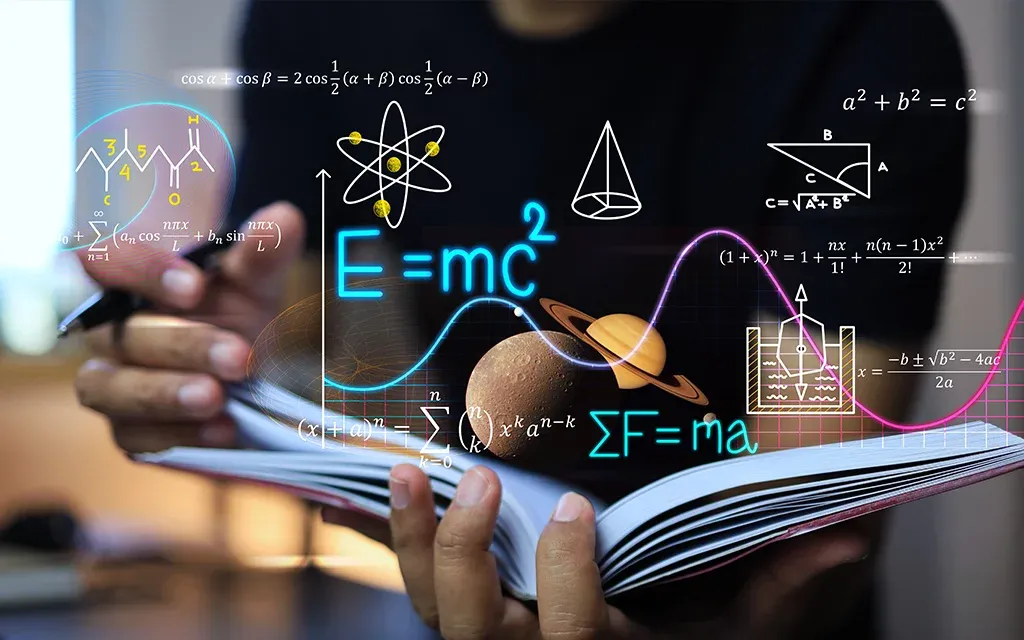
The full physics chain is developed in What's in a Name? and will not be repeated here. But its conclusions must be stated precisely, because everything that follows depends on them.
The world we encounter is not a flat container of solid objects carrying fixed properties through space while consciousness looks on from outside. Modern physics has dismantled that picture at every level. Quantum mechanics removes the old certainty of pre-existing local values. Bell's theorem and its experimental confirmations rule out local hidden-variable theories of the classical kind. Kochen-Specker contextuality prevents us from assigning definite values to all observables independently of measurement context. PBR-type arguments place severe pressure on treating the quantum state as merely ignorance about some deeper classical reality. Relativity weakens the idea of a universal present. Black-hole thermodynamics and quantum information theory make information physically load-bearing. Decoherence explains how stable classical histories emerge from deeper quantum structure. Cosmology and quantum gravity push toward the idea that the total history of the universe is a complete ordered structure rather than a sequence being manufactured moment by moment by an external clock.
None of this returns the old materialist victory condition: a universe made of local, classical, self-sufficient material units whose properties simply wait underneath observation. Whatever the ground of reality is, it must be non-classical, information-bearing, and capable of grounding the transition from quantum possibility-space to actualized determinate history.
That transition — from possibility to actuality — is the central problem. A possibility-space is not yet a world. A wavefunction is not yet an experienced history unless one specifies the ontology by which histories are actual. A mathematical structure is not yet lived reality unless one explains why it is actual rather than merely possible. The live options are limited: collapse (what grounds it?), many-worlds (what grounds the universal wavefunction and why is branch-local experience actual?), hidden variables (nonlocal or contextual, and still needing a ground), brute fact (not explanation but refusal of explanation).
Consciousness supplies the one domain where the possibility-to-actuality transition is directly observed from within. A human decision holds represented alternatives, specifies them by meaning and value, and actualizes one as determinate action. This is not a claim that consciousness causes quantum collapse. It is a claim that decision-making exposes, in a directly observable system, the functional structure of any non-arbitrary actualization. That structure is triadic:
Hold possibility. Specify intelligible order. Actualize determinate history.
Formally:
A_G : Ω → B

A_G = X_G ∘ S_G ∘ C_G
Where C_G holds or contains possibility, S_G specifies intelligible order, and X_G actualizes determinate being.
Remove containment, and there is no possibility-space to actualize. Remove specification, and there is no intelligible ordering — actuality is random or brute. Remove actualization, and nothing becomes definite. Add a fourth operation, and it collapses into one of the three. The three are not sequential steps. They are mutually constitutive: each is defined by its relation to the other two. Containment is containment of what will be specified and actualized. Specification is ordering of what is contained, for what will be actualized. Actualization is rendering determinate what was contained and specified.
The physics chain, then, delivers a constraint-vector. The sufficient ground of reality must be non-classical, information-bearing, mind-like (because only mind holds possibility without physically instantiating it), triadic in operation (because non-arbitrary actualization factors irreducibly into contain, specify, actualize), and omni-temporal (because the ground of the total block of history cannot be one event inside the block).
The next question is whether these operations are merely functional distinctions within a single act or whether they require a richer internal structure in the ground. That question takes us from physics to the interior life of God.
II. From Triadic Operation to Living Trinity
The physics chain arrives at triadic actualization. What's in a Name? derives this from the structure of actuality: any non-arbitrary movement from possibility-space to determinate history requires containment, specification, and actualization as mutually constitutive operations.
This essay adds a second, independent derivation. Both arrive at the same triadic structure. Their convergence is the strongest argument that the structure is not an artifact of either path alone.
The Self-Knowledge Derivation
The physics chain establishes that the ground is mind-like. The four deductive anchors of What's in a Name? push this further: the hard problem shows interiority is irreducible; normative rationality shows truth-binding is irreducible to causation; semantic intentionality shows meaning is irreducible to exterior relations; record-bearing actuality shows the world must be both physically traceable and consciously interpretable. Together these establish that the ground is not merely mind-like in a thin sense — capable of proto-experience or abstract computation — but personal in the thick sense: capable of self-presence, meaning, truth, rational self-expression, moral answerability, and address.
Now take that result and ask: what is the eternal interior life of a personal ground?
If the ground is eternally conscious, it must eternally know itself. This is not an optional feature of consciousness that might or might not be present. Consciousness that does not know itself is not yet personal in the full sense. It is mere sentience — feeling without self-presence. The four deductive anchors already established that the ground must be personal, not merely sentient. Therefore the ground must be self-knowing.
If the ground knows itself, and if the ground is infinite, perfect, and eternal, then its self-knowledge is not partial. It is not the kind of fuzzy self-acquaintance a human being has — shaped by memory failure, unconscious processes, self-deception, and limited perspective. Divine self-knowledge is complete, perfect, and total. The whole of the divine being is present to itself.
If that self-knowledge is complete, it is not merely a passive state of awareness. It is the total self-expression of the divine being. Everything that the ground is, is expressed in its self-knowledge. The self-knowledge is therefore not less than the ground itself. It is the ground's own being, articulated as self-expression.
The classical name for this is Logos — the Word, the Image, the perfect self-expression of the divine Mind. The Fourth Gospel opens with it: "In the beginning was the Logos, and the Logos was with God, and the Logos was God." The prologue is not imposing a Greek philosophical category onto the Hebrew God. It is identifying the eternal self-expression of Ehyeh Asher Ehyeh — the God who says I AM and in that saying perfectly expresses Himself.
The Objection: Why a Person, Not Just an Act?
The standard objection to this derivation is ancient: when a human being knows itself, that self-knowledge is an act of one person, not a second person. My self-awareness does not constitute a second "me." Why should divine self-knowledge be different?
The answer lies in the difference between finite and infinite self-knowledge.
When a human being knows itself, the self-knowledge is imperfect, fragmentary, and dependent on the knowing subject. My self-awareness does not contain everything I am. It is a partial, momentary, always-incomplete act. It cannot stand on its own. It is a flickering act of one limited subject.
Divine self-knowledge is categorically different. It is complete, eternal, and perfect. It contains everything the divine being is. It does not come and go. It does not depend on attention, memory, or effort. It is the total self-expression of infinite being. Because it is complete, it lacks nothing that the source possesses. Because it lacks nothing, it is not a diminished reflection but a full expression — possessing the same essence, the same life, the same power.
A full expression that possesses everything the source possesses, including self-presence, life, and personal being, is not merely an act of the source. It subsists. It is everything the source is, expressed as Image. It is not a second god, because it possesses the same divine essence. It is not a mere attribute, because a complete self-expression of personal being is itself personal. It is the Logos — distinct from the Source as expression is distinct from the one who expresses, yet fully possessing the one divine being.
The same argument moves to Spirit. If Source and Logos mutually know each other perfectly, and if that mutual knowledge is living — not dead information, not static mirroring, not abstract relation — then the life that flows between them is itself fully divine, fully personal, and fully possessing the one essence. That living relation is Spirit. If the relation between Source and Logos is the living relation of personal being to perfect personal self-expression, then it cannot be less than personal without making the communion of divine life less than the persons it unites.
The result: the one divine being eternally subsists as Source (the one who knows), Logos (the one who is the perfect expression of that knowing), and Spirit (the living communion between them). Not three gods — one essence. Not three modes of one person — three distinct personal subsistences within one being. Not hierarchy — each fully possessing the divine nature.
Why This Derivation Matters
The self-knowledge derivation is independent of the actualization derivation. The actualization derivation asks: what does the world require of its ground? The self-knowledge derivation asks: what does eternal conscious being require of its own interior life? Both arrive at the same triadic structure. Both map naturally to Father, Logos, Spirit.
The actualization derivation gives the cosmological reason for threeness: the structure of reality requires containment, specification, and actualization.
The self-knowledge derivation gives the personal-interior reason for threeness: eternal conscious being requires self-knowledge and living self-relation.
The convergence of two independent paths on one structure is significantly stronger than either path alone. It means the triadic claim is not an artifact of one particular argument but the structure that appears whenever the question of ultimate ground is pressed far enough — whether from outside (what does the world need?) or from inside (what does infinite personal being look like?).
Rival Monotheisms and Divine Simplicity
This result sharpens the critique of non-Trinitarian monotheisms.
Islam gives one transcendent Creator, divine speech, prophetic revelation, and moral seriousness. It shares much of the constraint-vector. But tawhid — the doctrine that God is one, incomparable, unbegetting, and unbegotten — prevents the self-knowledge derivation from resolving into personal distinction. If God perfectly knows Himself, and that self-knowledge is complete, is it merely an attribute? Islamic theology would say yes: divine knowledge is a real attribute of the one God, not a second personal subsistence. But the argument above shows that a complete self-expression of personal being is itself personal — not a diminished attribute but a full subsistent expression possessing the same essence. Tawhid, as formulated in classical Islamic theology, blocks the conclusion by defining divine unity as excluding any internal personal distinction. The physics-derived constraint and the self-knowledge derivation both press beyond that boundary.
Non-messianic Judaism faces a different version of the same pressure. The Hebrew canon already contains thick divine complexity: Word, Wisdom, Spirit, Angel of YHWH, Shekhinah, Glory, Son of Man, the enthroned Lord of Psalm 110, the divine King of Psalm 45, the Mighty God of Isaiah 9. Rabbinic Judaism polices these texts carefully. The rejection of "two powers in heaven" (b. Hagigah 15a; b. Sanhedrin 38b) shows that the tradition recognizes how powerfully the Hebrew textual field can generate divine-complexity readings. The guardrails exist because the pressure is real.
Christianity's claim is not that it invents divine complexity and projects it backward. It is that the Hebrew textual field already contains the raw materials of personal divine plurality, and that the Trinitarian reading is the fullest resolution of that field's own internal pressure.
Neoplatonism gives transcendence through the One, intelligibility through Nous, and procession into Soul. But the Neoplatonic triad is hierarchical and emanational — each level is a diminished overflow of the one above. In the Christian Trinity, Father, Son, and Spirit are co-equal, co-eternal, and mutually indwelling. The Neoplatonic triad is vertical degradation. The Christian Trinity is horizontal perichoresis. The self-knowledge derivation shows why: the Logos is not a diminished emanation of the Source, but a complete self-expression possessing the same essence. Spirit is not a further dilution, but the living communion of Source and Logos, equally possessing the one divine life.
The Mapping
Source / Conceiver / Knower                → Father
Specification / Logos / Self-Expression    → Son
Actualization / Life / Living Communion    → Holy Spirit
One living divine Being.
Eternally self-existent as Source.
Eternally self-knowing and self-expressive as Logos.
Eternally living in personal Spirit.
The Trinity is not an exception to monotheism. The Trinity is the only form of monotheism in which the ground of reality is eternally personal, eternally self-knowing, eternally self-expressing, and eternally alive. A solitary monad may be absolute, powerful, and one. But if it is internally without relation, then relation begins only when creation begins. If love requires another, and God is eternally alone, then love is not eternal in God. If self-expression begins only when God speaks the world, then expression is not eternal in God. If Spirit is merely an impersonal force, then the life of God is not personal communion.
The living God cannot be a dead simplicity.
This is not a rejection of divine simplicity if simplicity means that God is not composed of parts. The Trinity does not divide God into components. The Father, Son, and Spirit are not pieces of God. The rejection is of a dead simplicity: a unity so flattened that it cannot contain eternal self-knowledge, self-expression, love, and living communion. Christian simplicity must be living simplicity — the indivisible fullness of the one divine Being, not the emptiness of an undifferentiated monad.
III. Ehyeh Asher Ehyeh
The divine name grounds the Trinity in revealed identity, not merely in abstract structure.
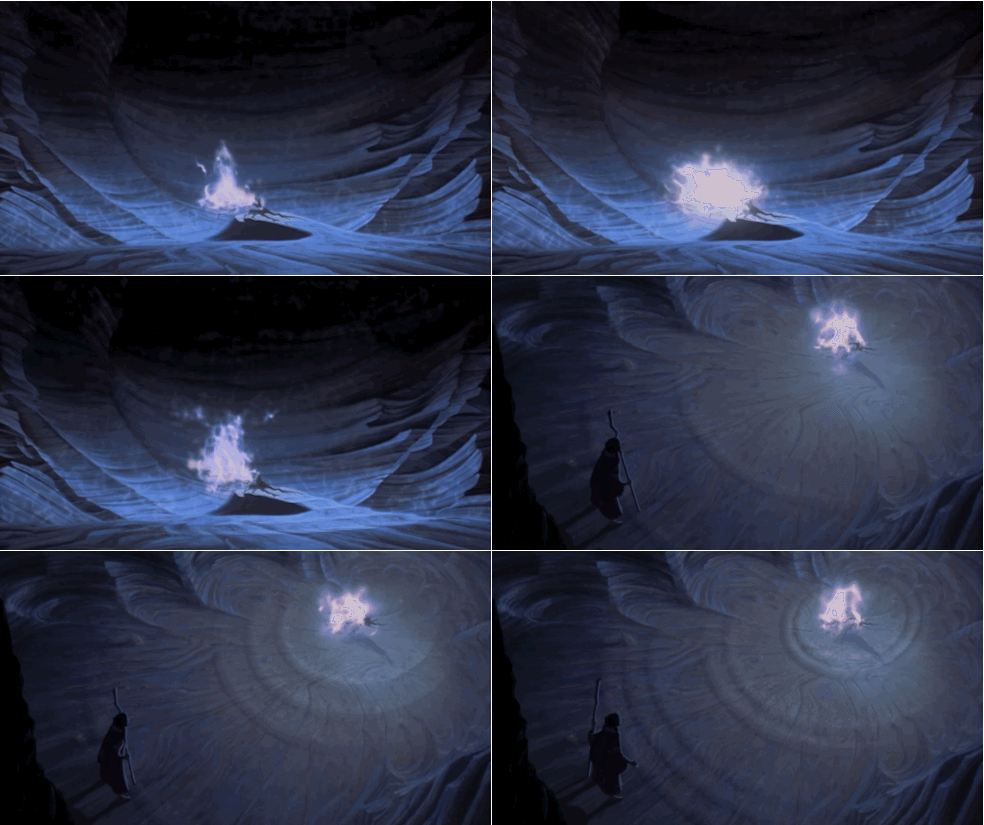
When God reveals Himself to Moses from the burning bush as Ehyeh Asher Ehyeh — I AM WHO I AM, or I WILL BE WHAT I WILL BE — He does not disclose Himself as a mute abstraction. He does not say, "I am a force." He does not say, "I am an object among objects." He reveals Himself as living self-existence: Being that is present to itself, expresses itself, and will show what it is by what it does in history.
The name carries a dual temporal register. Ehyeh is first person singular of the verb to be. It declares present self-existence — I AM. But it also carries the force of future disclosure — I WILL BE. God is the one who is, and the one who will reveal what He is by acting within the actualized block of history.
At the structural level — and this is a theological reading, not a replacement for the grammatical meaning — the name can be heard to resonate with the triadic structure:
The first Ehyeh corresponds to source-being: the Father as self-existent ground, the unbegotten I AM from whom everything proceeds.
Asher — the relational term, the "who" or "which" or "that" — functions as the living mediating movement by which being is not inert but self-related. It is the breath, the connection, the living relation between being and its expression. This maps to the Spirit: not a dead connector but the living personal movement by which Source and Expression are one.
The second Ehyeh corresponds to self-articulated being: the Logos as divine self-expression, the I AM as uttered, known, and revealed. This is why the Logos can say, before Abraham was, I AM. He does not say "I was" — a temporal verb for a temporal creature. He says Ehyeh: I AM. He bears the Name.
This triadic resonance does not replace exegesis. It does not prove the Trinity from Hebrew grammar alone. What it does is show that the revealed name of God is structurally hospitable to the triadic conclusion arrived at independently by physics and the self-knowledge derivation. The name says: I AM, living relation, I AM. The physics says: containment, specification, actualization. The self-knowledge argument says: Knower, Self-Expression, Living Communion. The three converge on the same structure, approached from three different directions.
The covenantal dimension matters as much as the structural one. Ehyeh Asher Ehyeh is not merely a metaphysical label. It is a promise. I WILL BE what I WILL BE. I will show you who I am by what I do. The name commits God to historical self-disclosure. If the ground of reality is the One who says this name, then history is not a meaningless accident. It is the field in which the I AM reveals Himself. The block of time is the canvas of divine self-disclosure. And the disclosure is not complete until the end — because Ehyeh Asher Ehyeh promises future revelation, not merely present existence.
This is why the argument must move from physics and metaphysics into history. The God whose name promises historical self-disclosure must actually disclose Himself in history. If He does not, the name is empty. If He does, history should bear the marks. The question is where those marks appear.
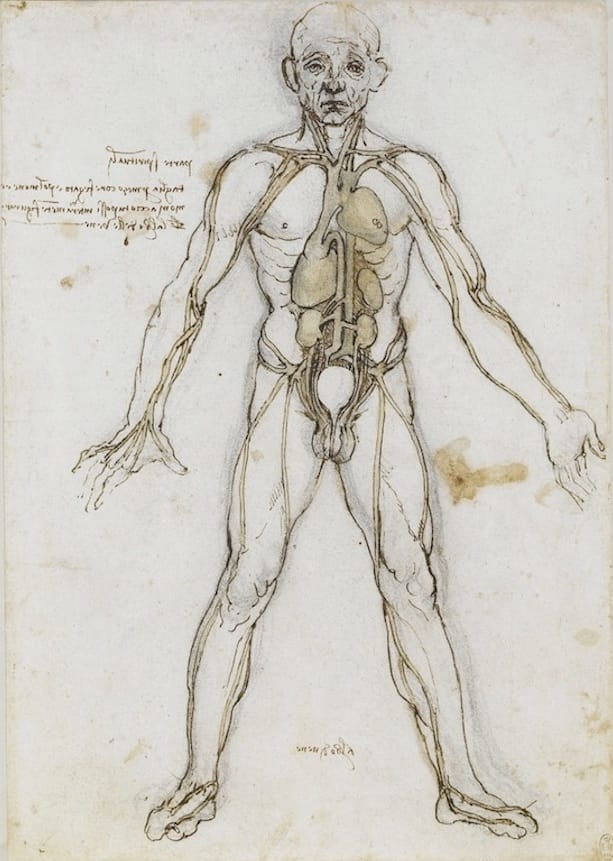
IV. The Image: Human Beings as Echad
Human experience is a witness to the Trinity, not merely an analogy for it.
A human being is echad — one. Not yachid in the sense of a flat, solitary, internally undifferentiated unit. A human being is one integrated whole that contains within itself a rich structure of personal registers. The human being thinks, judges, speaks internally, worships, wills, loves, suffers, remembers, imagines, creates, repents, and is aware of being aware. Each of these activities bears personal quality: the conscience addresses with authority, the inner voice reasons and rebukes, the spirit yearns, the will resists or commits. Yet these are not separate beings. They are one person — living, integrated, and internally complex.
This matters because the most common obstacle to receiving the doctrine of the Trinity is the assumption that personhood equals separate being. If "person" necessarily means "separate individual," then three persons must be three gods. But human experience already disqualifies that assumption. The conscience is personal — it speaks, commands, accuses, and acquits — yet it is not a separate being. The inner voice is personal — it reasons, narrates, deliberates, and sometimes says what the will does not want to hear — yet it is not a second being. Self-awareness is personal — it is the mind knowing itself, stepping back from its own operations to observe them — yet it is not a third being.
The human being is therefore one being with multiple personal registers. Personhood is not the same thing as separate being-ness. Unity and personal distinction coexist in finite, fractured, embodied form.
The Modalism Objection
The immediate objection is that human inner complexity supports modalism, not Trinity. My inner voice, conscience, and spirit are modes of one person — they are me experiencing myself under different conditions. They are not co-equal subsistences who mutually indwell. If the human case is the model, why not conclude that Father, Son, and Spirit are merely modes of one divine person?
The objection is real and must be answered directly.
The answer is that the human case is an image, not an identity. An image participates in the structure of its original without being identical to it. The structure that appears finitely and fractured in human beings exists eternally and perfectly in God — and the perfection transforms it.
In human beings, the personal registers are partial and intermittent. Conscience comes and goes. The inner voice is not always speaking. Self-awareness fluctuates. The registers depend on the underlying person for their existence and do not themselves subsist independently.
In God, the situation is different precisely because the self-knowledge derivation shows it must be. Divine self-knowledge is not partial, flickering, or dependent. It is complete, eternal, and fully possessing the divine essence. A complete self-expression of personal being is itself personal — it subsists. A living communion between Source and Expression that fully possesses the divine life is itself personal — it subsists. The divine "registers" are not intermittent modes that come and go. They are eternal, co-present, and mutually constituting subsistences.
The human case shows that personal-register plurality in one being is coherent. It is not incoherent, contradictory, or absurd. The Trinitarian claim then asserts that the divine case exceeds the human image in a specific direction: toward eternal, co-equal, mutually indwelling personal distinction rather than intermittent, dependent modality. The self-knowledge derivation provides the reason for this: a complete and living self-expression of infinite being is not a mode that appears and disappears. It is a permanent, full, and personal subsistence.
The Structural Parallel
The deeper parallel between human echad and divine echad is not merely that both contain plurality in unity. It is that both display the triadic actualization structure.
A human being holds possibilities — imagines, considers, conceives. This participates finitely in containment: the Father's function.
A human being specifies — reasons, judges, distinguishes, names, orders, values. This participates finitely in specification: the Logos's function.
A human being actualizes — wills, acts, speaks, creates, externalizes interior life into the visible world. This participates finitely in actualization: the Spirit's function.
Human consciousness is not merely an analogy for divine actualization. It is a real participation in the same structure. This is what "image of God" means in the framework of both essays: not a static property stamped on the human creature, but a structural participation in the triadic actualization that constitutes reality. We hold possibilities because the Father holds possibility. We specify because the Logos specifies. We actualize because the Spirit actualizes. Our consciousness performs, at finite scale, what the divine life performs eternally.
A machine is externally structured by code. A human being is internally dynamic through spirit. A programmed system processes inputs and produces outputs. It does not have an interior council. It does not experience the tension between mind, conscience, will, flesh, spirit, love, fear, memory, guilt, and worship. It does not repent. It does not grieve before God. It does not experience conscience as a voice with authority. It does not become aware of its awareness and then surrender that awareness to the One who made it.
Human beings do.
That is why we are not merely biological machines. We are visible bodies animated by invisible personal depths. We are echad.
V. The Coherence of the Trinity
The derivation and the image are now in place. Before the argument moves into ontology and history, the doctrine they yield must be defended against the standard objections directly. The objections are not new. Each rests on a confusion that the foregoing already resolves, but the resolutions are scattered. Here they are gathered and stated head-on. Six questions, six answers.
Why one being can be three persons
The objection assumes that "being" and "person" are the same category, so that three persons must be three beings. They are not the same category. Being answers the question what something is. Person answers the question who someone is. The Trinity affirms one what and three whos: one divine essence, numerically and indivisibly one, subsisting as three distinct persons.
The persons are not three instances of a shared kind, the way three human beings are three instances of humanity. They are three subsistences of one identical essence. The Father is wholly God. The Son is wholly God. The Spirit is wholly God. Yet there are not three Gods, because there is not three of the divine essence — there is one essence, wholly possessed by each person.
What distinguishes the persons, then, is not essence (they share one essence) and not parts (the essence has no parts) but relations of origin. The Father is unbegotten source. The Son is the eternally begotten self-expression. The Spirit is the eternal procession of living communion. The persons are distinguished only by their relative opposition: the begetter is not the begotten, the proceeding is not the source of procession. Everything else — essence, will, power, life, eternity — is held in common and held wholly.
The echad anthropology shows this is coherent. A single human being holds within itself mind, conscience, inner voice, and spirit — each bearing personal quality, none a separate being. The self-knowledge derivation shows why the divine case is not merely coherent but actual: complete self-expression of personal being subsists as a distinct who while remaining the one what.
Why the Trinity is not modalism
Modalism — the ancient error of Sabellius — holds that Father, Son, and Spirit are not three eternal persons but three masks, roles, or modes that one solitary divine person adopts: Creator, then Redeemer, then Sanctifier, played in succession or according to context. On this view there is one who wearing three costumes.
The Trinity rejects this for a precise reason. The persons are co-eternal and co-present, not successive. There was never a time when the Father was without the Son, because — as the self-knowledge derivation showed — the eternal Mind was never without its complete self-expression. God does not become triune at creation or at the incarnation. He is eternally triune. The Son is not a role the Father plays in redemptive history; the Son is the eternal Word who was with God and was God before anything was made.
The decisive display is the baptism of Jesus. The Son stands in the water. The Spirit descends as a dove. The Father speaks from heaven. Three persons are present simultaneously, in distinct action, in a single scene. This is not one person switching masks. It is three persons in one undivided act of self-disclosure.
The echad image must be guarded here, because it is the one place the human analogy can mislead. In human beings, the personal registers are intermittent and modal — conscience comes and goes, the inner voice falls silent. If the divine case were exactly like the human case, modalism would follow. But the perfection that transforms the image (Section IV) is precisely the point: divine self-expression is not an intermittent mode that appears and disappears. It is complete, eternal, and subsistent. The registers that flicker in us subsist eternally in God. That is the difference between an image and its original, and it is the difference between modalism and the Trinity.
Why the Trinity is not tritheism
Tritheism is the opposite error: three gods, loosely unified. It treats Father, Son, and Spirit as three divine beings who share a common nature the way three men share human nature — three instances of deity.
The Trinity rejects this because the divine essence is not a kind with multiple instances. It is one concrete, indivisible, numerically singular essence, wholly possessed by each person. The Son is not made from a second portion of divinity. He is the self-expression of the very same essence that is the Father's. There are not three minds, three wills, three powers, three lives. There is one mind, one will, one power, one life — subsisting as three persons.
This is secured by perichoresis: the mutual indwelling of the persons. Each person is in the others. The Father is in the Son and the Son in the Father (John 14:10-11). The divine life is not divided among three; it is one undivided life lived by three in eternal communion. And in every action toward creation, the three act inseparably as one: the Father purposes, through the Son, in the Spirit — one operation, not three coordinated operations. Three centers of subsistence, one being, one act.
Why self-knowledge is not merely an attribute
The unitarian reply to the self-knowledge derivation is that divine self-knowledge is a property God has — like omniscience or omnipotence — not a second person. God knows Himself the way He knows everything else: as a knower possessing knowledge. Knowledge is an attribute, and attributes do not subsist as persons.
This reply works for finite, partial self-knowledge. It does not work for the complete self-knowledge of infinite personal being, for three reasons.
First, an attribute is something less than its possessor — a feature among features. But complete self-knowledge of the whole divine being is not less than the being. It contains everything the being is, lacking nothing — including life, self-presence, and personhood. An expression that lacks nothing of its source is not a diminished feature of the source. It is the source's own being, fully expressed.
Second, an attribute does not act. Omniscience does not speak, love, or send. But the Logos speaks: before Abraham was, I AM (John 8:58). The Logos is sent, becomes flesh, and addresses the Father as you. A mere attribute cannot do this. A subsisting person can.
Third, the self-knowledge of a personal being, when complete, is necessarily itself personal. To know oneself perfectly, when the self one knows is a person, is to express the whole of a personal reality — and the complete expression of personhood is personal, not propositional.
The honest scope of the argument: this shows that complete divine self-expression has the structure of a subsisting person rather than a possessed attribute. It makes the Trinitarian reading the natural completion of what eternal conscious being is, rather than coercing a contradiction from anyone who denies it. But it removes the easy move — the claim that self-knowledge is obviously merely an attribute. On the contrary: the more perfectly a personal being knows itself, the less its self-knowledge resembles a property and the more it resembles a personal Word.
Why divine simplicity does not exclude real relations
Classical divine simplicity holds that God is not composed of parts: no composition of matter and form, no real distinction between essence and existence, no accidents added to a substance. The objection: if God is utterly simple, real distinction between three persons would introduce composition, and composition contradicts simplicity. Either simplicity is false or the persons are not really distinct.
The resolution, worked out by Augustine and sharpened by Aquinas, is that the persons are distinguished by subsistent relations — and a relation is not a part. Paternity, filiation, and procession are not three components bolted onto the essence. In God, who has no accidents, these relations are not added to the essence; they are identical with the essence, considered under the mode of relation. The Father is the divine essence as begetting. The Son is the divine essence as begotten. The Spirit is the divine essence as proceeding.
Because each relation is the whole essence subsisting relationally, no relation divides the essence into parts. The distinction between the persons is purely one of relative opposition: the only thing that makes the Father not the Son is that the begetter is not the begotten. Take away the relation and there is no remaining "piece" of God left over, because the relation is not a piece — it is the one essence in its relational mode of being.
This is what the essay earlier called living simplicity. Dead simplicity is a unity so flat it can hold no internal relation, and therefore no eternal knowledge, expression, or love. Living simplicity is the indivisible fullness of the one divine Being — without parts, yet internally rich enough to subsist as real, eternal, mutually constituting relations. Simplicity does not exclude relation. It is the kind of unity that real relation requires: not an aggregate of relating parts, but one essence whose very life is relational.
Why Jewish and Islamic objections presuppose an inadequate account of divine personhood
The strongest unitarian objection — shared in different forms by non-messianic Judaism and Islam — is that the oneness of God (echad, tawhid) excludes internal personal distinction. One God means one person. Three persons, however carefully qualified, compromise the unity.
The objection is not arbitrary. It guards something true: there is one God, and idolatry is the cardinal sin. But pressed as an argument against the Trinity, it smuggles in an unexamined premise — that personhood entails separate being, so that "one God" must mean "one person." That premise is precisely what the echad anthropology and the self-knowledge derivation refute. Personhood does not entail separate being. A single being can possess real internal personal distinction: the echad structure shows this is coherent, and the self-knowledge derivation shows it is what eternal conscious being requires.
Once that premise is removed, the inference from "one God" to "one person" no longer follows. Divine unity is unity of essence, will, and life — and that unity is fully preserved in the Trinity, where there is one essence, one will, one life, subsisting as three persons. The unitarian objection assumes that to defend unity one must deny internal distinction. But unity of essence and plurality of persons are not competitors; they answer different questions.
There is a deeper cost to the objection, and it falls on the unitarian side. A God who is eternally one person, and only one person, cannot eternally know another, love another, or speak to another. Before creation there is no one to love, no one to address, no Word to utter. Knowledge, love, and self-expression therefore begin only when the world begins. Such a God is not eternally personal in the full sense; He becomes relational only by creating. This is the lonely monad — the dead simplicity. The God of tawhid, when internal distinction is denied, and the God of strict yachid, when divine Word, Wisdom, and Spirit are reduced to impersonal attributes, both purchase unity at the price of eternal interpersonal life.
The Trinity does not pay that price. In the Trinity, God is eternally knowing, eternally self-expressing, and eternally loving — within His own being, before and apart from creation. Love is not something God learns by making creatures to love. Love is what God eternally is, because the Father eternally loves the Son in the Spirit. The objection, then, does not defend a higher view of God's unity. It presupposes a lower view of God's personhood — one in which the most personal realities, knowledge and love and word, are either absent from eternity or demoted to impersonal attributes. The Trinitarian claim is that the living God is more personal than the monad, not less, because He is eternally and internally the communion of persons that the monad can only reach by stepping outside itself.
VI. The Invisible and the Real
The strangest thing about the invisible world is that we already inhabit it.
Thought is invisible and real. Conscience is invisible and real. Will is invisible and real. Love is invisible and real. Guilt is invisible and real. Memory, intention, worship, repentance, imagination, desire, hope, and self-awareness are invisible and real.
This is not a weak concession — "yes, subjective experience exists, but the real world is material." It is the opposite. The most immediate thing we know — our own interior life — is not visible, tangible, or materially graspable. We can measure neural correlates. We can observe behavior. We can scan brain activity. But the thought itself is not the neuron. The guilt itself is not the hormone. The meaning itself is not the electrical trace. The four deductive anchors of What's in a Name? establish this rigorously: the hard problem shows interiority is irreducible to exterior mechanism; normative rationality shows truth-binding cannot be reduced to causal production; semantic intentionality shows aboutness cannot be extracted from exterior relations; record-bearing actuality shows science itself requires the conjunction of exterior trace and interior witness.
Modern materialism dies at the threshold of ordinary human experience. And it dies again at the threshold of physics.
The Physics of the Invisible
Quantum reality is not classical visible matter. At depth, physical reality is described through state-vectors, amplitudes, probabilities, correlations, operators, measurement contexts, and constraints. The quantum state is not tangible in the way ordinary objects are tangible. It is real, but it belongs to an invisible, non-classical, possibility-bearing register that becomes definite — visible, measurable, classical — through decoherence, environmental interaction, and constraint.
This does not mean quantum states are spiritual entities. The categories must be kept distinct. But the directional lesson is important: even within physics, the visible is downstream of something non-visible. Even material reality, at its foundations, is not the simple solid stuff materialism imagined. The physical world at its deepest layer is structured possibility that becomes definite actuality through a process physics can describe but whose ultimate ground physics alone cannot supply.
The parallel between human consciousness and quantum reality is structural, not identitarian:
Human thought is the bridge between invisible intention and visible action. The mind holds possibilities, specifies by meaning, and actualizes through will. The invisible becomes visible.
Quantum reality is the bridge between invisible state-structure and visible classical materiality. The quantum register holds possibility in superposition, physical law specifies admissible structure, and decoherence renders definite classical appearance. The invisible becomes visible.
Both occupy the borderland between invisible possibility and definite actuality. Both display the grammar of actualization. And in both cases, the visible is downstream.
The Ontological Thesis
The thesis is not: "invisible things exist in addition to visible things." The thesis is stronger: the invisible is ontologically prior to the visible. The visible world — classical, definite, measurable, material — is the downstream actualization of an upstream reality that is itself non-classical, information-structured, possibility-bearing, and invisible. This holds in physics (quantum → classical). It holds in consciousness (interior → exterior behavior). It holds in creation (God → Logos-specified → Spirit-actualized world). And it is stated directly in Scripture: "What is seen was not made out of things that are visible" (Hebrews 11:3).
The significance is that this thesis removes the materialist assumption that invisibility equals unreality. If the invisible is ontologically prior, then the burden of proof is reversed. It is not the believer who must explain how invisible realities can be real. It is the materialist who must explain how the visible can be foundational when physics shows it emerging from a non-visible register, and when the most immediate datum of human experience — one's own consciousness — is invisible.
The Asymmetry of Life
There is a sharp and observable instance of this priority, and it concerns life itself. Consciousness does not require a body, but a body requires consciousness in order to live.
The dependency runs one way only. Consciousness can exist without corporeality: God is conscious without a body; angels are conscious as spiritual beings whose visible form is an interface rather than a substance; the dead are conscious in the intermediate state, where the souls under the altar cry out and are answered (Revelation 6:9-11). But a body cannot live without the animating invisible principle. The body of dust is inert until the breath of life makes it a living being (Genesis 2:7), and "the body apart from the spirit is dead" (James 2:26). A corpse is precisely a body from which the invisible animating principle has withdrawn.
So consciousness is the independent variable and the body is the dependent one. This is the cleanest single demonstration of the whole invisible-priority thesis, because here the downstream item does not merely emerge from the upstream one — it cannot so much as live except by it. Life is not a property the body generates and then shares with an inner life. Life is the invisible animating principle, and the body is what that principle makes alive. Remove it and the visible remains, but only as a corpse.
This claim is framework-internal, not a neutral datum. A materialist denies it, holding that consciousness is a product of the body and cannot outlast it. But it is well-grounded within the framework by the hard problem: if consciousness were merely a bodily function, it could not persist when the body fails — yet the irreducibility of interiority and the priority of the invisible both indicate that consciousness is not merely a bodily function. The asymmetry is therefore not assumed; it follows from what has already been established. And it will prove decisive when the argument reaches the mode in which the two witnesses die and rise: their death is the withdrawal of the animating principle from the corporeal interface, and their resurrection is its restoration.
VII. The Joint Ontology
If the invisible is ontologically prior, and if Scripture describes a reality populated by spiritual beings, objects, and structures, then we need a taxonomy. Not to domesticate mystery, but to think precisely about what kind of existents the biblical world contains.
Categories
An object is anything that exists. This is the most general category. Physical objects, mathematical structures, spiritual entities, and abstract forms are all objects in this broad sense.
A being is an integrated living existent. It is not merely a thing but something that lives: it has dynamic internal organization, maintains itself, acts, and responds. A tree is a being. A bacterium is a being. They are alive, integrated, and self-maintaining — but they are not personal.
A person is a being with first-person interiority: capable of self-awareness, knowledge, will, love, address, rational judgment, moral agency, meaning, and self-disclosure. Persons can say "I." They can recognize other persons. They can be addressed and address in return. They bear responsibility.
A spirit is living personal interiority and agency. In human beings, spirit is the deepest register of personhood — the level at which the person is aware, prays, is convicted, worships, and relates to God. Spirit is not impersonal force. It is personal depth.
A spiritual being is a living personal agent of the spiritual register of creation — an existent that is personal, self-aware, and active, but whose primary mode of existence is in the non-visible realm. Angels and demons are spiritual beings. They are persons — capable of knowledge, will, address, and agency — who exist in the spiritual register rather than the physical one, though they can appear, act, and interact with the physical.
A spiritual object is an existent of the spiritual register that is not itself a living person. It is real, it exists in the unseen, it may have function and significance, but it is not self-aware or personal. The scroll of Revelation 5, the golden altar of Revelation 8, the crowns cast before the throne, and the crystal sea may be spiritual objects — real existents in the unseen that serve covenant, liturgical, or jurisdictional functions without being persons.
A spirit-bearing object is an object animated by, joined to, or participating in spirit without itself being an independent living person. This is the category that makes sense of phenomena like Ezekiel's wheels. The text says "the spirit of the living creatures was in the wheels" (Ezekiel 1:20-21). The wheels are not the cherubim themselves. They are not independent beings with their own personhood. But they are not dead matter either. They move when the cherubim move. The spirit that animates the living creatures extends into the wheels. The wheels are spirit-bearing objects: animated by and participating in the life of the beings they serve.
Criteria for Distinguishing Categories
How do we know which category an entity falls into?
The primary criterion is personal address and agency. If an entity speaks, is spoken to, exercises deliberate will, bears responsibility, or discloses itself — it is a person (and therefore a being, and therefore an object). Gabriel speaks, delivers messages, interprets visions, and "stands in the presence of God" (Luke 1:19). He is a spiritual being — a person.
The secondary criterion is independent self-sustaining life. If an entity is alive — growing, acting, self-maintaining — but does not clearly exhibit personal address, it is a being but not (clearly) a person. The tree of life in Revelation 22, for instance, may be a living spiritual being or a spirit-bearing object; the text does not give enough data to distinguish clearly.
The tertiary criterion is participation in spirit versus independent spirit. If an entity acts only when a spiritual being acts, and if the text explicitly links its animation to the spirit of another being, it is a spirit-bearing object. Ezekiel's wheels meet this criterion precisely.
If none of these criteria are met — if the entity simply exists and functions in the spiritual register without life, agency, or clear participation in another's spirit — it is a spiritual object.
Application
Cherubim: spiritual beings. They are described as living creatures with faces, wings, voices, and motion. They are personal agents. They guard the garden. They overshadow the mercy seat. They attend the throne. They are chayot — living ones.
The wheels of Ezekiel: spirit-bearing objects. They are animated by the spirit of the living creatures. They move when the creatures move. They do not speak, deliberate, or address. They participate in the life of the cherubim without being independent persons.
The Ark of the Covenant: a spirit-bearing object or spiritual-physical interface. It is not alive in the sense of biological life. It does not speak or deliberate. But it is not dead matter either. YHWH is enthroned above it. His presence intersects with the physical world there. Unauthorized contact is lethal not because the object is magical but because it is jurisdictional — the covenant-court interface where the living God meets the physical order.
The heavenly altar, golden censer, scroll, and sea of glass: spiritual objects. They are real existents in the unseen order that serve liturgical, juridical, and covenantal functions. They may or may not bear spirit in the participatory sense. The text presents them as furnishings of the heavenly court — real, functional, and significant.
Significance
This taxonomy matters because it gives us a precise vocabulary for speaking about the full biblical ontology without either flattening it into metaphor or inflating it into magic. The biblical world is not primitive because it contains spiritual beings and objects. It is ontologically richer than the flattened world modernity imagined. There is one world. One spectrum. Most of it invisible. All of it created, sustained, and accountable to God.
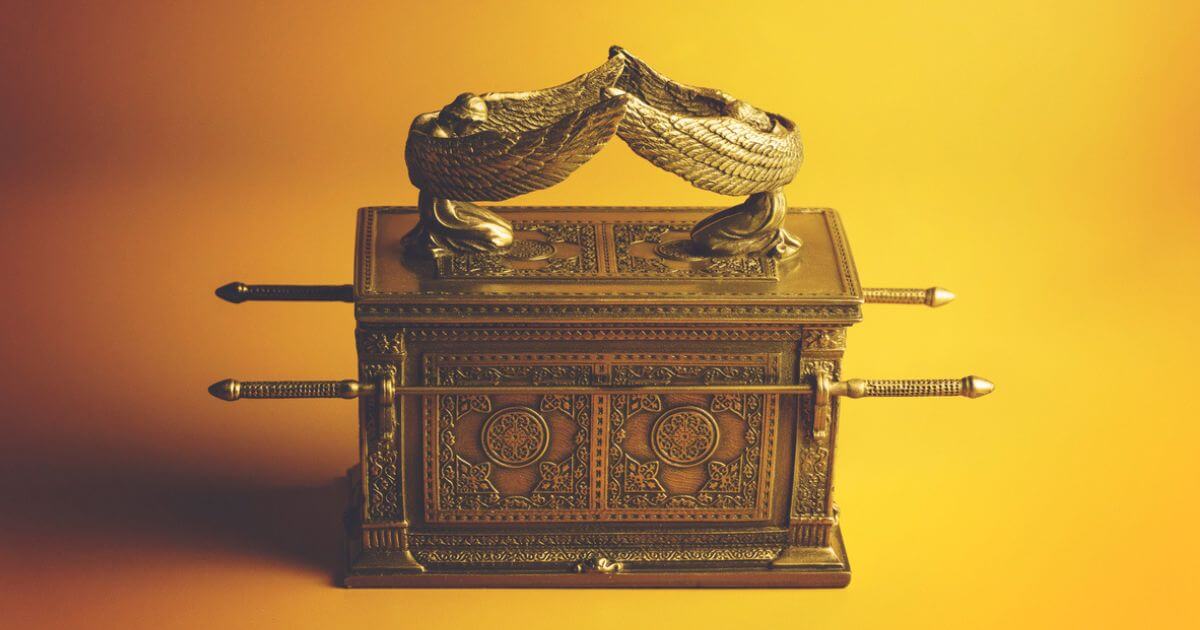
VIII. The Ark of the Testimony
The Ark of the Covenant is not an artifact in the ordinary sense. It is the covenant interface — the created physical-spiritual node where law, blood, mercy, presence, judgment, and testimony converge in one object.
What the Ark Contains
The Ark holds the testimony: the tablets of the covenant law. It is covered by the kapporet — the mercy seat — where blood is applied on the Day of Atonement. Two cherubim overshadow the mercy seat. YHWH declares that He will meet with Moses from above the mercy seat, from between the two cherubim (Exodus 25:22).
The Ark therefore contains, in miniature, the entire actualization structure in covenantal form:
The testimony inside is specification — the Logos-encoded intelligible order of the covenant. The law is the content: what God requires, permits, and forbids.
The mercy seat receiving blood is actualization-as-redemption — the costly making-real of mercy in a world where moral rupture has occurred. Blood answers law. Mercy answers judgment. The actualization of the covenant requires both.
YHWH enthroned above is the source-presence — the Father as self-existent ground from whom the covenant proceeds and to whom the testimony belongs.
The two cherubim are the witness office — they attend the place where law and mercy meet. They do not merely decorate the mercy seat. They guard, overshadow, and testify.
The Ark is therefore not merely symbolic. It is symbolic because it participates in a heavenly reality. It is a copy because there is an original. It is a shadow because there is a substance. Hebrews makes this explicit: the earthly tabernacle and its furnishings are copies and shadows of the heavenly things (Hebrews 8:5). Revelation confirms it: the heavenly temple is opened and the Ark of His covenant is seen in heaven (Revelation 11:19).
Jurisdictional Reality
The Ark's power is not magical. It is jurisdictional.
Uzzah does not die because God is arbitrary. He dies because unauthorized contact with the throne-interface of the living God is not a small matter. The Ark is the seat of divine presence, and presence in Scripture is never inert. It judges, cleanses, consumes, and establishes. Contact without authorization is contact with the judicial seat of the cosmos.
Dagon falls before the Ark because the Ark is jurisdictional. When it enters the territory of a false god, the false god collapses. This is not mechanical. It is sovereignty. The presence of YHWH, seated above the testimony, disestablishes rival claims to divine authority.
The Philistine tumors and rats (1 Samuel 5-6) are covenant-judgment phenomena. The Ark carries the testimony. The testimony is the standard. Those who possess the Ark without standing in covenant are subject to the standard without the protection of the blood.
The Heavenly Original
The earthly Ark was never the final reality. It was the terrestrial instantiation of a heavenly throne-testimony reality. Revelation 11:19 shows the Ark in heaven — appearing precisely when the seventh trumpet sounds, the two witnesses have completed their testimony, and the covenant court enters its enforcement phase.
The Ark appears at that moment because its function is evidentiary. In a court, the exhibit is displayed when the testimony is complete and the verdict is to be rendered. The Ark holds the testimony. The witnesses have testified. The court is convened. The Ark is shown as exhibit. Judgment follows.
This gives the eschatological material structural logic, not merely calendrical coincidence. The Ark appears in Revelation not because the author wanted a dramatic symbol but because the covenant-court procedure demands the display of evidence at the point of verdict.
IX. The Witness Office
The two witnesses of Revelation 11 belong to the Ark pattern. They are not random end-time prophets inserted into the narrative without structural precedent. They are the final instantiation of a witness-office that runs through the entire canon.
The Pattern
The Ark held the testimony. Two cherubim overshadowed the mercy seat — one on each end. YHWH was enthroned above. Solomon's temple intensified the pattern: two great cherubim of olive wood (1 Kings 6:23-28) stood in the Holy of Holies, their wings spanning the entire room. Zechariah then sees two olive trees standing before the Lord of all the earth (Zechariah 4:11-14). Revelation calls the two witnesses "the two olive trees and two lampstands that stand before the Lord of the earth" (Revelation 11:4).
The verbal echo is precise. Zechariah's two olive trees stand before the Lord of all the earth. Revelation's two witnesses stand before the Lord of the earth. The witnesses occupy the structural position of the cherubim — the presence-standing pair that attends the place of testimony.
The Standard Identification: Moses and Elijah
The standard identification of the two witnesses as Moses and Elijah has real textual support. The witnesses "have the power to shut the sky, that no rain may fall" (Elijah: 1 Kings 17) and "have authority over the waters to turn them into blood, and to strike the earth with every kind of plague" (Moses: Exodus 7-12). Moses and Elijah appear together at the Transfiguration (Matthew 17:3), suggesting they are the paired witnesses to Christ's glory.
This identification should not be dismissed. It captures something real about the witness office: the dual function of law (Moses) and prophetic judgment (Elijah). And the Transfiguration appearance is a significant data point.
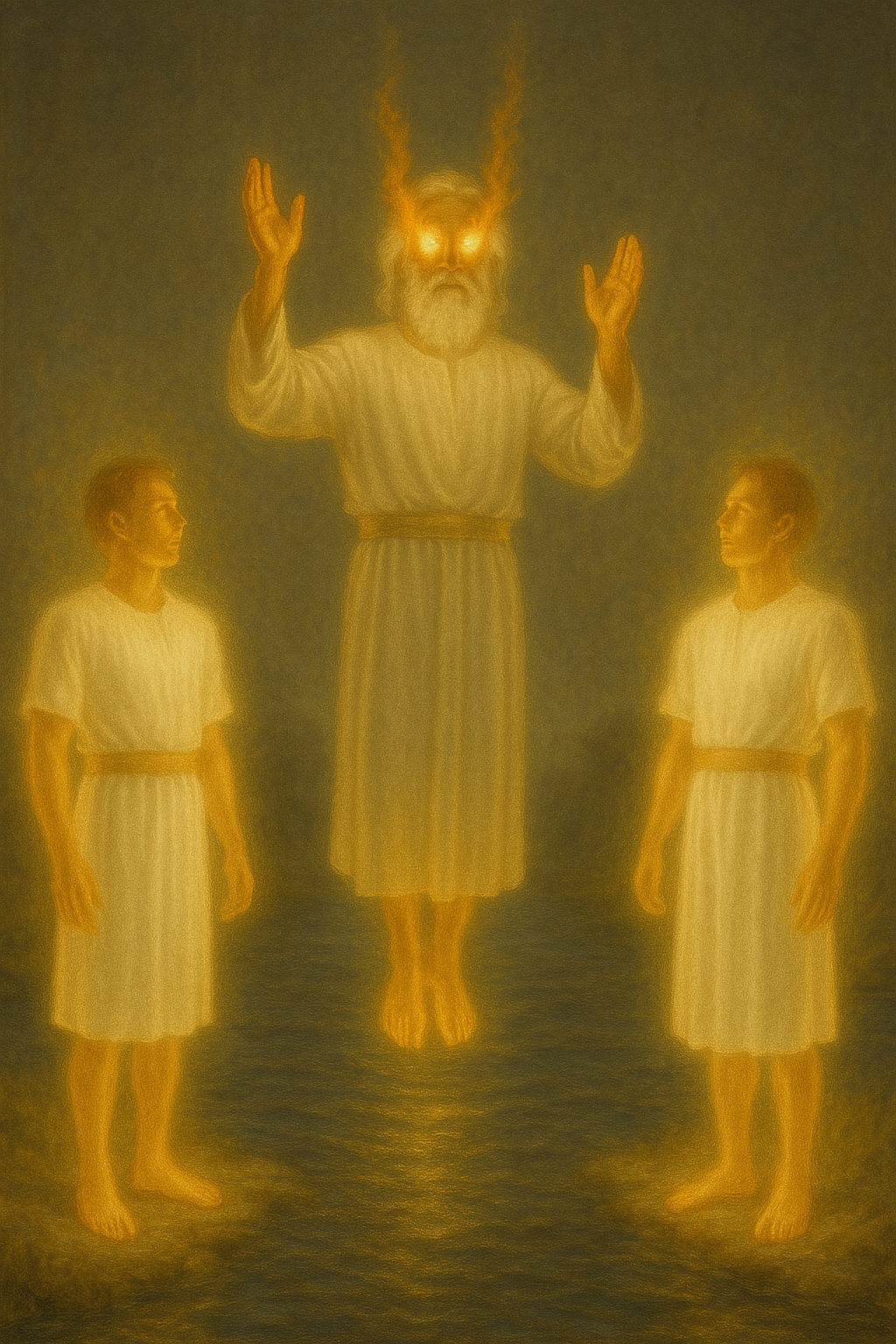
The Angelic Identification: Gabriel and Michael
A second identification — which may complement rather than replace the first — sees the witness office as fundamentally angelic. The structural argument:
Gabriel and Michael are the only angels named in the Protestant canon. Gabriel gives Daniel the seventy-weeks timetable (Daniel 9:21-27) — he is the timing-and-testimony witness. Gabriel announces the births of John the Baptist and Jesus (Luke 1:11-20, 26-38) — he marks the activation of the messianic timetable. He identifies himself with the words "I am Gabriel. I stand in the presence of God" (Luke 1:19) — he occupies the presence-standing position of the cherubim.
Michael is the "great prince who has charge of your people" (Daniel 12:1) — the warrior-guardian of Israel. In Jude 9, Michael contends with the devil over the body of Moses. In Revelation 12:7, Michael and his angels go to war against the dragon — directly connected to the sequence triggered by the witnesses' testimony, ascension, and the seventh trumpet.
Together, the pair exhibits the twofold cherubim office:
Gabriel: testimony, timing, announcement, interpretation. He stands in God's presence and delivers the message.
Michael: guardianship, warfare, judgment, covenant protection. He stands for Israel and executes the verdict.
The pattern appears repeatedly across Scripture in paired form. Two angels go to Sodom as judicial witnesses and agents of judgment (Genesis 19). Daniel sees a glorious figure clothed in linen with two attendants, one on each bank of the river (Daniel 12:5-7). Two angels witness the resurrection at the empty tomb (John 20:12). Two men in white witness the ascension (Acts 1:10). Revelation brings the final form: two witnesses who testify, are killed, are raised, stand on their feet, and ascend.
The Embodiment Objection
A natural objection arises against the angelic identification. The two witnesses are killed. Their corpses lie in the street of the great city for three and a half days (Revelation 11:8-9). How can spiritual beings — whose primary mode of existence is non-visible — have bodies that can be killed and lie as corpses?
The objection assumes that visible, killable embodiment is the proper possession of the physical register and an anomaly for the spiritual one. But the joint ontology of Section VII dissolves this. The body is not the substance of a person. It is the visible interface — the downstream actualization of an invisible personal reality. On this view, embodiment is available to any person, regardless of whether that person's primary mode is visible or invisible. The question is not "can a spiritual being have a body?" but "can the invisible take on a visible, assailable interface?" — and Scripture answers yes throughout.
Angels are embodied repeatedly in the canon. They eat at Mamre (Genesis 18:8). They wrestle at Peniel (Genesis 32:24-25). And at Sodom, the embodied angelic interface is shown to be not merely tangible but assailable. The men of the city press against the door, intending assault. The angels reach out, pull Lot inside, and strike the crowd with blindness (Genesis 19:9-11). One does not neutralize a threat one cannot be subject to. The defensive act presupposes that the corporeal form was a real locus of vulnerability — seizable, exposed, reachable by the mob's intent. Angelic embodiment in Scripture is therefore not a phantasm immune to harm. It is a genuine interface that can be threatened.
This makes the Revelation 11 scenario continuous with the established pattern rather than a stretch. The witnesses' death reads cleanly on the interface ontology: the corporeal interface is destroyed — which Sodom already shows is assailable — the persons are not annihilated, the Spirit of life re-establishes the interface, and they stand. This is the Sodom grammar extended one step: from assailable to destroyed-and-restored.
Two further points follow. First, the objection does not discriminate between the identifications. Moses died (Deuteronomy 34); Elijah was translated without dying (2 Kings 2:11). Neither is presently a walking, killable, earthly-embodied human. For either to be a witness who is killed, lies as a corpse, and is raised, that person must be granted a present killable bodily interface, die, and be restored — the identical requirement the objection raised against the angels. The axis cannot favor the human pair. Second, removing the obstacle does not establish the angelic identification. It only clears the ground. The identification still turns on the pattern arguments, not on whether a candidate can bear a killable body — for on the interface ontology, every candidate can.
The Mode of Death and Ascension
Two features of how the witnesses die and rise add convergent weight to the angelic reading. Neither is coercive. Together with the pattern arguments, they point in one direction.
The first concerns the manner of their resurrection. The wages of sin is death, and death holds dominion over those under sin (Romans 5:12, 14; 6:9). The witnesses are killed — but they rise after three and a half days, by the breath of life from God, and ascend visibly. This is not the general-resurrection pattern, in which the redeemed die and remain in death until the last trumpet. It is the firstfruits pattern, the pattern of the One over whom death had no abiding claim: "it was not possible for him to be held by it" (Acts 2:24). The witnesses are not held either.
This must be stated precisely, because the witnesses do die, and dying does not by itself prove anything — the redeemed die too. The refinement is twofold. Their death is not the wages of their own sin; it is martyrdom, imposed from outside by the Beast, in the same category as the death of Christ, whose dying did not compromise His sinlessness because it was the death of a victim, not the penalty of His own nature. And the mode of their rising — early, by the breath of life, ascending before their enemies — is the mode of beings over whom death has no abiding dominion. For unfallen angels this is grounded directly in sinlessness: there is no sin-debt to hold the animating principle in withdrawal. The body lay as a corpse because the principle was withdrawn; the body stood because the principle returned, and nothing held it back. On the asymmetry of life established earlier, this is exactly what the death and resurrection of a sinless person would look like. It also tells against Moses specifically, who died the ordinary death under the Adamic sentence and over whose body Michael disputed (Jude 9). A being who has already died that death is the wrong shape for this pattern. The pattern fits the sinless, or at most the translated who never tasted ordinary death.
The second concerns the summons. The witnesses hear a great voice from heaven saying, "Come up here," and they ascend in a cloud (Revelation 11:12). The language reads as a recall — a summons to a place that is already home, not a journey to a foreign destination. No prophet or apostle receives this. They die and wait for the resurrection. Elijah is the closest analogue, taken up bodily in the whirlwind (2 Kings 2:11) — but the difference is the disqualifier. Elijah was a mortal translated without dying; the witnesses die first, rise, and only then are summoned up. Elijah's translation is a one-time bypass of death; the witnesses' ascension is post-resurrection recall. If heaven is their home, "Come up here" is a return to their native domain — which is the angelic pattern.
The restraint must be kept. The same words, "Come up here," are spoken to John in Revelation 4:1, and John is a man caught up into heaven. So the summons can be addressed to a human; the phrasing leans toward beings whose home is heaven without strictly compelling it. As with the rest of the witness office, these strands converge on the angelic reading and remove the obstacles to it. They motivate; they do not coerce.
Resolution
Revelation does not name the two witnesses. The claim here is therefore not that the text states Gabriel and Michael explicitly, but that Gabriel and Michael are the strongest candidates once the Ark-pattern, Zechariah's olive trees, Daniel's named angels, Gabriel's presence-standing formula, and Michael's Daniel 12 / Revelation 12 role are placed together.
X. The Canon as Court Record
The Hebrew Scriptures are not a miscellaneous collection of ancient religious texts. They are a structured covenant witness — a court record arranged according to the logic of covenantal testimony, prosecution, and internalization.
Torah: The Testimony
Torah is the testimony placed inside the Ark. It gives creation, covenant, law, priesthood, blood, sacrifice, tabernacle, holiness, and the Ark itself. It establishes the terms, the standard, the blessing-and-curse structure, and the covenant identity of the people. Without Torah, there is no standard by which to measure fidelity or infidelity. Torah is specification — the Logos-encoded order of the covenant.
The word edut — testimony, witness — is not incidental to Torah. The tablets are called the edut. The Ark is the aron ha-edut, the Ark of the Testimony. The tabernacle is the mishkan ha-edut, the tabernacle of the testimony. The presence, the priesthood, and the worship all orbit around the testimony: the divinely given standard that establishes the terms of the relationship.
Nevi'im: The Prosecution
The Prophets are the covenant court in motion. They do not invent new revelation from nowhere. They prosecute Israel and the nations according to the testimony already given. They speak from the council of YHWH (Jeremiah 23:18, 22; 1 Kings 22:19-23). Their authority derives from their standing in the divine court: they have heard the counsel, received the charge, and now deliver the indictment.
The prophetic riv — the covenant lawsuit — is the legal form of much prophetic speech. Isaiah 1, Micah 6, Hosea 4, and Jeremiah 2 use lawsuit language: God summons witnesses (heaven and earth), presents charges (idolatry, injustice, covenant violation), and announces judgment (exile, destruction, famine). The prophets are not merely inspiring speakers. They are covenant prosecutors authorized by the divine court.
The prophets also project the testimony forward. They see not only present infidelity but future restoration: new covenant (Jeremiah 31), messianic king (Isaiah 9, 11; Micah 5), suffering servant (Isaiah 42, 49, 52-53), Spirit outpouring (Joel 2; Ezekiel 36-37), resurrection (Ezekiel 37; Daniel 12), and the nations gathered (Isaiah 2, 49, 60; Zechariah 14). The prosecution contains within it the promise of future resolution. Judgment is not the last word. The testimony has a telos.
Ketuvim: The Internalization
The Writings show what it is to live inside the covenant world — to experience its weight, its beauty, its anguish, and its hope from within.
The Psalms are the heart before the mercy seat. They are worship, lament, confession, praise, imprecation, and trust — the full range of human address to the covenant God. They internalize the testimony as liturgy, making the objective covenant subjectively inhabited.
Job is the cosmic court and the question of human limitation. Job demands an audience with God. He wants the covenant court to address his suffering. The book does not answer the problem of evil with a philosophical solution. It answers it with presence: God speaks from the whirlwind and Job sees God. The internalization is not resolution by argument. It is resolution by encounter.
Proverbs and Ecclesiastes are the grain of reality — how actualized creation works at the experiential level. Wisdom is not merely moral instruction. It is attunement to the Logos-structure of the world. Proverbs says wisdom was present with God at creation (Proverbs 8:22-31). To live wisely is to live in accordance with the specification by which the world was made.
Daniel is the timing architecture. It gives the prophetic integers that calibrate the covenant calendar: the seventy weeks, the time-times-and-half, the appointed times. Daniel is placed in the Writings (in the Hebrew canon arrangement) because its function is not prosecution but computation — the internal measurement of the covenant timeline.
Christ as the Testimony Made Flesh
The whole Tanakh — Torah, Prophets, Writings — converges on one figure. Torah places the testimony in the Ark. The Prophets enforce and project the testimony. The Writings place the testimony inside the human spirit. Christ is the Testimony made flesh. He does not merely teach the Torah. He is the Torah's content — the law fulfilled, the priesthood consummated, the sacrifice completed, the mercy seat embodied. He does not merely fulfill prophecy. He is the one to whom all prophecy points — the king, the servant, the branch, the son of man, the new covenant mediator. He does not merely answer wisdom's questions. He is Wisdom incarnate (1 Corinthians 1:24, 30; Colossians 2:3).
XI. The Entry of the Logos
The first advent is the entry of the Logos into the definite creation He specifies.
This sentence, if taken seriously, is the most extraordinary claim in the history of the world. The Encoder of the cosmic order enters His own encoded world as a creature within it. The One through whom all things were made (John 1:3; Colossians 1:16) becomes one of the things that were made — takes flesh, is born, grows, eats, sleeps, speaks, suffers, and dies inside the history He sustains.
The Trinitarian structure of the incarnation is explicit at every stage.
The Father sends. He is the source of the mission. The counsel, the purpose, and the timing originate in the Father's will. "God so loved the world that He gave His only Son" (John 3:16).
The Logos becomes flesh. He is the one sent. He does not cease to be God. He takes on created nature without surrendering divine nature. The specification-principle enters the specified world. The Word becomes audible, visible, touchable: "That which was from the beginning, which we have heard, which we have seen with our eyes, which we looked upon and have touched with our hands, concerning the word of life" (1 John 1:1).
The Spirit overshadows Mary. That word — episkiazo, overshadow — matters. The cloud overshadowed the tabernacle (Exodus 40:35). The glory overshadowed the Ark. Now the Spirit overshadows Mary. The womb becomes the living Ark — not because Mary is the object of worship, but because the true Testimony, the true Manna (the bread of life), the true priestly life (the rod that budded), and the true Presence enter the world through her.
Gabriel appears because the timing has arrived. He who gave Daniel the seventy-weeks timetable now announces the birth. The timing-witness office activates. The Danielic clock and the incarnation are connected through the same angelic officer.
The Ministry as Jurisdictional Actualization
In the ministry of Jesus, the Logos reorders reality. The miracles are not demonstrations of generic supernatural power. They are jurisdictional acts — the Logos exercising authority over every register of His creation.
Sickness is healed: authority over the body. The Logos who encoded biological order commands that order to restore itself.
Demons are expelled: authority over the spiritual register. The Logos whose specification governs all created beings commands rebellious spiritual agents to submit.
Storms obey: authority over nature. The one who specified the laws of physics commands the physical order directly.
Bread multiplies: authority over matter. The one who encoded the structure of physical reality is not constrained by ordinary conservation when He chooses to create.
The dead are raised: authority over death. Death is the most fundamental boundary of creaturely existence. The Logos who actualized life has authority over the boundary between life and death.
Sins are forgiven: authority over the covenant. Only the one who specifies the moral order can release debts against that order. This is why the scribes are scandalized — "Who can forgive sins but God alone?" (Mark 2:7). Precisely.
The temple is judged: authority over worship. The Logos who is the true temple (John 2:19-21) judges the corrupted physical temple. The shadow is judged by the substance.
The Cross
At the cross, the legal foundation of the new creation is laid.
Heaven testifies through darkness (Matthew 27:45). Three hours of midday darkness is not natural. It is cosmic witness: creation itself responds to the death of its Encoder.
Earth testifies through earthquake (Matthew 27:51). The physical order shudders as its Sustainer dies.
The temple testifies through the torn veil (Matthew 27:51). The barrier between the Holy Place and the Most Holy Place is removed from the top down. Access to the presence — previously mediated through priesthood, blood, and the Ark — is now opened by the death of the one who is the mercy seat.
The dead testify through opened tombs (Matthew 27:52-53). Death begins to yield its captives. The resurrection power of the Logos, even in death, begins to actualize.
The centurion testifies: "Truly this man was the Son of God" (Mark 15:39). Even an outsider — a Roman soldier, not a covenant insider — recognizes the significance.
The cross is not merely private forgiveness. It is the foundation of the new creation and the judgment of the old order. The powers are disarmed (Colossians 2:15). The testimony is fulfilled. The mercy seat is no longer an object — it is Christ Himself. Law is not abolished. It is fulfilled. Blood is not merely symbolic. It is applied. The Lamb slain before the foundation of the world (Revelation 13:8) is slain inside history, and the eternal decree becomes historical event.
The Resurrection as Ark Imagery
At the resurrection, two angels witness the empty tomb. In John's account, one sits at the head and one at the feet where the body had lain (John 20:12). This is Ark imagery of extraordinary precision. Two heavenly witnesses, one at each end, with the place of atoning presence between them. The slab where the crucified body lay becomes the mercy-seat pattern: two cherubim at either end, the atoning presence between.
The resurrection is not merely survival of death. It is the actualization of new creation inside the old. The Logos who entered death — the most extreme limit of creaturely existence — takes up His life again (John 10:17-18). The Spirit of life actualized the victory: "If the Spirit of him who raised Jesus from the dead dwells in you, he who raised Christ Jesus from the dead will also give life to your mortal bodies through his Spirit who dwells in you" (Romans 8:11).
At the ascension, two angels witness again (Acts 1:10). Jesus goes up in a cloud. The pattern is set. The witnesses of Revelation 11 later follow: raised from death, standing on their feet, called upward, ascending in a cloud.
XII. The Distributed Testimony
Pentecost is the Spirit actualizing the victory of the risen Logos in a people.
Before Pentecost, presence is localized. In the patriarchal period: theophanies at particular places. In the Mosaic period: tabernacle, Ark, pillar of cloud and fire. In the monarchic period: temple. In the incarnation: the body of Jesus. Presence is always real but always spatially concentrated — one Ark, one temple, one body.
After Pentecost, presence is distributed.
The Church becomes temple (1 Corinthians 3:16; Ephesians 2:21-22). The believers become Spirit-indwelt (Romans 8:9-11; 1 Corinthians 6:19). The testimony becomes multilingual (Acts 2:4-11). The fire that once belonged to Sinai and the altar now rests on human beings (Acts 2:3).
This is the Spirit's actualization work applied to the covenant community. The Father purposes. The Logos specifies the content of the Gospel: Christ crucified, risen, ascended, and returning. The Spirit actualizes that content in believers: regeneration, indwelling, sanctification, gifting, sealing, and empowerment for witness.
The apostles are not merely teachers. They are legal witnesses of the resurrection. Apostolic office is tied to eyewitness testimony (Acts 1:21-22; 1 Corinthians 9:1; 15:3-8). Their preaching is not religious opinion. It is covenant indictment and enthronement announcement: "This Jesus whom you crucified, God has made both Lord and Christ" (Acts 2:36).
Peter and John appear as a witness-pair before the temple authorities (Acts 3-4). Paul becomes the apostolic extension to the nations. The Church becomes the Spirit-filled witness-body of the risen Logos.
The structural parallel is precise:
The Ark held the testimony. The Church bears the testimony of Jesus.
The temple housed the presence. The Church is indwelt by the Spirit.
The old covenant wrote on stone. The new covenant writes on hearts (Jeremiah 31:33; 2 Corinthians 3:3).
Pentecost is the distributed testimony.
XIII. The Witness Age
The interval between Daniel's sixty-ninth and seventieth weeks is not empty delay. It is the witness-and-regathering age.
The Structure of the Gap
Messiah comes and is cut off at the appointed time — this is the Alpha Checksum of What's in a Name?, the Danielic temporal lock that calibrates the cross to Daniel 9. Jerusalem and the sanctuary are destroyed in AD 70. Israel is scattered under covenant judgment, but preserved among the nations. The Gospel goes to the nations. The Gentiles are grafted in (Romans 11:17-24). Israel remains partially hardened (Romans 11:25). The world-system matures toward Revelation conditions. Then Israel is physically regathered before the final week.
The gap has two great functions:
For the nations: the Gospel spreads. The Abrahamic promise — "in you all the families of the earth shall be blessed" (Genesis 12:3) — is fulfilled through the apostolic mission and its successors. The testimony of Jesus, carried by the Spirit-filled Church, reaches peoples, languages, and cultures across the globe.
For Israel: exile and preservation unfold, then regathering. The Deuteronomy 32 rhythm operates: election, apostasy, provocation, hiddenness, scattering, jealousy through a "not-a-people," judgment, vindication, and mercy. The Jewish people experience repeated displacement, yet preserve identity, scriptures, liturgy, memory, and covenantal consciousness across millennia. In 1948, after the long Roman-era diaspora, the State of Israel was formed in the ancestral land. Hebrew was revived from a primarily sacred, literary, and liturgical language into a modern national spoken language.
The seventieth week cannot occur with Israel absent from the land, Jerusalem irrelevant, and temple dynamics impossible. Therefore the gap must include both exile and regathering. The regathering of Israel is not merely a political event. It is a covenant prerequisite for the final sequence.
The Seals as Terminal Birth Pains
The six seals of Revelation 6 then function as the terminal birth pains of the witness age. They close the gap and bring Israel and the nations to the threshold of Daniel's final week.
The seal sequence is developed in detail in What's in a Name? and mapped to the modern historical regime-sequence. Here the structural point matters more than the dating: the seals are not random calamities. History is full of conquest, war, famine, disease, persecution, and cosmic disturbance. The question is whether the seals mark world-historical threshold regimes — events or systems that introduce a new planetary condition, operate at universal scale, and unfold in the order Revelation gives.
If they do, the witness age is not merely ending. It is ending according to the sequence the covenant-court anticipates.
XIV. The Court Clock
The eschatological sequence is not merely calendrical convergence. It is covenant-court procedure reaching enforcement.
The Sequence
The two witnesses complete 1,260 days of testimony. The Beast from the abyss kills them. Their bodies lie in the great city for three and a half days. The Spirit of life from God enters them. They stand on their feet. They ascend in a cloud. A great earthquake strikes. The seventh trumpet sounds. The heavenly temple opens. The Ark of the Covenant is seen.
Then Michael goes to war. The dragon is cast out of heaven. The accuser of the brethren is thrown down.
The Legal Logic
The Ark appears because the testimony has reached enforcement.
In a court, evidence is exhibited when testimony is complete and verdict is imminent. The Ark holds the testimony — the tablets, the standard, the covenant terms. The witnesses have testified for 1,260 days. They have been killed — the most extreme form of hostile response to testimony. They have been raised and vindicated — the court's confirmation that their testimony stands. They have ascended — the witnesses are recalled to the divine court.
Now the court acts.
The heavenly temple opens. The Ark is displayed. The testimony is before the bench. The verdict is rendered. Michael goes to war — not as an independent military action, but as the enforcement arm of the court's decision. The accuser is expelled from heaven because the testimony against him is complete and his standing before the court is revoked.
The Song of Moses is fulfilled because the covenant witness moves from warning to judgment. Deuteronomy 32 is invoked in Revelation 15: "They sing the song of Moses, the servant of God, and the song of the Lamb." The Song of Moses is a covenant lawsuit — it rehearses Israel's infidelity, God's judgment, God's vindication, and God's ultimate mercy. Its appearance at this point in Revelation is not decorative. It marks the transition from witness to enforcement within the covenant-court structure.
Harvest
The harvest imagery follows the court verdict:
The spring harvest (grain) gathers the righteous — the wheat is brought in before the storm.
The autumn harvest (grape) brings wrath — the grapes of the earth are gathered and thrown into the winepress of God's fury.
The tabernacle of the testimony opens (Revelation 15:5) because the plagues flow from the covenant court. The plagues are not random divine violence. They are covenant sanctions — the curses of Deuteronomy 28 and Leviticus 26 reaching their final and universal form. They proceed from the court that holds the testimony.
The testimony has become judgment.
XV. The Lattice
The proof is not a chain. It is a lattice.
A chain fails if one link breaks. A lattice holds because multiple nodes support each other independently. The structure of the argument across both essays is lattice-shaped: many nodes, each connected to multiple others, with no single linear dependency that can collapse the whole.
The Cross-Connections
Physics connects to: the triadic actualization structure (C→S→X derives from the possibility-to-actuality transition), consciousness (the natural experiment that shows actualization is mind-like), the invisible-as-real thesis (quantum non-classicality shows the visible is downstream), the block universe and omni-temporality (the ground cannot be inside the block), information as load-bearing (the world is structured content, not brute stuff).
The self-knowledge derivation connects to: the triadic personhood of God (Source, Self-Expression, Living Communion), consciousness (self-knowledge IS conscious interiority — the finite case illuminates the divine case), the divine name (Ehyeh = self-present self-knowing Being), the Logos doctrine (John 1 identifies the eternal Self-Expression).
Consciousness connects to: physics (supplies the operative model for cosmic actualization), the echad anthropology (human interiority displays the triadic structure), the image of God (structural participation in divine actualization), the hard problem (establishes that interiority is irreducible, so the ground must be mind-capable), normative rationality and semantic intentionality (establish that the ground must be personally Logos-capable, not merely mind-like in a thin sense).
The echad anthropology connects to: the Trinity (personal-register plurality in one being is coherent), consciousness (human interiority IS the echad phenomenon), the invisible-as-real thesis (human personal depths are invisible), the image of God (we are structural images of the triune ground).
The invisible-as-real thesis connects to: physics (quantum non-classicality), consciousness (interiority is invisible), the joint ontology (spiritual beings and objects are real invisible existents), the Ark (heavenly original is invisible; earthly copy is visible), the witness office (the asymmetry of life — consciousness as independent, body as dependent interface — explains the witnesses' death as withdrawal of the animating principle and their resurrection as its restoration), creation (visible is downstream of invisible specification by Logos).
The Ark connects to: the joint ontology (the Ark is a spirit-bearing or interfacial object), the two witnesses (cherubim pattern → witness office), the first advent (two angels at empty tomb = Ark imagery), the canon (Ark holds Torah testimony), the cross (Christ IS the mercy seat), the eschatological sequence (Ark appears in Revelation 11 at the point of covenant-court enforcement), the actualization structure (testimony + blood + presence = specification + actualization + source).
The canon connects to: the Ark (Torah placed inside the Ark as testimony), the prophets (covenant prosecution based on the testimony), the writings (internalization of the testimony), Christ (the Testimony made flesh), the eschatological sequence (testimony reaching enforcement).
The first advent connects to: the Trinity (Father sends, Logos becomes flesh, Spirit overshadows), Gabriel (timing-witness office activates at the incarnation), the Ark (empty tomb as mercy-seat pattern), the cross (covenant foundation of new creation), the Danielic timeline (Alpha Checksum).
The eschatological sequence connects to: the Ark (appears at the point of enforcement), the witnesses (complete testimony triggers the court), Michael (enforcement arm), the Song of Moses (covenant lawsuit reaching judgment), the seals (terminal birth pains closing the witness age), the Danielic timeline (seventieth week).
Why This Is a Lattice
Remove the physics, and the self-knowledge derivation still arrives at the triad. Remove the self-knowledge derivation, and the physics still arrives at triadic actualization. Remove both, and the echad anthropology still shows that personal plurality in unity is coherent, the canon still structures itself as covenant testimony, and the Ark pattern still governs the eschatological sequence.
Remove the eschatological layer, and the physics, self-knowledge, consciousness, anthropology, joint ontology, Ark, canon, first advent, and Pentecost still form a coherent lattice supporting the central claim.
Remove the Ark pattern, and the physics-to-Trinity chain still holds through the actualization and self-knowledge derivations. But add the Ark pattern back, and the eschatological material gains structural logic: the Ark appears because the testimony reaches enforcement, not merely because a calendar window opens.
This is the topology of the argument. No single node is the sole load-bearer. Multiple paths connect the physics to the Trinity, the Trinity to the canon, the canon to Christ, Christ to the eschatological sequence, and the eschatological sequence to the covenant court. The lattice can lose nodes and remain standing. It cannot lose all of them.
XVI. What Follows
The argument began in physics. It did not begin with a creed.
Physics removed the old materialist floor. Information became physically load-bearing. Quantum reality showed the visible emerging from an invisible register. Decoherence explained local classical appearance without restoring classical materialism. The actualization problem demanded an account of how possibility becomes history. Consciousness supplied the natural experiment. Actualization proved triadic. The self-knowledge of eternal Mind confirmed the triad from within.
Then the Rosetta Stone was applied.
Scripture named the Author: the Father, the Logos, and the Holy Spirit. The divine name disclosed self-existent, self-knowing, self-revealing Being. The echad structure of human interiority showed that personal plurality in one being is not incoherent but is the structural image of the ground. The invisible was shown to be ontologically prior to the visible. The joint ontology gave vocabulary for the full spectrum of created reality. The Ark emerged as the covenant interface where testimony, mercy, presence, and judgment converge. The canon structured itself as court record: testimony, prosecution, internalization. The first advent revealed the Logos entering His own creation. Pentecost distributed the testimony. The witness age unfolded. The eschatological sequence approached the point where the grammar becomes enforcement.
The conclusion is not that Christianity is compatible with physics. That is too weak. The conclusion is not that Christianity is a comforting personal preference. That is too small. The conclusion is that Christianity uniquely names the structure toward which physics, consciousness, time, history, and the created order jointly point.
The ground of actuality is not generic deity, abstract mathematics, impersonal being, political destiny, technological futurity, or brute law.
The ground is the living God.
The Father conceives, contains, and purposes — He is the Source from which all actuality proceeds.
The Logos specifies, encodes, and sustains — He is the Word through whom all things are made and in whom all things hold together.
The Spirit actualizes, gives life, and consummates — He is the living power by whom specified order becomes living creation.
Reality is one spoken object.
Physics is the language.
Scripture is the Rosetta Stone.
The Ark is the exhibit.
The witnesses are standing.
The testimony is nearly complete.
And the world is moving toward the moment when the grammar becomes enforcement.