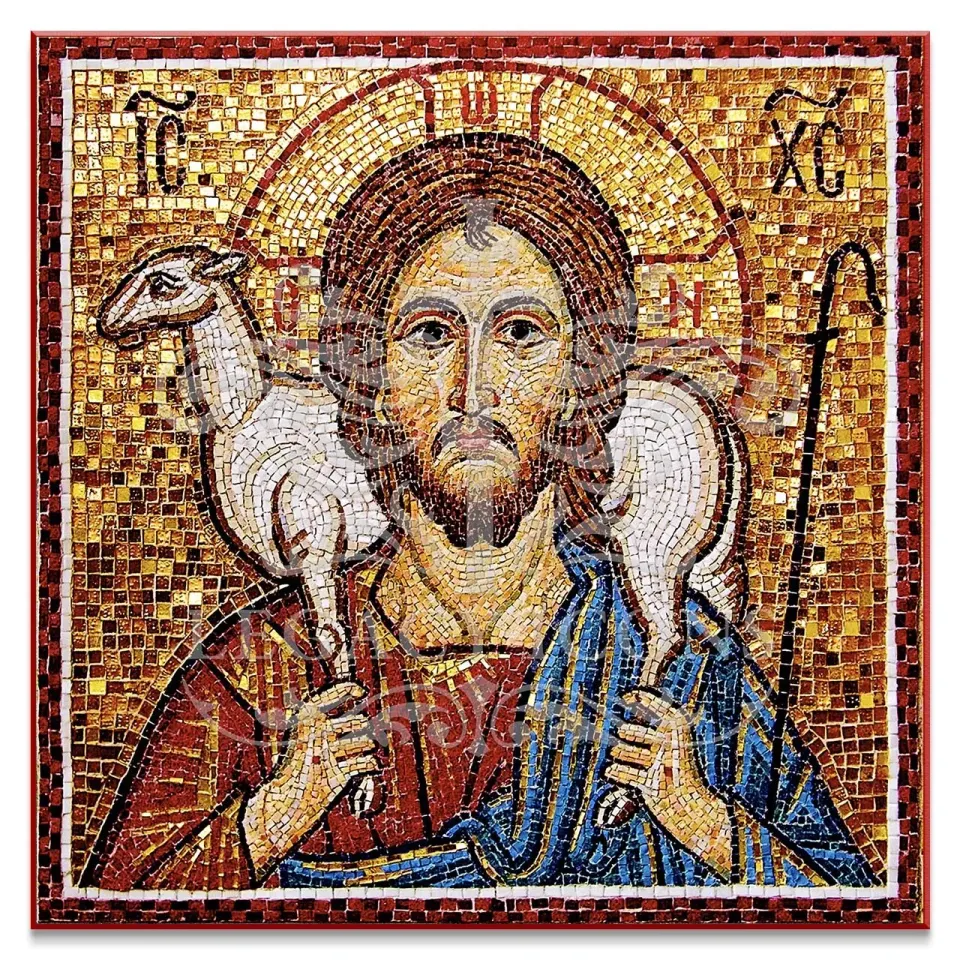
Then I said, "Behold, I have come — in the scroll of the book it is written of me." — Psalm 40:7
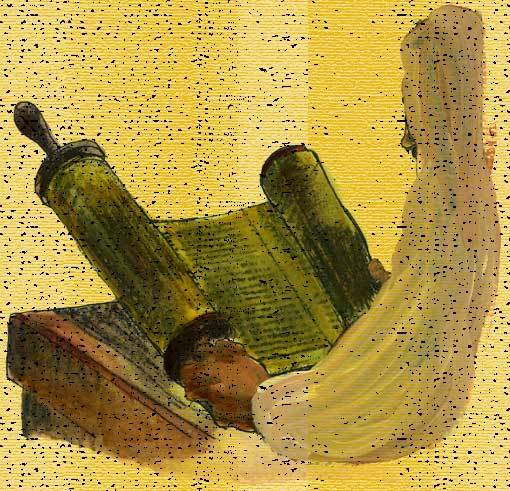
I. Exordium — It Is Written of Me
There is a way the apostles read the Psalms and it is not the way you were taught. They read them as depositions. A psalm of David, written in David's trouble, in David's voice, gets quoted as the speech of someone else. Someone for whom the words were true in a way they were never true of David.
Peter does it at Pentecost. David said, you will not let your holy one see corruption. But David saw corruption. His tomb was up the road. Everyone in the crowd had walked past it. So David spoke as a prophet, Peter says, in the person of another. The Epistle to the Hebrews does it three times in two chapters. It takes Psalm 22 and Isaiah 8 and Psalm 40 and puts them straight in the mouth of the Son. When he came into the world, he said. Said. Present speech, at the threshold.
The scholars call this prosopological exegesis. Reading by the person. You ask of a text not only what is said but who is speaking, and to whom, inside the life of God. It is not a trick the church fathers invented later. Matthew Bates has shown it was the apostles' own method, and they inherited it from a Jewish reading culture that already heard more than one voice in the oracles of the one God. The first Christians did not decide Jesus was divine and then ransack the Psalter for proof texts. They heard the Psalter speaking. First person. Suffering described too exactly. Vindication promised too completely. They asked the old question — who speaks here — and the answer they gave is the subject of this essay.
So I open where Hebrews opens its tenth chapter. At the threshold of the world, with a voice speaking before it enters.
Sacrifice and offering you have not desired, but a body you have prepared for me. In burnt offerings and sin offerings you have taken no pleasure. Then I said, Behold, I have come to do your will, O God — in the scroll of the book it is written of me.
Read it as the apostles read it. This is not David being pious. This is the interior speech of the Logos incarnate; The Davar YHWH, the Son. Spoken from outside time, into it. And it holds, in three clauses, everything this essay will spend its length unfolding. There is a will — the Father's purpose. There is a scroll — a written specification, deposited in advance, in which the speaker says he is already inscribed. There is a body — an interface, prepared, into which the speaker comes.
Will. Scroll. Body. Purpose, specification, actualization.
If you have read the essays before this one, you know the structure. You know it because those essays derived it twice, by two roads that never touch, before any of this exegesis was attempted.
What's in a Name? derived it from below — from physics, one result at a time. Walk the chain. First: physics has spent a century discovering that its deepest layer is not stuff but information. Entropy counts microstates; a black hole's entropy is written on its surface; the information capacity of any region of space lives on its boundary, one bit per four Planck areas — the holographic principle: the bulk is generated from a boundary encoding, the way a hologram's depth is generated from a film. Wheeler said it shortest: it from bit. But information, in the strict sense, is specification — a code. And a code is the kind of thing that is conceived. Second: quantum mechanics hands us a world that is, in its own formalism, a weighted space of possibilities — and the formalism contains no mechanism by which one possibility becomes fact. That is the measurement problem, unsolved after a century: the theory specifies everything except actualization. Something selects. Nothing inside the closed description does the selecting. Third: relativity abolishes absolute simultaneity, and with it the moving knife-edge of a universal "now." The totality of events stands as a block — past, present, future co-present, a four-dimensional structure that simply is. Which means actuality is not doled out moment by moment from inside the structure. The structure stands whole; whatever actualizes it does so from outside it. Fourth: quantum information is conserved — unitarity. No event's record is ever destroyed. Reality keeps its books, indelibly, by law. And fifth: consciousness — the one place in the universe where actualization is experienced rather than inferred, the one phenomenon no closed physical description has even begun to account for, and, not coincidentally, the thing that reasons bindingly and means things, which no arrangement of stuff explains either.
Now assemble the chain. The ground of the world must conceive a space of possibility; must specify the code that constrains it; must actualize, from outside the block, the outcome; must keep the record; and the only actualizing we know from the inside is conscious and personal. The essay wrote this as an operator — A_G = X∘S∘C: conception, then specification, then execution, composed — and showed the three operations are irreducible. Remove conception and there is nothing to specify. Remove specification and nothing is definite enough to actualize. Remove actualization and nothing is. The ground of reality is Logos-capable, or there is no reality.
 mwiya
mwiya
The Shape of God derived it from above — from the logic of personal being, with no physics in its premises. It started from one premise: a personal ground must know itself completely. An infinite person's self-knowledge cannot be partial, cannot be an accident, and cannot be a mere file — the complete self-knowledge of an infinite knower must fully be what it knows: a perfect, living self-expression, lacking nothing the original has, including personhood. So the expression subsists. It is not a property. It is someone. And between the knower and the known, the knowing is mutual, total, and alive — and that bond, carrying everything both have, is not a mood. It is someone. The essay then showed the structure closes at exactly three: two cannot close it, because an image without the living bond is a mirror, not a fellowship; and a fourth adds nothing that is not already present, for the love of the love is the love. Source, expression, bond. Being, relation, being. Which is what the strange grammar of the Hebrew Bible was guarding all along — one God who is echad, the word Scripture elsewhere uses for evening-and-morning becoming one day and man-and-wife becoming one flesh: a compound unity. Never once yachid, a bare point. The Shema's own choice of word is the doctrine in miniature.
 mwiya
mwiya
Two derivations. One from physics and information. One from the logic of personal being. Neither borrowed the other's premises. Both arrived at the same triadic structure. I will not re-derive them here. The mathematics is in those essays and it stays there. What this essay does is take the structure as established and ask the question the structure forces.
Because if the ground of reality conceives, specifies, and actualizes — if the worlds were framed by the word of God, so that what is seen was not made out of things that are visible, which is Hebrews 11:3 saying with precision what its author could not have known he possessed — and if the Son upholds the universe by the word of his power, the way a boundary encoding upholds the bulk it generates, which is Hebrews 1:3 — then the specifying operation of the ground is not an abstraction. It is the Logos. And the threshold speech of Psalm 40 is what it sounds like when the specification enters its own output.
Watch the operator run. Luke writes the conception in one sentence. The Holy Spirit will come upon you, and the power of the Most High will overshadow you. The Father's will: the purpose. The scroll: the specification, written in advance — it is written of me. The Spirit's overshadowing — episkiazō, the same verb the Greek Bible uses when the glory cloud settles on the finished tabernacle — the executing power, working in a womb. Mary's body becomes what the tabernacle was. The place where the specification dwells. Conceive. Specify. Actualize. The mechanics of the incarnation are the mechanics of creation, brought to a point.
Three laws govern this essay, and they are laws, not apologies.
The physics analogies are analogies of structure. The texts assert the correspondence in their own idiom; the correspondence is evidence, and the line between evidence and anachronism will be kept.
The move from three operations to three persons runs in two stages. The physics gives operations. The self-knowledge argument gives subsistence. The stages do not collapse.
And grammar before Speaker. The Hebrew Bible itself — on its own terms, in its own age, with the rabbis' own discomfort entered as evidence — carries a divine grammar of plurality in unity. The categories are Israel's before they are anyone's. That order is the whole force of the case.
Now the thesis. I will state it the way a court states things.
The Hebrew Bible is not an anthology of religion. It is a court record, and it says so. The Torah is deposited as testimony. Moses commands the finished scroll placed beside the Ark — that it may be there as a witness against you. The word is edut. Testimony. The legal word. The same word that names the Ark itself: the Ark of the Testimony. The Prophets are the prosecution. Their recurring form is the riv, the covenant lawsuit. Hear, O mountains, the indictment of YHWH. Heaven and earth get summoned as witnesses because Moses summoned them at the deposition. And the Writings are the case taken inward. The testimony sung, wept, argued with, lived in. The record become liturgy.
Testimony. Prosecution. Internalization. Torah, Prophets, Writings. The Tanakh's own three-part shape is the shape of a legal proceeding. A proceeding implies a verdict. A verdict implies a person concerning whom it is entered.
The record, taken whole, is jointly satisfiable by exactly one kind of figure, and the constraints are tight enough to be an identification. A Jew — the covenant is Israel's, and the record names no other executor. Torah-observant — the record's own terms disqualify a lawbreaker from fulfilling it. Bearing the Name — because the record keeps placing the Name of YHWH in an agent who is somehow YHWH and somehow with YHWH, and the case cannot close until that agent appears in person. And running a two-stage program — because the record's promises split, stubbornly, against every harmonizer, into a suffering accomplished and a sovereignty deferred. An atonement made. A kingdom awaited. A first arrival that opens the scroll. A second that closes it.
The offices of the court map the essay. The agent keeps the testimony. The grammar identifies the Bench. The calendar is the docket. The apostolic corpus is the continuing record. The consummation is enforcement.
One more thing belongs here, and it governs everything. The name.
The series before this one asked, in its title, what is in a name. This essay is the answer, because its title is the Name's own answer. Yeshua — the name the angel commands — contracts Yehoshua. YHWH saves. And Matthew 1:21 does what no other naming in Scripture does. It attaches a clause that explains the name by performing it. You shall call his name Yeshua — for he himself will save his people from their sins. He will be called "YHWH saves" because he will do the saving the name ascribes to YHWH. The sentence only parses if the bearer of the name is the agent of the Name.
The Lamb, John writes, was slain from the foundation of the world. At the center of the block — at the still point of the structure that holds all times — stands a sacrifice that the threshold speech walks toward with open eyes. Behold, I have come. The rest of this essay is the unrolling of the scroll in which that coming was written. What kind of Jew. Identified by what grammar. Arriving on what clock. Holding what office. Solving what problem in the cult. Keeping what calendar. Leaving what record. Returning to what end.
It is written of him. We are going to read it.
II. The Grammar — The YHWH Who Appears Beside YHWH
First, the grammar in which the question can even be asked. This movement speaks from the Hebrew Bible alone. On Jewish terms. With the rabbis' own discomfort entered as evidence. The claim: the Tanakh carries, through its whole length, a divine grammar of plurality in unity. A figure who is YHWH, who is with YHWH, who bears the Name, and who does YHWH's work in the world with YHWH's own hands.
I am not importing this from Nicaea. Nicaea was a late attempt to say in Greek what Moses had already written.
Start with the word Israel confesses twice a day. Shema Yisrael, YHWH Eloheinu, YHWH echad. The word is echad. One. Hebrew had another word ready. Yachid — the absolute solitary, the word for Isaac, the only son. Deuteronomy does not use it. Echad is the word of Genesis 2:24, where a man and a woman become one flesh. A oneness with relation inside it. The Shema guards God's unity. It does not legislate his solitude.
And the Name itself is the proof, before any catalogue. At the bush, asked for his name, God answers with three words. Ehyeh asher Ehyeh. Being. Relation. Being. The Name is not a word; it is a sentence, and the sentence has internal structure. The first Ehyeh is the speaker — I AM as source. The second is the spoken — I AM as expressed, as known. And the asher is the link itself, the relation between I AM and I AM, named inside the Name. God's self-designation is a self-relation, with the bond between knower and known given its own word. A yachid God would have answered with one word — Ehyeh, full stop. The God of the bush answered with a compound: one Name whose unity contains its own relation, which is exactly what echad means and exactly what yachid forbids.
The grammarians call the construction idem per idem — I will be what I will be, definition by self-reference — and the parsing concedes everything I need. It concedes that God can be defined only in terms of God; that the definiens and the definiendum are both Ehyeh; that the definition consists entirely of the relation between them. The reflexivity is not the church's gloss. It is the construction's own grammar, on the philologists' own reading. And the Name conjugates by speaker: when God says it, Ehyeh — I AM. When Israel says it, YHWH — HE IS, the third person of the same verb. One Name, two grammatical persons, the relation held across the speaking. Centuries later a bishop of Hippo would write that God is the lover, the beloved, and the love between them, and the church would call it the height of trinitarian theology. It was a translation. Three Hebrew words, spoken from a burning bush, had said it first.
And one Jew translated it before Augustine, in the first sentence of his gospel. In the beginning was the Word — being — and the Word was with God — pros ton theon, face toward face: relation — and the Word was God — being. John 1:1 is Ehyeh asher Ehyeh in Greek, three beats in the same order, and the rest of his gospel narrates the syntax. No one has ever seen God, he writes seventeen verses later — the first Ehyeh, the unseen — but monogenēs theos, the unique God who is in the bosom of the Father, he has exegeted him. Two called God in one verse. One making the other known. The second Ehyeh as the exegesis of the first, and "in the bosom" the asher made spatial. And John did not invent the structure. The Psalter speaks it. YHWH said to my Lord — the first Ehyeh addressing the second, in David's hearing, on the record. Your throne, O God, is forever and ever — therefore God, your God, has anointed you with the oil of gladness: God addressed, God anointing, and between them the oil — and you know by now what anointing oil is. The Spirit. The asher, poured. Hebrews opens its whole argument by quoting both psalms at the Son, and rests. Then, on the last night, the prayer that claims Exodus 23 outright: Holy Father, keep them in your name, which you have given me. The Torah said of the Messenger, my Name is in him. The man says, the Name you have given me — and reports the office complete: I have manifested your name to the people you gave me. And the Spirit finishes the sentence as the sent asher — the Paraclete whom the Father will send in my name, who proceeds from the Father — the bond, proceeding, doing what a relation does. The prayer's final clause opens the Name outward, and it is the whole gospel in one line: that the love with which you have loved me may be in them. The asher — the relation between I AM and I AM — extended to include the redeemed. That is what salvation is, stated grammatically. Being taken into the asher.
Now watch what the texts do inside the guarded space.
A pregnant Egyptian slave runs into the desert. The Angel of YHWH finds her by a spring. The Messenger of the Name. He speaks in the first person of God. I will so multiply your offspring that they cannot be numbered for multitude. Not "YHWH will." I will. And the text closes the scene with the narrator's own verdict: she called the name of YHWH who spoke to her, You are El Roi. The God who sees me. The narrator, not the slave, says the Messenger is YHWH. That is Genesis 16, and it is the first time in Scripture anyone gives God a name. A runaway Egyptian girl does it, talking to the Angel.
At Moriah the Angel of YHWH stops Abraham's hand. Now I know that you fear God, seeing you have not withheld your son, your only son, from me. From me. The offering was to God. The Messenger takes receipt in the first person.
At Mamre three figures come to Abraham's tent in the heat of the day. One stays and speaks as YHWH. Two go down to Sodom. Keep your eye on those two. They will be back at the end of this essay, and they will have the same assignment. When the judgment falls, Genesis 19:24 records it in a sentence that broke every later harmonizer's grammar. Then YHWH rained on Sodom and Gomorrah sulfur and fire — from YHWH, out of heaven. YHWH on the ground, raining fire from YHWH in the sky. Two subjects. One Name. One act. Justin Martyr argued this verse with Trypho the Jew in the second century, and Trypho's discomfort was not theater. He had inherited it.
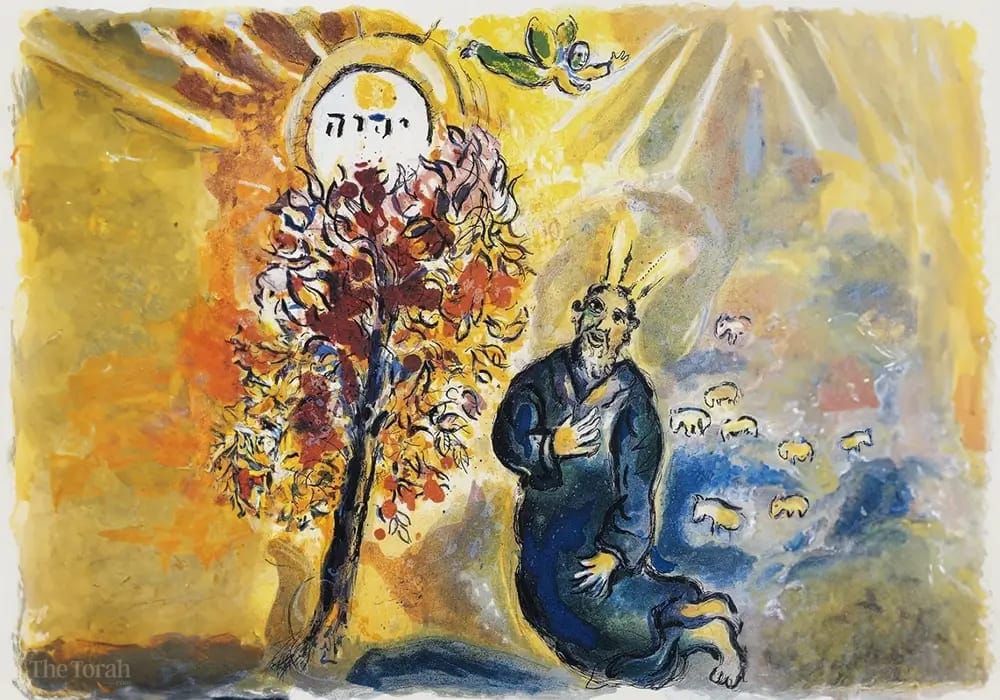
At the bush, the Angel of YHWH appears in the flame. Two verses later it is YHWH who sees Moses turn aside, God who calls from the bush, the Name who speaks. The Messenger does not carry a message about God. The Messenger is where God's own speech lives.
Then the Torah says the quiet part aloud. Before the wilderness, YHWH gives Israel a guide. Behold, I send an angel before you, to guard you on the way. Pay careful attention to him and obey his voice. Do not rebel against him, for he will not pardon your transgression — for my Name is in him. Exodus 23. The Name — the divine identity itself — is in this figure. He holds the power of pardon, and Israel's own theology gives pardon to God alone. The rabbis felt the heat of that verse. When a heretic pressed Rav Idi on it, the Talmud's answer was that the figure is Metatron, "whose name is like the name of his Master," and then the warning: do not exchange me for him. That is b. Sanhedrin 38b, and it is the sound of a tradition holding a live wire with rubber gloves.
Jacob wrestles a man in the dark by the Jabbok. At dawn he limps away and names the place: I have seen God face to face, and my life is delivered. Centuries later Hosea retells it and calls the opponent the angel and God, in parallel lines, in one breath. Joshua meets a man with a drawn sword outside Jericho. The man says he is the Captain of YHWH's host. Joshua falls on his face and worships, and the Captain does not stop him. He says take off your sandal, the place where you stand is holy. Sinai's protocol, on ordinary dirt, made holy by his standing on it. Manoah and his wife meet the Messenger and ask his name. He says, why do you ask my name, seeing it is wonderful — peli, the same root Isaiah will hang on a child: pele yoetz, Wonderful Counselor. The Messenger ascends in the altar flame and Manoah says, flatly, we shall surely die, for we have seen God.
And the name travels. In Daniel 8 two holy ones confer over the sanctuary, and the question of the times is put to a figure the Hebrew calls palmoni. Read minimally, it is the old anonym — "that certain one" — a name withheld, exactly as at the Jabbok, exactly as at Zorah: why do you ask my name? Read as the tradition read it — the reading the King James kept in its margin — it is peli joined to moneh: the Wonderful Numberer. The numberer of secrets. And watch what he does: he is the one the how-long question goes to, and he is the one who gives the count — unto two thousand three hundred evenings and mornings. The one whose name is Wonderful is the one who keeps the count. In the same book the voice from between the banks of the Ulai commands Gabriel by name — Gabriel, who stands in the presence of God, taking orders from the figure the attendants stand before. We will meet him again over the river, clothed in linen, with both hands raised.
Alongside the Messenger runs the Word. The Davar. By the word of YHWH the heavens were made, and by the breath of his mouth all their host. Psalm 33. Creation by Word and Breath. The operator's grammar in one verse, written centuries before anyone could exploit it. The Word came to Abram in a vision, Genesis says. Words do not come in visions. Persons do. And watch what the Word does next, two verses on: he brought him outside and said, look now toward heaven, and count the stars. The Word walks a man out of his tent. At Shiloh, YHWH reveals himself to the boy Samuel by the word of YHWH — and the text says YHWH came and stood, calling as at the other times: Samuel, Samuel. A word does not station itself in a doorway and call a boy's name twice. To Jeremiah the word of YHWH came — and then YHWH put out his hand and touched my mouth. The Word has a hand, and the hand deposits words: the Word giving words. Ezekiel pairs them in a single verse — the word of YHWH came expressly to Ezekiel, and the hand of YHWH was upon him there. At Horeb the Word converses: what are you doing here, Elijah? Mark the pattern, because it holds everywhere. Wherever the word of YHWH comes, the narrative gives him a body's verbs. He stands. He walks a man outside. He touches a mouth. He asks questions. The Davar is not a voice-event. He is a person who arrives. Wisdom in Proverbs 8 is beside him at creation, the amon, the master workman, rejoicing always before him. The specification, delighting in the execution. And when the Second Temple synagogues put these texts into Aramaic, they reached again and again for one device. The Memra. The Word of YHWH, who creates, reveals, saves, covenants. I hold the Targums loosely. Their written form is late and I will not lean my weight on them. But the instinct they preserve is the instinct the Hebrew forced.
Now Daniel 7. The text the whole question came to rest on. Thrones were placed — plural, and the rabbis noticed — and the Ancient of Days took his seat. And behold, with the clouds of heaven there came one like a son of man, and he came to the Ancient of Days and was presented before him. And to him was given dominion and glory and a kingdom, that all peoples, nations, and languages should serve him.
Mark the transport. In the whole Hebrew Bible, riding the clouds belongs to YHWH and to no one else. He makes the clouds his chariot. Behold, YHWH rides on a swift cloud and comes to Egypt. The clouds are the dust of his feet. Then a human figure arrives on the divine vehicle, into the divine court, and receives pelach — cultic service — from every nation. Distinct from the Ancient of Days. Endowed with what belongs to God alone.
What did the synagogue do with this text? It argued. Rabbi Akiva — Akiva — said the plural thrones were one for God and one for David. The Gemara keeps the rebuke: Akiva, how long will you profane the Shekinah! The greatest of the tannaim read Daniel 7 the way I am reading it, and he was not refuted. He was silenced. The later rabbis had a name for the whole family of readings. Shtei rashuyot. Two Powers in Heaven. They anathematized it with an energy that is itself my witness, because you do not build a fence that high around an empty field. Alan Segal spent a career on the polemic and showed what it concedes. The Two Powers reading was alive. It was Jewish. It was old. Before any church existed, the Son of Man in the Parables of Enoch was named before the stars were made, and the kings of the earth fell down and worshiped him. At Qumran, the Melchizedek scroll gave the word elohim — and Psalm 82's courtroom — to a heavenly deliverer who executes the great Jubilee. The grammar was not waiting for Christians. The Christians were Jews who concluded the grammar had a referent.
Two constraints, before this movement closes. The grammar shuts the door on errors in both directions.
It is not two gods. The Shema stands. Every text above is jealous for the unity of the Name. The Messenger bears the Name because there is one Name to bear.
And it is not one actor in masks. The figures face each other. YHWH rains fire from YHWH. The Son of Man is presented to the Ancient of Days — you cannot be presented to yourself. YHWH says to my lord, sit at my right hand — an oracle spoken by one to another, and we will live in that psalm for a whole movement. Your throne, O God, is forever — therefore God, your God, has anointed you. One addressed as God. Another named as his God. Distinction without division. Unity without solitude. Echad, not yachid.
And once, the Tanakh lines up all three in a single remembered history. In all their affliction he was afflicted, and the Angel of his Presence saved them. In his love and in his pity he redeemed them. But they rebelled and grieved his Holy Spirit. That is Isaiah 63. Note the chapter number. We will end this essay there, and not by accident. YHWH. The Angel of his Presence. The Spirit who can be grieved — and grief is not a property of forces. Or hear the sent one himself, Isaiah 48: from the time it came to be I have been there — and now the Lord YHWH has sent me, and his Spirit. The one who was always there, sent. And the Spirit. And the Sender.
The grammar is triadic. It is ancient. And it is Israel's.
So the question this grammar forces — the question Akiva was not allowed to finish — is not whether there is a figure who is YHWH-with-YHWH, who bears the Name, holds pardon, takes worship, rides the clouds. The texts assert him. The question is only this. Has he come?
He has. The rest of this essay is the showing. Therefore pay closer attention to what you have heard, lest you drift from it — for the question has an address, and the address is a Jewish one, and the answer walked in Galilee.
III. The Agent — A Torah-Observant Jew
The Office
Define the position before you argue the candidate.
Mashiach means anointed. In the Hebrew Bible it is not yet the title of the final redeemer. It is the title of an office-holder, and Israel anointed three offices. The king: Samuel's horn of oil over David, in front of his brothers. The priest: the oil running down Aaron's beard. The prophet: Elijah told to anoint Elisha in his place, and the Servant of Isaiah 61 — anointed to bring good news. Even Cyrus, a Persian who never knew the Name, is called YHWH's mashiach for one commissioned task. The title is functional. It names the man God has empowered for the work.
And the oil was never the substance. The Spirit was. The Spirit of YHWH rushed upon David from that day forward. The sevenfold Spirit resting on the shoot of Jesse. The Spirit of the Lord YHWH is upon me, because YHWH has anointed me. The anointed one is YHWH's empowered human executive. Son of God by office — you are my son, today I have begotten you, the coronation formula of Psalm 2. Seated at the right hand. The viceroy of the divine kingship.
Only in the Second Temple period does the office harden into an eschatological expectation, and it hardens plurally. The Psalms of Solomon wanted a royal purger who would drive the gentiles out of Jerusalem. Qumran waited for two messiahs, of Aaron and of Israel, and a prophet besides. The Melchizedek scroll waited for a heavenly deliverer. There was no checklist. Matthew Novenson proved the point for the guild: messiah-language in that world was a grammar people composed in, not a job description applied to applicants. Remember that, because the most common modern Jewish objection — Jesus failed the messianic checklist — presupposes a checklist that did not exist until the twelfth century, and we will meet its author by name.
What existed were the texts. And the texts describe three anointings no man had ever held at once. The prophet like Moses. The priest of an order older than Aaron — a priest forever, which no man who dies can be. The king of David's line. Hold the triple office in your mind. At the Jordan the Spirit comes down like a dove and stays, and the voice from heaven splices the coronation psalm to the Servant's commissioning — you are my son; in whom I delight. That is an anointing. The whole first century asked: anointing to which office? The record's answer is all three. In order.
The Forerunner
The office comes announced. And the announcement is itself a verdict in the grammar of the last movement.
Look hard at the texts all four gospels hang on John the Baptist. Isaiah 40:3. A voice cries: in the wilderness prepare the way of YHWH. Make straight in the desert a highway for our God. Malachi 3:1, YHWH speaking. Behold, I send my messenger, and he will prepare the way before me. And the Lord whom you seek will suddenly come to his temple. These are not forerunner-of-the-Messiah texts. They are forerunner-of-YHWH texts. The way prepared is YHWH's own way. The temple visited is his own house. And Mark, quoting Malachi, moves the pronoun. Behold, I send my messenger before your face, who will prepare your way. God's first person, re-addressed to Jesus. The identification is made by quotation grammar before anyone has said a christological word. If John is the voice, the one whose sandals he cannot stoop to is the YHWH of the verse.
John is Elijah's office in Elijah's clothes. The hairy garment, the leather belt — 2 Kings 1:8, reproduced stitch for stitch in Matthew 3:4. The man dressed in the office. Not Elijah's person; he denies that to the priests' faces. But Jesus affirms the office: if you are willing to accept it, he is Elijah who is to come. And it is Jesus himself who splits the Elijah office across two advents, in one answer, in a single pair of verses. Elijah does come, and he will restore all things — future tense, the Elijah of Malachi 4, before the great and dreadful Day. But I tell you that Elijah has already come — past tense, the messenger of Malachi 3. Matthew 17. Even the herald's office is two-staged. We will meet its second stage in the last movement, doubled, because at the judgment of the whole earth the Torah requires two witnesses.
John's own testimony carries weight no theologian added later. After me comes a man who ranks before me, because he was before me. A temporal claim about a cousin six months younger. Pre-existence, at the riverbank, in the Baptist's mouth. Behold, the Lamb of God, who takes away the sin of the world. Three lambs in one title. The Passover lamb whose blood holds off death. Isaiah's lamb, led silent to the slaughter. And the lamb of Moriah, of whom Abraham said the heaviest sentence in Genesis: God will provide himself the lamb.
Then, from prison, the question every honest reader asks sooner or later. John had preached the axe at the root. The winnowing fork. The wrath to come. The axe had not fallen and John was in a hole in Machaerus. Are you the one who is to come, or shall we look for another? Listen to the answer with care. Jesus sends back a chain of texts from Isaiah 35 and 61 — the blind see, the lame walk, lepers are cleansed, the deaf hear, the dead are raised, the poor get good news — and he leaves out the vengeance clauses that stand beside those very lines in Isaiah's own sentences. Then he adds one beatitude, just for John. Blessed is he who is not offended by me.
John expected the whole scroll at once. Jesus told him the scroll has a caesura. Hold that word. It is the hinge of this entire essay, and we will watch him cut it, in a synagogue, with his own hands.
The Kinsman
And before the agent's halakhah, the agent's household — because the singularity had a family, and the family is itself evidence. He is not a lone point of light descending into an abstraction called humanity. He is a son of Yosef and Miryam. The hometown takes a census out loud when he preaches there: is not this the carpenter, the son of Miryam, and brother of Yaakov and Yosef and Yehuda and Shimon — and are not his sisters here with us? Four brothers named, sisters present, a mother in the room. He is the firstborn of a full house. He is kin to the forerunner: Elisheva, the Immerser's mother, is his mother's kinswoman — the herald and the King are cousins, the two offices of Malachi running in one extended family, and still Yochanan must say I myself did not know him until the sign, because the office is conferred by heaven, not by the family table. And the record itself demonstrates a closer kinship still, by triangulation. Lay the three crucifixion lists side by side. Matthew names the women at the cross: Miryam of Migdal, Miryam the mother of Yaakov and Yosef, and the mother of the sons of Zavdai. Mark names the same scene, same order: Miryam of Migdal, Miryam the mother of Yaakov and Yoses, and Salome. The mother of Zavdai's sons is Salome. Then Yochanan's list: his mother, and his mother's sister, and Miryam the wife of Clopas, and Miryam of Migdal — four women, and the second is unnamed. Unnamed by the one gospel whose author never names his own family: not himself, not his brother, not his mother — the beloved disciple's consistent anonymity. The nameless sister of Miryam in John's list is the woman the others call Salome. Three lists, one conclusion: Salome is his mother's sister, and Yaakov and Yochanan, the sons of thunder, are his first cousins. The inner three were partly a family affair.
And the payoffs cascade through the record. The audacious request — the mother of Zavdai's sons kneeling to ask that her two boys sit at his right and his left in his kingdom — stops being a stage mother's overreach and becomes kinship politics: the aunt asks the nephew-king to flank his throne with family, exactly as near-eastern courts ran; David's own commanders were his sister's sons. Aunts can ask. And the answer lands with the irony the record planted: those seats were not his to grant — and at the lifting-up they were occupied, one on his right and one on his left, by two robbers. She asked for the enthronement positions. The enthronement was the cross. The positions were taken. But the cup question got its answer in time: can you drink the cup that I drink? They said they could. Yaakov ben Zavdai drank it first of the Twelve, under Herod's sword. Yochanan drank it longest, and outlived them all. Which is also why the word from the cross resolves into family law. Behold your mother — said to his first cousin, and in the near-eastern frame first cousin is brother-class kinship. His brothers did not yet believe. The nearest believing male kin present was Yochanan, standing beside his own mother — Miryam's sister — at the cross. He placed his mother with her sister's son; the transfer was not to a friend but within the house. And from that hour the disciple took her to his own home. Mark the boy he gave her to: the one who outran Kefa to the tomb and remembered the footrace in detail sixty years on; who lived to Trajan's reign and saw Patmos in the nineties — almost certainly the youngest of the Twelve, a youth when called, which is exactly why the eyewitness chain reaches the century's end. The cousin who leaned on him at the seder was the boy of the company, and he became the last living deponent, and the custodian of his mother.
He has friends he is not related to and does not employ: El'azar, Marta, Miryam of Beit Anya — a house he goes to in order to rest, the only place the record shows him weeping for grief. Behold how he loved him, the mourners say. The operator of the Exordium has a best friend, and the best friend dies, and he stands at the tomb and weeps before he works.
He is the carpenter's son, and so — as firstborn — the carpenter. The tekton: the builder, in a Galilean village, for thirty hidden years. And he is, the whole time, the heir of the house of David — the legitimate claim sleeping in a craftsman's hands. A hidden prince, planing yokes. Who then becomes known as a rabbi; and then is confessed as Messiah; and who, during the inspection week, standing in the temple courts, quotes the psalm that contains his entire biography in one verse: the stone the builders rejected has become the cornerstone. The Hebrew carries a pun the builders heard: the even and the ben, the stone and the son. The builders rejected the builder, and the builder became the stone the whole house stands on.
And the family is deposition-grade. His brothers did not believe in him during his ministry — the record says so plainly, an embarrassment no inventor includes. Then the risen one appeared to Yaakov — the appearance is on the earliest list, by name — and the unbelieving brother became the judge of the Jerusalem court, issued the double ruling, and died for the claim, with the city's fair-minded protesting his execution. Something happened to that man, and he was in the best position on earth to detect a fraud: he had shared a roof with the claimant. His other brother wrote a letter the canon keeps — Yehuda, servant of Yeshua the Messiah, brother of Yaakov: a man identifying himself as his brother's servant. His mother stood at the cross; his aunt stood with her. And two generations on, the empire was still taking the family seriously: Domitian, Hegesippus records, had the grandsons of Yehuda — the desposynoi, the Master's people — hauled to Rome and interrogated about the kingdom of David's heir. They showed the emperor a farmer's calluses and said the kingdom was not of this world but would come at the end of the age, and Caesar dismissed them as harmless. He was wrong about the harmless. The house of David, under imperial file, answering questions about a kingdom — that is what the carpenter's family was still doing sixty years after the tomb.
Now widen the frame once, all the way, and take in the irony of what this kinsman did. The man from the full house in Natzeret brought the God of Abraham to the world. Through him — not through the academies — billions read Israel's scriptures, confess Israel's God, pray Israel's psalms, and keep a faith whose every category is Jewish. What he established is, by raw census, the most widely practiced form of Judaism on earth — a Judaism so thoroughly opened to the nations that both communities came to call it a different religion, while the believing Jew reads it as what it claimed to be: the fulfillment of every promise in the Tanakh. The stone the builders rejected did become the cornerstone — of a house now standing in every nation under heaven. What remains is the part of the psalm not yet performed in public: the return on the clouds, in sight of all — and the redemption of Israel, and of Yerushalayim.
The Halakhic Agent
Now the agent himself. And here I have to clear away nineteen centuries of misreading, from both directions at once.
The Jesus of the record is not an antinomian. Not a Hellenizing liberal. Not the retroactive founder of a gentile religion, loosening Torah for the convenience of converts. He is a Torah-observant Jew of the late Second Temple period, and every legal dispute the record gives him sits inside the halakhic debate-space we can document from his own century. My method here is strict. Only disputes attested in pre-70 sources count as load-bearing. That rule shuts out the objection that I am reading later rabbinic categories backward onto him.
He wore tzitzit. The woman with the twelve-year flow of blood grasps the kraspedon of his garment — the Septuagint's word for the fringes Numbers 15 commands — and so do the crowds at Gennesaret. They touch the fringe and are healed. File that detail. Zechariah had promised a day when men from the nations would grasp the fringe of a Jew and say, we have heard that God is with you. The first healings of the coming gentile age were people grasping the tzitzit of this particular Jew.
He wore tefillin. The Shema commands it — you shall bind them as a sign on your hand, and they shall be as frontlets between your eyes — and his one recorded comment on phylacteries is a critique of ostentation, not of practice: they make their tefillin broad, he says of the showmen. You do not criticize the width of a thing your circle does not wear. Now stand back and see the ladder the commandments build, because it ends at this essay's first page. Circumcision: the covenant cut into flesh. Tzitzit: the Torah knotted onto the garment. Tefillin: the Torah bound to hand and head. The feasts: the Torah keeping time. The temple: the Torah occupying space. Israel strapped the scroll to the body at every point the body offered. And then Psalm 40: a body you have prepared for me — in the scroll of the book it is written of me. Israel bound the words to hand and head. The Son received a body in which the whole scroll would be actualized. The tefillin were the rehearsal. He was the binding.
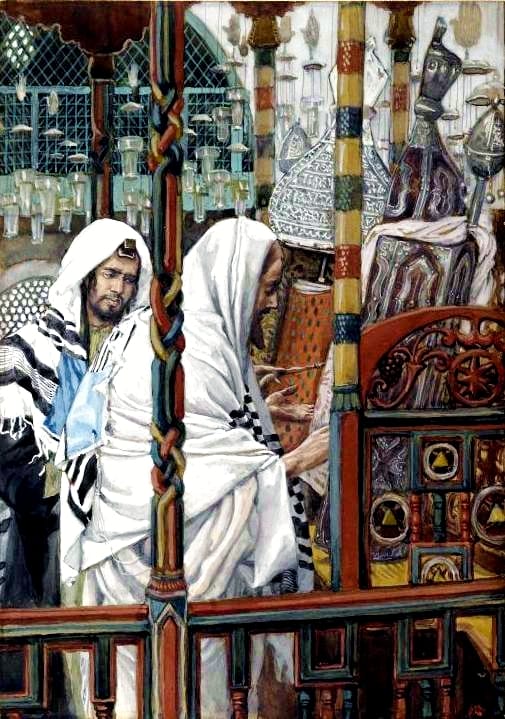
He kept the festivals. John's whole gospel runs on his pilgrimages. He paid the temple tax. He went to synagogue on Sabbath, Luke says, as was his custom. And he told the crowds, of the scribes and the Pharisees: they sit on Moses' seat, so do and observe whatever they tell you. No antinomian survives that sentence.
His Sabbath fights are case law, and they are fights inside the law. The Damascus Document, written a century before him, forbids lifting an animal out of a pit on the Sabbath. Qumran's rule. Jesus argues the other side: which of you, having a sheep that falls into a pit on the Sabbath, will not take hold of it and lift it out? He is appealing to the common practice of his Galilean hearers against the sect's rigor. Healing on the Sabbath was a live question — does healing by word even count as melachah, as work? His answers come in legal form, to legal opponents. Is it lawful on the Sabbath to do good or to do harm, to save life or to kill? Arguing the lenient end of a documented spectrum is not lawbreaking. It is the daf of the first century.
On the handwashing, the famous dispute of Mark 7, look at what is actually contested. The tradition of the elders. A non-Toraitic extension of priestly purity to laymen's bread. Jesus' counterattack is the korban ruling — vows men used to wall their assets off from the command to honor father and mother — and his charge is exact: you have a fine way of rejecting the commandment of God in order to establish your tradition, making void the word of God. Read it twice. His position is the conservative one. The written Torah, defended against an encroaching tradition. The man Christendom has used for two thousand years to relax the Law spent that afternoon tightening it.
And on divorce — the dispute always cited to prove him a Torah-amender — he rules stricter than Shammai, and he rules for the woman. The schools fought over two words in Deuteronomy 24, ervat davar. Hillel's house allowed divorce for any cause, a burned dinner would do; the Mishnah preserves the dispute. Shammai's house held the line at sexual disgrace. Jesus reaches behind Deuteronomy to the design: the two shall become one flesh — echad again — and he strips the husband's unilateral power. Divorce a wife without proven cause and the adultery is yours, against her. Exodus 21 had given the wife enforceable rights, food and clothing and marriage duty. Malachi had said YHWH hates the man who covers his garment with violence by faithless divorce. Jesus enforces the husband's Toraitic duty against a legal culture that had priced the exit. That is not abolition. That is a judge of Israel ruling for the weak party, from inside the Law, which is exactly what Isaiah said the Spirit-anointed shoot would do.
Do not think that I have come to abolish the Torah or the Prophets. I have not come to abolish them but to fill them full — plērōsai — for truly, until heaven and earth pass away, not an iota, not a dot, will pass from the Torah until all is accomplished. Therefore whoever relaxes one of the least of these commandments and teaches others to do the same will be called least in the kingdom of heaven. The covenanters of Qumran wrote a letter cataloguing the works of the Law, maasei ha-Torah, contending for the fuller doing of them. That sentence of his belongs to their world. And notice what it contains: an anathema, issued in advance, against the most common gentile reading of Jesus. He saw the misreading coming and cursed it first.
So when they finally bring him in, mark what the charges are not. No sustained Sabbath charge. No food-law charge. No festival charge. The Deuteronomy 13 test — the wonder-worker who says, let us go after other gods — is never even alleged, because every act of power in the record is directed to the God of Israel. The charges, when they come, are two. Neither is a Torah charge. They are identity charges.
Which brings us to the hour.
The Roads
Now put the body on the road, because that is where it spent its life. Stand outside Capernaum at first light, before the heat. The lake is flat and pewter-colored, two hundred meters below sea level, and the basalt is already warm underfoot. A band of men is forming up on the shore road — sandals, staffs, a bag of bread, a skin of water. The sandal is a leather sole and a thong. Nothing else. By the second hour the dust has worked into every seam of the foot; by the sixth, the thong has worn its groove; and the day's stage is twenty-five, perhaps thirty kilometers, village to village, with the Torah's own rhythm governing the week — six days the column moves, and on the seventh it does not, wherever it happens to be, because the walker keeps Shabbat.
Count what the record makes him walk. Natzeret to Yerushalayim is a hundred and fifty kilometers by the Jordan road, and Luke says the family went every year. The Torah summons a man three times a year. Do the arithmetic across the hidden decades and the boy and then the man has walked thousands of kilometers before a single recorded sermon — down the rift valley in the pilgrim caravans, the road dropping below sea level into the heat, then the long climb at the end. Then the ministry: Josephus counts two hundred and four villages in Galilee, and the evangelists say he went through all their towns and villages — circuit after circuit through the basalt hills. The northern excursion to Tyre and Sidon and back around through the Decapolis is a two-hundred-kilometer arc through gentile country. Caesarea Philippi, at the snow-fed springs under Hermon, is a hundred-kilometer round trip for one question: who do you say that I am? John's gospel has him shuttling to Yerushalayim feast after feast — including in winter, for Chanukah, the wet season, when the mud takes the road. Add the Perea road, the long travel narrative, the daily village work, and the ministry alone is four to six thousand kilometers. The lifetime is somewhere between twenty-five and forty thousand. Take the upper band and he walked the circumference of the earth — inside a country you can see end to end from one mountain.
The record keeps the body's fatigue without embarrassment. Jacob's well, Samaria, the sixth hour — noon — and the text says it plainly: Yeshua, wearied from the journey, sat down by the well. The Word that constituted the cosmos is sitting in the dust at noon because his feet hurt, asking a stranger to draw him water because he has no bucket. Foxes have holes, he says on another road, and the birds of the air have nests, but the Son of Man has nowhere to lay his head — the sentence of a man who has slept on the ground and means it. His one recorded sleep in the ministry is in the stern of a boat, on the cushion, in a storm, because the boat was the only place the crowds could not follow. And when the company arrives anywhere, the first liturgy is the basin — the road washed off the feet. Hold that, because on the last night he will take the basin himself, kneel, and wash the feet that have walked all of this beside him, the calluses and the cracked heels of fishermen, twelve pairs of feet with three years of Galilee on them — and tell them that this is what lordship is.
And feel the last road, because the record means you to. From Yericho the road to Yerushalayim climbs a thousand meters in twenty-seven kilometers — from two hundred and fifty below the sea to the cool of the heights, up through the Wadi Qelt, switchback after switchback in furnace air, the gorge walls close and blind. It is robber country; everyone knew it; he set his own parable on this exact road — a certain man went down from Yerushalayim to Yericho and fell among thieves — and then he walked it uphill, with Pesach pilgrims thick around him and the city waiting to kill him at the top. He had told them three times what was at the top. He walked toward it at a walker's pace, and Mark keeps the image of the column: he went on ahead of them, and they were amazed, and those who followed were afraid. The Son of David, on foot, climbing, out in front, alone.
Then mark this. The man walked, on any honest count, tens of thousands of kilometers — and rode three. The only ride in the record is the last descent, Beit Pagei down the Mount of Olives into the city, on a colt, because Zechariah had specified the animal five centuries in advance. He walked the earth's circumference and rode a borrowed colt for half an hour — and the half hour was the sign. Even his transport was exegesis.
And the walking did not stop at the tomb. On the first afternoon of the resurrection — risen, glorified, death behind him — he falls in step beside two travelers on the Emmaus road and walks eleven kilometers at their pace, opening Moshe and all the prophets, and their hearts burn somewhere around the seventh kilometer. He could have appeared anywhere, instantly, as anything. He chose a road, and a walking pace, and a Bible study on foot. The pace of revelation is a walking pace. It always was.
IV. The Hour — Judea Under the Clock
History does not usually cooperate with theology. Here it does something stranger. It constrains it. This movement shows that the candidacy was time-boxed — by the record's own sequence, by an expectation the enemy documented, by a jurisdictional clock the tradition itself dates, and by an archive that burned. The box closed in the year 70. No one has been eligible since.
The Sequence
Daniel 9:26. An anointed one shall be cut off and have nothing — and the people of the prince who is to come shall destroy the city and the sanctuary.
The arithmetic of the seventy weeks lands where you would expect — I have run it elsewhere — but the sequence carries the verdict alone, and the sequence cannot be dated away. The anointed one is cut off first. The city and sanctuary are destroyed after. Grant Maccabean authorship; grant a writer in the 160s before Christ. No second-century writer engineers the Roman destruction of 70, and the sequence binds whoever wrote it: the anointed one dies before the temple falls.
The temple fell in 70. Every candidacy after 70 is void on the record's own terms. Only the men cut off before the fire need apply.
The Clock, Attested by the Enemy
And there was a clock, and the enemy kept it. Ask Rome.
Josephus, explaining the war to his patrons: what more than all else incited them to the war was an ambiguous oracle, likewise found in their sacred scriptures, to the effect that at that time one from their country would become ruler of the world. Tacitus, who despised Jews and Christians both: the majority were convinced that the ancient scriptures of their priests alluded to the present as the very time when the East would grow strong and rulers coming from Judaea would acquire universal empire. Suetonius says the same in his life of Vespasian.
Three hostile witnesses. Two of them Roman. They attest that the Jewish scriptures held a timed expectation of a world-ruler out of Judea, and that the time was then — the first century. They attest it because they needed it to explain a war. You may fight about the oracle's referent. You may not fight about the clock. The men who recorded it burned the city to stop it.
The Jurisdiction
John reports the Judean authorities telling Pilate: it is not lawful for us to put anyone to death. The Talmud confirms it, and the Talmud dates it. Forty years before the destruction of the Temple, capital jurisdiction was taken from Israel. b. Sanhedrin 41a. Forty years before 70 is the year 30. The tradition's own memory fixes the transfer of the death penalty to Rome at exactly the moment in question.
Which means this. At that moment and no other, a man condemned by Israel's court would die by Rome's method. And only Rome's method satisfies the file the scriptures had been quietly building. Pierced — they have pierced my hands and my feet; they shall look on me whom they have pierced. Lifted up — as Moses lifted the serpent in the wilderness. Hanged on a tree — entering the curse of Deuteronomy 21 in order to drink it dry. And yet not a bone broken — the Passover-lamb rubric of Exodus 12, kept to the letter when the soldiers broke the legs of the other two and found him dead already, and pierced him instead. Stoning, Israel's own method, satisfies none of it. The texts specify an execution Israel could not perform and Rome would never have invented. The jurisdiction had to be lost for the prophecies to be kept.
Mark that. It is the first entry in a pattern I will name at the end. In this case, the objections keep turning out to be the fulfillment conditions.
We even have the hardware. The heel bone of one Yehohanan, crucified in the first century, came out of a Jerusalem ossuary with the iron nail still through it. Crucified Jews were buried after all, against a century of scholarly insistence that they never were. The Pilate stone at Caesarea names the prefect. The Caiaphas ossuary names the priest. The cast of the trial narratives is attested down to their bones.
Two Trials, Two Charges
He was tried twice because the claim was double. The two charges are this essay's two theses, entered as formal accusations.
Before the Sanhedrin, the high priest puts him under oath — the adjuration, the one question form a Jew may not deflect. And under oath he answers the Messiah question by welding the two most dangerous texts in the grammar into one sentence. You will see the Son of Man seated at the right hand of Power — Psalm 110 — and coming with the clouds of heaven — Daniel 7. The session and the advent. Akiva's two thrones, claimed by their occupant, on the record, under oath. The high priest tears his robes. The charge is blasphemy. An identity verdict. They understood him perfectly.
Before Pilate the charge is sedition. Are you the King of the Jews? An office verdict. And Rome, with its genius for paperwork, nails the conviction over his head in Hebrew, Latin and Greek. Yeshua of Nazareth, King of the Jews. Divine identity in the Jewish court. Royal office in the Roman one. The essay's two claims, prosecuted in a single weekend, each conviction publishing the claim it meant to bury.
And the tradition kept strange receipts. Forty years before the destruction — the year 30 again — the lot for the scapegoat stopped coming up in the right hand. The crimson thread stopped turning white. The temple doors opened by themselves at night. b. Yoma 39b. The Yom Kippur apparatus, by the tradition's own testimony, stopped registering acceptance from that year and never registered it again. I do not lean on it. I note that their archive and mine agree on the date.
The Two-Messiah Mirror
Now the objection of objections. Ramban put it at Barcelona in 1263 and every honest Jewish reader has put it since. The world is not redeemed. No universal peace. No completed ingathering. No temple. The wolf does not lie down with the lamb; the wolf is doing fine. If he was the one, why is the work unfinished — and is not the "second coming" a patch sewn on to save a failed claim?
It is the right question. The answer is that the interval is in the record. Not improvised by Christians. Written in, at eight separate points, by eight separate hands.
Sit at my right hand until I make your enemies your footstool. A session of unstated length between enthronement and subjugation. I will return to my place until they acknowledge their guilt and seek my face — YHWH withdrawing, on a condition, waiting for Israel's word. He shall give them up until the time when she who is in labor has given birth — an interval inside the Bethlehem oracle itself. The anointed one cut off, and the end not yet. The Servant who dies, is buried with the rich — and then prolongs his days and divides the spoil: death and triumph given to one figure, in that order, in one chapter. The pierced one mourned not at the piercing but at the end, when the spirit of grace is poured out. And his own two sentences, which we will come to: you will not see me again until you say, Baruch haba b'shem YHWH. Jerusalem will be trampled until the times of the gentiles are fulfilled.
Eight gaps. Eight untils. Sewn through Torah, Prophets, Writings, and the laments of the gospels. The two-stage program is not the patch. It is the pattern.
And here is the remarkable thing. The rabbis found it too. The tradition that refused him stared at the same texts and was driven to the same split. It just resolved the split with two persons instead of two advents. The Talmud contains a slain messiah. Messiah ben Joseph, killed in the last war, mourned by the nation — and the proof text the Gemara hangs on his death is Zechariah 12:10. The pierced one. b. Sukkah 52a. A dying messiah, dying on my verse, in the Bavli. And on the manner of his coming, the Gemara preserves a perfect perplexity: it is written, with the clouds of heaven — and it is written, lowly, riding on a donkey. The resolution offered is conditional. If Israel is worthy, the clouds. If not, the donkey. b. Sanhedrin 98a. Both modes. One figure. The rabbis holding Daniel 7 in one hand and Zechariah 9 in the other, unable to put either down.
The record's answer is not either-or. It is both, in order. The donkey first, at the visitation. The clouds second, at the verdict. Same data. Two solutions. One of them must invent a second messiah the texts never name. The other only has to read Isaiah 53 as written, where one Servant dies and divides the spoil.
What He Did Instead
The first century wanted a particular show. The Psalms of Solomon wanted the king who would purge Jerusalem of gentiles. Qumran wanted the purifying priest. The crowds wanted what the sign-prophets and sword-carriers kept promising — Gamaliel lists two of them from memory at the trial of the apostles, Theudas and Judas the Galilean, and Josephus catalogues them by the dozen, each with his followers, each ending on Roman iron.
Against that script, watch his inversions, and note that each one is deliberate.
They try to take him by force and make him king — after the loaves, in the wilderness, the crowd surging. He withdraws. John 6:15. The only man in that century to decline the office at the exact moment of acclamation. He stages his entry on the donkey — choosing, with an exegete's deliberateness, the humble clause of the pair the rabbis would puzzle over for centuries. He does not cleanse Jerusalem of Romans. He cleanses the temple of Israel's own corruption, and the words in his mouth while he does it are Jeremiah's — the temple sermon, the indictment that preceded the first destruction, read back into the same courts. He does not predict the temple's liberation. He predicts its demolition, not one stone on another. And he renames the enemy. Not Caesar. The powers behind the thrones. The strong man to be bound. The accuser to be thrown down. A war aimed at the rulers of this age, to be won — this is the strangest strategy ever stated aloud — by dying.
None of that is what failure looks like. It is what a different program looks like. The ben-Joseph half, executed first, on schedule.
The Aftermath — Anticipation, Not Adaptation
Then 70 came. The altar was gone, and Judaism faced the question his ministry had already answered. Where does atonement live when there is no temple?
At Yavneh, Yohanan ben Zakkai gave the answer that built rabbinic Judaism. Walking past the ruins with his disciple, who cried out — woe to us, that the place where Israel's sins were atoned is destroyed — Yohanan answered: my son, do not grieve. We have another atonement as effective as this. Deeds of lovingkindness. As it is said: I desire chesed and not sacrifice.
Hosea 6:6. Now open the gospel. Jesus had cited that exact verse, programmatically, twice — go and learn what this means, I desire chesed and not sacrifice — while the temple still stood. And he had paired it with an authority Yavneh never claimed: the Son of Man has authority on earth to forgive sins. The verse on which rabbinic Judaism rebuilt after the catastrophe is the verse he had made his program before it. Theirs was adaptation. Brave, brilliant adaptation. His was anticipation. Atonement relocated by its owner, ahead of the fire, with the prediction of the fire on the record.
And when the political-military reading of the office finally found its perfect candidate, the result closed the question for good. Rabbi Akiva — the greatest of them, the same Akiva of the two thrones — looked at Shimon bar Kosiba at the head of an army and said: this is the King Messiah. Three years later the land was ash. Akiva died under Roman combs. The sages cursed the calculators of ends. The checklist was applied by its ablest practitioner to its likeliest candidate, and it was falsified in blood. After 135 Jewish messianism went quiet and deferred, and in time it codified its trauma into criteria. We will meet the codifier in Movement IX. The point here is short. The political-military reading was tested. It failed its test. The crucified reading was tested too — by the predicted destruction, by the sequence of Daniel 9, by the survival and explosion of a movement whose founder had been executed in public — and you are reading an essay about it twenty centuries later because it did not.
The Visitation
Malachi said the Lord would suddenly come to his temple. He came. And mark the date he came on. The entry falls on the tenth of Nisan — and Exodus 12:3 makes the tenth of Nisan the day the Passover lamb is selected and brought into the house, to be kept and examined until the fourteenth. He rode in on lamb-selection day. The four days that follow are the lamb's inspection, and the gospels record it as exactly that: the chief priests, the scribes, the elders, the Pharisees with the Herodians, the Sadducees — every faction in sequence, probing him in the temple courts for blemish, and finding none. The inspection's formal verdict comes from the magistrate, three times, on the fourteenth: I find no fault in him. The lamb passed. Selected on the tenth. Examined four days. Slaughtered on the fourteenth, without blemish and without spot, per the rubric.
And Mark keeps the other inspection with a clerk's flatness: and he entered Jerusalem and went into the temple, and when he had looked around at everything, as it was already late, he went out to Bethany with the twelve. The owner's inspection. The evening before the audit. On the day Israel inspected lambs, the Lamb inspected the temple — two examinations, one date, each party grading the other, and only one of them passed.
Next morning, the enacted verdict. A fig tree in full leaf with no fruit on it, cursed. The temple courts cleared, Jeremiah in his mouth. The fig tree found withered from the roots. And days before, coming down the Mount of Olives with the crowds shouting, he had wept. Wept over the city that was about to kill him, and named the legal category through the tears: you did not know the time of your visitation.
The word is episkopē. In Hebrew, pequddah. It is the Exodus word. I have surely visited you — paqod paqadti — the promise at the bush, the verb of the first redemption. The same visitation, arriving again, unrecognized by the city built on the memory of the first one. Forty years — one generation, as he said — between that sentence and its execution. Josephus's omens. The Talmud's forty years of failed lots. The legions. The fire.
But hear the exact wording of the withdrawal, because the return is written inside it. Your house is left to you desolate. For I tell you, you will not see me again until you say, Baruch haba b'shem YHWH. Blessed is he who comes in the Name of YHWH. Not never. Until you say. The next visitation waits on a sentence — the Psalm 118 welcome — and the trampling of Jerusalem runs until the times of the gentiles are fulfilled. Judgment and regathering in one breath. Sentence and suspended clause.
He mourned over her. He did not mourn over Rome. Hold that asymmetry. In the last movement it will decide a famous identification.
Time, Line, Place
Three coordinates fix a man.
The time you have seen. The sequence, the attested clock, the jurisdictional window, all closing on the same forty-year corridor.
The line. He had to be David's, and the record holds a trap here so fine that I can only call it design. Jeconiah, the exiled king, carries a curse: write this man down as childless, for none of his offspring shall succeed in sitting on the throne of David. Jeremiah 22. But the royal succession runs through Solomon to Jeconiah. So a biological son of the royal line is disqualified by the very line that qualifies him. The title and the blood are at war. Now watch the genealogies. Matthew walks straight down the royal line, through Jeconiah, to Joseph — and then breaks the chain of begetting. Joseph, the husband of Mary, of whom was born Jesus. Legal paternity by acknowledgment — Joseph names the boy, and in Israel naming is claiming — conveys the title without the blood. Luke supplies the blood by another road, down from David through Nathan, around the curse entirely. The virgin birth, which the critics treat as the story's most embarrassing miracle, is the genealogy's required legal instrument. It is the only mechanism by which a son of David can hold Solomon's title without Jeconiah's blood. The objection is the fulfillment condition. Again.
And in 70 the temple's genealogical archives burned. Josephus, who pulled his own pedigree out of them, says so. After 70, no claimant can prove Davidic descent. Ever. The credential expired with the clock. The line closed when the window closed.
The place. Bethlehem Ephrathah, named by Micah with a three-level address — too little to be among the clans of Judah — and an origins clause that out-scandals everything in Movement II: whose goings forth are from of old, from days of eternity. And the oracle sits inside a unit that compresses this whole essay into four verses. The judge of Israel struck on the cheek with a rod — the passion, standing before the nativity in the text's own order. The ruler from Bethlehem whose origins are from eternity. The interval — he shall give them up until she who is in labor has given birth. And the shepherd whose greatness reaches the ends of the earth, in the majesty of the Name of YHWH his God. Smitten judge. Eternal origin. Labor-bounded interval. Name-bearing universal shepherd. Micah wrote my table of contents seven hundred years early.
The expectation was public and fixed. Herod's scribes cite the verse to him without checking a scroll. The Jerusalem crowd throws it at Jesus as an unanswered objection — does not the Scripture say the Messiah comes from Bethlehem, the village where David lived? — and John leaves the objection hanging in the air, unresolved, which is the criterion of embarrassment in its best suit: the evangelist records the challenge because everyone knew the answer, and the answer was Bethlehem, and he could afford to leave it hanging.
And the parameter is unfakeable. No man chooses his birthplace. It took an imperial census — Rome again, the unwitting logistics department of the kingdom of heaven — to move a Galilean couple to the city of David at the right moment. The Quirinius crux resolves and the structure never depended on it. It depends on this: time, line, place. Each axis alone admits many candidates. The conjunction admits, as far as the record knows, one. And the third axis was administered by his enemies' empire.
V. The Priest-King — After the Order of Melchizedek
Israel's constitution split its two thrones and built a wall between them. The king came from Judah. The priest came from Levi. And the wall was enforced. When King Uzziah walked into the sanctuary to burn incense — a good king, a strong king, drunk on his own strength — eighty priests physically barred him, and leprosy broke out on his forehead at the altar, and he was a leper to the day of his death. 2 Chronicles 26. A Judahite priest is, under Sinai, a contradiction in terms.
But the record requires one. The agent of the last movement must atone — that is the next movement. The figure of the grammar must reign. One man, both thrones, and no leprosy. How?
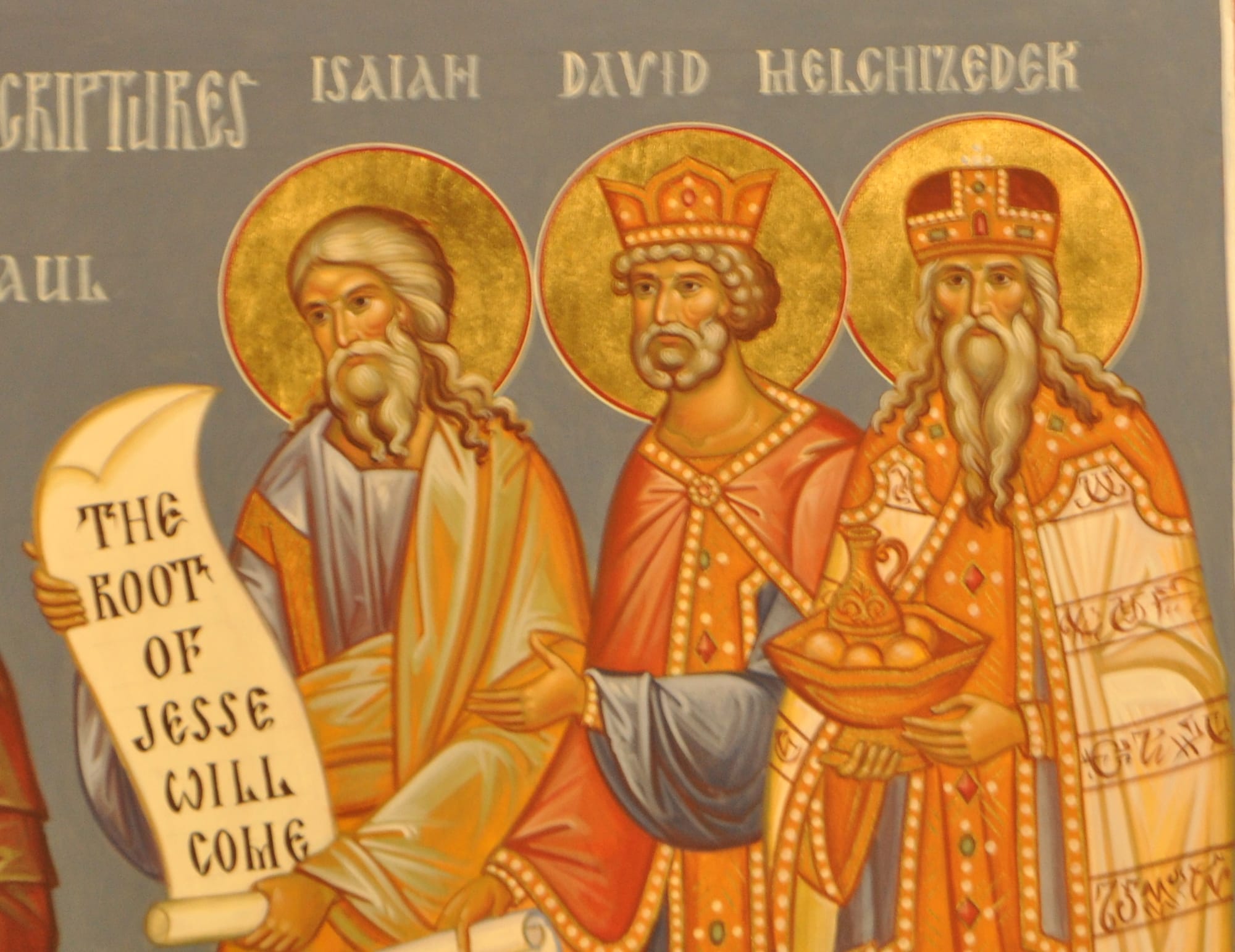
Psalm 110 is the answer. It is the most quoted text in the entire apostolic corpus — more than any passage of the Hebrew Bible — because it solves the constitutional problem in two verses. The first you have met. YHWH says to my lord: sit at my right hand, until. David — Israel's highest man — calling someone his lord. The session. The interval. The fourth verse is the legal innovation, and listen to how it is framed: YHWH has sworn and will not change his mind: you are a priest forever, after the order of Melchizedek.
Melchizedek gets three verses in Genesis and one in the Psalter, and those four verses carry more constitutional weight than any others in the Torah. He is king of Salem — Jerusalem before there was an Israel — and priest of El Elyon, God Most High. Both offices. One man. Before Sinai built the wall. He brings out bread and wine. He blesses Abraham. And Abraham — the patriarch, the friend of God — pays him a tithe.
The author of Hebrews, reasoning like the Second Temple Jew he was, draws the halakhic inference and it still lands like a punch. Levi was in Abraham's loins. So Levi — the whole priestly line, in its ancestor — paid tithes to Melchizedek, and the lesser is blessed by the greater. The Aaronic priesthood, in its own forefather, acknowledged a superior priesthood, royal and older than itself. Aaron's order is tribal, hereditary, interrupted by death, established by command. Melchizedek's order is royal, personal, permanent — forever — and established by oath. The only priesthood in Scripture that God swears into existence. When God swears, the matter leaves the realm of the revisable. We will count his oaths in the last movement. This one stands near the head of the registry.
And now read the psalm's two verses as the single syllogism they are. Verse four says priest forever. Forever is not a flourish. It is a job requirement, and it disqualifies every mortal who ever wore the ephod — Aaron's order was an office of relay, many priests in succession, Hebrews says, because death kept removing them from their post. A priest forever must be a priest whom death cannot remove. Verse one names the only candidate: David's Lord, seated at the right hand, appointed — Hebrews again — not on the basis of bodily descent but by the power of an indestructible life, holding his priesthood permanently because he continues forever. He is priest forever because he is David's Lord and lives forever. The two verses were always one sentence. Which means the resurrection is not an appendix to the priesthood. It is the ordination. The empty tomb is the certificate of office — the proof, entered into evidence on the third day, that the candidate meets the oath's tense.
That reading was Jewish before there were Christians. Cave 11 holds the proof. The scroll we call 11QMelchizedek casts Melchizedek as the heavenly deliverer of the great Jubilee — the tenth jubilee, the final release. He proclaims liberty to the captives of Isaiah 61. He executes the judgments of Psalm 82 — God has taken his place in the divine council. He atones for the sons of light on the last Day of Atonement. A pre-Christian Jewish text in which Melchizedek is the elohim of the courtroom psalm, the herald of the Jubilee, and the agent of final atonement. The categories were not merely available. They were assembled and waiting, in a jar, in a cave.
And once, in the Tanakh's own narrative, the two crowns were set on one head as a sign. Zechariah is told to take silver and gold and make crowns. And set them — on whom? Not on Zerubbabel the governor, the Davidic heir, where every political instinct points. On Joshua the high priest. Yehoshua ben Yehotzadak. Mark the name. It is his name. And say to him: behold, the man whose name is the Branch. He shall build the temple of YHWH and bear royal honor, and shall sit and rule on his throne. And there shall be a priest on his throne, and the counsel of peace shall be between them both. Zechariah 6. A priest crowned king. Ruling from the throne. The two offices at peace in one figure. And the figure's name is Yeshua. The sign was performed, written down, and left in the file like a photograph of a man not yet born.
So the session of Psalm 110 is not waiting. It is the priestly interval. What does a priest do, seated, between the sacrifice and the verdict? He intercedes. Isaiah wrote it into the Servant's job description — he bore the sin of many, and makes intercession for the transgressors — present tense, ongoing. The corpus confirms the posture: who is at the right hand of God, who indeed is interceding for us. The interval that scandalized Ramban is the priest's shift at the altar of the true tabernacle.
The right hand is not a waiting room. It is the Holy of Holies, occupied.
Therefore, since we have a great priest over the house of God — a priest by oath, a king by birth, the two crowns at peace on one head exactly as the sign-act said — draw near. The throne he sits beside is named, for you, a throne of grace. That is not my sentence. It is the homily this essay is modeled on, drawing the only conclusion the office allows.
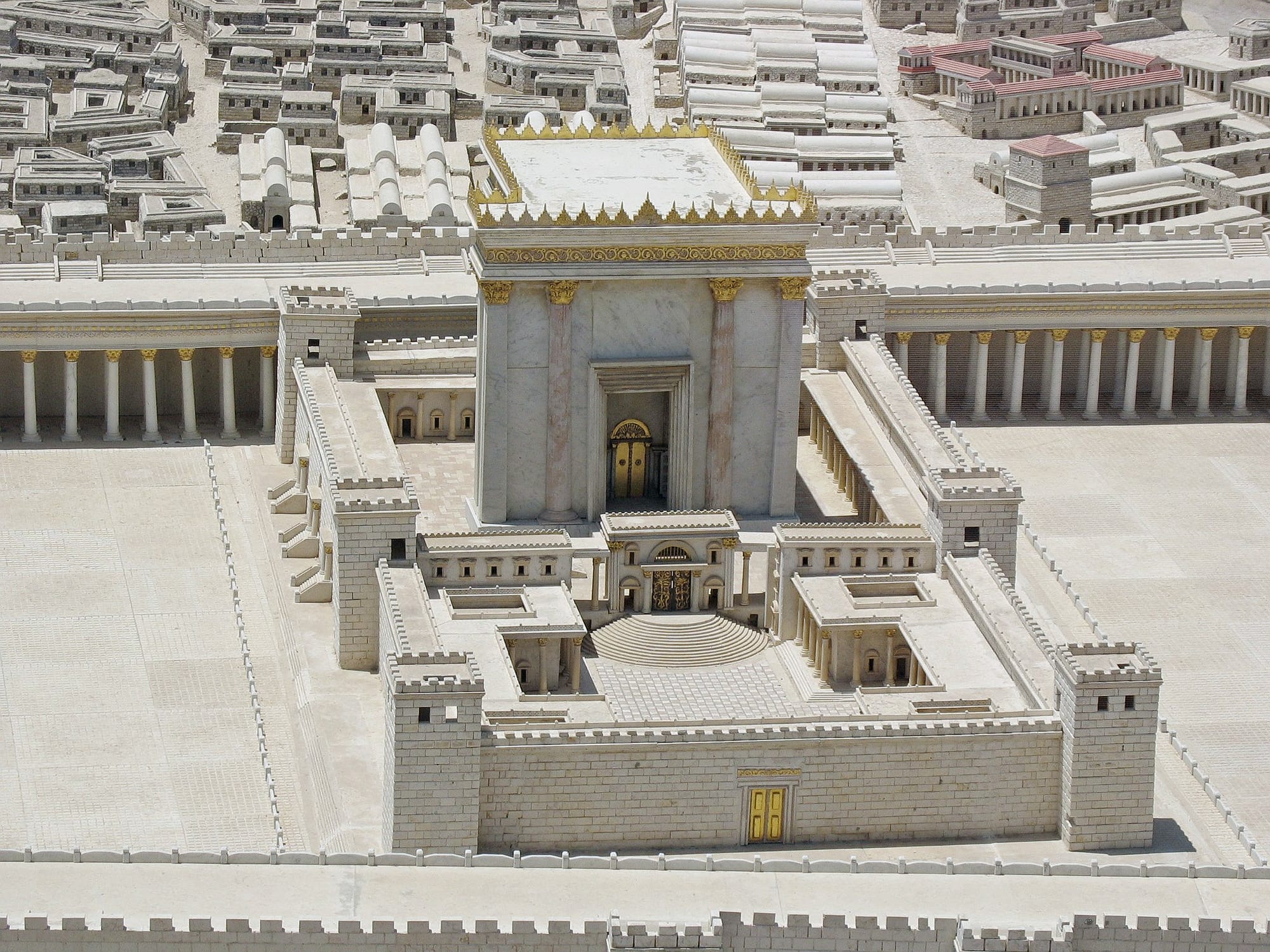
VI. The Temple Cult — The Blood That Could Not, and the Blood That Could
Here I must be most careful, because the standard Christian telling of this material has done real harm. The argument is not that the sacrificial system was a crude mistake which Jesus corrected. The argument — the only honest one — is that the Torah's own cult states its own limit. The Tanakh's own poets and prophets appeal past that limit. And the limit has the exact shape of a door.
Read the cult's terms of service. Numbers 15 provides sacrificial atonement for sin done bishgagah. Unintentionally. By straying. Then it states the boundary: but the person who does anything with a high hand — defiantly, fist to heaven — reviles YHWH, and that person shall be cut off from among his people. His iniquity shall be on him. For deliberate, eyes-open rebellion the system offers no sacrifice. None. It never did. The altar handled the sins of the stumbling. The sins of the defiant it declined, in writing.
Now stand where David stood. Adultery with Bathsheba. Uriah set up at the wall and killed by proxy. High-handed, twice over. No goat in the inventory touches it. No bull. No offering exists for his case. And David — the man who organized the temple liturgy, who wrote its songbook — writes the sentence that exposes the boundary from inside: For you will not delight in sacrifice, or I would give it. You will not be pleased with a burnt offering. The sacrifices of God are a broken spirit. That is not anti-cultic sentiment. That is a man standing on the far side of the cult's own stated limit, appealing straight past the machinery to chesed — have mercy on me, O God, according to your steadfast love — because the published mechanism has no clause for him.
The prophets say it in chorus, and notice that every voice is Israel's own. I desire chesed and not sacrifice — Hosea. To obey is better than sacrifice — Samuel, to a king. With what shall I come before YHWH — he has told you, O man, what is good — Micah. I have had enough of burnt offerings; your hands are full of blood — Isaiah, in his first chapter. So when the Epistle to the Hebrews writes that it is impossible for the blood of bulls and goats to take away sins, it is not a gentile sneering at Leviticus. It is a Jew quoting his own Bible's settled internal verdict. The same verdict Psalm 40 renders in the verse this essay opened with. Sacrifice and offering you did not desire.
Then what was the cult for? Watch its central day with that question open.
Yom Kippur. Two goats by lot. One laYHWH — slaughtered, its blood carried alone, through the veil, to the kapporet: the mercy seat, the slab of gold between the two cherubim, where the Presence met the testimony. One la'azazel — kept alive, the priest's hands pressed hard on its head, the confessed iniquities of all Israel spoken onto it, then led out and away, into the wilderness, to Azazel. The Second Temple readers knew that name. In the Enochic books Azazel is the bound rebel of the desert, the teacher of corruption, chained in the dark until the judgment. Read the rite with their eyes and it is exact: expiation within the veil, and the guilt exiled without — carried back to the wilderness, returned to sender. And the Mishnah adds a requirement: the two goats should be alike — alike in appearance, in size, in value. Hold that image of two who are alike, one released and one offered. It will return, at a trial, with a crowd shouting, and both goats will have the same name. And blood, because the Torah explains its own mechanism: the life of the flesh is in the blood, and I have given it for you on the altar to make atonement for your souls; for it is the blood that makes atonement by the life. Life for life. The principle stated in the Torah's own voice, in the Torah's own words.
A system that handles inadvertence but not rebellion. That runs on life-for-life. That must be repeated, morning by morning, year by year — a reminder of sins, not their removal. That is not a broken machine. That is a scale model, and the Torah says so. Moses is commanded to build everything after the tavnit — the pattern — shown him on the mountain. The earthly sanctuary instantiates a heavenly specification. Read that through this essay's framework and feel the hair rise: the cult is a physical execution of a prior specification. Hebrews calls the earthly system a copy and shadow of the heavenly things, and for centuries readers have heard Plato in the sentence. It is not Plato. Plato's forms are timeless abstractions with no appointment to keep. The tavnit is a specification awaiting full actualization. Not shadow versus form. Model versus building. Scroll versus performance.
Then Isaiah 53 names the missing offering.
The Servant. The Arm of YHWH revealed — and despised, and rejected. A man of sorrows. Cut off from the land of the living. Assigned a grave with the wicked, and with a rich man in his death. And verse ten uses the technical term, the precise word from the priestly manuals: when his soul makes an asham. A guilt offering. The most juridical of the sacrifices, the one with restitution built into its logic. A person as the asham. The category the cult lacked — an offering sufficient for the high-handed sin, for David's case, for rebellion as such — supplied in a man who bore the sin of many and was numbered with the transgressors.
And if you fear the chapter has been doctored in transmission, the oldest Bible manuscript on earth settles the famous crux in its favor. The Great Isaiah Scroll, copied at Qumran a century before Jesus, reads at 53:11: out of the anguish of his soul he shall see light. Light. After death. In a Hebrew text no Christian hand ever touched. The Servant's resurrection is in the scroll from the cave, and you can go to Jerusalem and look at it under glass.
This is why the Lamb language of the Forerunner was not sentiment. Passover lamb — the blood that turns death from the door. Akedah lamb — God will provide himself the lamb, and on that same ridge of hills a father did not withhold his son, his only son. Isaiah's lamb — led to the slaughter and silent. Three institutions of substitution, converging on one Galilean, at one Passover, dying outside the city wall at the hour the lambs died inside it, under a sky the record darkens at noon, with not one bone broken, per the rubric.
And then a detail I cannot read as anything but a signature. First day of the week, before light. Mary stoops into the tomb and sees two angels in white, sitting where the body of Jesus had lain — one at the head and one at the feet. One at the head. One at the feet. Flanking the empty place of a blood-marked body. You have seen this furniture. It is the kapporet. The mercy seat between the two cherubim, the place of atonement inside the veil — built now in stone and linen, shown open, with the atonement accomplished and gone. The empty slab between two attendants is the Holy of Holies with the work finished. And the two attendants, by the way, want watching. They have been flanking this story since Mamre.
Jeremiah had promised what this makes possible. I will make a new covenant with the house of Israel and the house of Judah. I will put my Torah within them, and I will write it on their hearts. For I will forgive their iniquity, and I will remember their sin no more. Read the terms slowly. Torah internalized — not abolished; written deeper, on hearts instead of stone. Forgiveness grounded — finally, even for the high-handed, in something the old system's own fine print never covered. And addressed to Israel and Judah. Not to a replacement.
The new covenant is the old testimony installed at depth, with the asham the docket always lacked entered into evidence at last. And the temple's own instruments — the lot, the thread, the doors — by the Talmud's own testimony, went silent from that very year. The model was decommissioned upon delivery of the building.
One question remains, and it is the deepest in this movement. How does one death, at one date, under one procurator, atone for sins committed centuries before it and millennia after? The answer is the position of the One receiving the offering. To the God outside the structure — the God for whom the Name conjugates across all three tenses, who is and who was and who is to come — the cross is not a receding event. The moment is ever-present before him. Revelation says it as a title: the Lamb slain from the foundation of the world — the slaying at the structure's still center, equidistant from every coordinate. Paul says it as jurisprudence: God had passed over former sins, and the cross was set forth to show his righteousness — the offering reaching backward, justifying the forgiveness already extended to Abraham and to David, whose case had waited outside the cult's limit for a thousand years. Hebrews says it as estate law: a death has occurred that redeems them from the transgressions committed under the first covenant. Explicitly retroactive. And Hebrews names the medium: he offered himself without blemish to God through the eternal Spirit. The offering was carried on the eternal relation — the asher — and what is offered through the eternal is eternally present. That is why once-for-all is not hyperbole. One moment suffices for all moments, because the Recipient holds all moments at once.
And the resurrection makes the redemption not merely applied across time but alive across it. Because he lives forever after having died, the redemption is never archival. It is staffed. He is able to save to the uttermost, since he always lives to make intercession. Your security is not a past transaction remembered. It is a living person, seated. The death he died, he died once for all; the life he lives, he lives to God — and the redeemed, hidden in him, live inside that tense.
Then the dark symmetry, and it must be said with the same precision. The moment's eternal presence is also why judgment is eternal. There is one ever-present cross, and only two postures before it: in it, or exposed to it. To die denying him is not to escape the moment but to stand eternally related to it from the wrong side — whoever does not obey the Son shall not see life, but the wrath of God remains on him. Remains. Abides. And Hebrews draws the consequence without flinching: for the one who tramples the Son and profanes the blood, there no longer remains a sacrifice for sins — no other sacrifice remains, because there was only ever the one moment, and the one moment, refused as refuge, remains as wrath. The wrath of the Lamb is the same ever-present slaying, met as the face that cannot be endured by those who declined to be hidden in it. The eternal value of the moment cuts both ways, because the moment does not pass.
Therefore, where there is forgiveness of these, there is no longer any offering for sin. The veil is open. Enter.
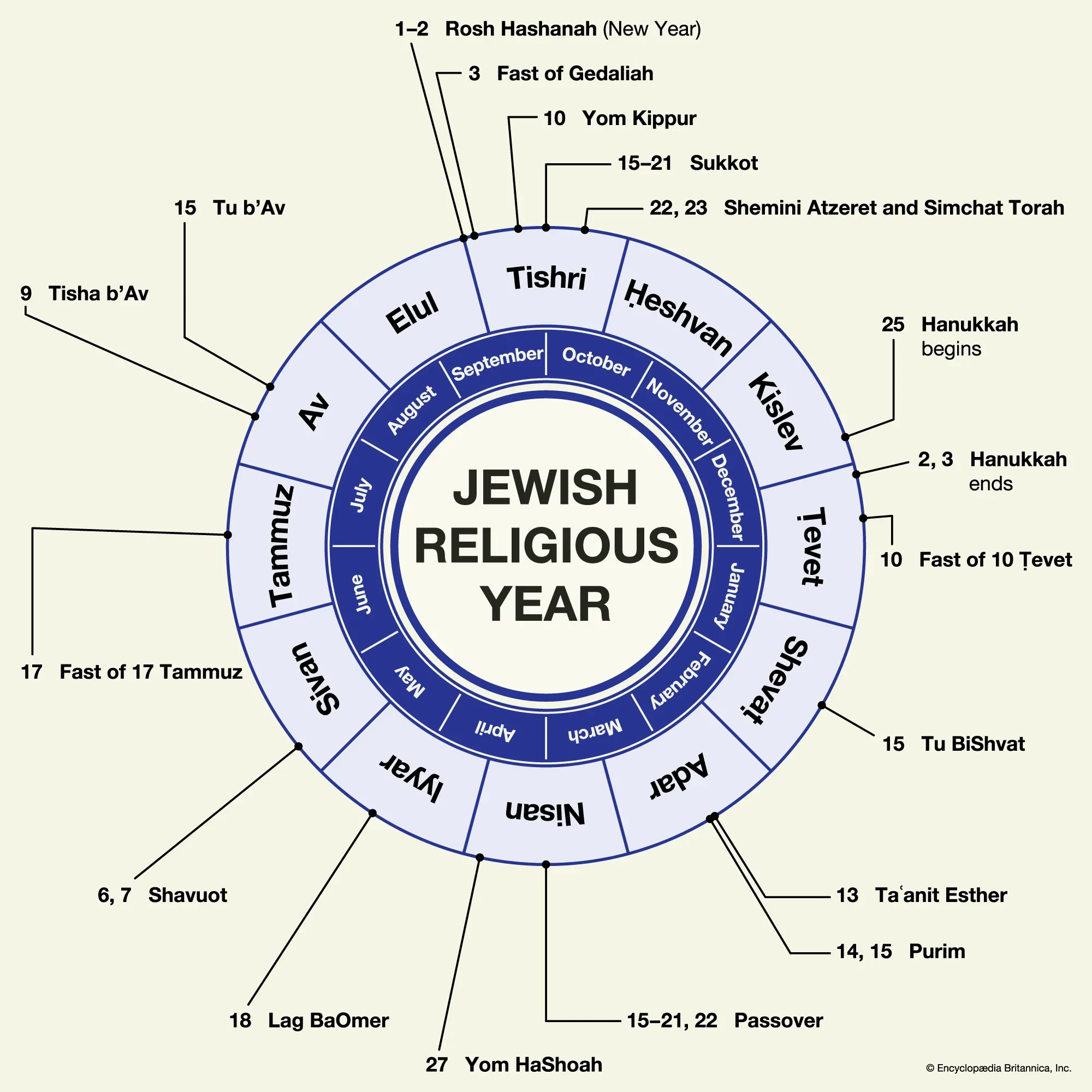
VII. The Calendar — The Docket
Leviticus 23 opens with a sentence whose legal force usually dies in translation. These are the appointed times of YHWH — moadei YHWH — holy convocations, which you shall proclaim at their appointed times. A moed is an appointment. A fixed meeting, set in advance, between parties. Miqra kodesh, usually rendered "holy convocation," carries the sense of a summons — a called assembly, a rehearsal. The feasts of Israel are not farm folklore with theology stapled on. They are a docket. The court calendar of the covenant. Seven sessions, proclaimed in advance, each one scheduled before its substance was supplied.
This is not speculation. The spring sessions were discharged on their dates, and the record names them by their dates.
He dies at Pesach. Messiah our Passover lamb has been sacrificed — Paul, writing to gentiles within twenty-five years, as if it were obvious. The asham of the last movement, delivered at the feast of substitutionary blood, while the lambs died across the valley. The famous chronology crux — the Synoptics' Passover meal against John's Passover eve — I engage elsewhere; it bears on the hour, not the day, and under every serious resolution the death is bound to Passover. The docket holds either way.
And at the table, the night before, he performed the caesura a second time. The Seder drinks four cups, and he stopped before the last. I will not drink again of the fruit of the vine until that day when I drink it new with you in my Father's kingdom. He suspended the liturgy mid-rite — the Passover paused before its final cup, exactly as Isaiah was paused before its vengeance clause. The scroll, rolled mid-verse. The seder, halted mid-cup. Both stand open at the same seam, and both resume at the same event. The kingdom has a standing dinner reservation, made aloud, on the record, at the table — and the host has not had wine since.
And the table that night had an empty seat with a name on it. John was dead by that Passover — the forerunner's office complete on its first stage, as he himself had ruled: Elijah has already come. The seder he paused was a seder with Elijah's chair vacant. The tradition's own furniture knows it: the four cups answer the four redemption verbs of Exodus 6 — bring out, deliver, redeem, take — all discharged at the first exodus. But there is a fifth verb in the next verse: I will bring you in. The land. The ingathering. And the Talmud's fifth-cup dispute left that cup standing — poured, undrunk, assigned to Elijah to resolve when he comes. The custom's formal shape is later; grade it honestly; but it crystallizes what the table already held: an unfinished verb, a suspended cup, an empty chair belonging to a two-staged office. Even teyku — the Talmud's word for a question left unresolved — was read as the acronym: the Tishbite will answer the difficulties. The open questions and the open chair have the same owner.
And John named his own seat. The friend of the bridegroom, he called himself — who stands and hears the bridegroom's voice; therefore this joy of mine is now complete. The best man. And the best man's office is at the wedding — which is what the resumed Passover is: blessed are those invited to the marriage supper of the Lamb. The paused seder resumes as the wedding feast. The friend of the bridegroom, raised, takes the chair that stood empty at the suspension. The fifth cup — the ingathering verb, fulfilled by then — is finally drunk. The chair is empty between the advents because the office is two-staged. It fills in the resurrection, because the wedding does not start without the best man.
He rises on Firstfruits. The day after the Sabbath of Passover week, when the first sheaf of the barley was lifted before YHWH to consecrate the harvest to come. And Paul does not note the coincidence. He names the event by the feast. Messiah has been raised from the dead, the firstfruits — aparchē — of those who have fallen asleep. The resurrection is titled by its calendar position. The first sheaf, guaranteeing the field.
Fifty days, counted by the Torah's own count, and then Shavuot. The covenant feast — the anniversary of Sinai in Second Temple reckoning; the book of Jubilees kept it as the feast of covenant-making before any church existed. And on that morning, in that city, wind and fire and the Torah-of-the-heart Jeremiah promised, and three thousand souls entering covenant where, at the calf, three thousand had fallen. Three appointments. Three discharges. Each dated by the apostles themselves, in festal vocabulary. Either this is the most sustained coincidence in the history of religion, or it is a docket being worked in order.
Which brings me to the caesura. The single most important reading act of his ministry.
Nazareth. Sabbath. As was his custom. They hand him the scroll of Isaiah and he finds the place. The Spirit of the Lord YHWH is upon me, because he has anointed me to bring good news to the poor. He has sent me to proclaim liberty to the captives, and recovering of sight to the blind, to proclaim the year of YHWH's favor —
And there he stops.
Rolls the scroll. Hands it to the attendant. Sits down. Every eye in the synagogue on him. Today this Scripture has been fulfilled in your hearing.
But Isaiah's sentence does not stop there. The next clause — the same breath of Hebrew — is and the day of vengeance of our God. He stopped mid-verse. The year of favor: proclaimed, fulfilled, today. The day of vengeance: left rolled in the scroll. Undeclared. Pending. That is the two-advent program performed as a liturgical act. The scroll opened on the favor and closed on the vengeance — and when we reach the last movement we will find the exact verse where the closed clause speaks again, in the first person, from a man with blood on his clothes. The caesura also answers John in prison: the chain of texts Jesus sent back was the favor-half of these same passages, vengeance omitted, with a beatitude for the man strong enough to bear the omission. He knew where in the sentence he was living. So must we.
The "year of favor" is Jubilee language. The fiftieth-year release — debts canceled, slaves freed, land returned. And the Jubilee is the calendar's deep structure. Daniel's seventy weeks are ten jubilees. The Qumran Melchizedek scroll schedules the final atonement and release in the tenth jubilee. The first advent proclaims the release. The second enforces it. That is all a Jubilee ever was, once some masters refuse to free their slaves: liberty announced, then liberty executed against the holdouts.
Now the fall sessions. Yom Teruah. Yom Kippur. Sukkot. Shemini Atzeret. For these I claim a pattern, not a date, and I run a strict admissibility rule: a festal claim earns a place here only on a dated precedent, an explicit textual link, or a pre-Christian Jewish reading. Nothing else gets in.
The day of trumpets stands on the corpus's own trumpet texts. At the last trumpet the dead will be raised. The Lord himself will descend with the trumpet of God. He will send out his angels with a loud trumpet call, and they will gather his elect. Awakening and assembly. That is what Yom Teruah has always rehearsed — the blast that wakes the sleepers and musters the camp.
The national Yom Kippur is written at Zechariah 12 and 13, and we will stand inside it in the last movement. The house of David looks on the pierced one. They mourn as one mourns an only son. And on that day a fountain is opened for the house of David and the inhabitants of Jerusalem, to cleanse them from sin and uncleanness. Recognition. Repentance. Cleansing. The Day of Atonement performed at last by the nation itself, in the streets instead of the sanctuary.
And Sukkot — here the Tanakh itself declares the feast outlives the present age. Everyone who survives of all the nations that came against Jerusalem shall go up year after year to worship the King, YHWH of hosts, and to keep the Feast of Booths. Zechariah 14. With a drought sanction for the nations that skip it. The kingdom age, in the prophets' own description, is an epoch-length Sukkot containing annual Sukkots. The feast of ingathering, and of God dwelling in tents with men, kept at last by everyone. John has been telling you this all along. The Word became flesh and tabernacled among us — eskēnōsen, pitched his sukkah. And at the water-drawing of Sukkot, the loudest liturgy of the year, he stood up and cried out: if anyone thirsts, let him come to me and drink.
After Sukkot's seven days, the Torah appends a strange eighth day. Shemini Atzeret. The assembly that lingers past the feast. The last moed on the list. It maps onto the last event on history's list — the great white throne, past the millennium, the books opened, the sea giving up its dead. The docket's final page and history's final page are the same page. The calendar and the timeline run out together, because they were always one document.
And this architecture is no Christian invention. The rabbis split it between themselves. In the Talmud's debate on the season of redemption, Rabbi Eliezer holds for Tishrei — in Tishrei the world was created, in Tishrei Israel will be redeemed. Rabbi Yehoshua answers: in Nisan they were redeemed, and in Nisan they are destined to be redeemed. b. Rosh Hashanah 11a. The two-cluster question — spring redemption or fall redemption — argued inside the Bavli, to a standstill. My answer is the gentlest on offer. Both rabbis are right. Nisan's cluster was discharged at the first advent. Tishrei's waits on the second. The synagogue even reads Zechariah 14 — the nations keeping Sukkot — as the haftarah for Sukkot's first day. The forward arc is embedded in the liturgy of the very community that declines to draw it.
And both communities, I say it plainly, misread the docket. Each kept the half the other dropped.
The Jewish misreading keeps the clock and declines to read its face. The moedim observed — magnificently, faithfully, for two thousand homeless years — as memorial and covenant, while the forward arc their own Talmud debates goes unclaimed.
The gentile misreading was worse, because it was deliberate. At Nicaea the church formally cut Pascha loose from Pesach. Constantine's letter survives. It calls it unworthy to reckon the feast "with the Jews." The church suppressed the Quartodecimans — the communities of Asia Minor who kept Nisan 14 because the apostle John had taught their fathers to keep it. With John's own practice outlawed, Easter went adrift on a solar formula, the category of pending appointments was lost, and gentile eschatology has been done with newspapers instead of the docket ever since.
The proof text recruited for the severance teaches the opposite of what it is quoted for. Let no one pass judgment on you in questions of food and drink, or with regard to a festival or a new moon or a Sabbath — which are a shadow of the things to come. Colossians 2. The verb is present tense. The feasts are — still, as Paul writes — a shadow. And the genitive is future. Of the things to come. A shadow cast backward by an approaching body. The verse asserts the docket's continuing prophetic function. It was drafted into service against the very thing it says.
Israel kept the clock and will not read its face. The church read the face and threw the clock away. I intend to hold both.
I have published, elsewhere, a dated reading of where on this docket the present hour stands, with its falsification conditions tabled. It is not imported here, and nothing here hangs on it. This essay is the case. The wager is my signature on it, and the season will grade the signature, not the case.
VIII. The Record — Jewish Literature, Jewish Deponents
The Continuing Record
The New Testament is Jewish literature. I do not mean it politely. I mean it generically. Matthew argues like a proto-rabbinic text — formula citations, verbal analogy, fulfillment exegesis. Hebrews, this essay's own model, is a logos paraklēseōs, a synagogue homily — the same form Paul is invited to deliver, by that name, in Pisidian Antioch. Revelation is a merkavah apocalypse that barely parses unless Ezekiel, Daniel, and Zechariah are open beside it, which is the point. The corpus was written by Jews, about a Jew, in Jewish forms, quarrying Jewish texts, to rule on the most Jewish legal question there is: on what terms do the nations enter the commonwealth of Israel?
It is the court record, continued. And like the Tanakh's record, it stands on deponents.
The Layered Court
But first understand the courtroom, because the Judaism of the record is not flat. It is layered — a living federation of jurisdictions, each with its own bench, its own jurisprudence, its own test question — and the record preserves him being examined before every one of them. That is itself evidence. A later inventor writes one cardboard "Judaism" for his hero to transcend. The record instead preserves the whole map, faction by faction, each in its own legal idiom.
The Pharisees, both schools, test him on divorce — the Hillel-Shammai question, in their exact terms — and on Sabbath, and on the greatest commandment; he answers in their idiom, from inside their debate space, and a scribe tells him he has answered well. The Sadducees, who deny resurrection, set their signature trap — the seven-times widow — and he answers them from the only court they accept, the Torah itself, and from the bush of all places: I AM the God of Abraham, the God of Isaac, the God of Jacob — he is not the God of the dead but of the living. He proves the resurrection from the tense of the Name at the bush. The grammar of Movement II, deployed as halakhah, against the temple aristocracy, and the crowd is astonished. The Zealot current and the Herodians close a pincer on him with the tribute coin — answer yes and lose the nationalists, answer no and hang for sedition — and he splits the trap along the line of the image and the inscription: render to Caesar what is Caesar's, and to God what is God's; and whose image is on you? The chief-priestly aristocracy demands his authorization — by what authority? — and he answers a licensing question with a licensing question about John's immersion, and the bench recuses itself rather than rule. The Essene shadow stands behind the Sabbath disputes — the pit, the animal, the stricter rule of the Damascus sect against the lenient practice he argues. The Samaritans — the estranged jurisdiction, wrong mountain, partial canon — receive him at a well, and he neither flatters nor spares: you worship what you do not know; salvation is from the Jews — and then stays two days and is confessed there first as savior of the world. The Galilean villages give him his base; the Judean temple elite gives him his trials. The Hellenist diaspora seeks him at the feast — certain Greeks among the pilgrims: sir, we would see Jesus — and his answer is the hour and the grain of wheat. The God-fearers reach him through the centurion whose faith outstrips Israel's, and the proselyte class through the Ethiopian on the Gaza road, reading Isaiah 53 aloud.
Count the benches. Pharisaic, Sadducean, priestly, Essene-adjacent, Zealot, Herodian, Samaritan, Galilean, Judean, Hellenist, God-fearing, proselyte. He is not tested before one Judaism. He is examined before every living jurisdiction of Israel, each in its own idiom, on its own signature question — and no bench convicts him on Torah. The only charge that finally stands is the one this essay began with: the identity charge. The layered court ran out of law and had to reach for blasphemy. That is what a complete examination looks like, and the record kept all of it.
The Twelve
And the deponents were Jews — not incidentally, constitutionally. The constitution is Deuteronomy's. The Prophet-like-Moses statute sets the office's citizenship requirement in its own words: a prophet from your midst, from your brothers, like me. The prophetic office in Israel was never open to the nations — every holder from Moses to Malachi was an Israelite by statute — and the apostles claim their warrant under exactly that text: Peter cites Deuteronomy 18 in the temple sermon; Stephen cites it to the Sanhedrin. The final Prophet came from the brethren, per the statute. His deputies hold commission under the same constitution.
And deputies has a legal name. Apostolos is the Greek for the shaliach — the Jewish agency institution — and the Mishnah states its operating rule: a man's agent is as himself. Jesus commissions them with that rule verbatim, applied twice in one sentence, up the whole chain of agency: whoever receives you receives me, and whoever receives me receives him who sent me. Agent, Prophet, Sender. The apostolic testimony binds because the Torah's own law of representation makes the agent's act the principal's act. The continuing record is admissible under Israel's rules of agency — and the agents, like the Principal, had to be from the brethren.
Begin, then, with the number. Twelve is not a round figure; it is a claim. You will sit on twelve thrones, he told them at the table, judging the twelve tribes of Israel. The Twelve are the nucleus of restored Israel — the regathering, in embryo, seated at a seder. And the arithmetic mattered enough that the church's first act — before Pentecost, before a single sermon — was an election. Eleven would not do. They cast lots, the priestly method, and restored the number to tribal strength, and only then did the fire fall. And the architecture holds to the end of the book: the New Jerusalem's twelve gates bear the names of the tribes, and its twelve foundations the names of the apostles. The two twelves, built into the eternal city's masonry. The polity of the double commission, in stone, forever.
And mark the first audience. At Pentecost the hearers were Jews, devout men from every nation under heaven — and Luke gives the roll: Parthians, Medes, Elamites, Mesopotamia, and on around the map. The diaspora, assembled for the covenant feast, hearing the mighty works of God each in his own tongue. Babel reversed — onto Jewish ears first. The gospel's first international audience was Israel scattered, the regathering previewed in miniature at the feast of covenant, and only later, by vision and crisis and council, the nations. To the Jew first was the order of the facts before it was ever a formula.
Now watch their practice, because Luke records it without comment, which is how you know it was simply the air they breathed. Peter and John go up to the temple at the hour of prayer, the ninth hour — apostles keeping the tamid clock. Solomon's Portico is the church's first address. Peter, a decade into the apostolate, can say of himself: nothing common or unclean has ever entered my mouth — the vision shocks him because his kashrut was intact. Luke dates the missionary journeys by the festal calendar — we sailed away after the days of Unleavened Bread; he was hastening to be at Jerusalem, if possible, on the day of Shavuot — the docket running inside the travel log. And Paul's synagogue habit receives from Luke the exact formula he used for Jesus: as was his custom. The author noticed the continuity. He meant you to.
And James — the Lord's brother, the man who issued the double ruling — was famous in Jerusalem for a Torah piety so rigorous that tradition remembered his knees calloused like a camel's from temple prayer. When the high priest Ananus had him killed in the year 62, Josephus records what happened next: the fair-minded of the city were outraged, and protested to the incoming governor, and Ananus was deposed. Read that again. Non-Christian Jewish Jerusalem objected to the execution of the church's chief elder — on the grounds of his righteousness under the Law. The hostile-attestation pattern, one more time: the city that rejected the claim vouched for the claimant's brother's observance.
Which yields the strongest single argument in this movement, and it is hiding in plain sight. The admission of gentiles arrives in Acts as a crisis. It takes a triple vision, a shocked Peter, a furious debate, and a formal council to resolve. Sit with what that proves. You do not convene a beth din to decide whether gentiles may join a gentile movement. The controversy is only intelligible if the movement's entire constitution — membership, leadership, liturgy, calendar, self-understanding — was Jewish, so thoroughly Jewish that the nations' entry was a constitutional question of first impression. The gentile-admission crisis is the proof of the church's Jewish constitution. And no later gentile church invents a story in which its own admission was the problem. The embarrassment is the authentication.
The Deponents
Consider what it would do to you.
You are in Bethany. A man four days dead — four days, past the limit where the tradition let the soul linger near the body, past every resuscitation story you have ever heard, with his own sister protesting the smell — comes out of his tomb because a voice told him to. Not a rite. Not a procedure. Speech. Lazarus, come out. The Davar of the second movement, the Word that made the worlds by saying so, addressing a corpse in the imperative. And being obeyed.
Now read the authorities' response, because it is the most backhanded attestation in literature. They do not deny it. No one in the narrative disputes that the man was dead or that he is at dinner. Their response is suppression. What are we to do? This man performs many signs. If we let him go on like this, everyone will believe in him. And then the council resolves to kill Lazarus too. To re-kill the evidence. Hostile witnesses do not suppress what did not happen. Centuries later the Talmud's polemic took the same line, calling his works sorcery. Reclassifying the power. Conceding the events.
The texts keep the phenomenology of witness with an honesty legend never manages. Fear. The Gerasenes find the demoniac clothed and in his right mind, and they are afraid, and they beg Jesus to leave. The disciples in the boat, after the wind stops on command, fear with a great fear — more afraid of the calm than they had been of the storm. At Nain a funeral turns around mid-march and fear seizes them all. The parents of the man born blind are hauled in and answer like every family squeezed by power since: he is of age, ask him. And the man himself gives the deposition no cross-examination has ever cracked. One thing I know. I was blind, and now I see.
Then the resurrection set. The formula Paul says he received and delivered — datable, on the field's own consensus, to within a few years of the events — ends with a clause that is either insane or an invitation. He appeared to more than five hundred brothers at once, most of whom are still alive. Still alive. Go ask them. A forger does not write a checkable-witness clause. A litigator does.
Two facts about these deponents settle the matter. First, they are named. Bartimaeus. Jairus. Simon of Cyrene, identified by his sons Alexander and Rufus, as though the readers could look the family up — because, as Richard Bauckham showed, they could: the named figures were the living custodians of their own testimony in the communities that kept it. Second, their behavior mutated. Larry Hurtado spent a career on the most stubborn datum in the field. Torah-keeping, Shema-confessing, monotheist Jews — the least likely population on the planet — began, within months, giving cultic devotion to a crucified man. And they died rather than stop. A mutation in Jewish devotion of that size requires a cause of that size. Their own account of the cause is the plainest sentence in Acts. We cannot but speak of what we have seen and heard.
I ended an earlier essay by observing that you cannot un-know what you now know. The deponents are that sentence's first instances. They could not recant, because recanting required un-seeing.
The Misread Apostles
Before I answer the record's critics, I have to rescue its authors from their friends.
The Paul of the Western imagination — the convert who escaped Judaism, discovered grace, and abolished the Law — was built, as Krister Stendahl showed, by reading Romans through Luther's tormented conscience. The Paul of the record circumcises Timothy. He takes a Nazirite vow and pays for four others, in the temple, on James's counsel, precisely to demonstrate in public that he lives in observance of the Torah. He says I am a Pharisee — present tense, on trial, decades into the apostolate. He legislates: let each one remain as he was called; was anyone circumcised when called, let him not seek to remove it — and calls it my rule in all the churches. His polemic against works of the law targets gentile judaizing — the demand that converts from the nations come in through proselyte conversion — not Jewish covenant life. The works-righteousness Judaism he supposedly demolished never existed; E.P. Sanders proved it to the guild's lasting embarrassment.
Peter's sheet vision, the other abused text, interprets itself on the page. Peter draws the moral in his own voice: God has shown me that I should not call any person common or unclean. People, not menus. He says so.
Even the hardest verse, Hebrews 8:13 — "obsolete and ready to vanish away" — read what is quoted around it. The new covenant of Jeremiah 31. In which Torah is written on hearts. Addressed to the house of Israel and the house of Judah. What ages out is the mediation system of the model sanctuary, Aaron's apparatus, the copies. What gets installed is the testimony itself, at depth, in its own people. The proof text for deletion describes an upgrade.
The Double Ruling
So when the question of the nations finally reached the record's own court — Jerusalem, the council of Acts 15 — watch what the beth din actually did, because both communities have misremembered it for nineteen centuries.
The question: must gentiles who enter through the Messiah become Jews? Circumcision, the full yoke?
The ruling: no. No greater burden than these requirements. Abstain from idol-meat. From blood. From things strangled. From porneia. Those four are not arbitrary. They are the resident-alien laws of Leviticus 17 and 18 — the ger toshav floor, the Torah's own category for the righteous of the nations living inside Israel's polity, the floor the rabbis would later systematize for the children of Noah. And James grounds the ruling in a prophecy whose imagery should stop you where you stand. After this I will return and rebuild the fallen sukkah of David... that the remnant of mankind may seek the Lord, and all the gentiles who are called by my Name. Amos 9. The nations come in under David's rebuilt sukkah. The council's proof text for not circumcising Greeks is a Sukkot image — the feast of the nations from the docket — cited by the Lord's own brother as constitutional ground.
Six chapters later. Same book. Same leadership. The mirror ruling. Tens of thousands of Jewish believers, all zealous for the Torah, and Paul instructed to show Jerusalem in public that he teaches no apostasy — you yourself walk in observance of the Torah. One court. Two rulings. One polity. The gentile without the burden. The Jew without abrogation. Galatians 2 shows the same structure institutionalized: two apostolates, circumcision and uncircumcision, divided fields, one gospel, one handshake. This is not a transitional compromise that mature theology later outgrew. It is the constitution.
The Double Commission
And the constitution has a spine. One oracle that holds both halves.
It is too light a thing that you should be my servant to raise up the tribes of Jacob and to restore the preserved of Israel. I will make you as a light for the nations, that my salvation may reach to the end of the earth. Isaiah 49:6.
Read its geometry. Israel's restoration is not the ceiling of the commission. It is — too light a thing — the floor. The nations are added to Jacob's restoration, not substituted for it. One Servant. Two clauses. No abrogation in either direction. And Luke brackets his entire two-volume work with this oracle. Old Simeon, holding the infant in the temple, blesses in its double clause: a light for revelation to the gentiles — and glory for your people Israel. Paul, decades on, cites the verse word for word as his marching orders, and cites it again on trial. The double ruling of Acts is the double clause of Isaiah, executed.
The "one new man" of Ephesians 2 — waved for nineteen centuries as the abolition of the distinction — says the opposite if you let it speak. Gentiles, formerly alienated from the commonwealth of Israel — politeia, citizenship — are made fellow citizens. Accession language. Not replacement language. You do not join a commonwealth by dissolving it. And the dividing wall of hostility that falls had a street address: the soreg, the temple barrier, the low wall whose inscription promised death to any gentile who passed it. We have dug up two of the actual stones; you can read the threat in a museum. What falls is the exclusion. Not the distinction. What the gentile joins is Israel's house, on Israel's foundations.
Zechariah saw the posture exactly. Ten men from the nations of every tongue shall take hold of the tzitzit of a Jew — the fringe that marks Torah obligation is the handhold — saying, let us go with you, for we have heard that God is with you. Attachment. Not substitution. The woman with the issue of blood grasped that fringe first and was healed. She was the prophecy's down payment.
And understand what the grafting actually confers, because it is an upgrade beyond anything the old categories held. The gentile does not enter as resident alien — the council's floor — nor even as proselyte, by the knife. He enters as a son. Adoption — huiothesia — and the instrument of his adoption is the very instrument the Torah promised for Israel's own renewal: YHWH your God will circumcise your heart, and the heart of your offspring, to love YHWH your God with all your heart. Deuteronomy 30. The circumcision of the heart is not Paul's metaphor. It is Moses' promise — the Torah's own stated endpoint, the one operation God reserved to himself. So when Paul writes that circumcision is of the heart, by the Spirit, and that in him you were circumcised with a circumcision made without hands, he is announcing Deuteronomy 30:6 executed — on Jew and gentile alike, by one operation: the new birth, the poured-out Spirit, the same surgery. The Jew's renewal instrument and the gentile's entry instrument are the same instrument. One adoption. One heart. One mother city — the Jerusalem above is free, and she is our mother; you have come to Mount Zion, to the heavenly Yerushalayim — while the vocations remain distinct, exactly as the council ruled.
And David demonstrated it at his own table before the theology had words. Read the roster of the gibborim — the mighty men, the king's innermost honor roll — and mark who is in it. Zelek the Ammonite. Uriah the Hittite, closing the list — a Hittite among the thirty-seven, at the king's table, in the record forever. And Ittai the Gittite, a Philistine of Gath commanding a third of David's army, swearing the Ruth oath in YHWH's name: as YHWH lives, wherever my lord the king shall be, whether for death or for life, there also will your servant be. David's kingdom took the nations into its inner circle at full honor a thousand years early — and the genealogy carries Rachav and Rut inside the line itself. The Son of David's polity was previewed at the father's table and in the father's blood.
Then the completion, through the body prepared — and mark the geography of access. He died outside the gate — Jesus suffered outside the gate, Hebrews says, to sanctify the people through his own blood — outside the walls, beyond the soreg, beyond the camp entirely, on a hill visible to all: the asham performed in the one space where Jew and gentile could stand side by side. The gentile could not pass the barrier into the inner court. So the altar was moved outside the barrier, to unrestricted ground. And then the Jewish anchors hold while the access universalizes: the resurrection in a Jewish tomb, the rich man's, per the clause; the demonstration to five hundred Jewish witnesses — the deposition kept within the brethren, per Deuteronomy's own rules; the ascent from the Mount of Olives along the kavod's route, where he returns. Jewish coordinates. Universal door. What Torah pointed to, what David previewed, the New Covenant completes through the body of Psalm 40 — and let us go to him outside the camp stands as the open invitation to both houses at once.
And for the Jew, the commission's other clause. Torah not terminated but rendered legible. After this essay's movements, every moed has its referent. The cult has its asham. The liturgy has its subject. Telos — Romans 10:4 — means goal, not expiry date. Observance after the Messiah is not obsolete. It is reading the score after you have finally heard the music.
And the commission came with an expansion algorithm, and the algorithm is concentric. You will be my witnesses in Jerusalem, and in all Judea and Samaria, and to the end of the earth. From the root, outward, ring by ring — and the book of Acts is the algorithm executing in order. Chapters 2 through 7: Jerusalem, entirely among Jews. Chapter 8: scattered into Judea and Samaria — the estranged half-kin first. Then the threshold class: the Ethiopian God-fearer reading Isaiah 53 in his chariot; Cornelius the God-fearer, whose admission took a triple vision — the sojourner-in-Israel category first, exactly as the Torah's own concentric holiness predicts. Then Antioch. Then the empire. Out of Zion goes forth the Torah — the word radiating from the root, in the order the root's own law prescribed.
The demographic history follows with the inevitability of arithmetic. A movement that begins entirely Jewish and successfully evangelizes an overwhelmingly gentile world must become majority gentile — the double commission's very success dilutes its founding character. Then two ruptures harden the dilution. After 70, the temple's loss cuts the Jerusalem anchorage. After 135, Hadrian bars Jews from the city, and Eusebius records the consequence in one administrative sentence: from that point the bishops of Jerusalem were gentiles. The mother church, de-Judaized by imperial decree. The synagogue's benediction closes the door from one side; the new rhetoric of Christianity-versus-Judaism closes it from the other. The parting of the ways completes, and the next movement of this essay is the record of what the majority-gentile church then did with its inheritance.
But Romans 11 says the algorithm is a circuit, not a ray. A partial hardening has come upon Israel until the fullness of the gentiles has come in — and so all Israel will be saved. The wave goes out from Zion to the ends of the earth, and at the terminus it folds back: the times of the gentiles fulfilled, the Deliverer coming from Zion, the natural branches regrafted — how much more easily, Paul says, than the wild ones were grafted in. The commission's last ring and the trampling's until are the same boundary. When the outbound leg completes, the return leg begins. The commission is a round trip. It left from the Mount of Olives, and it lands there.
And the algorithm ran on feet. Sha'ul's land legs alone approach ten thousand kilometers; with the sea voyages the total passes fifteen thousand. Feel one stage of it. The Via Sebaste out of Perga climbs a hundred and sixty kilometers into the Pisidian highlands — river fords running snowmelt, the Taurus passes, bandit country the whole way — and when Sha'ul later writes danger from rivers, danger from robbers, in toil and hardship, in sleepless nights, in hunger and thirst, in cold and exposure, he is not composing rhetoric; he is reading you that road's trail notes. He crossed Anatolia overland three times, fifteen hundred kilometers a crossing. On the Via Egnatia, Luke logs the stage towns of a walker — Philippi, Amphipolis, Apollonia, Thessalonica — fifty-kilometer days on Roman paving stones, the legions' road requisitioned for the herald of another King. Once, before his last Yerushalayim, he sent the company ahead by ship around the cape and walked from Troas to Assos alone — thirty-two kilometers of coastal road, one man, one day, on foot, with chains waiting at the end of the journey and he knew it: the apostle taking one last long walk to pray. And at the very end of Acts the walking is reversed: as he comes up the Appian Way under guard, the believers of Rome walk out of the city to meet him — fifty kilometers out, to the Forum of Appius; others to Three Taverns — brothers walking a two-day road just to fall in step beside a prisoner for the last stretch. And seeing them, Luke says, Paul thanked God and took courage. Rome built those roads for its legions. The Kingdom moved its heralds along them at five kilometers an hour, on bleeding feet — and Sha'ul, who knew exactly what his feet looked like, is the one who quotes the verse: how beautiful are the feet of those who bring good news. He was quoting Isaiah. He was also, with a walker's irony, describing the ugliest, most beautiful feet in the empire.
The Names
One more body of evidence, and it has been hiding in the translations. Restore the record's proper nouns — Hebrew for the Jews, Greek and Latin where the bearers were Greeks and Romans, Hebrew for the places and feasts, Aramaic where the text itself preserved his voice — and the record starts preaching through its own onomastics.
The roster re-Judaizes instantly: Yeshua, Miryam, Yosef, Shimon, Yochanan, Yehuda, El'azar, Marta, Sha'ul. And one name is a scandal of translation. James is Yaakov. The Epistle of James is the Epistle of Jacob, and its muted address line is thunder in Hebrew: Yaakov — to the twelve tribes in the Dispersion. The patriarch's name, addressing the patriarch's sons. It was anglicized into a king's vanity, and the letter's whole self-understanding went with it.
The geography preaches. The Bread of Life is born in Beit Lechem — the House of Bread — and laid in a feeding trough. He is raised in Natzeret, and Matthew's strangest formula only works in Hebrew: he shall be called a Notzri — the netzer, the Branch of Isaiah 11. Yeshua ha-Notzri is Yeshua the Branch-man, and "can anything good come out of Branch-town?" is a question Isaiah answered seven centuries early. His headquarters is Kfar Nachum, the Village of Comfort. The healing pool is Beit Chesda, the House of Mercy. The blind man washes in Shiloach — and John translates it for you: which means Sent. And he is crushed in Gat Shemanim — the oil press. The Mashiach, the oiled one, pressed in the place where oil is pressed, until what was in him came out. The place name is the event's exegesis.
The names run typologies. Miryam guards the infant deliverer, as Miriam guarded the basket. Yosef dreams and carries the child down to Egypt to preserve him — the patriarch's résumé, re-run by name. Yehuda sells the beloved son for silver, as Yehuda the patriarch priced Yosef at silver: Judah sells Joseph's antitype, second verse same as the first. Sha'ul of the tribe of Binyamin — named for the Benjaminite king who hunted David — hunts David's heir, and is stopped on the road by the heir asking David's own question to Saul: why do you persecute me? Then he carries two names for the two commissions: Sha'ul in the synagogue, Paulos to the nations — the double commission on one man's letterhead. And the darkest reading in the manuscript tradition, the one Origen could not unsee: the released prisoner's full name — Yeshua bar-Abba. Yeshua, son of the father, released into the crowd; Yeshua, the Son of the Father, sent within the veil. Two alike, as the Mishnah requires the two goats to be alike. The crowd performed the sixteenth of Leviticus by acclamation, and did not know it.
The Aramaic fossils are eyewitness signatures. Talitha koumi, to a dead girl. Ephphatha, into deaf ears. Rabbouni — Miryam of Migdal's recognition-cry in the garden. Abba, in the oil press — and Paul transliterates Abba into Greek letters for Rome and Galatia, because the churches kept praying his prayer-word in his language even where no one spoke it. You preserve verbatim what you heard yourself. And the oldest preserved liturgy of the church is one Aramaic word in a Greek letter: Maranatha. Our Lord, come. Jews, within years, praying to Yeshua, as Lord, asking him to come — the devotional mutation and this essay's entire eschatology, fossilized in a single untranslated cry.
And the Word did not merely become flesh. The Word acquired a tongue. Listen to the naming of the rock, in the language it happened in. In Greek it limps — Petros, petra, a masculine name and a feminine noun, the pun explained rather than heard. In Aramaic it is seamless, one word twice: you are Kefa, and on this kefa I will build. Shimon was named Rock before Peter became a church word. And the scholars who retrovert the Beatitudes into the Galilean Aramaic he spoke find something the Greek had flattened: poetry. Four-beat lines. Alliteration. Rhyme at the line-ends — the mourners and their comfort chiming, avilaya and yitnachamun. Reconstruction, graded as reconstruction — but the conclusion is firm even at minimum: the Sermon was composed in a tongue and meter, by a Galilean poet, for ears that kept it because it sang. The gospels are a Greek transcript of an Aramaic voice, and at the moments that mattered most — the dead girl, the deaf man, the garden, the cross — the transcript gives up translating and just lets you hear him.
The feasts come back into focus. Pentecost is a Greek ordinal hiding a Torah feast: the Spirit fell when the day of Shavuot had fully come — Sinai's anniversary, which is the point. John has him in Solomon's Portico at Chanukah, interrogated about his identity at the feast of the rededicated temple. Luke dates a shipwreck by Yom Kippur — sailing was dangerous because the Fast was already over. The supper is the Last Seder, paused before its final cup, with Eliyahu's chair empty. And at Golgotha the bystanders hear Eli, Eli and say: he is calling Eliyahu — let us see whether Elijah comes. The confusion only works in the Semitic, and it tells you what the onlookers' last theological act was: watching for the Tishbite.
And the city at the end of the book is New Yerushalayim. Its twelve gates bear the names of Yaakov's sons. Its twelve foundations bear the names of Yeshua's shlichim. Hebrew names, in stone, forever, on every entrance and under every wall. So when Sha'ul writes that the nations have been grafted in, that the gentile was once alienated from the politeia of Israel and is now a fellow citizen, that there is an Israel of God — restore the names and the referent cannot be misread. No one walks through a gate named Yehuda, into a city founded on Kefa, and wonders whether the church replaced Israel. The masonry answers in Hebrew. The frame is the Tishbite's frame — the covenant polity that carried the sojourner class in its own prosecutor's name — and the next movement is the record of what happened when the names were translated and the frame was forgotten.
IX. The Counter-Readings
My Own House First
The record faces three great counter-readings, and I have standing to file against two of them only if I file against my own first.
The gentile church, holding the constitution of the last movement in its hands, violated nearly every clause. Justin's "true Israel" hardened into replacement. Melito preached deicide at Sardis. Chrysostom preached worse at Antioch, and the medieval consequences are written in blood that has not finished drying. Marcion was condemned in form and absorbed in function — every sermon that sets the Old Testament God of wrath against the New Testament God of love is Marcion with table manners. At Nicaea the church cut the docket loose by imperial letter, because the calendar was Jewish, and silenced the Quartodecimans, who had John's practice from John's hands. Augustine de-materialized the kingdom; the millennium became a metaphor; the land promises evaporated into "heaven"; and the King himself was repainted, century by century, into a European who could not have passed the soreg of his own iconography.
Every one of these errors is one error. Reading the record as if the court had changed venue. As if the case had been transferred from Israel to "the church." The record forbids the transfer in writing: it is not you who support the root, but the root that supports you. Do not become proud. Fear. The branch was warned. The branch boasted anyway. I write as a wild olive shoot, and I file this indictment against my own grafting first.
The Rabbinic Counter-Reading
The first external counter-reading keeps the text and contests the identification. Its two greatest architects deserve to be argued with by name, the way a man argues with his fathers.
Both wrote from inside catastrophe, and the dating is itself my argument. Rashi's reading of Isaiah 53 as collective Israel was forged in the Rhineland of the Crusades, where Israel was the suffering servant of the nations, bleeding in the streets of Mainz and Worms. Maimonides' messianic criteria were codified downstream of Bar Kokhba's ashes and Almohad steel, by a man whose Epistle to Yemen begs his readers to stop calculating ends, because calculation kept getting Jews killed. These are protective systematizations. They are honorable. They are also late — twelve centuries late — and the earlier evidence sits, almost uniformly, with the readings they replaced.
On Isaiah 53. The servant is distinguished from Israel inside the chapter itself — for the transgression of my people he was stricken. The speaker's people are Israel. So the servant is not. The servant is innocent and silent under the blows; Isaiah's Israel, by the prophet's own first chapter, is neither. And the adjacent Servant Song assigns the mission: to raise up the tribes of Jacob — and a servant commissioned to restore Jacob cannot simply be Jacob. The collective reading dies on the grammar of Isaiah 49 before it ever reaches chapter 53. The older Jewish witnesses read an individual. Targum Jonathan opens the song: behold, my servant the Messiah. The Talmud names the Messiah the leper scholar, citing 53:4 — surely he has borne our griefs. The Yom Kippur liturgy itself carries a piyyut applying the song to the Messiah who departed from us. The collective reading is the innovation. The messianic reading is the inheritance. Where the traditions diverge, the revision sits in the later text — a rule we are about to apply, even-handedly, in the opposite direction.
On Maimonides. His criteria — a king from David, Torah-faithful, who fights the wars of YHWH, builds the temple, gathers the exiles; and if he is killed before completing these, he is not the one — have one fatal feature. They contain no clause for the tradition's own texts. No suffering servant. No pierced one of Zechariah 12. No Messiah ben Joseph — though the slain messiah stands in his own Talmud, dying on Zechariah's verse. No anointed one cut off before the sanctuary's destruction, though Daniel 9 states the sequence. No priest after the order of Melchizedek, though the oath stands in the Psalter. The clause "if killed, he is not the one" does not merely exclude Jesus. It excludes b. Sukkah 52a. It begs the question against the Bavli itself.
And under the halakhah lies the philosophy. The Guide's negative theology — God admits no attributes, certainly no Word who is with God and is God — renders the entire grammar of this essay's second movement unreadable in principle. The Malak texts must be allegorized before exegesis can begin. That is not a finding. It is a commitment, imported from Athens by way of Cordoba. Meanwhile the one tanna who applied the political-military criteria with full confidence to a living candidate — Akiva, on Bar Kokhba — was refuted by history inside three years. The checklist has been tested exactly once. It failed.
The Twelfth Principle, which Rambam gave every Jew as obligation — I believe with perfect faith in the coming of the Messiah, and though he tarry, I will wait daily for his coming — I receive with both hands. It is the criteria I contest. Not the waiting. The waiting is the most correct thing in the world.
The Counter-Deposition
The second external counter-reading does the inverse. It keeps much of the identification's grandeur and contests the text.
Islam enters this record six centuries after the events, with no chain of custody to the deponents. It enters not as a witness but as a counter-deposition. Its objections will be met at full strength, and with honor, because Islam preserved what I have said elsewhere and mean: a monotheism of granite. A reverence for Jesus that shames much of Christendom. A seriousness about the transcendence of God that the secular West has entirely lost.
Notice first the mirror-image structure, because it decides the case before the arguments start. The rabbinic counter-reading keeps the text and denies the identification. The Islamic counter-reading affirms an exalted identification — Kalimatullah, the Word of God; a Spirit from him; virgin-born; Messiah; a sign to the worlds — and claims the text was corrupted. Tahrif. Now watch: each objection is destroyed by what the other concedes. The Masoretic fidelity that rabbinic Judaism achieved — checkable now against the Qumran scrolls across a thousand years of independent transmission — empirically settles the corruption charge: the manuscripts predate Islam by seven centuries, and where the traditions diverge, the revision sits in the later text. And the Quran's own titles destroy the deflationary reading: no other prophet in the Quran is the Word of God. Two hostile traditions, each annihilating the other's objection, each thereby certifying the record. The record could not buy better witnesses.
Now the concession argument, and I make it with respect. Surah 4:171 grants the second and third operations of this essay's opening — the Word, and the Spirit — and then forbids the conclusion: say not "three." But a title has logic whether or not its consequences are welcome, and Islamic theology learned this from the inside, in one of the great crises of its history. The Mihna. The ninth-century inquisition over whether the Quran — God's Word — is created or uncreated. The Muʿtazilites said created, to guard the divine unity. Ahmad ibn Hanbal took the lash rather than say it, because a created Word makes God's self-expression a creature. And the synthesis that became orthodoxy split the difference: God's inner speech uncreated and eternal; its recitation created. An uncreated Word. Eternally with God. Distinct from his essence, inseparable from it. Harry Wolfson, the great historian of philosophy, said plainly what I am saying: the orthodox doctrine of the uncreated Quran is, structurally, the Christian doctrine of the Logos. In fleeing the Trinity, the theology of tawhid marched to its threshold and pitched camp there. The architecture is not a Christian imposition. It is what the title Word of God does to any theology rigorous enough to mean it.
On the Trinity the Quran rejects — did you say to people, take me and my mother as two gods besides Allah? — I note only that no church ever confessed that triad. Whatever the verse targets, the doctrine of this essay is untouched, because this essay's triad was derived, twice, before any creed was consulted. And on the crucifixion denial — the hardest point, and I will not soften it — Surah 4:157 stands against the unanimous testimony of every external source we possess. Tacitus. Josephus. The Talmud's own hostile notice. No historian of any allegiance corroborates the substitution. Even within Islamic scholarship the denial is not monolithic; there is a serious exegetical tradition reading the verse as denying the boast of having defeated him, not the event. But the deepest answer is internal. You cannot have Kalimatullah without the Word genuinely entering the world the Word constitutes. And a Word that genuinely entered the world genuinely bore its physics. The title the Quran grants makes the cross not a scandal to be denied but a consequence to be expected. The Word, in a world like this one, gets crucified. That is nearly the oldest Christian sentence there is.
And the substitution theory — that he did not die but only appeared to — collapses on four fronts at once, and I will walk them in order, because each one alone is sufficient.
The prophetic front. The substitution does not merely contradict history. It falsifies the Tanakh. Daniel says the anointed one is cut off. Isaiah 53 specifies a death and a life after the death — the same servant dies, is buried with the rich, and then prolongs his days and sees light: that is resurrection grammar, not survival grammar, and a Jesus who never died fulfills neither clause. Psalm 22 narrates a crucifixion from inside it. Zechariah has YHWH pierced and mourned. Several ancient prophets, writing centuries before, converging on one event — against one claimant, six hundred years after, who was not there, asserting the opposite. The substitution requires the prior testimony to be wrong and the later non-witness to be right. No court on earth reasons that way, and no honest mind should.
The recognition front. The people at the cross were precisely the people least able to be fooled about identity. His mother. Would your own mother fail to recognize you, dying? His mother's sister stood beside her. John stood close enough to receive a custody assignment from the cross itself — behold your mother. His enemies, who had engineered the execution, stayed to watch it succeed. The executioners — professionals, whose competence Rome enforced with their own lives — broke the legs of the two criminals, found him dead already, and ran a lance through his side as verification: blood and water, the medical signature of death, recorded by a man standing there. And then Nicodemus and Joseph of Arimathea took the body down with their own hands, wrapped it, carried it, and sealed it in the tomb. You do not handle a corpse for an hour and mistake it for a living man, or for the wrong man. The substitution requires every class of witness — family, friend, enemy, executioner, undertaker — simultaneously deceived about the one fact each was best positioned to know. That is not skepticism. That is special pleading, filed from six centuries' distance, by a witness to nothing.
The theodicy front. And deceived by whom? The substitution makes God the author of the deception — and the Quran's own frame says as much: in the same pericope, they schemed, and Allah schemed, and Allah is the best of schemers. Then ask the question that frame cannot survive. This deception fooled the mother, launched the resurrection faith, founded the church, and generated the very corruption Islam then blames on the deceived. The corruption charge presupposes the deceit as its first cause: God runs history's greatest deception, then indicts its victims for believing it. Why? The Quran elsewhere celebrates God delivering his prophets openly — the fire cooled for Abraham, the sea split for Moses. Why, for the Word of God uniquely, deception instead of deliverance? And note that the Quran's own verb resists the theory: in that same passage God says to Jesus, inni mutawaffika — I will cause you to die and raise you to myself — and tawaffa, everywhere else in the book, means death. The classical commentators wrestle with the verse because the grammar will not lie down. There is no answer to the why, because the premise is wrong, and the previous movement of this essay is the reason: the death was not a defeat requiring rescue. It was the offering. Rescuing the Lamb from the altar is not mercy. It is the cancellation of atonement.
The incentive front. Now run the game both directions. The apostles claimed checkable facts — five hundred witnesses, most still alive — and the claim purchased them expulsion from the synagogue, the empire's lash, and poverty against their former trades. Zebedee's sons left a boat with hired men. Matthew left a tax franchise. They preached submission to the very authorities killing them. They took no plunder, raised no army, enforced nothing, demanded no tribute, and died one by one rather than amend a sentence. Inverted cult incentives: no money, no power, no harem — only the testimony, held under torture, by the men positioned to know whether it was false. Then run the comparison. The movement that arose six centuries later held political power within its founder's lifetime, financed itself by conquest and tribute, ruled the lands it entered, and enforced its confession by law. One movement's witnesses paid everything to say what they had seen. The other's beneficiaries gained everything by what they ruled. Testimony against interest versus testimony with interest. Every court on earth knows which to weight, and so do you.
And beneath all four fronts lies the real difference, the one that is not a disputed verse but a different account of what God does with a human being. Jesus constituted his community by new birth. You must be born again — of the Spirit, the Spirit poured out at Pentecost, the asher sent. The believer is hidden in the Son; the Father and the Son make their home in him — we will come to him, Jesus said, and make our home with him; and the prayer's last clause asks that the love with which the Father loved the Son be in them. YHWH in the redeemed — individually, and as one body, living stones built into a temple. Islam offers submission before God. The gospel offers habitation by God. One is compliance before the throne. The other is being taken inside the Name. That is not a difference of doctrine. It is a different ontology of salvation, and it is the one the grammar of the bush was always building toward.
So I end the counter-readings not in refutation but at a door. To the Jewish reader: I have argued nothing from outside your house. The grammar is your Tanakh's. The discomfort is your Talmud's. The slain messiah is your Gemara's. The fringe the nations grasp is on your garment. To the Muslim reader: the titles your own book gives him are load-bearing, and what they bear is this essay. The tug you may feel is not me. On my account of reality, it is the Word himself — the one your tradition names and mine — pulling on a mind he constituted. The exit, for all of us, is the same door.
X. The Unshakeable Kingdom — The Closed Scroll Opens
Yet once more I will shake not only the earth but also the heavens... that the things that cannot be shaken may remain. Therefore let us be grateful for receiving a kingdom that cannot be shaken. Hebrews 12.
This movement is the enforcement phase. The verdict executed. The jurisdictions transferred. The oaths discharged. The architecture is date-free, and the texts are not vague. They are a convergence so dense that the only labor left is restraint.
The Caesura Closes
Begin where Nazareth stopped. The scroll closed mid-verse, on the day of vengeance. Isaiah 63 is where the clause speaks.
Who is this who comes from Edom, in crimsoned garments from Bozrah, he who is splendid in his apparel, marching in the greatness of his strength?
It is I, speaking in righteousness, mighty to save.
Why is your apparel red, and your garments like his who treads in the winepress?
I have trodden the winepress alone, and from the peoples no one was with me... for the day of vengeance was in my heart, and my year of redemption had come.
The deferred clause, spoken at last, in the first person, by a warrior walking up from Edom with stained clothes. And it is the same chapter — the same — that gave the second movement its triad: YHWH, the Angel of his Presence, the grieved Holy Spirit. The favor-year and the vengeance-day, cut apart in Nazareth, sewn together at Bozrah. And the speaker laments that there was no man, no one to uphold — so my own Arm brought me salvation. The Arm of YHWH. The figure Isaiah has been unveiling since the Servant's song opened with the question — to whom has the Arm of YHWH been revealed? The Servant of 53 and the warrior of 63 are one Arm. Two days.
The Convergence, Attested
I said in the Exordium that the consummation texts converge. Here is the discipline of the claim. I am not assembling the convergence. The texts assemble it themselves, by quotation. I am only reading the citations.
Revelation 19. The rider's name is the Word of God — the Davar of the second movement, armed. From his mouth comes a sharp sword — Isaiah 11's rod of his mouth; Isaiah 49's mouth made a sharp sword. Specification as verdict. The same speech that called Lazarus out of a tomb, now addressed to armies. He will tread the winepress of the fury of the wrath of God — Isaiah 63, quoted. He will rule them with a rod of iron — Psalm 2, quoted. The birds gorge on the flesh of kings — Ezekiel 39's sacrificial feast after Gog, nearly verbatim. Behold, he is coming with the clouds, and every eye will see him, even those who pierced him — Daniel 7 and Zechariah 12:10, fused in Revelation's opening sentence, exactly as Jesus fused Psalm 110 and Daniel 7 under oath at his trial. The stone the builders rejected becomes the stone that crushes — Psalm 118 and Daniel 2, fused by Jesus himself in the vineyard. Even the pre-Christian synagogue had the image: the Wisdom of Solomon shows the Davar leaping from the royal throne at midnight over Egypt, a stern warrior carrying the sharp sword of the irrevocable command. Word-as-warrior is not John's invention. It is Israel's memory of the first Passover, thrown forward onto the last.
One figure. The Word. The Arm. The Son of Man. The pierced one. The stone. The rod-bearer. The treader of the press. The convergence is the identification.
The Jurisdictions
Why are nations judged at the end, and not only men? Because the world is administered, and the administration is the defendant.
Deuteronomy 32:8, in the older text the Qumran caves preserved: when Elyon gave the nations their inheritance, he fixed the borders of the peoples according to the number of the sons of God. But YHWH's portion is his people. Jacob his allotted heritage. The nations allotted to subordinate powers. Israel kept as YHWH's own. Psalm 82 is the indictment of that administration: God has taken his place in the divine council; in the midst of the elohim he holds judgment. How long will you judge unjustly? You are elohim, sons of the Most High, all of you. Nevertheless, like men you shall die. And the psalm's last line is a filing for the estate's transfer: Arise, O God, judge the earth — for you shall inherit all the nations. The Qumran Melchizedek scroll quotes exactly this psalm for the final Jubilee.
Now read the cross as the legal event it claims to be. Having canceled the cheirographon — the certificate of debt, with its decrees, which stood against us — he set it aside, nailing it to the cross. He disarmed the rulers and authorities and put them to open shame, triumphing over them in it. Colossians 2. The debt instrument destroyed is the disarmament. The powers' leverage over the allotted nations was the unpaid account, and the asham paid it. Now is the judgment of this world. Now will the ruler of this world be cast out. And I, when I am lifted up from the earth, will draw all people to myself. The de-allotment, announced from its own instrument.
Hence the most lawyerly therefore in the corpus. All authority in heaven and on earth has been given to me. Go therefore and make disciples of all nations. The mission to the nations is the execution of a transfer of jurisdiction. Psalm 82:8 in motion. Psalm 2:8 claimed — ask of me, and I will make the nations your heritage. The grafting of the last movements presupposes exactly this dispossession. And the end of the present arrangement is announced in the deed's own language: the kingdom of the world has become the kingdom of our Lord and of his Messiah. The Day of YHWH is not cosmic temper. It is the enforcement of a transfer of title executed at the cross — against holdover administrators who refuse to vacate.
The Circuit
The investiture is narrated in two gospels, and each carries half of Daniel's verse. Matthew ends on a mountain in Galilee with the dominion clause: all authority in heaven and on earth has been given to me — edothē, the grant verb of Daniel 7:14 itself, and to him was given dominion and glory and a kingdom, quoted by its recipient in the past tense. The grant is already in hand; the indestructible life is the credential. They worship him there — the service clause, rendered. Go therefore and disciple all nations — Daniel's all-peoples-nations-and-languages, converted into a commission; the Great Commission is Daniel 7:14, executing. And the rite of entry he prescribes carries the Name in its full syntax: baptizing them in the name — singular — of the Father and of the Son and of the Holy Spirit. One name. Three referents. Echad grammar, administered to the nations.
Then Luke supplies the other half of the verse. Now stand on the Mount of Olives and watch the investiture from the ground. He blesses them, and a cloud takes him out of their sight. You have read this scene before, from the other end. I saw in the night visions, and behold, with the clouds of heaven one like a son of man came to the Ancient of Days and was presented before him. Daniel saw the arrival. The disciples saw the departure. Acts 1 is Daniel 7:13 viewed from earth — the ascent on the cloud is the presentation at the throne — and the dominion clause began executing ten days later, in wind and fire. The two men in white stand there, of course; the configuration attends every hinge. And they issue the symmetry decree: this same Jesus will come in the same way as you saw him go. Same person. Same cloud. Same mountain — the feet on the Mount of Olives are already in Zechariah's file; the departure coordinates are the return coordinates. And when they ask him the schedule — will you at this time restore the kingdom to Israel? — he does not say there is no schedule. He says it is not for you to know the times and seasons the Father has fixed by his own authority. Fixed. The docket exists. It is sealed. And you know by now who keeps the count. One more thing, before the cloud: you will receive power when the Holy Spirit comes upon you — eperchomai — Luke's annunciation verb, the very formula of the conception, now spoken over the hundred and twenty. The church is conceived by the same verb as her Lord. The operator runs twice.
And the mountain was chosen long before. When the glory abandoned the first temple in Ezekiel's vision, it withdrew by stages, and the last station is on record: the glory of YHWH went up from the midst of the city and stood upon the mountain east of the city. The Mount of Olives. The kavod departed by the Mount of Olives. And when Ezekiel sees the glory return to the final temple, it comes from the way of the east, through the east gate, along the same axis it left on. Now lay the gospel over the vision. He wept over the city from that mountain. He ascended from that mountain. He returns to that mountain. The visitation, the ascension, and the return run the kavod's own route — because he is the kavod: the radiance of the glory, Hebrews calls him, the exact imprint of the substance. Luke 19 is Ezekiel 11:23 enacted — the glory standing on the mountain east of the city, weeping, before withdrawing. The two men in white were not announcing a new itinerary. They were confirming the glory's old one.
Then John, sixty years on, is shown the interval itself. The Lord God speaks: I am the Alpha and the Omega, who is — ho ōn, the Septuagint's own rendering of Ehyeh — and who was and who is to come. The Name, conjugated across all three tenses. And then the figure among the lampstands — Daniel's man in linen, point for point — lays his right hand on John and takes the same register: I am the first and the last — YHWH's exclusive title from Isaiah — and the Living One. I died, and behold I am alive forevermore. The priest-forever credential, spoken aloud. And I have the keys of Death and Hades — the de-allotment, carried as keys. Two speakers. One title set. The two Ehyehs in stereo, and the second one is standing among menorahs, dressed as a priest, tending lamps. That is what the session looks like. Not a waiting room. A sanctuary, staffed. And the book's first oracle announces the return mode: behold, he is coming with the clouds, and every eye will see him, even those who pierced him. Cloud up. Cloud down. The circuit, declared at both terminals.
And Israel sings the circuit every year without naming it. Psalm 47 — God has gone up with a teruah, YHWH with the sound of the shofar — is the psalm the synagogue recites seven times on Yom Teruah, before the blasts. The ascension psalm, sung on the feast of the trumpet. Read the rest of it. A great King over all the earth. God reigns over the nations. The princes of the peoples gather as the people of the God of Abraham. The ascent, the enthronement over the allotted nations, and the gentile ingathering — Acts 1, the de-allotment, and the grafting — in one psalm, on the one feast that rehearses the next item on the docket. The synagogue keeps singing the cue.
And heaven answers in Revelation 7, in the pause between the sixth seal and the seventh. The servants sealed from the twelve tribes of Jacob — the first clause of the double commission. Then a multitude no man can number, from every nation, tribe, people, and tongue — the second clause — standing before the throne with palm branches in their hands, crying salvation. The hosanna. The lulav. The liturgy of Sukkot, performed in heaven before the ingathering completes on earth. He who sits on the throne will tabernacle over them, the text says — skēnōsei, the sukkah verb — and the comfort clauses are quoted from Isaiah 49 itself, the double commission's own chapter. The two cohorts of the one oracle, presented together at the throne, waving the branches of the feast still pending. The anticipation is built into the structure. Each session of the docket is rehearsed at the one before it, above and below, until the shofar that Psalm 47 has been practicing finally sounds for the event it was written about.
The Two Witnesses — Elijah's Office at Full Scope
The enforcement opens, as Torah requires, with testimony. And at the judgment of the whole earth, the testimony is doubled. On the evidence of two witnesses shall a charge be established.
Revelation 11 presents them by their office formula. The two olive trees and the two lampstands who stand before the Lord of the earth — Zechariah 4, quoted. And behind Zechariah, a chain. As YHWH lives, before whom I stand — Elijah's oath, twice. Elisha inherits the formula with the mantle. Gabriel introduces himself by it: I am Gabriel, who stands in the presence of God. And in Israel's court procedure, the parties shall stand before YHWH. Standing-before is the witness posture. The formula is the office.
It is Elijah's office, and the file says so in detail. Elijah enters Scripture as the Tishbite, of the toshavei of Gilead — the Hebrew puns his gentilic on toshav, sojourner, resident alien. A man with no named father. No fixed address. Fed by unclean birds. Lodged with a gentile widow — a precedent Jesus cited in Nazareth, in the same sermon as the caesura, and the congregation tried to throw him off the cliff for it. Elijah's drought was a covenant sanction, Deuteronomy 28 executed on Israel. Carmel was a covenant lawsuit, verdict rendered by fire. The witnesses hold the same brief at full scope — the Lord of the whole earth — stationed at Jerusalem, shutting the sky for 1,260 days, which is to the day the length of Elijah's own drought: three years and six months, as Jesus and James both count it. Between them they wield exactly the jurisdictions of the Song's two summoned witnesses — heaven shut, earth and waters struck — and you are about to see why that matters.
They are untouchable until they have finished their testimony — the "my hour" grammar; the office cannot be killed mid-deposition. Then they are killed. And after three and a half days, a breath of life from God entered them, and they stood up on their feet. Read the clause slowly. It is Ezekiel 37:10. Verbatim. The valley of bones' own resurrection formula. Their rising quotes the prophecy whose national fulfillment it triggers. Then: come up here. And the cloud. Elijah's exit, upgraded — the office that once ascended without dying now passes through death first, because after the Lamb, everything does. Even Elijah's chariot now routes through a grave.
And the city of their station carries, in the text, the two most loaded aliases in the Torah: the great city that is spiritually called Sodom and Egypt — where their Lord was crucified. Jerusalem, under indictment names. Now watch the instruments. The witnesses devour their enemies with fire — Sodom's instrument. They turn the waters to blood and strike with every plague — Egypt's instruments. The weapons match the charge sheet. And Sodom is these officers' own prior case. The two who left Mamre to inspect and execute Sodom — I told you to watch them — are the configuration that has flanked this whole record. The cherubim over the mercy seat. The two holy ones of Daniel 8, conferring over the sanctuary, putting the how-long question to palmoni — the Wonderful Numberer, the name-withheld center who alone gives the count. The two on the riverbanks of Daniel 12, flanking the man clothed in linen above the waters — the same center, asked the same question, how long till the end of these wonders, the pele root again — answering with both hands raised to heaven, swearing the count by him who lives forever. His appearance is the son of man of Revelation 1, point for point: the linen, the gold, the eyes of fire. The docket of this essay's seventh movement has an officer, and this is he — the clerk of the appointed times, the only one in the record who answers how long. Moses and Elijah flanking him on the mountain, speaking of his exodus. The two in white at the empty slab, one at the head, one at the feet. The two in white at the ascension, promising the return. The same two attendants, the same office, from Abraham's tent to the last trumpet. Their final assignment is the reopened Sodom file, at the city now wearing Sodom's name.
Mystery Babylon — and the Tears That Identify Her
Who, then, is the harlot of Revelation 17 and 18? Babylon the great, drunk on the blood of the saints. The majority answer for eighteen centuries has been Rome, and the case is not weak. The seven hills are real. Babylon was a known cipher for Rome. State it at strength. Then read the book's own definitions, because the book defines its own terms and the definitions decide it.
"The great city" enters Revelation at 11:8 with an explicit definition: where their Lord was crucified. Every later "the great city" — including "the woman is the great city" — inherits that definition unless the author revokes it. He never revokes it.
And the harlot idiom has a grammar. Adultery is a covenant crime. Pagan cities in the prophets are proud, violent, idolatrous. But the harlot — the harlot is the covenant city. How the faithful city has become a whore — Isaiah 1, of Jerusalem. Ezekiel 16 and 23, the most scandalous chapters in Scripture, both Jerusalem. Hosea's whole ruined marriage. Only a wife can commit adultery. Only the city with a husband can be the harlot. Rome never had the vows.
Add the blood signature: in her was found the blood of prophets — beside his own bitter geography: it cannot be that a prophet should perish away from Jerusalem. Add the deliberate pairing: the same angelic formula — come, I will show you — introduces the harlot in the wilderness and the bride from heaven. Two women. Two cities. The counterfeit and the true. And the counterfeit of the New Jerusalem is not Rome. Nobody counterfeits a stranger. You counterfeit the original.
But the seal of the identification is the one you can feel. Grief is covenant property. The oracles against the nations are pronounced. Babylon, Tyre, Nineveh, Edom — verdicts, not tears. The laments are wept, and only over the covenant city. Oh that my head were waters. The whole book of Lamentations. How can I give you up, Ephraim. Now audit his tears. Jerusalem, Jerusalem — the doubled vocative of bereavement; David's Absalom, Absalom. The weeping on the descent, over the city about to kill him. Daughters of Jerusalem, weep not for me. Three laments. One city. Not one syllable of grief over Rome in the entire record. And in Revelation 18, who mourns Babylon? Kings and merchants. Commercial grief. Lost cargoes. While heaven rejoices over her. The only one who ever wept over "the great city" before her fall wept on the Mount of Olives.
The judge's tears identify the defendant. He mourned over her. He did not mourn over Rome. And Zechariah completes the terrible symmetry: at the end, she weeps over him. They shall look on me whom they have pierced, and mourn as one mourns an only son. His tears at the first advent. Hers at the second. The reciprocal lament of a marriage being saved at the last hour.
This is the Song of Moses' final count. Deuteronomy 31 and 32. The Song deposited as a witness; the scroll laid beside the Ark; heaven and earth summoned as the covenant's two witnesses. At the end, the two standing officers wield precisely heaven and earth. The martyrs sing the Song of Moses, the servant of God, and the Song of the Lamb. The tent of witness is opened in heaven, and the last plagues come out of the testimony's own sanctuary. The vine of Sodom and the grapes of wrath, from the Song's own verses, become the winepress outside the city. And the Song's last line — he avenges the blood of his servants — is quoted verbatim over Babylon's fall. The lawsuit that opened with a scroll beside the Ark closes with the Ark's two attendants prosecuting the terminal count at Jerusalem. The record closes itself.
The Election and the Constraint
Which obliges me to say a hard thing carefully — to the Christian Zionist whose love for Israel I share, and to the Jewish reader whose homecoming I bless.
The regathering is real, and it is grace. Ezekiel saw it in stages. The bones come together, bone to its bone. Sinews. Flesh. Skin. But there was no breath in them. The land first. The Spirit after. A national body reconstituted before its revival — exactly as the last eighty years have run. The fig tree has leafed. The lesson of the fig tree was given for a reason.
What Christian Zionism gets right is the election. Irrevocable. Structurally unique — Jacob is YHWH's own allotment in the architecture of Deuteronomy 32, and the gifts and the calling of God are without repentance. What it gets wrong is the fantasy that election suspends covenant. One verse holds both truths and cuts both ways. You only have I known of all the families of the earth — therefore I will punish you for all your iniquities. Amos 3:2. The therefore runs from chosenness to judgment. Election is not exemption. It is intensified liability.
A state built on secular Basic Law — Torah not supreme, no anointed king, sovereignty like all the nations — stands, however miraculously regathered, in the posture of 1 Samuel 8. Give us a king like all the nations. And YHWH's own gloss on that request: they have rejected me from being king. Bones, assembled. Breath, not yet.
And the monarchy's case law on security alliances is uniform. Unbroken. Asa hires Aram and the seer tells him: from now on you will have wars. Ahaz buys Assyria with temple silver — the very crisis that occasioned the Immanuel sign. Hoshea courts Egypt and the northern kingdom ends. Hezekiah shows Babylon the treasury and hears the Babylon oracle. Woe to those who go down to Egypt for help, who trust in chariots, and do not look to the Holy One of Israel. Every security covenant with a power is the same offense in different dress: the displacement of YHWH from the one office he reserved. I will be to her a wall of fire all around, declares YHWH.
Isaiah wrote the eschatological template, and it is exact. Rulers in Jerusalem boasting: we have made a covenant with death, and with Sheol an agreement; when the overwhelming scourge passes through, it will not come to us. A security pact. In their own mouths. As refuge. And the answer comes in the same oracle — the alternative refuge, laid in the same city: Behold, I lay in Zion a foundation, a tested stone, a precious cornerstone. Whoever believes will not be in haste. Then the annulment: your covenant with death will be annulled, and the overwhelming scourge — you will be trampled by it. The pact or the stone. Two refuges. Mutually exclusive. Offered to the same city in the same breath.
Daniel 9:27's covenant with many — whatever its parties prove to be — is that oracle's last instance. The moment a secular construct is formally ratified as Israel's guarantor of peace and security, YHWH's office is contracted out, and the therefore of Amos engages. The corpus even kept the slogan and the consequence in one sentence: while they are saying, "peace and security" — pax et securitas, the actual formula of imperial guarantee — sudden destruction comes upon them, as labor pains upon a pregnant woman. The slogan. The trigger. And the labor.
Jacob's Trouble — the Labor
Labor. Because that is the figure the prophets chose, and it changes how the darkness must be read.
Alas! That day is so great there is none like it. It is a time of distress for Jacob — yet he shall be saved out of it. Jeremiah 30:7. The unequaled-trouble formula returns in Daniel 12 — a time of trouble such as never has been — but at that time your people shall be delivered — and in his own Olivet discourse, and every time the deliverance clause is welded into the same verse. Jeremiah names the figure two verses earlier: ask now, and see — can a man bear a child? Why then do I see every man with his hands on his stomach, like a woman in labor? The trouble is labor. And Jeremiah 30 and 31 are one scroll — the Book of Consolation. The chapter of the labor stands immediately before the chapter of the new covenant. The travail and the birth are a single oracle.
Revelation paints it: a woman clothed with the sun, the moon under her feet, twelve stars on her head — Joseph's dream; the woman is Israel — crying out in birth pains before the dragon. Jesus calls the opening convulsions the beginning of birth pains. Isaiah asks the question the whole architecture answers: shall a land be born in one day? Shall a nation be brought forth in one moment? For as soon as Zion was in labor, she brought forth her children.
The second arm of the final week is the labor's hard stage. The remnant flees when the abomination stands — immediately, no going back for the cloak — into the wilderness, where the woman is nourished 1,260 days. The route is in the file. Edom and Moab and the main part of the Ammonites shall escape from his hand — Daniel 11:41, the one region the adversary does not hold: the Transjordan. Hosea: I will allure her into the wilderness, and speak to her heart, and make the Valley of Achor a door of hope. Micah: I will gather the remnant of Israel like sheep in a fold — and the Breaker goes up before them. And Ezekiel gives the wilderness phase its legal name: I will bring you into the wilderness of the peoples, and there I will enter into judgment with you face to face — as I entered into judgment with your fathers in the wilderness of the land of Egypt — and I will make you pass under the rod. The second exodus includes the second wilderness court. Face to face. The covenant lawsuit's final session, held in person.
And that, at last, explains the strangest line in the warrior's itinerary. Why does he come from Edom, from Bozrah? Because that is where his fold is. The Breaker, retrieving the remnant from the sheepfold of the south, treading the winepress on the road to Zion. The geography of the second advent is a shepherd's route.
The Oaths
Under the whole enforcement runs a registry I find almost unbearable to read calmly. The things YHWH has sworn. Promises can carry conditions. An oath is God putting his own life in escrow.
He swore to Abraham on Moriah — by myself I have sworn: in your offspring shall all the nations of the earth be blessed. The charter oath. Hebrews calls it the anchor of the soul, sure and steadfast. He swore the boundary of the waters to Noah — and Isaiah says the covenant of peace after the Servant's asham is sworn the same way: as the days of Noah, so I have sworn. He swore in the wilderness: as I live, all the earth shall be filled with the glory of YHWH. He swore in the Song itself, with the gesture written in: I lift my hand to heaven and swear, as I live forever — I will take vengeance. And the gesture travels. Ezekiel's lifted hand, oath after oath. The man clothed in linen above the river, raising both hands to heaven, swearing by him who lives forever the timeline of the shattering. And the mighty angel of Revelation 10, one foot on the sea and one on the land, raising his right hand to heaven, swearing by him who lives forever and ever — that there shall be delay no longer. The same oath, discharged.
He swore that every knee shall bow and every tongue confess. He swore the priesthood of Psalm 110 — sworn, and will not change his mind. He swore David's line and seed. He swore by his own right hand and his mighty Arm that Israel's grain would never again feed her enemies. He swore the kingship itself: as I live, declares the Lord YHWH, surely with a mighty hand and an outstretched arm and with wrath poured out, I will be king over you. And — the strangest collateral in Scripture — he pledged the laws of physics. If this fixed order departs from before me — the sun, the moon, the stars — then shall the offspring of Israel cease from being a nation before me forever. Jeremiah 31. Every sunrise is a covenant document. The regularities of the universe, which my earlier essays read as the signature of the Logos, are here deposited as Israel's bond. The physics is the collateral.
The kingdom that cannot be shaken is the one secured by everything that shakes.
The End of the Docket
Then the sequence the texts themselves order. The fountain opened for the house of David — the national Yom Kippur of Zechariah 12 and 13: they look on the pierced one, they mourn as for an only son, and a fountain is opened to cleanse them; and so all Israel shall be saved, as it is written — the Deliverer will come from Zion.
And here Daniel's most stubborn integer finally pays out, because the clause Daniel never narrates, Ezekiel does. Unto two thousand three hundred evenings and mornings — then the sanctuary shall be cleansed. Daniel gives the count and stops. Ezekiel gives the liturgy, and the liturgy has two phases, each with its own date in-text.
First the land. After the final war, seven months: for seven months the house of Israel will be burying them, that they may cleanse the land. The judgment of the nations and the cleansing of the ground, running from the Day of Atonement — and the period runs out on a date Ezekiel names to the day: in the first month, on the first day of the month, you shall purify the sanctuary. The count from Yom Kippur lands exactly on the first of Nisan. I have run the calendar; it lands on the ordinance's own date, not a day before, not a day after. The judgment phase terminates precisely where the purification phase is commanded to begin.
Then the sanctuary. Ten days, the first of Nisan to the tenth, the purification decade — and consider who else holds the tenth of Nisan. On the tenth day of the first month Israel came up out of the Jordan and entered the land, Yeshua son of Nun leading them in. On the tenth of the first month the lamb is selected and brought into the house. On the tenth of the first month he rode into Jerusalem and was inspected four days. And on the tenth of the first month the sanctuary's cleansing completes — nitzdaq, vindicated — the integer discharged on the date that has always meant entry, selection, and presentation. The sanctuary is cleansed on lamb-selection day, by the Lamb.
Then the glory: and behold, the glory of the God of Israel came from the way of the east, and the glory of YHWH filled the house — this is the place of my throne, where I will dwell in the midst of the people of Israel forever — enthroned above the living cherubim of the chariot, the configuration become throne furniture. And then, four verses on, the feast: in the first month, on the fourteenth day of the month, you shall celebrate the Passover. Yom Kippur, the seven months, the first-of-Nisan ordinance, the ten days, the glory enthroned, the Passover kept. Daniel's integer, discharged by Ezekiel's calendar — the count from one prophet, the content from the other, the two books completing each other across the exile they shared. The sanctuary is cleansed in time for the seder. Which is to say: the table is ready, the fifth cup is poured, the chair is filled, and the host drinks.
The nations up to Jerusalem for Sukkot, year after year, the feast of dwelling kept at last by everyone, rain withheld from the ones who stay home. The thousand years. The last revolt, and fire from heaven, and the devil thrown where the case files of Sodom said such things go. The great white throne on the docket's eighth day — Shemini Atzeret, the assembly that lingers past the feast — the books opened, the sea giving up its dead. And then the city. The bride. The true Jerusalem, the one the harlot counterfeited, coming down out of heaven with the Name on every forehead, and a voice saying the oldest promise in the file: behold, the dwelling of God is with man.
Sukkot without end. The calendar and the timeline run out at the same point, because they were always the same document.
Therefore, since we are receiving a kingdom that cannot be shaken, let us be grateful, and worship with reverence and awe. He who promised is faithful. He who swore has never once failed to discharge an oath, and the registry above is the ledger of a God who pays.
The Chain
Now hear the whole case as one deposition, clause answered by event, without stopping.
A body you have prepared for me — and the Word became flesh and tabernacled among us. He was despised and rejected by men — and the crowds took up stones, and the synagogue dragged him to the cliff's edge, and at the last they came with clubs and torches to arrest him at night. By his stripes we are healed — and Pilate took Jesus and had him scourged: the Roman flagrum, the dumbbell wounds by the dozen, the back the exhibit still shows. He was pierced for our transgressions — and they crucified him: the wrists, the feet, the lance. The punishment that brought us peace was upon him — and at the ninth hour he cried, my God, my God, why have you forsaken me: the forsaking was the punishment, borne aloud, in the Psalter's own opening words. And YHWH has laid on him the iniquity of us all — behold, the Lamb of God, who takes away the sin of the world. He was assigned a grave with the wicked — and with him they crucified two robbers, one on his right and one on his left. And with a rich man in his death — and Joseph of Arimathea, a rich man, took the body and laid it in his own new tomb. You will not let your holy one see corruption — and on the first day of the week the tomb held nothing but the slab between two attendants. Out of the anguish of his soul he shall see light and be satisfied — the scroll from the cave, a century early, with the resurrection in its eleventh verse. By his knowledge shall my righteous servant justify many — and the asham was entered into evidence, sufficient at last for the high-handed. YHWH has sworn and will not change his mind: you are a priest forever — and the indestructible life took office, the empty tomb its certificate. Sit at my right hand until I make your enemies your footstool — and the session opened, the priest among the lampstands, interceding. Your troops will be willing on the day of your battle, arrayed in holy splendor — and the armies of heaven followed him on white horses, dressed in fine linen, white and clean: the willing, in the splendor. The Lord is at your right hand; he will crush kings on the day of his wrath; he will judge the nations — and the rider called the Word of God treads the winepress alone, his garments stained from Bozrah.
And then the sixth seal. The sun black as sackcloth. The whole moon like blood. The stars falling as figs drop from a fig tree shaken by a strong wind — the fig tree, even here. And the heavens receded like a scroll being rolled up. Read that slowly. At Nazareth he rolled the scroll closed on the day of vengeance. At the sixth seal the sky itself is rolled up as the day of vengeance opens — the same gesture, performed by the heavens, at the same seam. And the kings of the earth, the princes, the generals, the rich, the mighty, slave and free, hide in the caves and call to the mountains: fall on us, and hide us from the face of him who sits on the throne, and from the wrath of the Lamb.
The wrath of the Lamb. The chain began with a body prepared for slaughter. It ends with the slaughtered body's face, which kings cannot endure. The first noun of the deposition and the last are the same person in the same office — the Lamb, given, then wrathful — at the two ends of one interval.
For the great day of their wrath has come, the kings cry, and who can stand?
Malachi asked it first, in the forerunner's commissioning: who can stand when he appears? And the very next chapter answers with a roster. The sealed of the tribes of Jacob. The multitude no man can number. Standing — hestōtes — before the throne. The posture of Elijah, of Elisha, of Gabriel, of the two witnesses — standing before the Lord — given now to everyone washed in the Lamb's blood. The kings hide in the rocks. The redeemed stand in the Presence. That is the whole difference, and it was always the only question the record was asking: when the scroll's second half is read aloud, will you be hiding from the face, or standing before it?
XI. Peroration — Between the Opened Scroll and the Closed One
We live between two readings of one book. In Nazareth he opened the scroll, read the favor, and closed it on the vengeance. At Bozrah the closed clause speaks. Everything in this essay — the grammar, the agent, the hour, the priesthood, the asham, the docket, the record, the enforcement — sits inside that caesura. Inside the year of favor. It has run nearly two thousand years because the Judge is also the Priest, and the Priest is still seated, still interceding, still — by his own oath — until.
Before I close, look back at the pattern I promised to name. It is the strangest feature of the whole case, and I have not seen its like in any merely human story.
Every objection turned out to be a fulfillment condition.
The Jeconiah curse should kill the Davidic claim. Instead it requires the virgin birth — the line's only legal instrument. The loss of capital jurisdiction should have made the blasphemy verdict unexecutable. Instead it forced the one method the prophecies specified: pierced, lifted, hung on the tree, bones whole. "If he was killed before finishing the work, he is not the one" — and the objector's own Talmud holds a slain messiah, dying on Zechariah's pierced verse. The destruction of the temple should have orphaned the movement. Instead it sealed the candidacy window of Daniel 9 and burned the archives, so that no later claimant could ever qualify. The delay itself — the great and honest Jewish objection — is written into the texts eight times as until. Even the divided rabbinic readings — two messiahs, two seasons, clouds or donkey — are each half right, and only he makes both halves true.
A fraud collapses under objections. A myth ignores them. This record metabolizes them. Every stone thrown at it turns out to be load-bearing in its foundation. There is a name for a structure in which the attacks are part of the architecture. The name is design.
So. The verdict, and the parties.
To the Jewish reader — achi, if you will let me. I have argued nothing from outside your house. The grammar is your Tanakh's. The discomfort is your Talmud's. The slain messiah is in your Gemara. The divided seasons are your rabbis'. The fringe the nations grasp is on your garment, exactly as Zechariah said. The Twelfth Principle you may pray daily — though he tarry, I will wait — I receive as the truest sentence in the siddur. My whole essay is one respectful amendment to it. He tarries because he came. The waiting has a face. And the next visitation is, by his own word, conditioned on a sentence only your nation can say. He is not waiting for Rome's welcome, or for mine. You will not see me again until you say it.
To the Muslim reader: your book calls him Kalimatullah. I have taken the title with total seriousness — more, I would argue, than the theology that grants it — and followed where an uncreated Word must lead. Into the world he constitutes. Through its physics. Through its death. Out the other side. The tug is not polemic. The tug is the Word.
To the Christian reader — my own house. We were grafted in, wild branches on a cultivated tree, and we spent centuries sawing at the root from our seat in the canopy. The court never changed venue. The docket never changed calendar. The King never changed nationality. Repent of the boasting. Relearn the clock. And when the fall feasts begin to discharge, do not be found explaining them away with the same hermeneutics that explained away the spring ones, right up until an empty tomb forced the issue.
And to the reader who came in owing allegiance to none of the three: you have read the record now. You know about the grammar that made the rabbis flinch. The clock the Romans attested. The curse that required a virgin. The jurisdiction that required a cross. The scroll stopped mid-verse. The lots that failed for forty years. The five hundred witnesses with their addresses implied. The cloth that waited for photography. The oaths with the sunrise as collateral. I told you, at the start of this series, that you cannot un-know what you now know. That was never a threat. It is the mechanics of testimony. A deposition, once heard, deputizes the hearer. You are in the record now. The only open question is on which page.
And for my part, let me file my own statement, so the record carries it. This is the Yeshua I know. The one who lived humbly as a man of Galilee — a carpenter from a full house, a brother, a cousin, a friend who wept at a friend's tomb — and who died, and rose, and changed the world. And the same one whom Yochanan saw on Patmos and fell at his feet as though dead: eyes like torches of fire, like the flares of the sun itself; hair white as wool, as snow; a face shining like the sun in its strength; feet like bronze glowing in a furnace; dressed in the long robe with the golden sash, standing among the lampstands; and a voice like the sound of many waters — I am a man of the Zambezi, and I will say it plainly: a voice like Victoria Falls, the smoke that thunders. The Galilean and the Glory are one person. That is the whole essay in one sentence.
And this is the hope, in the order the texts give it. He went up with a shout, with the sound of the trumpet — Psalm 47, the ascension sung — and by the symmetry the attendants decreed, he descends the same way: with a shout, with the voice of the archangel, with the trumpet of God, and the dead in Messiah rise first. And mark where the risen are taken, because Isaiah and Yeshua describe the same architecture in two languages. Your dead shall live, Isaiah says; their bodies shall rise — and in the very next verse: come, my people, enter your chambers, and shut your doors behind you; hide yourselves for a little while, until the fury has passed by. And Yeshua, at the table, the night of the undrunk cup: in my Father's house are many rooms; I go to prepare a place for you; and I will come again and take you to myself. The rooms prepared are the chambers commanded. Resurrection, then shelter, doors shut, a little while — while the indignation does its work below. Then the celebration John was shown: the multitude no man can number, in white robes, palms in hand, the Lamb at the center shepherding them to springs of living water, every tear wiped — Sukkot kept in heaven while the earth is judged. And then the return — and we return with him: the armies of heaven on white horses, dressed in fine linen, white and clean; and he ahead of us on his white horse, his robe dipped in blood from Bozrah, his eyes the flame I described, and on his royal head many crowns. We wear the white he gives. He wears the blood he paid. That is the procession I expect to ride in, and this essay is my enlistment paper.
My own wager stands in public, dated and falsifiable, and the season will grade it. What this essay needs, it has. A court record three millennia deep, jointly satisfiable by exactly one figure — who came on the clock, under the Name, through the curse, by the cross, into the session — and who left the docket's remaining appointments standing, like the unread half of a verse, in a scroll he intends to finish reading aloud.
Then I said: Behold, I have come — in the scroll of the book it is written of me.
It was written of him. It was written, it turns out, to you. And the age does not end with a trumpet first. It ends with a sentence — the one the whole record has been teaching its readers to say, the welcome on which the next visitation waits:
Baruch haba b'shem YHWH. Blessed is he who comes in the Name of YHWH.
Today, if you hear his voice.
Appendix — The Contested Exhibit
This appendix is severable. Nothing in the movements rests on it. If the exhibit fails, the case stands unmoved. I include it because a court receives contested exhibits under objection, with the dispute attached — and because this exhibit, if genuine, is addressed to you and me more than to any generation before us.
In Turin there is a linen cloth. Herringbone twill, fourteen feet by three and a half. It bears the faint full-body image — front and back, head to head — of a naked, bearded, Semitic man who has been scourged, crowned with thorns across the whole scalp, pierced through the wrists, speared in the side, and not broken in the legs.
The measured facts first, because the facts are not in dispute. Only the dating and the mechanism are.
The image is a photographic negative. Discovered in 1898, when Secondo Pia developed the first photographs of the cloth and found the true portrait waiting on his plates. The artifact's primary information was unreadable for the whole of its documented existence, until a technology that decodes it was invented.
The image encodes three-dimensional distance information. Discovered in 1976, when the VP-8 analyzer rendered brightness as relief and the face rose off the cloth. Photographs do not do this. Paintings do not do this.
The coloration sits in the topmost two hundred nanometers of the outermost fibrils. No pigment. No brushwork. No direction. No soak. Chemistry, not paint — and chemistry no laboratory has reproduced at scale. The ENEA physicists managed small patches with ultraviolet pulses of an intensity no source on earth could deliver across a body.
The blood is real. Heme positive. High in bilirubin — the blood of a man beaten before he bled. And the blood was on the cloth before the image formed. There is no image under the stains. A forger paints the figure first and adds the blood after. This cloth records the death first. Then the event.
The anatomy knows what no artist knew until the twentieth century. Nails through the wrists, thumbs folded in — the median nerve — not through the palms that tear. The dumbbell wounds of a Roman flagrum, by the dozen. A cap of thorns, not the artistic wreath. The lance wound where a lance goes. The legs unbroken. The dorsal image shows no compression — no flattening where a body's weight pressed it to the stone. And the man is naked, and Semitic, against every devotional convention of the centuries accused of forging him. A forger sells the market what it expects. No medieval market expected this.
Against all of it stands one measurement. The 1988 radiocarbon dating of a single corner sample: 1260 to 1390. And against the measurement stand the chemists who showed the sampled corner differs in material from the main cloth, the statisticians who showed the subsamples disagree beyond tolerance — and one quiet manuscript in Budapest. The Pray Codex, illuminated between 1192 and 1195, shows the burial shroud of Christ with this cloth's herringbone weave and its L-shaped run of poker holes. A dated manuscript cannot depict an object that does not yet exist. Sixty years before the radiocarbon window opens. The dispute is real and unresolved, and it is stated here in full, because this case does not hide its objections. It metabolizes them.
But I am allowed one observation no other framework can make, because it belongs to this essay's own theology of the record. Whatever this cloth is, its information was time-locked. Encoded in negative. Encoded in three dimensions. Sealed past its entire chain of custody — past every king, crusader, duke, and pope who venerated it blind — addressed to the only generations holding the instruments to read it. 1898. 1976. In a universe that keeps records — the universe this whole series has argued we live in — that is what a deposition sealed for a future court looks like. Daniel was told the same about his own scroll. Shut up the words and seal the book, until the time of the end. None of the wicked shall understand. But those who are wise shall understand.
If the exhibit is false, the case has lost nothing. If it is genuine, the court has been holding, in evidence, a photograph of the asham — developed nineteen centuries late, on purpose, for the generation that would need it most and trust testimony least.
Either way the case rests. The docket stands. The next session is on the calendar.
— M.M.
Comprehensive Bibliography
Entries are annotated to the movements they serve. Primary sources first, in canonical-historical order; modern scholarship alphabetical within sections.
I. Hebrew Bible, Versions, and Text
- Biblia Hebraica Stuttgartensia. 5th ed. Stuttgart: Deutsche Bibelgesellschaft, 1997. [Base Hebrew text throughout: Exod 3 (Ehyeh), Deut 6, 18, 30, Isa 49, 53, Ps 22, 40, 110, Dan 7–9, Zech 12–14, Ezek 39–48.]
- Septuaginta. Ed. A. Rahlfs, rev. R. Hanhart. Stuttgart: Deutsche Bibelgesellschaft, 2006. [LXX renderings; Ps 40:6 "a body you have prepared" (39:7 LXX) — Movement I, VI.]
- Ulrich, Eugene, and Peter W. Flint, eds. Qumran Cave 1.II: The Isaiah Scrolls (DJD XXXII). Oxford: Clarendon, 2010. [1QIsaª — "he shall see light," Isa 53:11 a century before the ministry — Movements VI, X (The Chain).]
- Tov, Emanuel. Textual Criticism of the Hebrew Bible. 3rd ed. Minneapolis: Fortress, 2012. [Proto-MT stability; the tahrif adjudication — Movement IX.]
- Stenning, J. F., ed. The Targum of Isaiah. Oxford: Clarendon, 1949; and Chilton, Bruce. The Isaiah Targum (The Aramaic Bible 11). Wilmington: Glazier, 1987. [Tg. Jonathan reading Isa 52:13's servant as Messiah — Movement IX (Rashi block).]
II. Second Temple Literature and Qumran
- García Martínez, Florentino, and Eibert J. C. Tigchelaar, eds. The Dead Sea Scrolls Study Edition. 2 vols. Leiden: Brill, 1997–98. [CD (Damascus Document) 11 — Sabbath stringency, Movement III; 11Q13 (11QMelchizedek) — Movement V.]
- Vermes, Geza. The Complete Dead Sea Scrolls in English. Rev. ed. London: Penguin, 2011. [Accessible parallel edition.]
- Nickelsburg, George W. E., and James C. VanderKam. 1 Enoch: The Hermeneia Translation. Minneapolis: Fortress, 2012. [Azazel as bound desert rebel — the two-goats frame, Movement VI.]
- Stuckenbruck, Loren T. The Book of Giants from Qumran. Tübingen: Mohr Siebeck, 1997. [Enochic background; long-term project corpus.]
- Charlesworth, James H., ed. The Old Testament Pseudepigrapha. 2 vols. New York: Doubleday, 1983–85. [Second Temple thought-world.]
III. Rabbinic Literature
- Danby, Herbert, trans. The Mishnah. Oxford: Oxford University Press, 1933. [m. Yoma 6:1 — the alike goats, Movements VI, VIII; m. Berakhot 5:5 — the shaliach rule, Movement VIII; m. Middot — temple courts; m. Kelim 1:6–9 — the ten concentric degrees of holiness: the Mishnah's own statement of the distance gradient, Movement VI.]
- Epstein, Isidore, ed. The Babylonian Talmud. 35 vols. London: Soncino, 1935–48. (Digital: Sefaria.org; Koren Steinsaltz edition for modern apparatus.) [b. Yoma 39b — forty years of failed lots, Movements IV, VI; b. Sanhedrin 41a / b. Avodah Zarah 8b — capital jurisdiction removed, Movement IV; b. Sukkah 52a — Messiah ben Joseph slain, Movements IV, IX; b. Sanhedrin 97a–98b — the until-texts, Rav's "all the appointed times have passed," Movement IX; b. Rosh Hashanah 11a — Nisan/Tishri redemption debate, Movement VII; b. Pesachim 117b–118a — the fifth-cup dispute, Movement VII.]
- Goldin, Judah, trans. The Fathers According to Rabbi Nathan (Avot de-Rabbi Natan). New Haven: Yale University Press, 1955. [ARN 4 — Yochanan ben Zakkai's Hos 6:6 move, Movement IV.]
- Mikraot Gedolot (Rashi on Isaiah 53; digital: Sefaria.org; English: A. J. Rosenberg, Judaica Press). [The collective-Israel reading and its costs — Movement IX.]
- Driver, S. R., and Adolf Neubauer. The Fifty-Third Chapter of Isaiah According to the Jewish Interpreters. 2 vols. Oxford: James Parker, 1877. [The classic anthology: messianic readings of Isa 53 across rabbinic history — Movement IX.]
- Goldschmidt, Daniel, ed. Machzor for the Days of Awe. Jerusalem: Koren/Mossad Bialik. [The Yom Kippur piyyut "Az mi-lifnei bereshit" — the wounded Messiah in the liturgy itself, Movement IX.]
- Nachmanides (Ramban). The Disputation at Barcelona. Trans. Charles B. Chavel. New York: Shilo, 1983. [The until-texts contest; Movement IX.]
- Maimonides. Mishneh Torah, Hilkhot Melakhim u-Milchamoteihem 11 (uncensored text per Yemenite MSS). [The two-stage Messiah test and the "if he was killed" clause — Movement IX.]
- Maimonides. The Guide of the Perplexed. Trans. Shlomo Pines. Chicago: University of Chicago Press, 1963. [Negative theology; the apophatic guard — Movement IX.]
- Twersky, Isadore, ed. A Maimonides Reader. New York: Behrman House, 1972. [Thirteen Principles; Commentary on m. Sanhedrin 10.]
- Langer, Ruth. Cursing the Christians? A History of the Birkat HaMinim. Oxford: Oxford University Press, 2012. [The synagogue's side of the parting — Movement VIII.]
IV. New Testament Text and Background
- Novum Testamentum Graece (NA28). 28th ed. Stuttgart: Deutsche Bibelgesellschaft, 2012. [Base Greek text; the Matt 27:16–17 apparatus — Ἰησοῦν Βαραββᾶν in Θ, f1, Sinaitic Syriac; bracketed reading — Movement VIII (The Names).]
- Metzger, Bruce M. A Textual Commentary on the Greek New Testament. 2nd ed. Stuttgart: Deutsche Bibelgesellschaft, 1994. [John 1:18 monogenēs theos; the Barabbas variant; Movement II, VIII.]
- Bauckham, Richard. Jesus and the Eyewitnesses: The Gospels as Eyewitness Testimony. 2nd ed. Grand Rapids: Eerdmans, 2017. [Named witnesses as living footnotes; the protective anonymity of the Jerusalem accounts; the Aramaic fossils as verbatim memory — Movements VIII, and The Names.]
- Bauckham, Richard. Jude and the Relatives of Jesus in the Early Church. Edinburgh: T&T Clark, 1990. [The desposynoi; Domitian and Yehuda's grandsons — Movement III (The Kinsman).]
- Hurtado, Larry W. Lord Jesus Christ: Devotion to Jesus in Earliest Christianity. Grand Rapids: Eerdmans, 2003. [The devotional "mutation" among monotheist Jews; Maranatha — Movements II, VIII.]
- Hurtado, Larry W. One God, One Lord: Early Christian Devotion and Ancient Jewish Monotheism. 3rd ed. London: Bloomsbury T&T Clark, 2015.
- Hengel, Martin. Crucifixion in the Ancient World and the Folly of the Message of the Cross. Philadelphia: Fortress, 1977. [The crucifixion-only dossier; Roman exclusivity of the penalty — Movement IV.]
- Brown, Raymond E. The Death of the Messiah. 2 vols. New York: Doubleday, 1994. [The trials, Barabbas, the women at the cross — Movements IV, VIII.]
- Bock, Darrell L. Blasphemy and Exaltation in Judaism: The Charge against Jesus in Mark 14:53–65. Tübingen: Mohr Siebeck, 1998. [The identity charge as the only surviving charge — Movements IV, VIII (Layered Court).]
- Licona, Michael R. The Resurrection of Jesus: A New Historiographical Approach. Downers Grove: IVP Academic, 2010. [The 1 Cor 15 creed's earliness; the minimal-facts core — Movement VIII.]
- Lapide, Pinchas. The Resurrection of Jesus: A Jewish Perspective. Minneapolis: Augsburg, 1983. [An Orthodox Jewish scholar's concession on the resurrection — Movement VIII.]
- Wright, N. T. The Resurrection of the Son of God. Minneapolis: Fortress, 2003. [Resurrection within Jewish categories — Movements V, VIII.]
- McDowell, Sean. The Fate of the Apostles. London: Routledge, 2015. [The martyrdom traditions graded by evidence; the incentive-inversion argument — Movement IX.]
- Stökl Ben Ezra, Daniel. The Impact of Yom Kippur on Early Christianity. Tübingen: Mohr Siebeck, 2003. [The two-goats typology in early reception — Movement VI.]
- Berenson Maclean, Jennifer K. "Barabbas, the Scapegoat Ritual, and the Development of the Passion Narrative." Harvard Theological Review 100 (2007): 309–34. [The bar-Abba / Azazel-goat reading in scholarship — Movements VI, VIII.]
- Pitre, Brant. Jesus and the Last Supper. Grand Rapids: Eerdmans, 2015. [The fourth cup halted; the Passover frame of the vow — Movement VII.]
- Jeremias, Joachim. The Eucharistic Words of Jesus. London: SCM, 1966. [The seder structure of the supper; the vow of abstention — Movement VII.]
- Jeremias, Joachim. New Testament Theology, Part One: The Proclamation of Jesus. London: SCM, 1971. [The Aramaic substratum; Abba; the poetic forms — The Names.]
- Black, Matthew. An Aramaic Approach to the Gospels and Acts. 3rd ed. Oxford: Clarendon, 1967. [Retroversion method; the Beatitudes' Aramaic poetry — The Names.]
- Rengstorf, Karl H. "ἀπόστολος." In Theological Dictionary of the New Testament, vol. 1, ed. Kittel. Grand Rapids: Eerdmans, 1964. [Apostolos as shaliach — Movement VIII (The Twelve).]
- Instone-Brewer, David. Divorce and Remarriage in the Bible. Grand Rapids: Eerdmans, 2002. [The Hillel–Shammai divorce question in its legal terms — Movements III, VIII.]
- Attridge, Harold W. The Epistle to the Hebrews (Hermeneia). Philadelphia: Fortress, 1989. [The essay's model text; priesthood, ephapax, the veil — Movements V, VI.]
- Wills, Lawrence. "The Form of the Sermon in Hellenistic Judaism and Early Christianity." Harvard Theological Review 77 (1984): 277–99. [The logos paraklēseōs genre — the essay's own form.]
V. Judaism and the Parting of the Ways
- Vermes, Geza. Jesus the Jew: A Historian's Reading of the Gospels. London: Collins, 1973. [The Galilean hasid in his Jewish setting — Movement III.]
- Flusser, David. Jesus. Jerusalem: Magnes, 2001. [A Jewish scholar's portrait; halakhic texture — Movement III.]
- Sanders, E. P. Jesus and Judaism. Philadelphia: Fortress, 1985; and Paul and Palestinian Judaism. Philadelphia: Fortress, 1977. [Covenantal nomism; the misread apostles — Movement VIII.]
- Stendahl, Krister. "The Apostle Paul and the Introspective Conscience of the West." Harvard Theological Review 56 (1963): 199–215; and Paul Among Jews and Gentiles. Philadelphia: Fortress, 1976. [The recovery of Paul's actual question — Movement VIII.]
- Nanos, Mark D., and Magnus Zetterholm, eds. Paul within Judaism: Restoring the First-Century Context to the Apostle. Minneapolis: Fortress, 2015. [The Torah-observant Paul — Movement VIII.]
- Fredriksen, Paula. Paul: The Pagans' Apostle. New Haven: Yale University Press, 2017; and When Christians Were Jews: The First Generation. New Haven: Yale, 2018. [The ger-class entry of the nations; the Jewish first generation — Movement VIII.]
- Kinzer, Mark S. Postmissionary Messianic Judaism. Grand Rapids: Brazos, 2005. [Bilateral ecclesiology — the Double Commission's modern articulation.]
- Skarsaune, Oskar. In the Shadow of the Temple: Jewish Influences on Early Christianity. Downers Grove: IVP, 2002; and Skarsaune & Hvalvik, eds. Jewish Believers in Jesus: The Early Centuries. Peabody: Hendrickson, 2007. [The continuity and its erosion — Movements VIII, IX.]
- Dunn, James D. G. The Partings of the Ways. 2nd ed. London: SCM, 2006. [Post-70 and post-135 dynamics — Movement VIII.]
- Becker, Adam H., and Annette Yoshiko Reed, eds. The Ways that Never Parted. Tübingen: Mohr Siebeck, 2003. [The long entanglement — Movements VIII, IX.]
- Segal, Alan F. Two Powers in Heaven: Early Rabbinic Reports about Christianity and Gnosticism. Leiden: Brill, 1977 (repr. Baylor, 2012). [The two-powers texts as live first-century options — Movement II.]
- Boyarin, Daniel. The Jewish Gospels: The Story of the Jewish Christ. New York: New Press, 2012. [Dan 7's Son of Man as pre-Christian Jewish binitarianism — Movement II.]
- Heiser, Michael S. The Unseen Realm: Recovering the Supernatural Worldview of the Bible. Bellingham: Lexham, 2015. [Deut 32:8–9, Ps 82, the allotted nations and the fallen council — Movements VI (gradient), X (jurisdictions).]
- Novenson, Matthew V. The Grammar of Messianism. Oxford: Oxford University Press, 2017; and Christ among the Messiahs. Oxford, 2012. [No fixed messianic checklist; messiah-language as Jewish political grammar — Movement III.]
- Schäfer, Peter, ed. The Bar Kokhba War Reconsidered. Tübingen: Mohr Siebeck, 2003. [The Akiva endorsement and its falsification — Movements IV, IX.]
- Mason, Eric F. 'You Are a Priest Forever': Second Temple Jewish Messianism and the Priestly Christology of Hebrews. Leiden: Brill, 2008. [Melchizedek traditions behind Heb 7 — Movement V.]
- Beale, G. K. The Temple and the Church's Mission: A Biblical Theology of the Dwelling Place of God. Downers Grove: IVP Academic, 2004. [Eden as the first sanctuary; the cherubim-veil; the no-temple terminus of Rev 21 — the distance-gradient arc's scholarly frame, Movement VI.]
- Edersheim, Alfred. The Temple: Its Ministry and Services as They Were at the Time of Jesus Christ. London: Religious Tract Society, 1874. [The courts, the choreography, Yom Kippur's procedure — classic descriptive source, Movement VI.]
- Sanders, E. P. Judaism: Practice and Belief, 63 BCE–66 CE. London: SCM, 1992. [Pilgrimage scale, temple operation, common Judaism — Movements III, VI, VII.]
- Safrai, Shmuel, and Menahem Stern, eds. The Jewish People in the First Century (CRINT I.1–2). Assen: Van Gorcum, 1974–76. [Pilgrim festivals, diaspora networks, daily praxis — Movements III, VII, VIII.]
- Hays, Richard B. Echoes of Scripture in the Gospels. Waco: Baylor University Press, 2016. [The evangelists' figural hermeneutic — the method behind the essay's typologies.]
VI. Greco-Roman and Patristic Sources
- Josephus. Jewish Antiquities and The Jewish War. Loeb Classical Library (trans. Thackeray, Marcus, Feldman). Cambridge: Harvard University Press. [Ant. 18.63–64 (Testimonium, minimal core); 18.116–19 (John the Baptist); 20.200 (James — the outraged fair-minded); War 6.288–309 (the portents; the eastern gate); 204 villages of Galilee (Life 235) — Movements III, IV, VIII.]
- Tacitus. Annals 15.44; Histories 5.13. Loeb. [Christus, the supreme penalty under Pilate; the temple portents — Movement IV.]
- Suetonius. Claudius 25.4; Nero 16. Loeb. [Chrestus; the persecution — Movement IV.]
- Pliny the Younger. Letters 10.96–97. Loeb. [Carmen Christo quasi deo — early devotion under interrogation — Movement VIII.]
- Eusebius. Ecclesiastical History. Loeb (trans. Lake, Oulton). [HE 2.23 (Hegesippus on James); 3.19–20 (the desposynoi before Domitian); 4.5–6 (gentile bishops of Jerusalem after 135) — Movements III, VIII.]
- Eusebius. Life of Constantine. Trans. Cameron & Hall. Oxford: Clarendon, 1999. [3.18–19 — "nothing in common with the Jews": the Nicaea calendar rupture — Movement VII.]
- Origen. Commentary on Matthew (Comm. ser. 121, on Matt 27:16–17). [The "Yeshua Barabbas" reading and Origen's discomfort — Movement VIII.]
- Justin Martyr. Dialogue with Trypho. Trans. T. B. Falls, rev. T. P. Halton. Washington: CUA Press, 2003. [The second-century Jewish–Christian dispute in full; the until-texts and Isa 53 already contested — Movement IX background.]
- Holmes, Michael W., ed. The Apostolic Fathers. 3rd ed. Grand Rapids: Baker, 2007. [Ignatius's Christianity-versus-Judaism rhetoric — Movement VIII.]
- Bickerman, Elias. "The Warning Inscriptions of Herod's Temple." Jewish Quarterly Review 37 (1947): 387–405. [The soreg inscriptions — Movements VI, VIII.]
- Ritmeyer, Leen. The Quest: Revealing the Temple Mount in Jerusalem. Jerusalem: Carta, 2006. [Courts, gradient, the architecture of access — Movement VI.]
VII. Islamic Sources and Scholarship
- The Qur'an. Trans. M. A. S. Abdel Haleem. Oxford: Oxford University Press, 2004. [3:45–55 (Kalimatullah; the scheming; innī mutawaffīka); 4:157–58; 5:116 — Movement IX.]
- al-Tabari. Jami' al-bayan 'an ta'wil ay al-Qur'an (on Q 4:157; 3:55). [The classical substitution traditions and their internal variety — Movement IX.]
- Lawson, Todd. The Crucifixion and the Qur'an: A Study in the History of Muslim Thought. Oxford: Oneworld, 2009. [The exegetical tradition's diversity; denial of the boast, not the event — Movement IX.]
- Ayoub, Mahmoud. "Towards an Islamic Christology II: The Death of Jesus — Reality or Delusion?" The Muslim World 70 (1980): 91–121. [The tawaffā problem stated from within Islamic scholarship — Movement IX.]
- Reynolds, Gabriel Said. "The Muslim Jesus: Dead or Alive?" Bulletin of the School of Oriental and African Studies 72 (2009): 237–58. [The Quranic death-of-Jesus texts read philologically — Movement IX.]
- Wolfson, Harry A. The Philosophy of the Kalam. Cambridge: Harvard University Press, 1976. [The uncreated Word; the Mihna; the Kalimatullah pressure point — Movement IX.]
VIII. Chronology, Calendar, and Astronomy
- Hoehner, Harold W. Chronological Aspects of the Life of Christ. Grand Rapids: Zondervan, 1977. [The 444 BC decree; the 173,880-day computation; Nisan 10, AD 33 — Movements IV, X; wager apparatus.]
- Anderson, Robert. The Coming Prince. London: Hodder & Stoughton, 1894. [The original day-count; cited as the computation's source tradition.]
- Humphreys, Colin J., and W. G. Waddington. "Dating the Crucifixion." Nature 306 (1983): 743–46. [April 3, AD 33; the lunar eclipse at moonrise — Movement IV.]
- Finegan, Jack. Handbook of Biblical Chronology. Rev. ed. Peabody: Hendrickson, 1998. [Regnal data; the chronological frame — Movement IV.]
- Beckwith, Roger T. Calendar and Chronology, Jewish and Christian. Leiden: Brill, 1996. [Calendar disputes; intercalation; Quartodeciman background — Movement VII.]
- Espenak, Fred, and Jean Meeus. Five Millennium Canon of Solar Eclipses: –1999 to +3000. NASA/TP–2006-214141; and Five Millennium Canon of Lunar Eclipses. NASA/TP–2009-214172. [The August 12, 2026 total solar eclipse; the August 28, 2026 partial lunar eclipse — Appendix/wager register, cited via The Tesseract*.]*
- Rainey, Anson F., and R. Steven Notley. The Sacred Bridge: Carta's Atlas of the Biblical World. Jerusalem: Carta, 2006. [Road networks and distances underlying the kilometer estimates — The Roads.]
- Casson, Lionel. Travel in the Ancient World. Baltimore: Johns Hopkins University Press, 1994. [Daily stages, road conditions, sea passages — The Roads (both Yeshua's and Sha'ul's legs).]
- French, David. Roman Roads and Milestones of Asia Minor. Ankara: British Institute, 1981–2016 (fascicles). [The Via Sebaste and Anatolian routes of the missions — Movement VIII.]
- Schnabel, Eckhard J. Early Christian Mission. 2 vols. Downers Grove: IVP Academic, 2004. [The journeys' itineraries, distances, and logistics — Movement VIII.]
- pyluach (Python library for Hebrew-calendar computation; MIT license). [Used to verify: YK 5794 → 1 Nisan 5794 = 169 days exactly; Pesach 5794 = April 3–4, 2034; the dual-1,290 convergence — research document, wager register.]
IX. The Shroud (Appendix — Contested Exhibit)
- Damon, P. E., et al. "Radiocarbon Dating of the Shroud of Turin." Nature 337 (1989): 611–15. [The 1260–1390 result — stated, not evaded.]
- Rogers, Raymond N. "Studies on the Radiocarbon Sample from the Shroud of Turin." Thermochimica Acta 425 (2005): 189–94. [The sample-area critique.]
- Jumper, E. J., et al. "A Comprehensive Examination of the Various Stains and Images on the Shroud of Turin." ACS Advances in Chemistry 205 (1984): 447–76. [The STURP findings: no pigment; the image chemistry.]
- Berkovits, Ilona. Illuminated Manuscripts in Hungary, XI–XVI Centuries. Budapest: Corvina, 1969. [The Pray Codex (c. 1192–95): the herringbone weave and the four poker holes a century before the C-14 window opens.]
- de Wesselow, Thomas. The Sign: The Shroud of Turin and the Secret of the Resurrection. London: Viking, 2012. [The art-historical case incl. the Pray Codex argument; cited for evidence, not for its thesis.]
X. The Author's Related Essays (mwiya.com)
- The Shape of God. [The triune grammar; the actualization framework.]
- What's in a Name? [The Actualization Operator; A_G = X∘S∘C — the Exordium's derivation.]
- The Tesseract. [The seals, circuits, and checksums; the validation architecture; the falsification gates — the essay's severable wager register.]
- Q.E.D. [The probabilistic case; the axes.]
- The Day After Tomorrow. [The Kingdom Birth Model; the discrimination table.]
- Regarding Truth. [The Islam counter-deposition in its original form — rearchitected as Movement IX's coda.]
Editions of the Talmud, Mishnah, and medieval commentators are accessible digitally at Sefaria.org. The NASA eclipse canons are public catalogs. Where the essay grades a source (variant readings, traditional harmonizations, retroversions, the Shroud), the bibliography lists the witness without upgrading the grade.